AgentOps

AgentOps is a comprehensive platform designed for monitoring, debugging, and optimizing AI agents in both development and production environments. It provides advanced tools such as session replays, metrics dashboards, and custom reporting, enabling developers to track the performance, cost, and interactions of their AI agents in real-time.

Some of the out-of-the-box integrations include:

  • CrewAI,
  • Autogen,
  • Langchain,
  • Cohere,
  • LiteLLM,
  • MultiOn.

This wide compatibility ensures seamless integration with a diverse range of AI systems and development environments.

General
AuthorAgentOps, Inc.
Release Date2023
Websitehttps://www.agentops.ai/
Documentationhttps://docs.agentops.ai/v1/introduction
Technology TypeMonitoring Tool

Key Features

  • LLM Cost Management: Track and manage the costs associated with large language models (LLMs).

  • Session Replays: Replay agent sessions to analyze interactions and identify issues.

  • Custom Reporting: Generate tailored reports to meet specific analytical needs.

  • Recursive Thought Detection: Monitor recursive thinking patterns in agents to ensure optimal performance.

  • Time Travel Debugging: Debug and audit agent behaviors at any point in their operational timeline.

  • Compliance and Security: Built-in features to ensure that agents operate within security and compliance standards.

Start Building with AgentOps

AgentOps offers developers powerful tools to enhance the monitoring and management of AI agents. With easy integration through SDKs, it provides real-time insights into the performance and behavior of agents. Developers are encouraged to explore community-built use cases and applications to unlock the full potential of AgentOps.

👉 Start building with AgentOps

👉 Examples

AgentOps top builders

Explore the top contributors showcasing the highest number of AgentOps app submissions within our community.

AgentOps AI technology page Hackathon projects

Discover innovative solutions crafted with AgentOps, developed by our community members during our engaging hackathons.

CodeForge AI — Autonomous Code Generation

CodeForge AI — Autonomous Code Generation

CodeForge AI — From Prompt to Secure, Intelligent Code CodeForge AI is an AI-powered autonomous developer agent that transforms natural-language requirements into functional, optimized, and understandable code. Developed by team Prompt to Product for the Vultr Agent Rush Hackathon, it combines intelligent code generation, secure execution, automated debugging, and performance analysis into one platform. The Problem AI coding assistants can generate code quickly, but developers still face challenges verifying correctness, identifying bugs, analyzing algorithm efficiency, and safely executing unfamiliar code. Running untrusted AI-generated code without isolation can create serious security risks. Our Solution CodeForge AI bridges the gap between AI-generated code and reliable software development through an intelligent workflow that generates, tests, analyzes, and improves code. Key Features AI Code Generation: Converts natural-language instructions and pseudocode into structured code in Python, C++, and JavaScript. Secure Sandbox Execution: Uses Docker-based isolation to support controlled execution of generated Python code. Autonomous Error Repair: Analyzes execution failures and attempts to correct generated code automatically. Performance Analysis: Estimates time and space complexity and identifies potential algorithmic inefficiencies. Step-by-Step Explanation: Explains generated algorithms, program logic, and illustrative execution traces. Interactive Dashboard: Provides a modern web interface for code generation, inspection, testing, and debugging. Technology Stack CodeForge AI uses React, Vite, JavaScript, Python, FastAPI, Docker, and REST APIs. Its architecture is designed to integrate Vultr Serverless Inference for AI-powered generation and repair, with deployment on Vultr cloud infrastructure.

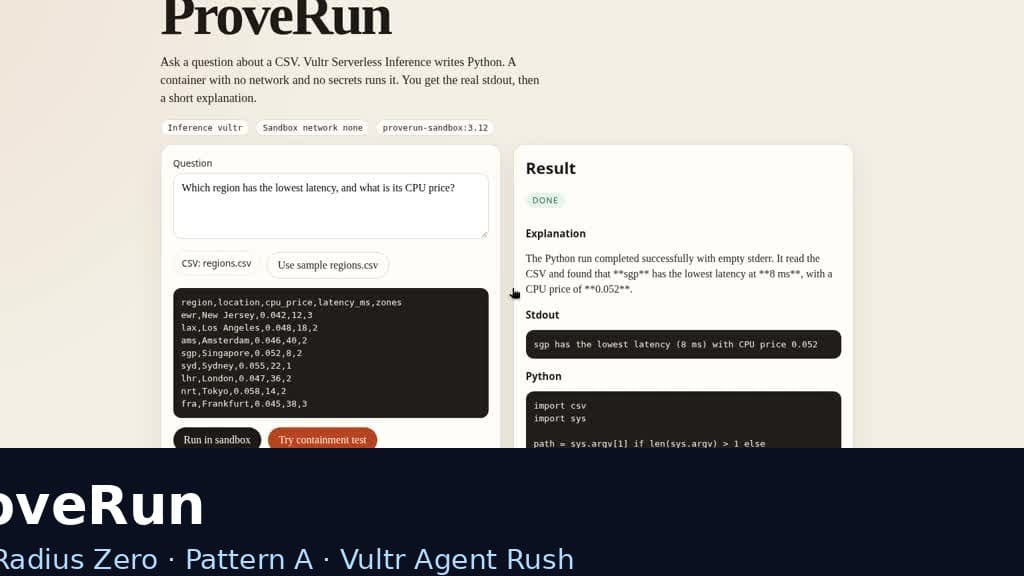
BlastRadius Zero: Vultr Sandbox Gatekeeper

BlastRadius Zero: Vultr Sandbox Gatekeeper

BlastRadius Zero is a containment-first multi-agent cloud execution gatekeeper and isolated gVisor sandbox verifier built for Track 01 (Blast Radius Zero) of the Vultr Agent Rush Hackathon. Autonomous cloud and SRE agents routinely propose high-risk shell, Terraform, Kubernetes, and SQL remediations that can trigger runaway GPU billing loops, drop production columns, exfiltrate secrets, or cause cache stampedes. BlastRadius Zero acts as the centralized control layer between multi-agent planning (Triage Agent, Infra Patch Agent, and Rollback Synthesizer powered by Vultr Serverless Inference at https://api.vultrinference.com/v1/chat/completions) and isolated execution inside ephemeral gVisor (runsc) sandboxes on Vultr Cloud Compute: 1. Deterministic Multi-Language AST & Policy Gatekeeper: Parses Shell, SQL, Terraform, and JSON proposals line-by-line against four core containment policies (POL-01 No Unbounded Deletion, POL-02 Least Privilege IAM, POL-03 Cost Cap <= $50/hr, and POL-04 Zero Secret Exfiltration), computing a deterministic Blast Radius Score (0-100) and mapping impacted nodes on an interactive SVG cloud topology. 2. Enforced Vultr Sandbox Containment Flags: Every execution enforces four hard containment guarantees: Process Isolation (runsc gVisor with --network=none and seccomp-bpf filtering), Secret Hygiene (env_mounted=0 with zero credentials exposed inside the sandbox), Resource Limits (cgroups v2 1.0 vCPU, 512 MB RAM, pids.max=64, 15s wall-clock cap), and Lifecycle Discipline (ephemeral rootfs destroyed immediately after execution with a SHA-256 verifier receipt). 3. Zero-Blast-Radius Synthesis & Shadow Dry-Run: When a raw agent proposal violates containment policies (HTTP 403 BLOCKED), BlastRadius Zero synthesizes a drop-in zero-blast-radius remediation, runs a shadow canary simulation comparing P95 latency and error recovery curves, and exports signed JSON, Markdown, and SARIF 2.1.0 audit bundles.

AeroMesh: Decentralized Disaster Response Mesh

AeroMesh: Decentralized Disaster Response Mesh

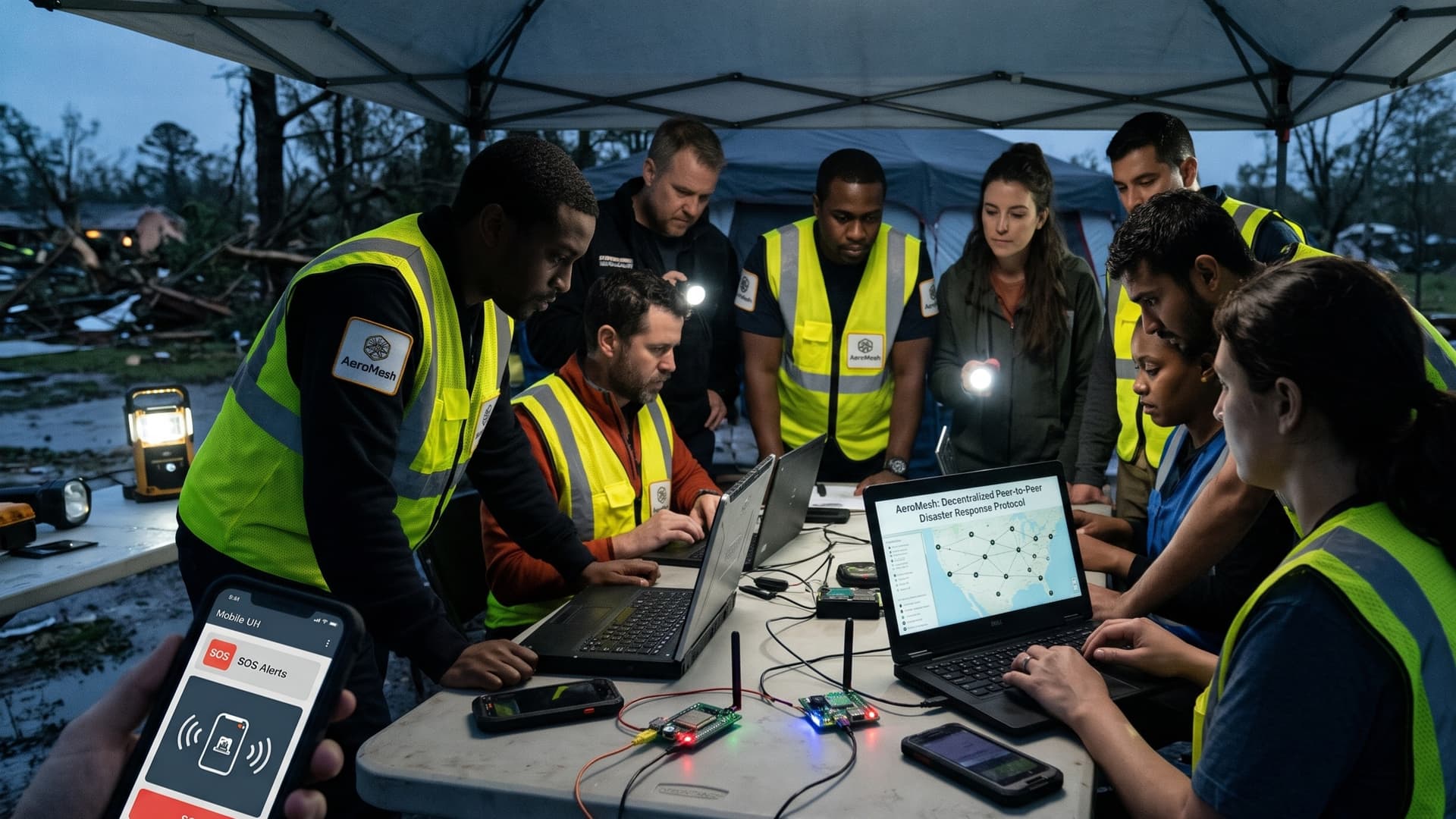
AeroMesh is an open, decentralized communication framework built for zero-connectivity environments during catastrophic natural disasters, power grid failures, and complete telecommunication blackouts. Traditional disaster relief depends heavily on cellular towers and cloud infrastructure, which are often the first assets knocked offline. When these networks collapse, first responders and stranded citizens are isolated, causing critical rescue delays. AeroMesh solves this by turning consumer devices—smartphones, laptops, and single-board edge microcontrollers—into autonomous, cooperative relay nodes. Operating as a Delay-Tolerant Mobile Ad-Hoc Network (DTN/MANET), the protocol uses local interfaces like Wi-Fi Direct and Bluetooth Low Energy (BLE) to form dynamic, self-healing peer-to-peer topologies without requiring central gateways or towers. At its core, AeroMesh runs an opportunistic store-and-forward epidemic routing protocol. Devices discover nearby peers, exchange cryptographic signatures, and propagate emergency packets across network partitions. To prevent data conflicts across disconnected clusters, the system implements Conflict-Free Replicated Data Types (CRDTs), mathematically guaranteeing eventual consistency for casualty lists, supply inventories, and incident maps upon reconnection. Security relies on on-device asymmetric key pairs, enabling zero-trust verification of packet authenticity without a central Certificate Authority. Field teams access live data through an embedded, browser-based offline dashboard served directly from edge nodes, ensuring reliable coordination when every other network fails.

Agent_Trap_Evals

Agent_Trap_Evals

The problem: agents rarely fail hard questions. They fail chores. They report "backup verified" because the log says success, while the archive is truncated. These false claims slip out during routine work, and a real shell makes them dangerous. What Receipts does: you give it a real task, like checking a backup or triaging a failing build. A control layer plans the work and runs every action in an isolated Vultr sandbox [gVisor pods on VKE]. The sandbox has no secrets, has time and memory caps, and is destroyed after each task. Every command's output, exit code, and files become a receipt. Before any claim reaches you, a verifier checks it against those receipts: did the agent check the layer that matters, or just the easy one? An unsupported claim is blocked and sent back to be verified, or reported as unverified. You get the answer together with its proof. Containment: [demo moment, e.g. the agent runs rm -rf / and the sandbox absorbs it; the host is untouched]. Measured: we score Receipts with agent-trap-evals, an open-source trap set we built before the hackathon from real agent incidents. Verifier off vs. on: [X/Y vs. X/Y caught], [n] false alarms on honest controls. For: platform and DevOps teams putting agents on operational work, where a confident false "done" costs more than a slow answer. Sandboxes like E2B contain actions but don't check claims. Eval tools score offline but don't stop a bad claim at runtime. Receipts does both, live. [Business model; next steps.] All LLM calls use Vultr Serverless Inference.