AWS

Amazon Web Services (AWS) is the world's most comprehensive and broadly adopted cloud platform, offering over 200 fully featured services from data centers globally. Since its launch in 2006, AWS has provided a highly reliable, scalable, low-cost infrastructure platform in the cloud that powers hundreds of thousands of businesses in 190 countries worldwide. AWS is a leader in cloud computing, offering services that span compute, storage, databases, networking, analytics, machine learning, artificial intelligence, Internet of Things (IoT), security, and enterprise applications.

General
CompanyAmazon Web Services, Inc.
Founded2006
Websitehttps://aws.amazon.com/
Documentationhttps://docs.aws.amazon.com/
Technology TypeCloud Provider

Start Building with AWS Products

AWS provides a vast array of services that enable developers and businesses to build sophisticated, scalable applications in the cloud. From foundational services like compute and storage to advanced machine learning and AI capabilities, AWS offers the tools needed to innovate and grow.

AWS SageMaker

AWS SageMaker is a fully managed machine learning service that enables developers to quickly and easily build, train, and deploy machine learning models at scale. You can find more information on our AWS SageMaker tech page.

AWS Kiro

Kiro is an AWS-powered agentic coding service that uses "spec-driven development" to turn prompts into code and tests. You can find more information on our AWS Kiro tech page.


AWS AI Technologies top builders

Explore the top contributors showcasing the highest number of AWS AI Technologies app submissions within our community.

AWS AI Technologies Hackathon projects

Discover innovative solutions crafted with AWS AI Technologies, developed by our community members during our engaging hackathons.

Agent_Trap_Evals

Agent_Trap_Evals

The problem: agents rarely fail hard questions. They fail chores. They report "backup verified" because the log says success, while the archive is truncated. These false claims slip out during routine work, and a real shell makes them dangerous. What Receipts does: you give it a real task, like checking a backup or triaging a failing build. A control layer plans the work and runs every action in an isolated Vultr sandbox [gVisor pods on VKE]. The sandbox has no secrets, has time and memory caps, and is destroyed after each task. Every command's output, exit code, and files become a receipt. Before any claim reaches you, a verifier checks it against those receipts: did the agent check the layer that matters, or just the easy one? An unsupported claim is blocked and sent back to be verified, or reported as unverified. You get the answer together with its proof. Containment: [demo moment, e.g. the agent runs rm -rf / and the sandbox absorbs it; the host is untouched]. Measured: we score Receipts with agent-trap-evals, an open-source trap set we built before the hackathon from real agent incidents. Verifier off vs. on: [X/Y vs. X/Y caught], [n] false alarms on honest controls. For: platform and DevOps teams putting agents on operational work, where a confident false "done" costs more than a slow answer. Sandboxes like E2B contain actions but don't check claims. Eval tools score offline but don't stop a bad claim at runtime. Receipts does both, live. [Business model; next steps.] All LLM calls use Vultr Serverless Inference.

Rehearsal: AI Factory Recovery Planner

Rehearsal: AI Factory Recovery Planner

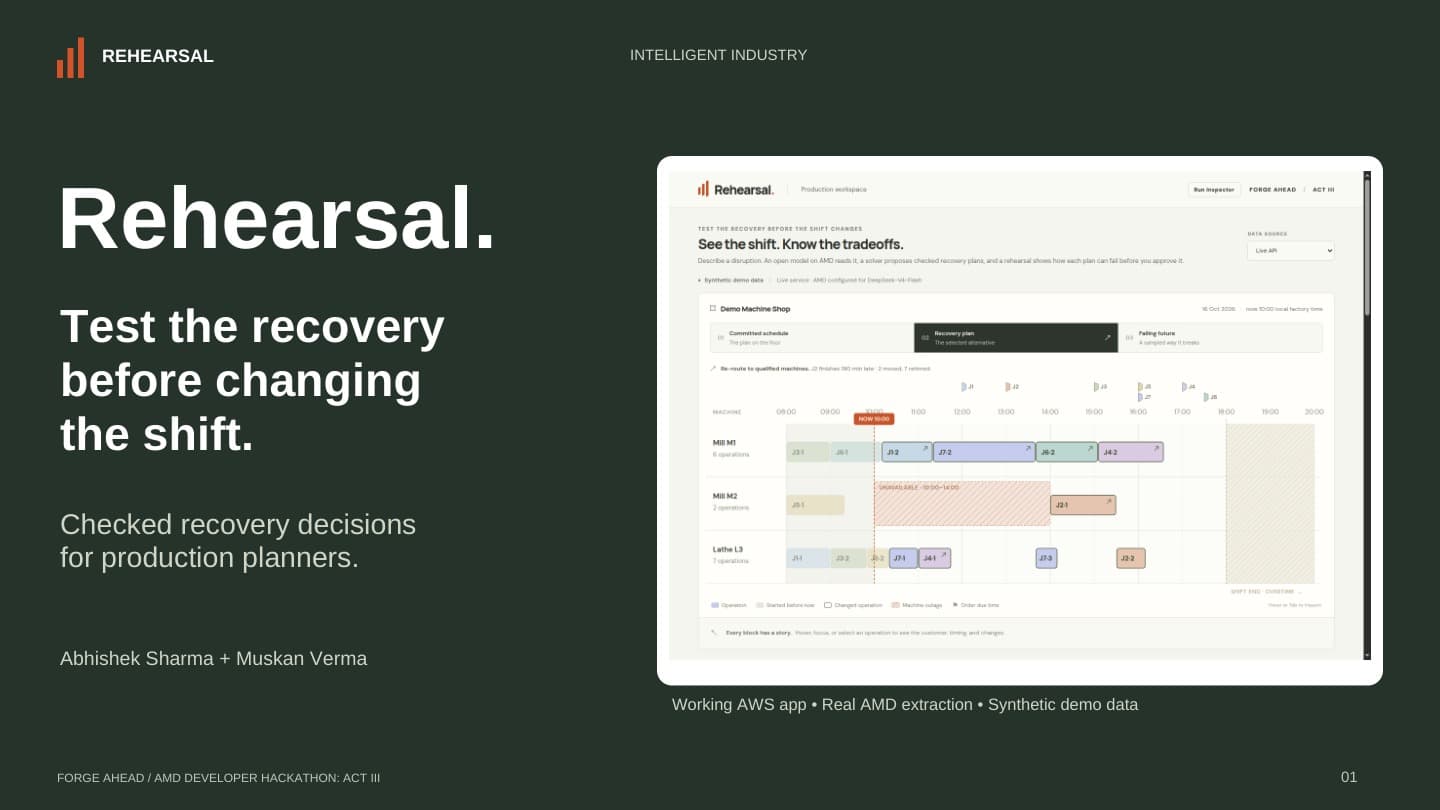
A machine stops, but the orders still need to ship. A production planner has to decide what to move, which deliveries may slip, and whether overtime is worth considering. Rehearsal helps them see those choices before changing the shift. The planner enters a supervisor's message in everyday language. DeepSeek V4 Flash, served through AMD Token Factory, proposes planning changes linked to the original words. The application checks machine names, times and conflicts, and asks for human review when required information is unclear. OR-Tools generates recovery alternatives on CPU. A separate schedule checker verifies each returned plan. The planner can then rehearse a plan across 500 simulated scenarios, inspect exposed delivery promises, and open a specific failure to see where delays build up. Before exporting, the planner acknowledges the required tradeoffs. The server rechecks its stored plan and produces a dispatch CSV and a decision record containing the constraints, approvals, AMD trace and simulation evidence. Our intended users are production planners in machine shops. The working application is deployed on AWS, with public code and reproducible evaluation records. All factory data and uncertainty assumptions are synthetic; customer time savings and real-world reliability have not been established. AMD powers message interpretation; scheduling, checking and NumPy simulation run on CPU. Built by Muskan Verma and Abhishek Sharma, Team Forge Ahead, for the Intelligent Industry track.

AdvancedLeads AI — Multi-Agent Lead Scoring

AdvancedLeads AI — Multi-Agent Lead Scoring

B2B lead qualification is usually a single model's judgment call, and single-model judgment is unreliable: it's confident, opaque, and hard to audit. AdvancedLeadsGeneration-AI replaces that with a structured debate between agents, then a scored reconciliation against historical deal data. The system runs three roles. An advocate agent argues why a lead is a strong fit, citing signals from the lead's profile and company data. A risk agent argues the opposite — surfacing counter-evidence, red flags, and gaps in the data. A reconciliation layer then scores both arguments against historical won/lost deal patterns and produces a final lead score with the reasoning attached, so a sales team can see not just the score but why it was given. The key design decision was separating advocacy from risk assessment. A single prompt asking a model to "evaluate this lead" tends to collapse into one perspective. Forcing two agents to argue opposing positions, then having a third layer judge between them, produces more balanced output and surfaces concerns a single-pass evaluation would miss. We built it on IBM Granite models via IBM Watsonx.ai, with a FastAPI backend exposing the workflow as public-facing REST APIs and a Next.js frontend. The project won the IBM Granite Hackathon on lablab.ai (Team PolyEns, February 2025). The architecture and API contracts are documented publicly in the repository so the debate-and-reconcile pattern can be reused for other scoring workflows — vendor evaluation, candidate screening, or any decision where a single model's opinion isn't enough.

ATLAS

ATLAS

ATLAS is not a simple chatbot; it is a universal AI orchestration system designed to manage any organization or startup. It acts as the "operating system" of a company, capable of planning, delegating tasks to specialized AI agents, and enforcing strict security protocols (Zero Trust). The Demo: Orchestrating Cloud Infrastructure For this hackathon, we demonstrate ATLAS orchestrating a complex cloud infrastructure: ZTC Hosting. Managing web hosting requires juggling multiple APIs (cPanel/WHM, billing, DNS) and handling critical incidents. ATLAS acts as the central brain. It analyzes events, delegates tasks to specialized agents (Support, Network Operations, Provisioning), and uses secure, typed API tools to execute operations. Real-time 3D Digital Twin To make this complex AI activity understandable to humans, ATLAS projects the entire organization into a real-time 3D digital twin. Every AI agent has a 3D avatar. Their movements, statuses, and animations map directly to the actual infrastructure state. If an incident occurs, the NOC agent visibly investigates. Crucially, for high-risk actions, the agent waits for human approval (Human-in-the-loop). AMD Technology Integration To meet the hackathon's technical requirements, ATLAS's core reasoning engine (a high-performance Large Language Model) is hosted and served on AMD Developer Cloud using ROCm and vLLM. The heavy lifting of the AI inference is powered by AMD GPUs. This proves that ATLAS is a hardware-agnostic, production-ready architecture capable of running on AMD infrastructure without rewriting its core logic.