Kiro

Kiro is an AWS-powered agentic coding service designed to revolutionize software development through "spec-driven development." It leverages artificial intelligence to interpret natural language prompts and automatically generate code and tests, significantly accelerating the development lifecycle. Kiro aims to reduce manual coding efforts and improve code quality by ensuring that applications adhere closely to their specifications.

General
AuthorAWS
Release Date2025
Websitehttps://aws.amazon.com/
Documentationhttps://aws.amazon.com/documentation-overview/kiro/
Technology TypeAgentic IDE

Key Features

  • Spec-Driven Development: Translates high-level natural language specifications into functional code and comprehensive tests.
  • AI-Powered Code Generation: Utilizes advanced AI models to write code automatically, reducing development time.
  • Automated Test Creation: Generates relevant test cases alongside code, ensuring immediate validation and higher quality.
  • AWS Integration: Seamlessly integrates with the broader AWS ecosystem, leveraging cloud infrastructure for scalable development.
  • Agentic Workflow: Employs AI agents to manage and execute development tasks, from planning to implementation.

Start Building with Kiro

Kiro offers an innovative approach to software development, allowing teams to rapidly build and test applications by focusing on specifications rather than intricate coding details. As an AWS-powered service, it provides the scalability and reliability expected from a leading cloud provider. Developers interested in leveraging AI for accelerated and more reliable coding should explore Kiro's capabilities.

πŸ‘‰ Kiro Documentation on AWS πŸ‘‰ Explore AWS AI/ML Services

kiro top builders

Explore the top contributors showcasing the highest number of kiro app submissions within our community.

AWS kiro AI technology Hackathon projects

Discover innovative solutions crafted with kiro, developed by our community members during our engaging hackathons.

Inko: Voice-First Research Companion

Inko: Voice-First Research Companion

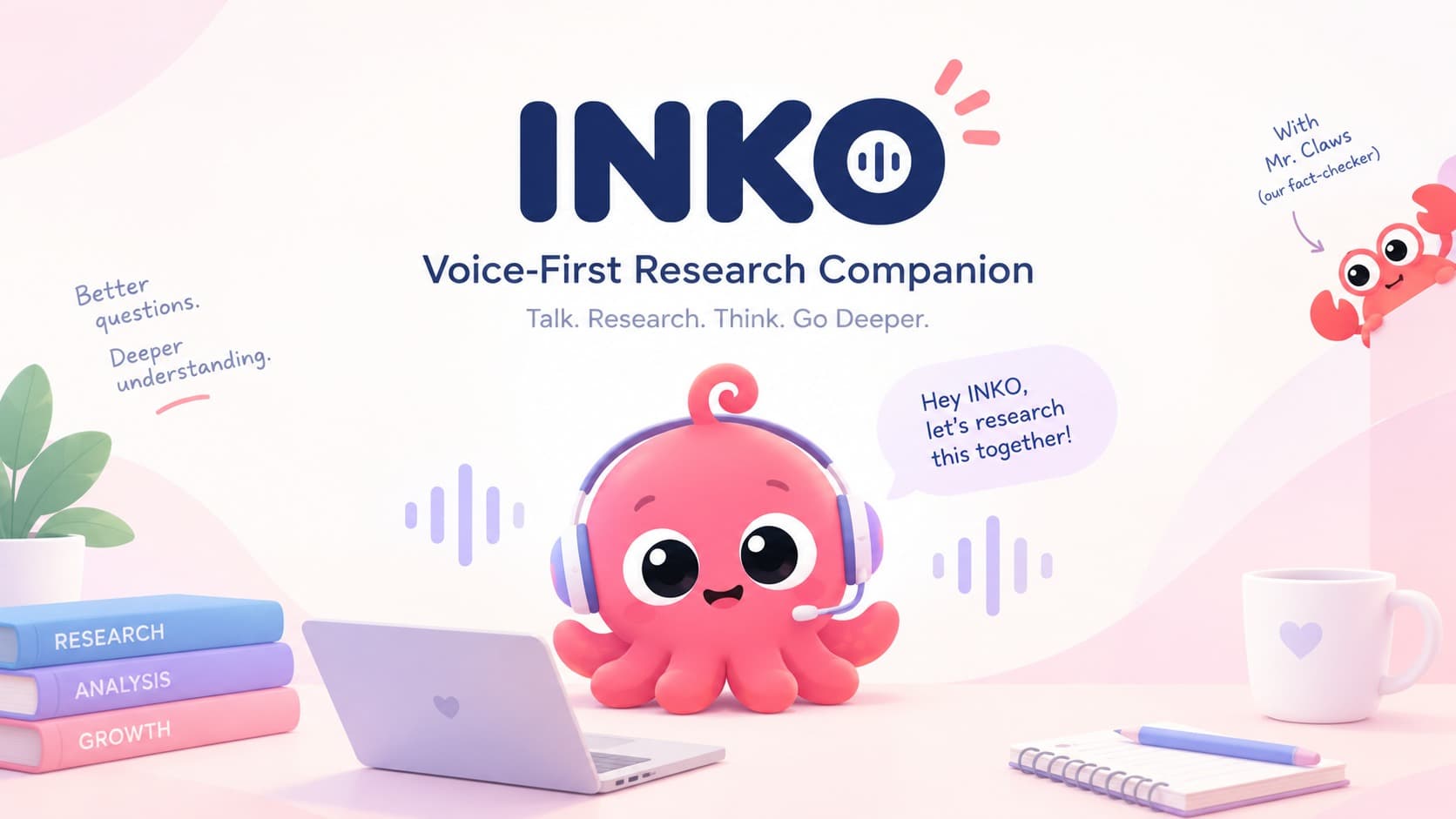
Research should be a process of discovery, not a constant struggle between tabs, sources, notes, and disconnected tools. INKO is a voice-first academic research companion designed to let students investigate topics through natural conversation. Instead of manually navigating through different research tools, students can simply tell INKO what they want to investigate and let the agent guide the workflow. A student can ask INKO to research a topic, find relevant sources, compare evidence, identify contradictory findings, organize important information, and explain what the evidence means. INKO can also visualize findings on a research canvas and challenge the student's conclusions through a voice-based debate or Socratic discussion. The core experience is: Talk β†’ Research β†’ Compare β†’ Find Contradictions β†’ Organize β†’ Explain β†’ Challenge. Voice is not just an input method. It is the primary interface for interacting with the application. INKO can use voice commands to trigger application actions, allowing the interface to respond automatically as the research progresses. INKO is powered by AssemblyAI's Voice Agent API for its real-time conversational voice experience, including speech recognition, turn detection, text-to-speech, interruption handling, and tool calling. These capabilities allow INKO to move beyond a voice chatbot and act as an agent that can interact with the research workspace. The goal is simple: make academic research feel more like having an intelligent research partner beside youβ€”one you can talk to, question, challenge, and ask to investigate with you.

Automated Dead Code Detection

Automated Dead Code Detection

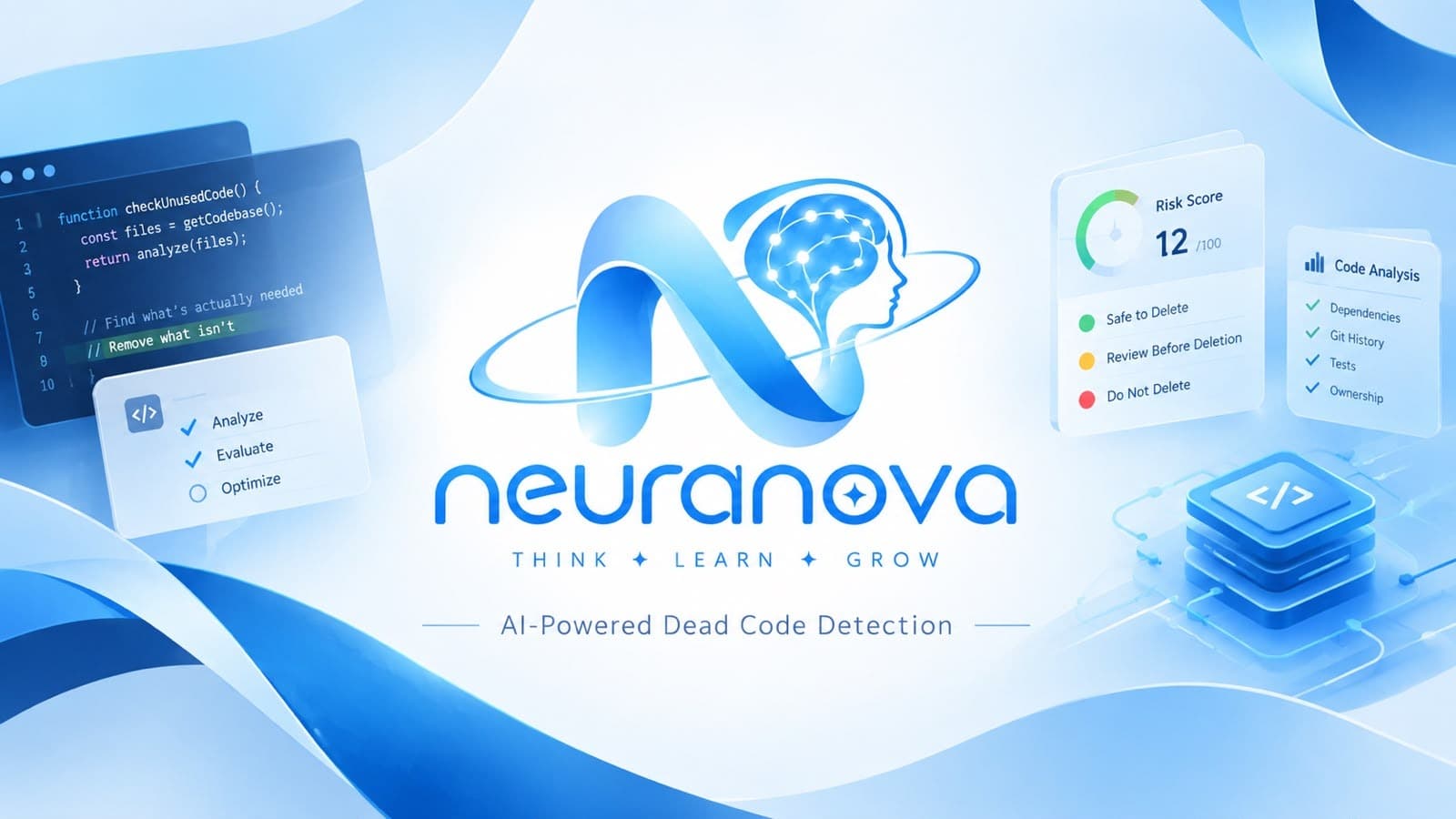
Problem statement- Dead code can contain hidden dependencies, making deletion risky. Developers need to understand its purpose, dependencies, and potential impact before removing it. Solution statement- NeuraNova analyzes dependencies, runtime activity, Git history, tests, and ownership. It combines this evidence to assess risk and recommend whether the code should be deleted. odern software repositories often accumulate *dead code, legacy functions, deprecated helpers, and unused utilities* over time. Although this code may appear unnecessary, developers cannot simply delete it because it may have hidden dependencies, dynamic usage, or historical importance. Manually investigating every piece of potentially unused code is time-consuming and can lead to accidental breakages. As a result, teams often leave unused code in their repositories, increasing *technical debt, maintenance effort, and code complexity. description- Modern software repositories often accumulate *dead code, legacy functions, deprecated helpers, and unused utilities* over time. Although this code may appear unnecessary, developers cannot simply delete it because it may have hidden dependencies, dynamic usage, or historical importance. Manually investigating every piece of potentially unused code is time-consuming and can lead to accidental breakages. As a result, teams often leave unused code in their repositories, increasing *technical debt, maintenance effort, and code complexity. *NeuraNova* addresses this problem through an AI-powered, evidence-based approach to dead-code detection and dependency risk assessment. Instead of relying on a simple β€œused vs. unused” check, NeuraNova investigates multiple signals before recommending deletion. It analyzes the code structure and dependencies using *AST analysis, checks **test suites and test coverage, examines **Git commit history, considers **runtime usage, and uses **code ownership* information to build a broader picture of how a piece of code is connected to the repository. The target users are *software developers, engineering teams, and organizations* maintaining large or continuously evolving codebases. Developers interact with NeuraNova by submitting or scanning their codebase for potentially unused code. The system analyzes the identified symbols and combines evidence from different sources to generate a *real-time risk assessment. It then provides a clear AI verdict such as *β€œSafe to Delete”* or *β€œNeeds Review,”** along with the supporting evidence and reasons behind the recommendation. Suggested deletions can also be routed to the responsible developer or code owner for review and approval. What makes NeuraNova unique is its *multi-signal evidence fusion* approach. Traditional dead-code detection may identify code as unused based on limited references, but NeuraNova goes further by investigating dependencies, tests, Git history, runtime signals, and ownership together. This makes the process more like a *β€œSherlock Holmes for your codebase”*β€”investigating the evidence before recommending an action. By replacing guesswork with automated evidence-based analysis, NeuraNova helps developers make faster and more informed cleanup decisions. It reduces the risk of removing important code, minimizes technical debt, improves maintainability, and supports cleaner and more efficient software repositories.

JodTod – Smart Expense Sharing App

JodTod – Smart Expense Sharing App

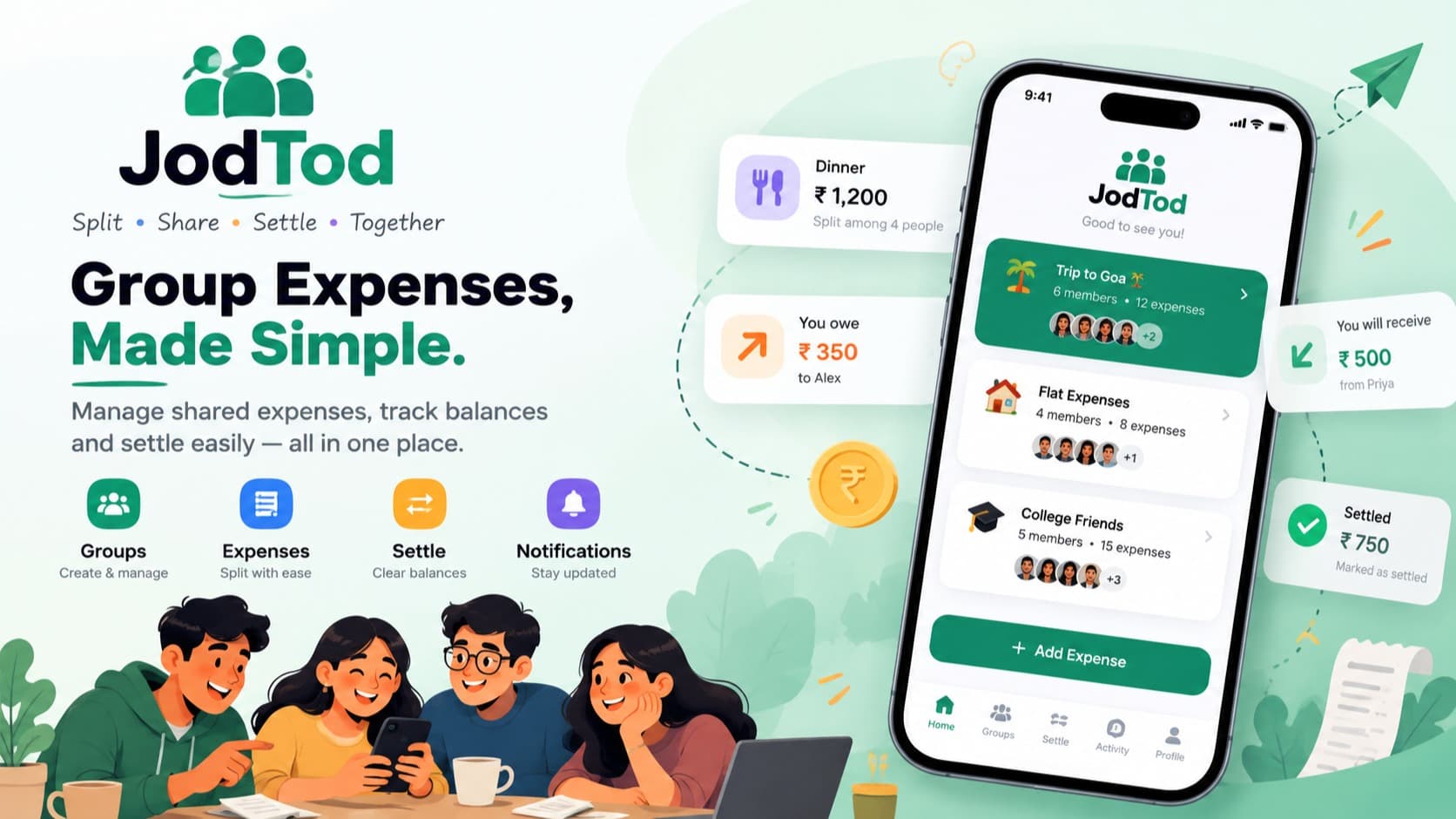
Managing shared expenses is a common challenge for friends, roommates, families, students, and travel groups. When multiple people contribute different amounts toward food, trips, rent, events, or daily purchases, tracking who paid, who owes whom, and how much needs to be settled often becomes confusing. People frequently depend on manual calculations, chat messages, screenshots, spreadsheets, or separate payment applications, which can lead to errors, forgotten payments, unnecessary back-and-forth, and unclear financial records. JodTod is a smart group expense management and settlement application designed to simplify this entire process in one place. Users can create or join groups, add shared expenses, record who paid, define how an expense should be divided, view individual balances, and settle outstanding amounts. Instead of manually calculating multiple transactions, JodTod organizes the information and presents each member's financial position clearly. The primary target users are students, friends, roommates, families, travel groups, event organizers, and any group that regularly shares expenses. Users interact with JodTod by creating groups, adding people, recording expenses, selecting participants, and choosing how costs should be split. The application maintains the group's expense activity and provides settlement information so members can understand their outstanding obligations and complete the required payments. What makes JodTod distinctive is its focus on connecting the complete shared-expense lifecycle rather than treating bill splitting as an isolated calculation. Group activity, people management, expense creation, balances, settlement actions, profiles, and notifications are designed to work together as a unified experience. This reduces the need to maintain fragmented information across messaging apps, calculators, spreadsheets, and payment records. JodTod also emphasizes a simple and accessible mobile-first experience so that an expense can be recorded immediately when it occurs. By centralizing group financial information and automating calculations, the application reduces manual effort, minimizes calculation errors, improves transparency among group members, and makes settlement easier to understand. For evaluation and demonstration, a dedicated demo account will be provided so reviewers can access the application directly without completing the signup process. The demo credentials will allow users to log in and explore the application's core features and workflows using a prepared demonstration account. The overall goal of JodTod is to turn shared expenses from a source of confusion and repeated calculations into a structured, transparent, and convenient group-management experience. Project Repository: https://github.com/jha16rohit/JodTod App: [APP LINK]

Code2Edge: Deployment with Proof

Code2Edge: Deployment with Proof

Porting a PyTorch model to a microcontroller sounds like a model problem, but it's really a pipeline problem. A keyword-spotting model needs audio resampled, windowed, FFT'd, run through a Mel filterbank, log-compressed, and normalized before it ever reaches the network β€” and the constants controlling each step (window size, FFT convention, epsilon values) are usually scattered across config files nobody rereads. Get one of them wrong in the C rewrite and the device still boots fine; it just quietly predicts the wrong thing, with no black-box "pass/fail" test telling you why. Code2Edge solves this with stage-wise differential parity instead of black-box testing. The same audio corpus runs through both the Python reference pipeline and the generated C pipeline, and every intermediate tensor is compared β€” max/mean absolute error, cosine similarity, and eventually prediction agreement. If a stage drifts past tolerance, the system flags exactly which stage and offers a deterministic hint (e.g., "shape mismatch at framing β€” check hop length"), so debugging starts from evidence instead of guesswork. Bob drives this as an orchestrator, not a black-box code generator. An MCP server gives it five hardware-aware tools (profiling the model, inspecting the pipeline, checking the target, running parity tests, benchmarking) plus workflow tools for starting runs and gating steps. Bob follows a fixed sequence: analyze the repo, produce an Edge Readiness Report, pause for a human APPROVE/REJECT, generate code, run a host parity gate (with a 3-attempt repair loop before escalating to a human), build for the MCU, run a device parity gate, benchmark on real silicon, and open a pull request. The target users are embedded/ML engineers who need confidence that a ported pipeline behaves identically to its source model β€” not just that it compiles. The project is grounded in a real trained workload: a 119,372-parameter DS-CNN for 12-class keyword spotting (96.65% test accuracy), deployed to an STM32U585 (Cortex-M33) on an Arduino UNO Q. What makes this different is the discipline around honesty: every reported number is explicitly labeled real (measured from an artifact) or mock (a placeholder for an unavailable dependency), and the two are never mixed. Host-side parity is fully real and passing across 500 samples and 4 pipeline stages. Physical benchmarking is real and passing on actual silicon (50/50 correct inferences). Device-side parity is real but currently limited to a single fixture rather than the full corpus β€” an openly disclosed gap, with a hardware-validation guide checked in to finish the job.

Nexora AI: Autonomous SDLC Modernization

Nexora AI: Autonomous SDLC Modernization

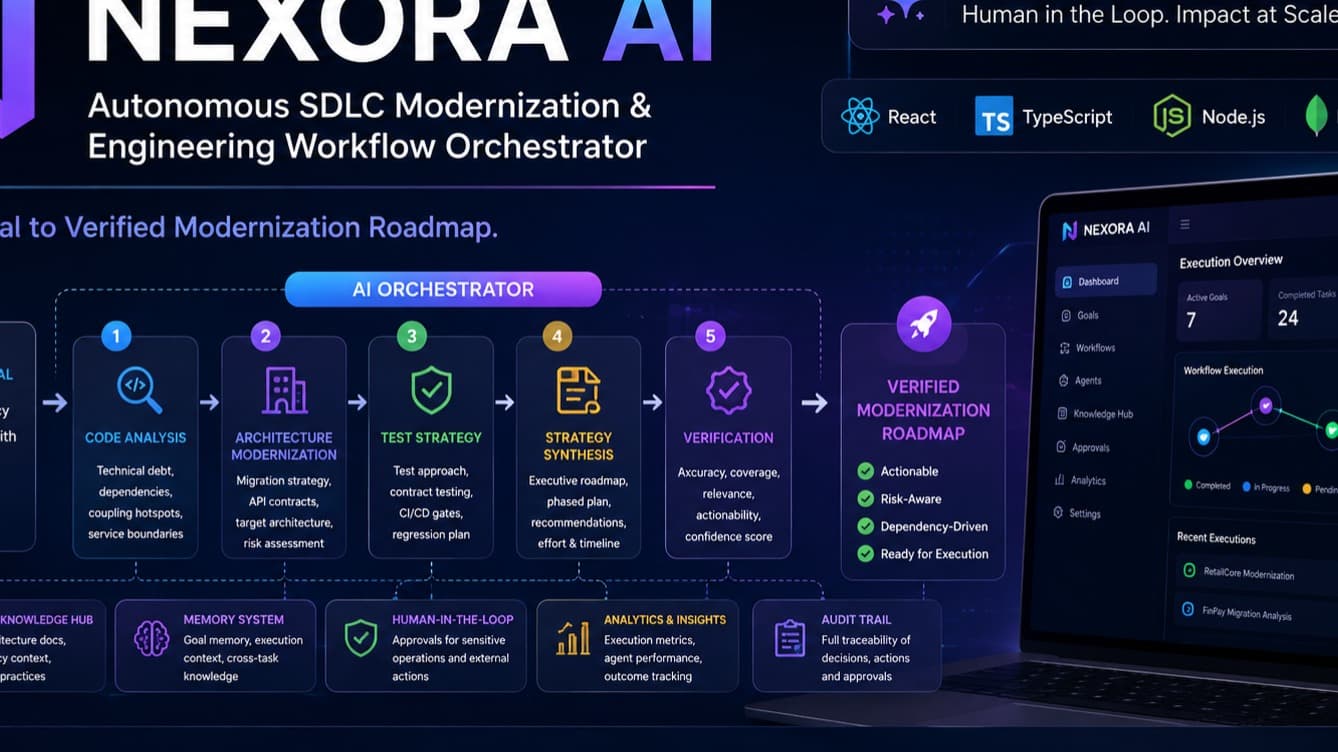
Modernizing legacy software is difficult because engineering teams must understand complex dependencies, identify technical debt, define safe migration boundaries, design testing strategies, and coordinate execution across many activities. This planning process is often time-consuming, difficult to reproduce, and vulnerable to incomplete or disconnected analysis. Nexora AI addresses this challenge with an autonomous multi-agent SDLC modernization platform. A developer begins by describing a high-level modernization goal. Nexora analyzes the goal, identifies constraints and success criteria, and automatically converts it into a dependency-aware workflow represented as a DAG (Directed Acyclic Graph). The platform coordinates specialized AI agents for different stages of modernization. The Code Analysis Agent identifies technical debt, coupling hotspots, end-of-life technology risks, and potential service boundaries. The Architecture Modernization Agent develops migration phases, API contracts, target architecture recommendations, and risk considerations. The Test Strategy Agent creates testing strategies, contract-testing requirements, CI/CD quality gates, and regression checkpoints. A Strategy Agent synthesizes these outputs into an executive roadmap, while a Verification Agent evaluates the resulting work for accuracy, completeness, relevance, and actionability. Nexora also grounds agent reasoning using a Retrieval-Augmented Generation (RAG) knowledge layer and memory system. For the demonstration, the platform includes a fictional 480,000-line Spring 4 / Java 8 RetailCore monolith with legacy dependencies, high coupling, and low test coverage. The system uses this knowledge to generate a realistic modernization workflow covering service boundaries, strangler-fig migration, API contracts, testing, risks, and phased execution. The target users are software engineers, architects, technical leads, engineering managers, and modernization teams working with complex or legacy systems. Users interact through a unified dashboard where they can create goals, inspect the generated DAG, execute tasks, review agent outputs, monitor verification results, and view analytics. A key differentiator is that Nexora is not simply a chatbot producing a single response. It assembles a team of specialized agents, manages their dependencies, shares context between tasks, grounds outputs in knowledge, verifies results, and supports human-in-the-loop approval for sensitive operations. This creates a more structured, traceable, and governed approach to AI-assisted software modernization.