Bright Data MCP Server

The Bright Data MCP Server is an open-source Model Context Protocol (MCP) server that connects AI agents and coding assistants to Bright Data's web data infrastructure. It exposes over 60 tools covering real-time web search, page navigation, structured data extraction, and managed browser automation, all accessible from within Claude, Claude Code, Cursor, and other MCP-compatible environments.

General
DeveloperBright Data
TypeMCP Server for AI Agent Web Access
Tools60+
LicenseOpen-source
GitHubbrightdata/brightdata-mcp
Documentationdocs.brightdata.com/ai/mcp-server

Core Features

  • 60+ AI-ready tools: tools for web search, page scraping, structured data extraction from 120+ sites, and browser automation, all callable from AI agents via MCP.
  • Real-time web access: agents retrieve live data from the open web, not cached or static snapshots.
  • Claude and Claude Code integration: configures directly into Claude Desktop or Claude Code via MCP server settings; no additional code required.
  • Claude Skills support: the brightdata skill teaches Claude how to select the right tool, handle errors, and follow best practices across the full tool surface.
  • Scraping Browser access: the MCP server can drive a managed Playwright/Puppeteer browser for JavaScript-heavy pages.
  • SERP and structured extraction: search engines and 100+ site-specific scrapers are available as discrete tools.

Supported Environments

EnvironmentIntegration
Claude DesktopDocs
Claude CodeBlog guide
Claude Agent SDKBlog guide
CursorMCP server config
ComposioToolkit

Tools and Resources


Ecosystem and Integrations

  • Works with any MCP-compatible client, including Claude Code, Cursor, Windsurf, and custom agent frameworks.
  • Pairs with the Python SDK and JavaScript SDK for programmatic access outside of agent contexts.
  • The MCP server delegates requests to Bright Data's proxy and unblocking infrastructure, so agents bypass bot detection without additional configuration.

Install and configure the MCP server from github.com/brightdata/brightdata-mcp, or follow the Claude Desktop integration guide to get started in minutes.

Bright Data MCP Server top builders

Explore the top contributors showcasing the highest number of Bright Data MCP Server app submissions within our community.

Bright Data Bright Data MCP Server AI technology Hackathon projects

Discover innovative solutions crafted with Bright Data MCP Server, developed by our community members during our engaging hackathons.

ATLAS

ATLAS

ATLAS is not a simple chatbot; it is a universal AI orchestration system designed to manage any organization or startup. It acts as the "operating system" of a company, capable of planning, delegating tasks to specialized AI agents, and enforcing strict security protocols (Zero Trust). The Demo: Orchestrating Cloud Infrastructure For this hackathon, we demonstrate ATLAS orchestrating a complex cloud infrastructure: ZTC Hosting. Managing web hosting requires juggling multiple APIs (cPanel/WHM, billing, DNS) and handling critical incidents. ATLAS acts as the central brain. It analyzes events, delegates tasks to specialized agents (Support, Network Operations, Provisioning), and uses secure, typed API tools to execute operations. Real-time 3D Digital Twin To make this complex AI activity understandable to humans, ATLAS projects the entire organization into a real-time 3D digital twin. Every AI agent has a 3D avatar. Their movements, statuses, and animations map directly to the actual infrastructure state. If an incident occurs, the NOC agent visibly investigates. Crucially, for high-risk actions, the agent waits for human approval (Human-in-the-loop). AMD Technology Integration To meet the hackathon's technical requirements, ATLAS's core reasoning engine (a high-performance Large Language Model) is hosted and served on AMD Developer Cloud using ROCm and vLLM. The heavy lifting of the AI inference is powered by AMD GPUs. This proves that ATLAS is a hardware-agnostic, production-ready architecture capable of running on AMD infrastructure without rewriting its core logic.

CloudOps RCA

CloudOps RCA

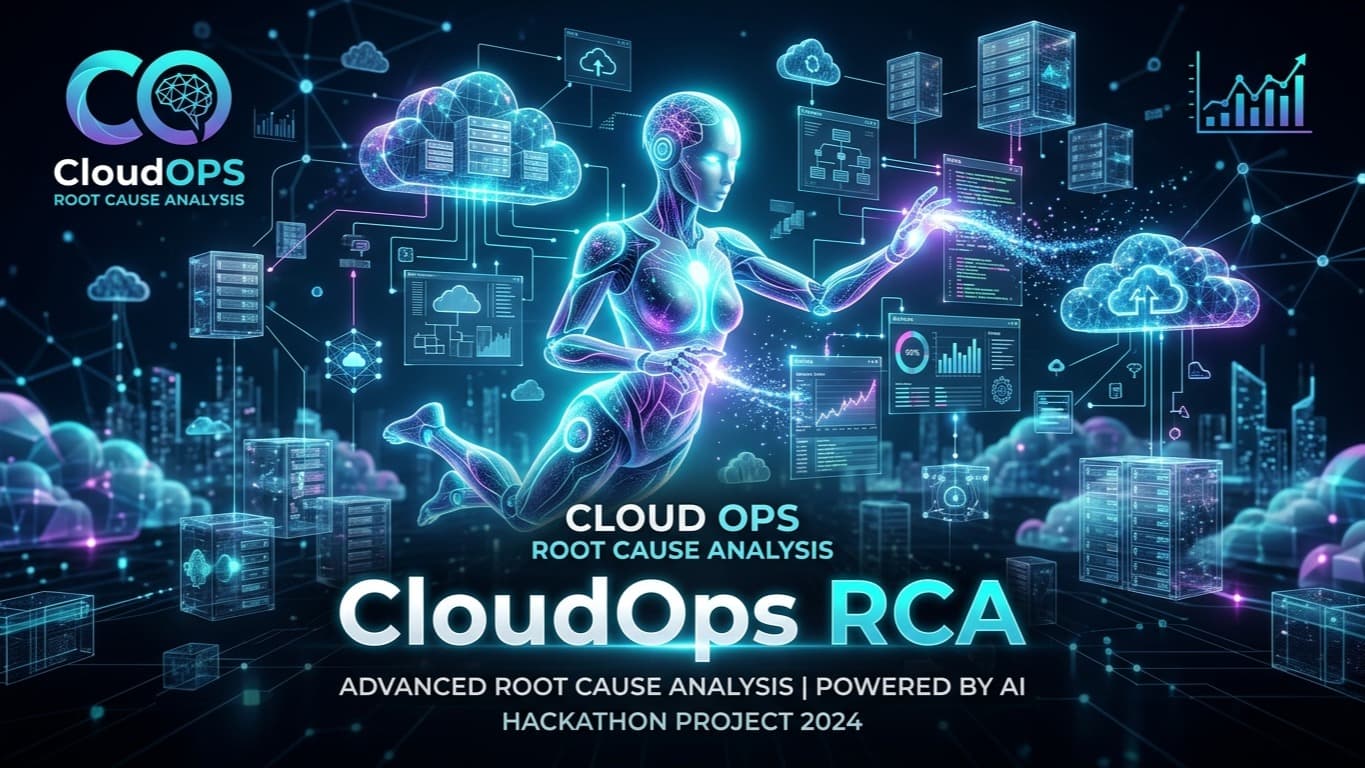
Problem Modern cloud incidents are chaotic. When a critical alert fires—such as a payment gateway timing out—on-call engineers waste precious time context-switching. They are forced to dig through distributed logs, hunt down stale markdown runbooks, analyze recent Git commits, and piece together timelines under immense pressure. Mean Time to Resolution (MTTR) remains stubbornly high because correlating this scattered infrastructure data is a slow, deeply manual process. Solution CloudOps RCA is an agentic Site Reliability Engineering (SRE) platform powered by "Bob," an autonomous AI on-call agent. When an incident occurs, Bob doesn’t just suggest what to do—it actively investigates. It automatically reads your infrastructure runbooks, executes live database queries against your logs, inspects recent deployment diffs, and synthesizes a Root Cause Analysis (RCA). Once Bob identifies the exact cause, it prepares the fix and pauses for human approval before automatically applying the remediation (like rolling back a configuration or reverting a breaking commit). Target Users & Interaction Our target users are DevOps engineers, SREs, and on-call backend developers. Users onboard by connecting their GitHub repository. When an incident triggers, engineers open the CloudOps RCA dashboard and watch Bob's investigation unfold in real-time. Through a live WebSocket UI, the user sees exactly which tools Bob is executing. Once Bob formulates its hypothesis, the engineer reviews the attached evidence. With a single click of "Approve," the user authorizes Bob to instantly deploy the fix to the live environment over secure APIs. What Makes It Creative & Unique Most AI DevOps tools are passive chatbots that output terminal commands for humans to copy and paste. CloudOps RCA flips this paradigm: it is a fully autonomous, "human-in-the-loop" execution engine. We uniquely leveraged the Model Context Protocol (MCP) to give our AI agent direct, secure access to production infrastructure. Bob doesn't hallucinate log data; it physically executes SQL queries against a live Neon Postgres database and interacts with the GitHub REST API to read source code and push revert commits. It bridges the gap between conversational LLMs and deterministic infrastructure control. Effectiveness & Efficiency CloudOps RCA effectively eliminates the grueling "investigation" phase of incident response. By the time an engineer opens their laptop, Bob has already collected the logs, identified the bad deployment, and prepared the fix. This shifts the engineer's role from a frantic detective to a confident approver. By replacing manual log-diving with machine-speed automated triage, CloudOps RCA slashes MTTR from hours to minutes, saving revenue and preventing engineer burnout.

CI Intelligence Agent

CI Intelligence Agent

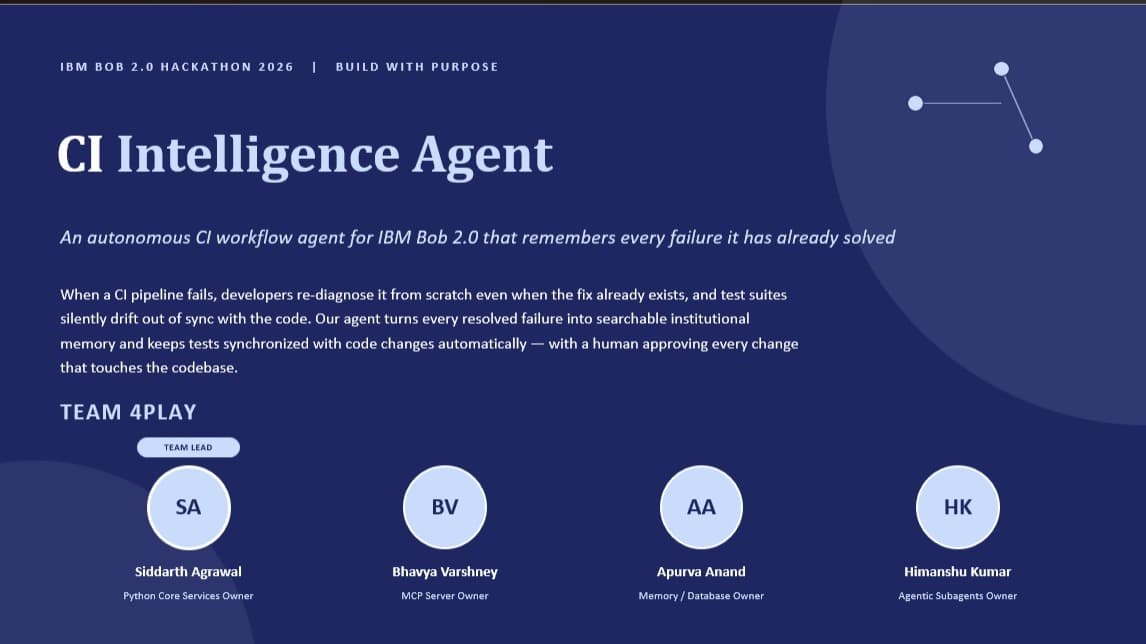
Problem Statement Modern CI/CD workflows force developers to repeatedly switch between CI dashboards, test reports, chat threads, documentation, and deployment tools. When a pipeline fails, engineers often have to manually inspect large failure logs, determine whether the problem is new or a known issue, search historical discussions for previous solutions, and decide whether to rerun, fix, or revert the change. This process is time-consuming, inconsistent, and causes previously solved debugging knowledge to become “tribal knowledge.” Release decisions are also often based on manually checking test results, code coverage, and deployment conditions, which can lead to unsafe or reactive deployments. Solution We are building an AI-assisted CI/CD Intelligence Agent powered by IBM Bob 2.0 that brings failure analysis, historical memory, coverage analysis, release checks, and deployment safety into a single developer workflow. IBM Bob acts as the reasoning layer: it understands the developer's request, analyzes code and failures, and coordinates specialized subagents. A Node.js MCP server provides Bob with tools such as `run_pipeline`, `recall_failures`, `store_failure`, `get_coverage_report`, and `check_release_readiness`. When a CI pipeline fails, Bob can retrieve the structured failure, generate a failure signature, and use the SQLite failure-memory store to find similar failures and previously successful actions such as rerun, fix, or revert. The result is passed to a triage subagent that produces a structured recommendation rather than blindly executing a change. The new failure and outcome can then be stored, creating a feedback loop so future failures can benefit from previous debugging experience. The system also analyzes coverage reports, checks release-readiness conditions, and uses Bob lifecycle hooks as safety controls. Before deployment, the release gate can identify blockers, while a deployment guard prevents unsafe commands when release requirements are not satisfied. Actual corrective or deployment actions remain subject to developer approval. The result is a context-aware, memory-enabled, and safety-controlled CI/CD workflow that helps developers move from failure → understanding → recommendation → safe release with fewer repetitive manual steps.