Cloudflare Workers AI

Run machine learning models, powered by serverless GPUs, on Cloudflare's global network. Workers AI allows you to run AI models in a serverless way, without having to worry about scaling, maintaining, or paying for unused infrastructure. You can invoke models running on GPUs on Cloudflare's network from your own code — from Workers, Pages, or anywhere via the Cloudflare API.

General
AuthorCloudflare, Inc.
WebsiteCloudflare Workers AI
Documentationhttps://developers.cloudflare.com/workers-ai/
TypeServerless AI Inference Platform
Launch Year2023
GPU Network180+ cities globally

Features

50+ Open-Source Models

  • Text generation (Llama, Mistral, and more)
  • Text embeddings and classification
  • Image generation and classification
  • Automatic speech recognition
  • Translation models
  • Object detection capabilities

Serverless Infrastructure

  • Pay-for-what-you-use pricing model
  • Automatic scaling with demand
  • No infrastructure management required
  • Fast cold start times with V8 isolates

Global Edge Network

  • AI inference close to users for low latency
  • Models available in 180+ cities worldwide
  • Reduced network bottlenecks
  • Consistent performance globally

Developer Platform Integration

  • Seamless integration with Cloudflare Workers
  • Works with Pages for full-stack AI applications
  • REST API for platform-agnostic access
  • Integration with Vectorize (vector database)
  • AI Gateway for monitoring and control

Key Capabilities

  • Edge AI Computing: Run AI models at the network edge for minimal latency
  • Serverless GPU Access: Access powerful GPU infrastructure without provisioning
  • Model Catalog: Curated selection of popular open-source AI models
  • Real-time Inference: Low-latency AI processing for interactive applications
  • Global Deployment: Deploy once, run everywhere on Cloudflare's network
  • Integrated Ecosystem: Works with R2 storage, D1 database, and other Cloudflare services

Use Cases

  • Building AI-powered chatbots and conversational interfaces
  • Real-time content moderation and classification
  • Image and video processing at scale
  • Personalization and recommendation engines
  • Automated translation and localization
  • Voice recognition and text-to-speech applications
  • RAG (Retrieval-Augmented Generation) systems
  • AI-powered API endpoints and microservices

Supported Model Categories

  • Large Language Models: For text generation and chat applications
  • Embedding Models: For semantic search and similarity matching
  • Image Models: For generation, classification, and analysis
  • Speech Models: For transcription and synthesis
  • Vision Models: For object detection and recognition
  • Translation Models: For multilingual content processing

Cloudflare Workers AI top builders

Explore the top contributors showcasing the highest number of Cloudflare Workers AI app submissions within our community.

Cloudflare Cloudflare Workers AI AI technology Hackathon projects

Discover innovative solutions crafted with Cloudflare Workers AI, developed by our community members during our engaging hackathons.

AI-Powered Emergency Room Digital Twin

AI-Powered Emergency Room Digital Twin

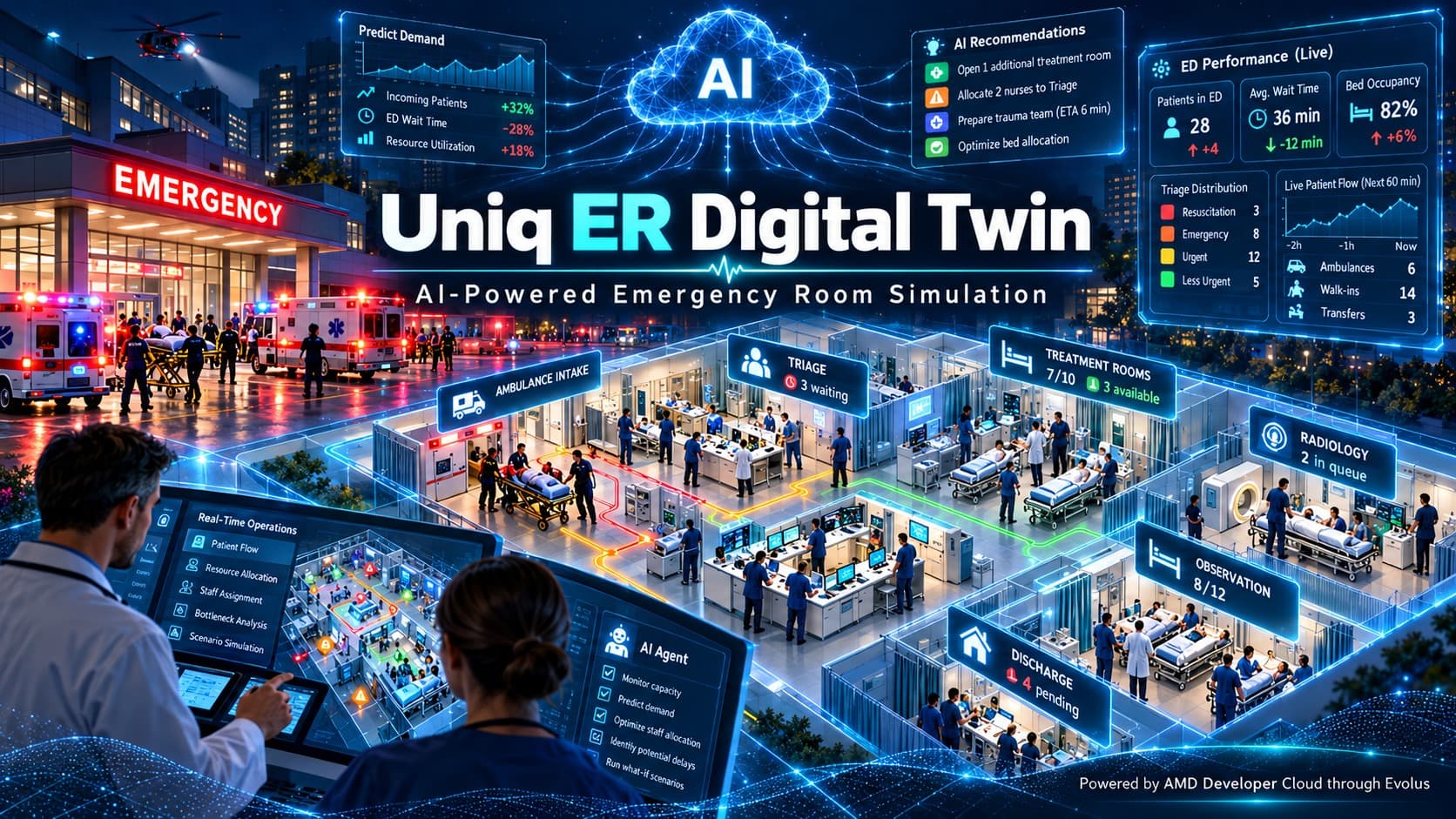
# Uniq ER Digital Twin – AI-Powered Emergency Room Simulation Uniq ER Digital Twin is an AI-powered emergency room simulation developed for the AMD Developer Hackathon ACT III, under the Health & Wellbeing track. The project explores how artificial intelligence and digital twin technology can improve hospital efficiency, optimize resource allocation, and support critical decision-making in emergency departments. The platform simulates a dynamic emergency room environment with patients, doctors, nurses, ambulances, treatment rooms, and limited medical equipment. It features mass-casualty scenarios, cascading emergencies, and patient deterioration, creating realistic challenges in managing hospital resources such as CT scanners, ventilators, and specialized medical staff. Powered by AMD Developer Cloud through Evolus, the AI agent analyzes emergency room conditions and recommends patient assignments and resource allocation strategies. These AI-generated decisions are compared against the simulation's built-in allocation system under identical scenarios, allowing evaluation of waiting times, patient deterioration, resource utilization, and overall operational performance. The interactive 2D dashboard provides real-time visualization of hospital operations, patient movements, resource availability, and incident timelines. Users can control simulation speed, introduce disruptions, examine decisions, and generate detailed outcome reports. By combining AMD-powered AI, autonomous agents, and digital twin technology, Uniq demonstrates the potential of intelligent hospital coordination systems to reduce bottlenecks, improve emergency preparedness, and support healthcare professionals in high-pressure environments.

ATLAS

ATLAS

ATLAS is not a simple chatbot; it is a universal AI orchestration system designed to manage any organization or startup. It acts as the "operating system" of a company, capable of planning, delegating tasks to specialized AI agents, and enforcing strict security protocols (Zero Trust). The Demo: Orchestrating Cloud Infrastructure For this hackathon, we demonstrate ATLAS orchestrating a complex cloud infrastructure: ZTC Hosting. Managing web hosting requires juggling multiple APIs (cPanel/WHM, billing, DNS) and handling critical incidents. ATLAS acts as the central brain. It analyzes events, delegates tasks to specialized agents (Support, Network Operations, Provisioning), and uses secure, typed API tools to execute operations. Real-time 3D Digital Twin To make this complex AI activity understandable to humans, ATLAS projects the entire organization into a real-time 3D digital twin. Every AI agent has a 3D avatar. Their movements, statuses, and animations map directly to the actual infrastructure state. If an incident occurs, the NOC agent visibly investigates. Crucially, for high-risk actions, the agent waits for human approval (Human-in-the-loop). AMD Technology Integration To meet the hackathon's technical requirements, ATLAS's core reasoning engine (a high-performance Large Language Model) is hosted and served on AMD Developer Cloud using ROCm and vLLM. The heavy lifting of the AI inference is powered by AMD GPUs. This proves that ATLAS is a hardware-agnostic, production-ready architecture capable of running on AMD infrastructure without rewriting its core logic.

CareCenter: AI Shift Handover on AMD

CareCenter: AI Shift Handover on AMD

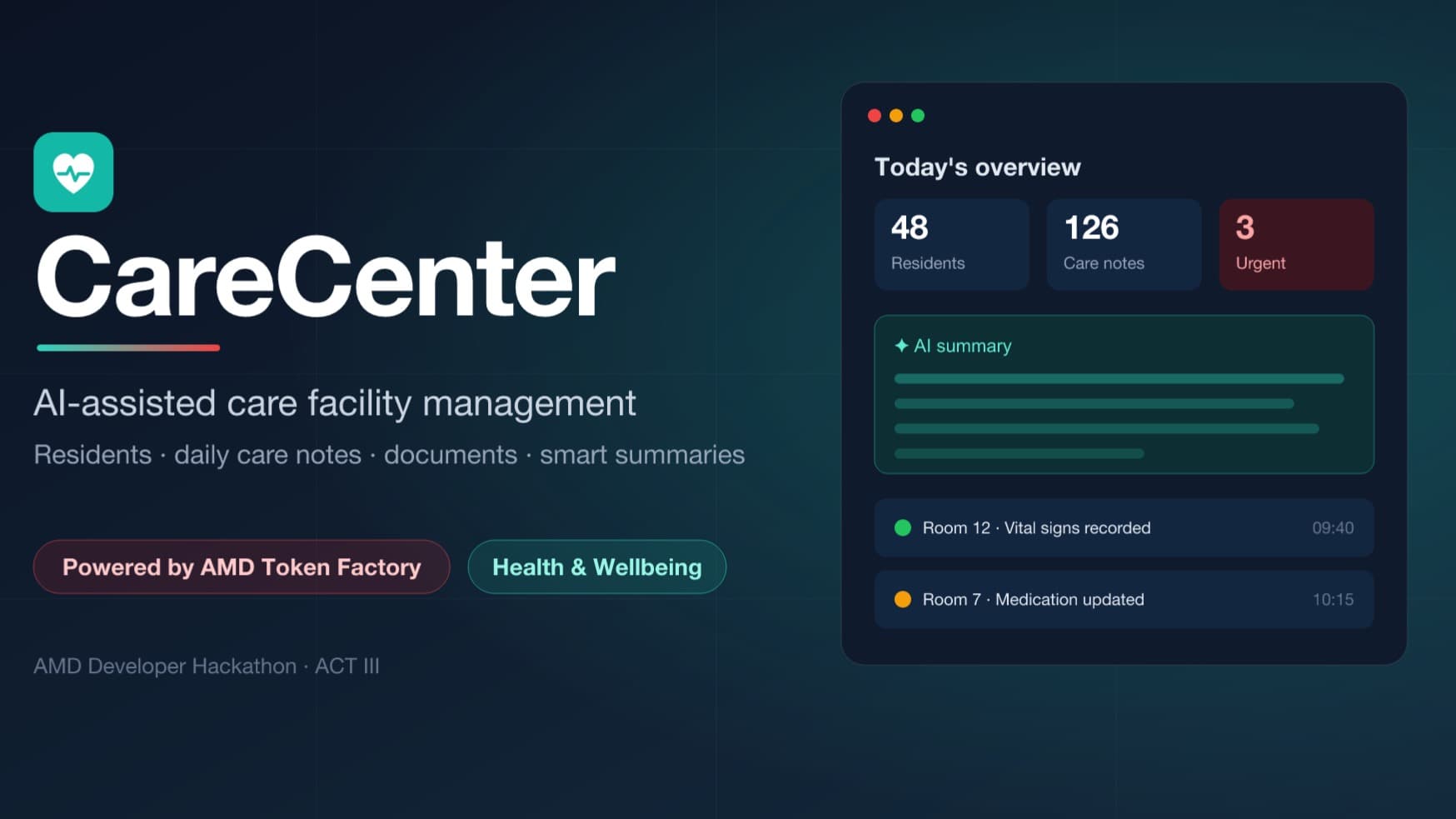
In disability and elderly care homes, the most dangerous moment of the day is the shift change. A night-shift carer may have recorded a fall at 5 a.m., a low blood sugar reading, or a resident who refused medication, but the incoming team has minutes to read dozens of scattered notes per resident. Important details get lost, and residents pay the price. CareCenter is an in-house care management system for disability and elderly care facilities. Staff record medications, vital signs, care tasks, observations and incidents for each resident, manage documents with expiry tracking, and administrators see every action in a plain-language audit log. The system is already in daily use at a real disability care facility. For this hackathon we added an AI Shift Handover Summary. With one click, a carer picks the last 12, 24 or 48 hours and receives a short, bullet-point handover: urgent items first, then medications given, vital signs, care performed and what the next shift must do. The summary is generated by an open model (DeepSeek-V4-Flash) running on AMD GPUs through AMD Token Factory, connected via an OpenAI-compatible provider layer. Because this is health data, privacy is built in. Before anything leaves the system, names, national ID numbers, phone numbers and dates are masked, and a final check blocks the request if any personal data remains. The model is instructed never to diagnose or invent information, staff notes are treated as data rather than instructions to resist prompt injection, every summary is logged without storing its content, and the UI clearly labels the output as AI-generated so carers verify it against the original records.