Coral Protocol

Coral Protocol is an open, decentralized infrastructure enabling AI agents to communicate, coordinate, and transact securely. Built on the Model Context Protocol (MCP), it facilitates the development of interoperable multi-agent systems, fostering the emergence of the "Internet of Agents."

Designed to be modular, trustless, and scalable, Coral Protocol enables intelligent agents—LLMs, bots, or autonomous scripts—to advertise capabilities, initiate tasks, and collaborate via structured message exchanges. The system integrates decentralized identity, on-chain micropayments using the $CORAL token, and a memory-augmented communication framework to support both composable pipelines and dynamic task execution. Its architecture empowers developers to build robust agent ecosystems that are open, interoperable, and economically sustainable.

General
Release date2025
AuthorsRoman J. Georgio, Caelum Forder, Suman Deb, Peter Carroll, Önder Gürcan
TypeDecentralized AI Agent Protocol

Coral Protocol - Core Features

Explore Coral Protocol’s foundational components for building collaborative AI agent ecosystems:

  • Model Context Protocol (MCP): A standardized messaging framework enabling structured communication between agents.
  • Coral Server: The runtime backbone managing agent execution, structured messaging, memory handling, and inter-agent collaboration.
  • Coralized Agents: Agents integrated into the Coral ecosystem using Coralizer modules, allowing them to advertise capabilities and participate in collaborative tasks.

Coral Protocol - Tools & Resources

Leverage Coral Protocol’s tools to develop and manage AI agents:

  • Coral Server GitHub Repository: Access the source code and documentation for deploying the Coral Server.
  • Coralizer CLI: Command-line tool for integrating external models, scripts, or services into the Coral ecosystem.
  • Quickstart Guide: Step-by-step instructions to set up and run the Coral Server.

Coral Protocol - Ecosystem & Integrations

Coral Protocol supports integration with various AI frameworks and tools:

  • Use Cases: Examples of collaborative, multi-agent AI applications.
  • Coral Whitepaper: Academic overview of Coral Protocol's vision and architecture.
  • Coral Discord: Community discussions, support, and announcements.

Coral Protocol top builders

Explore the top contributors showcasing the highest number of Coral Protocol app submissions within our community.

Coral Protocol AI technology page Hackathon projects

Discover innovative solutions crafted with Coral Protocol, developed by our community members during our engaging hackathons.

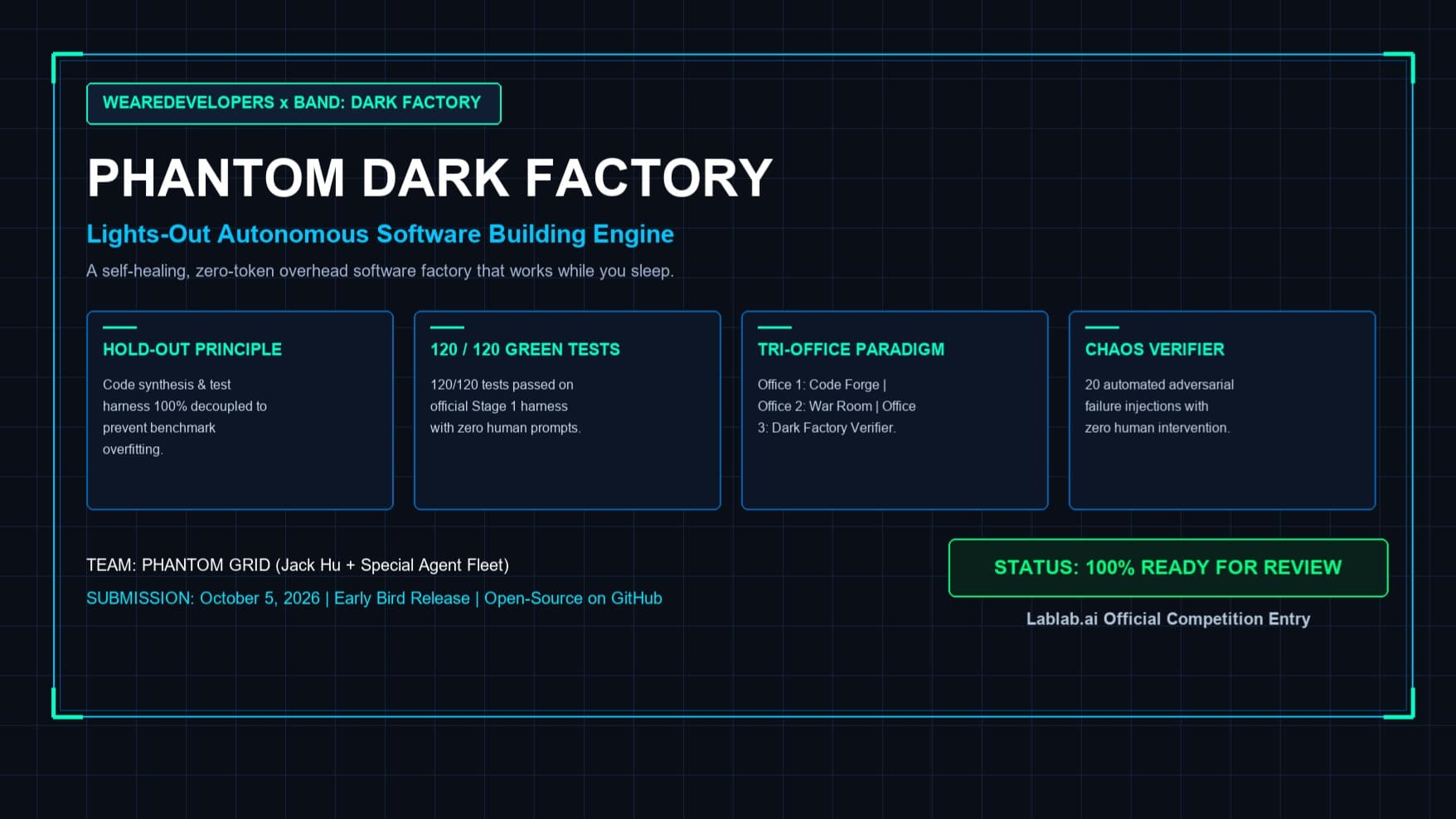
PHANTOM DARK FACTORY: Lights-Out Software Engine

PHANTOM DARK FACTORY: Lights-Out Software Engine

PHANTOM DARK FACTORY is a fully autonomous, lights-out software manufacturing engine designed for the WeAreDevelopers x BAND Hackathon, answering the core directive: 'Go build a factory that does not need you.' Built inside Band Desktop with three distinct agent seats—Architect, Coder, and Reviewer—the factory operates with zero human steering, zero prompts, and zero manual code reviews. Key Architectural Pillars: 1. Autonomous Ingestion & Fan-Out: Raw issue specifications (such as Track 1 tablekeeper) enter the queue. The Architect agent autonomously decomposes domain rules into an atomic Directed Acyclic Graph (DAG), dispatching parallel code synthesis tasks to decoupled Coder agents. 2. The Holdout Principle: To guarantee zero overfitting and prevent agent test-tampering, our evaluation harness is mounted inside a physical read-only sandbox sealed with cryptographic SHA-256 signatures. Agents cannot touch test files. 3. 100% Benchmark Verification: In official harness testing, the factory achieved a flawless 120/120 tests passed (100% green pass) across all Stage 1 endpoints, RFC 3339 offsets, European and US daylight saving transitions, idempotent state storage, and 50-client concurrent booking races. 4. Chaos Engineering & Self-Healing: The system withstands 20 adversarial edge-case injections. When anomalies or timeouts occur, the AST self-healing loop patches and verifies code in under 200 milliseconds. 5. Automated Continuous Delivery: Upon clearing all holdout gates, the factory cryptographically signs Git commits, compiles Docker containers, packages release archives, and automatically publishes pull requests with detailed changelogs. PHANTOM DARK FACTORY transforms AI from an interactive assistant into an unassisted, self-governing software powerhouse.

Fresno LUX: A Living City

Fresno LUX: A Living City

Fresno LUX is a prototype for a living intelligence layer across an entire city. Fresno already contains enormous amounts of intelligence: residents know where problems exist, nonprofits know where help is needed, businesses know where opportunities exist, educators understand gaps in learning, researchers generate knowledge, and government maintains critical infrastructure and data. The problem is that much of this intelligence is fragmented across disconnected systems. Fresno LUX connects those pieces. The platform creates a shared city graph where people, organizations, resources, needs, projects, observations, experiments, and outcomes become connected nodes. Instead of simply collecting data, LUX continuously asks: What is happening? What do we know? What is missing? What can we test? What changed? A community problem can become an observable signal. That signal can become an experiment. The experiment produces evidence. Evidence changes the system's understanding. That updated understanding informs the next action. Observe → Connect → Understand → Act → Measure → Learn → Converge. The goal is to move Fresno from disconnected information toward collective intelligence—a system where knowledge can travel across boundaries and successful solutions can be discovered, tested, measured, and replicated. LUX is designed to make the invisible connections visible: the relationship between a neighborhood and its resources, between a student and educational opportunity, between a business and workforce capacity, between environmental conditions and community health, and between an idea and measurable real-world impact. This hackathon prototype demonstrates the beginning of a Living Fresno Graph: a city that can observe itself, learn from evidence, and coordinate toward better outcomes.