CrewAI

CrewAI is a cutting-edge multi-agent framework designed to transform team collaboration and automation by utilizing advanced AI agents. Built on a modular architecture, the platform enables organizations to efficiently create, manage, and deploy teams of AI agents tailored for specific tasks. These agents collaborate to streamline workflows, automate complex processes, and offer actionable insights, making CrewAI ideal for developers, engineers, and businesses aiming to leverage AI for more dynamic and intelligent problem-solving.

General
AuthorCrewAI
WebsiteCrewAI
Repositoryhttps://github.com/crewAIInc/crewAI
Documentationhttps://docs.crewai.com/
Discordhttps://discord.com/invite/X4JWnZnxPb
TypeAI Collaboration Platform

Key Features

  • Multi-Agent Collaboration: CrewAI allows for the creation of AI teams, where each agent takes on specific roles and tasks. These agents communicate and collaborate autonomously, ensuring that tasks are divided and completed efficiently. By simulating a human-like teamwork dynamic, the platform helps users solve complex problems more creatively and effectively.

  • Advanced Automation: Beyond routine task automation, CrewAI empowers teams by automating intricate, multi-step processes. It handles everything from decision-making to task delegation, reducing the need for manual oversight while enhancing productivity.

  • Modular and Customizable: CrewAI offers extensive customization options, allowing users to build and tailor AI agents to suit various use cases. Whether it’s automating customer support, performing in-depth data analysis, or managing workflows, the platform supports a wide range of integrations with other tools and technologies.

  • Real-Time Insights and Decision Support: Leveraging AI’s ability to process and analyze data quickly, crewAI offers real-time insights and recommendations. The agents can identify trends, make predictions, and suggest actions, enabling more informed decision-making for businesses and engineering teams.

  • Seamless Integration: CrewAI is designed to integrate smoothly with existing technology stacks, including popular project management, communication, and analytics tools via custom tools. This ensures that organizations can adopt AI-enhanced workflows without disrupting their current operations.

Use Cases

  • Project Management: Streamline task assignment, monitor progress, and ensure deadlines are met with AI-driven insights.

  • Customer Support: Automate routine inquiries and enhance agent efficiency with AI-generated suggestions, improving response times and customer satisfaction.

  • Sales and Marketing: Automate lead generation, personalize outreach, and analyze campaign performance to refine strategies and achieve better results.

Start Building with CrewAI

CrewAI provides a robust and flexible framework for building AI teams that can enhance productivity, automate intricate workflows, and deliver actionable insights. Its modular, customizable design, combined with advanced AI collaboration tools, makes it an ideal solution for organizations aiming to integrate AI into their operational frameworks effectively.

Explore community-built use cases and applications to see how crewAI can transform your operations.

👉 Start building with CrewAI

CrewAI top builders

Explore the top contributors showcasing the highest number of CrewAI app submissions within our community.

CrewAI AI technology page Hackathon projects

Discover innovative solutions crafted with CrewAI, developed by our community members during our engaging hackathons.

InnerOS: Governed AI & Voice Ops on AMD

InnerOS: Governed AI & Voice Ops on AMD

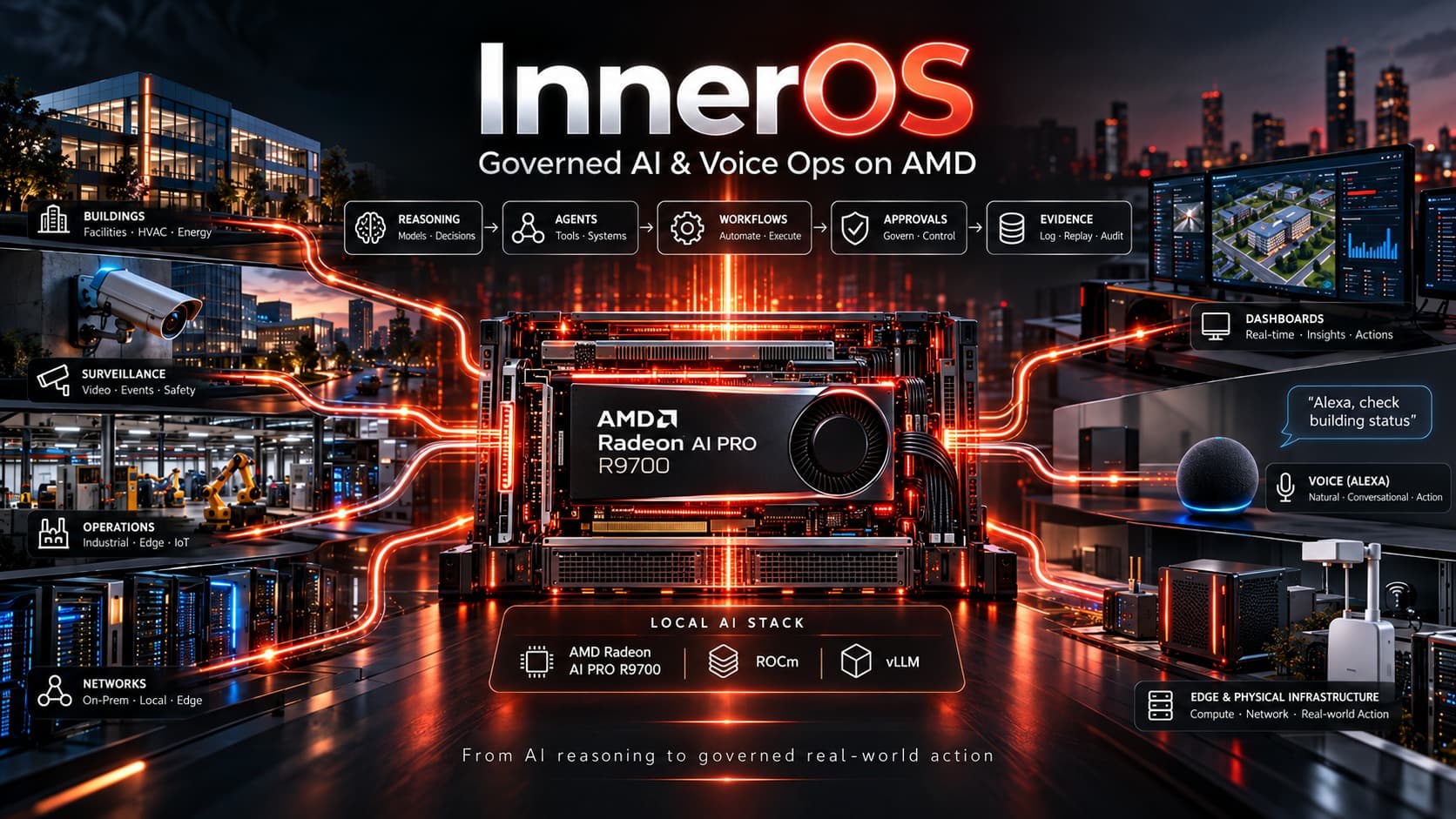
InnerOS is a governed AI operations fabric that moves AI beyond chat and into real business execution. For AMD Developer Hackathon ACT III, we built and verified a new end-to-end partner lane on top of the existing InnerOS control plane. A real Bellini smart-building incident is analyzed by Gemma-4-31B-IT through AMD Developer Cloud and ROCm. Gemma produces a structured IncidentPlan with diagnosis, severity, recommended actions, and execution boundaries. InnerOS then passes that governed result to Evolus, where Workflow and Knowledge Library components turn the decision into an operational work-order representation. InnerOS preserves policy, approvals, execution state, cryptographic evidence, and replay. We are explicit about what was reused versus built for ACT III. InnerOS governance, local AMD ROCm/vLLM/Qwen execution, MCP/A2A coordination, and evidence/replay concepts existed before the event. ACT III added the live AMD Developer Cloud + Gemma integration, structured IncidentPlan contract, live Evolus integration, Bellini→Gemma→Evolus→Evidence pipeline, Judge Console, and public submission package. InnerOS also reuses technology developed in our parallel Alexa hackathon. The working Inner Oz skill already queries live InnerOS/Home Assistant energy data and has demonstrated a governed UniFi restart with owner approval and post-action verification. A newer voice-programming flow can create a GitHub repository and governed InnerOS Ops Task for an AI agent; task creation is verified, while agent completion is tracked separately. The architecture is unified: AMD provides the compute foundation, Gemma provides reasoning, Evolus provides business workflow execution, Alexa provides natural voice access, and InnerOS provides governance, orchestration, evidence, and proof. Reason. Act. Prove.

ReviewSquad: AI code review with IBM Bob

ReviewSquad: AI code review with IBM Bob

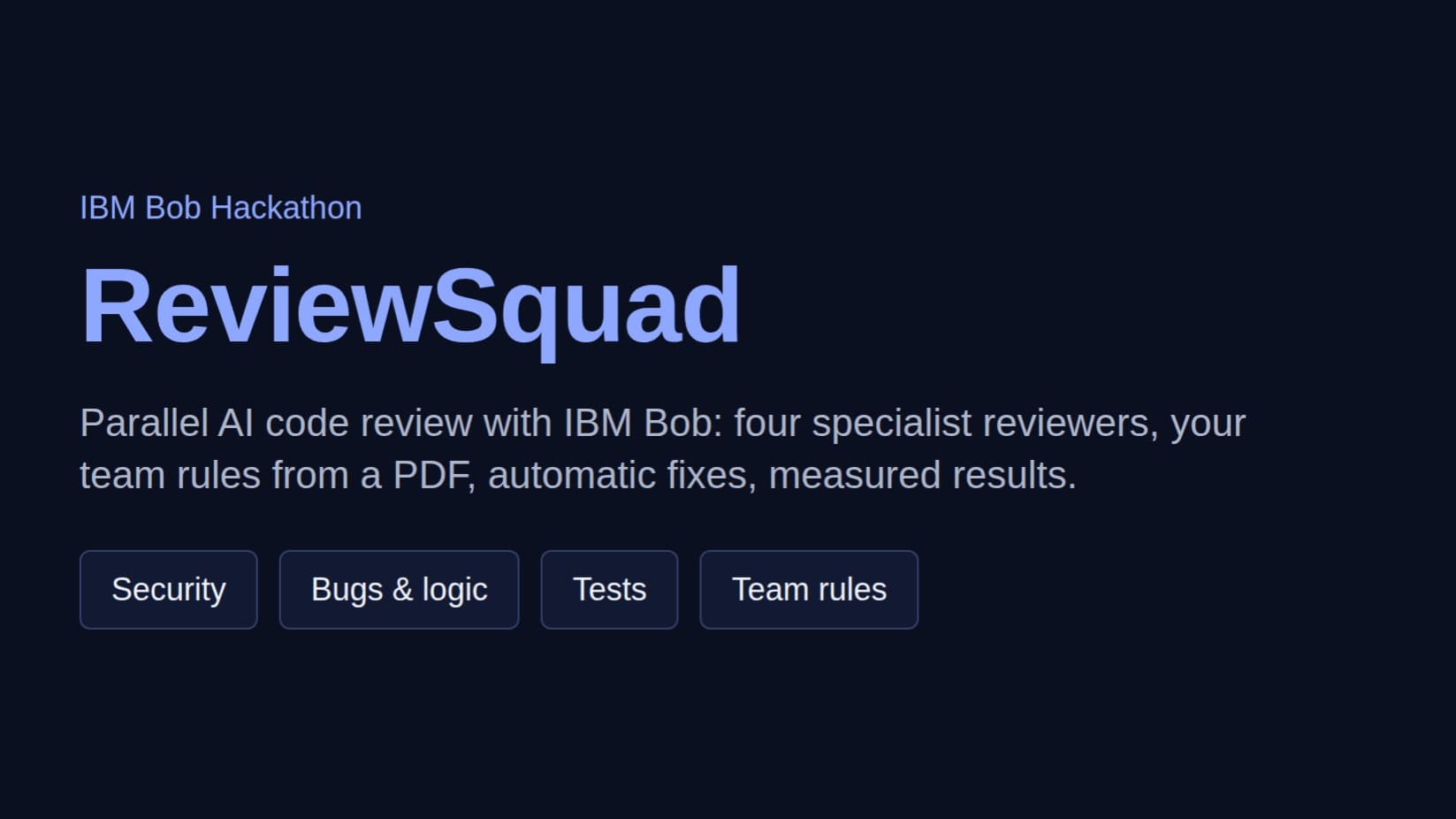
The problem Code review is one of the slowest and least reliable steps in software delivery. Pull requests wait hours for a busy reviewer, and when the review happens, it is often rushed: the tests pass, the diff looks reasonable, approved. But passing tests do not mean safe code. Hard-coded secrets, SQL injection, inverted business logic and untested code slip into production, where fixing them costs far more. Reviews are also inconsistent: each reviewer checks different things, and the team's written guidelines are rarely applied line by line. The solution ReviewSquad turns IBM Bob into a disciplined code review team. A developer opens the pull request in IBM Bob, selects the Review Lead mode and asks it to review. ReviewSquad then runs the full workflow: 1. It converts the git diff into a review brief with exact line numbers and runs the tests and fast automated checks for hard evidence. 2. The Review Lead reads the team's own code review guidelines from a PDF (document understanding). 3. It runs four specialist reviews - Security, Bugs & Logic, Tests and Team Rules - each recording structured findings with the file, line, severity, the guideline rule broken, and a fix. 4. The findings are merged into one review with a clear verdict. 5. After a human approves, a Fixer mode repairs every finding and adds tests; tests and checks run again. 6. ReviewSquad publishes a shareable report of what was found, by whom, and the before/after state. Target users are development teams where senior reviewers are a bottleneck. Developers interact entirely through IBM Bob's chat; reviewers read one report. Why it is different Most AI review tools make a single pass and leave a list of comments. ReviewSquad runs the whole workflow - understand the rules, review, decide, fix, verify, report - with clear roles and permissions: reviewer modes are read-only, and only the Fixer may edit code, only after approval. Deterministic tools do the counting; Bob does the judgment. Because the rules come from a document, every team gets reviews against its own standards, not generic advice. We also measure instead of claiming. Our demo pull request contains 11 planted problems and passes all 8 of its tests; GitHub marks it "Ready to merge". A hidden answer key, which Bob cannot read, scores the review. Impact (our recorded run) - Automated checks alone caught 7 of 11 planted problems; ReviewSquad with IBM Bob caught 10 of 11, including an inverted coupon-expiry check that no test or linter flagged. - After the Fixer: 37 of 37 tests pass (up from 8), and automated warnings dropped from 22 to 0. - The full review, fix and verification took minutes of agent time instead of a manual review cycle, with every finding traceable to a line and a team rule.

Nexora AI: Autonomous SDLC Modernization

Nexora AI: Autonomous SDLC Modernization

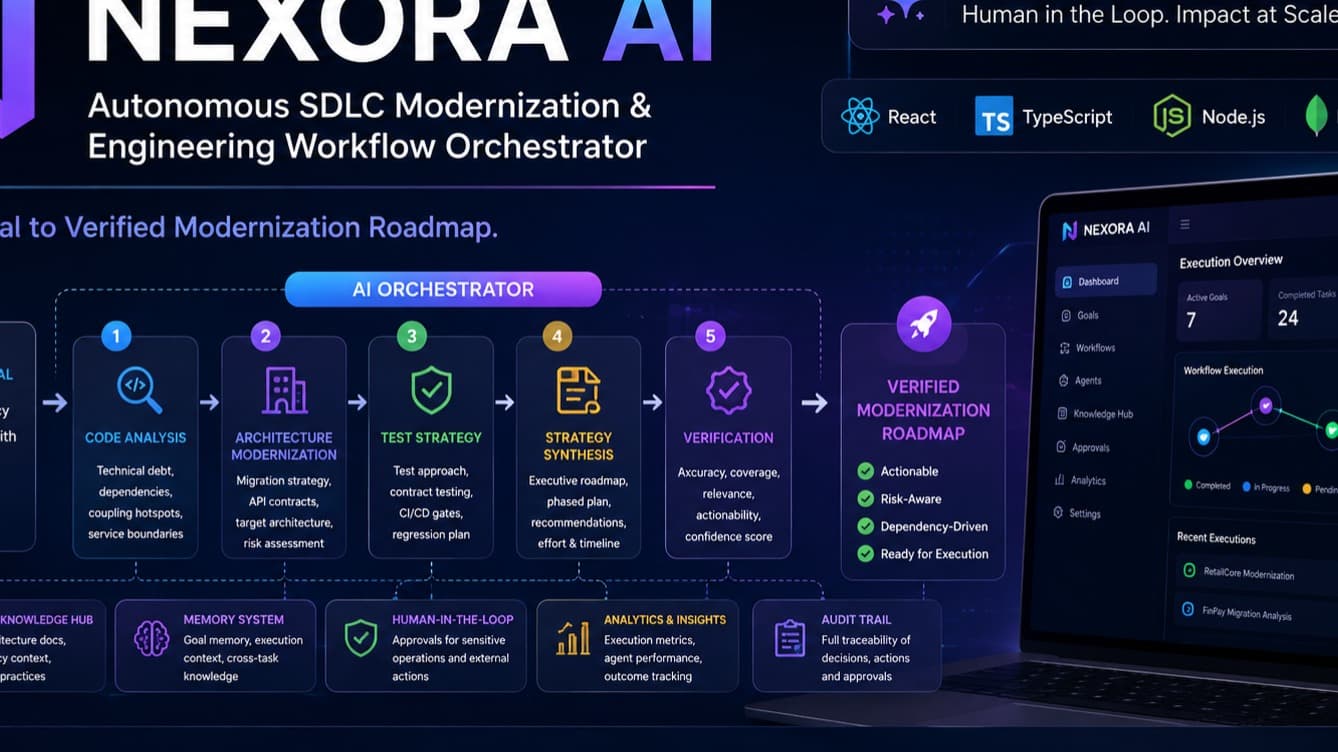
Modernizing legacy software is difficult because engineering teams must understand complex dependencies, identify technical debt, define safe migration boundaries, design testing strategies, and coordinate execution across many activities. This planning process is often time-consuming, difficult to reproduce, and vulnerable to incomplete or disconnected analysis. Nexora AI addresses this challenge with an autonomous multi-agent SDLC modernization platform. A developer begins by describing a high-level modernization goal. Nexora analyzes the goal, identifies constraints and success criteria, and automatically converts it into a dependency-aware workflow represented as a DAG (Directed Acyclic Graph). The platform coordinates specialized AI agents for different stages of modernization. The Code Analysis Agent identifies technical debt, coupling hotspots, end-of-life technology risks, and potential service boundaries. The Architecture Modernization Agent develops migration phases, API contracts, target architecture recommendations, and risk considerations. The Test Strategy Agent creates testing strategies, contract-testing requirements, CI/CD quality gates, and regression checkpoints. A Strategy Agent synthesizes these outputs into an executive roadmap, while a Verification Agent evaluates the resulting work for accuracy, completeness, relevance, and actionability. Nexora also grounds agent reasoning using a Retrieval-Augmented Generation (RAG) knowledge layer and memory system. For the demonstration, the platform includes a fictional 480,000-line Spring 4 / Java 8 RetailCore monolith with legacy dependencies, high coupling, and low test coverage. The system uses this knowledge to generate a realistic modernization workflow covering service boundaries, strangler-fig migration, API contracts, testing, risks, and phased execution. The target users are software engineers, architects, technical leads, engineering managers, and modernization teams working with complex or legacy systems. Users interact through a unified dashboard where they can create goals, inspect the generated DAG, execute tasks, review agent outputs, monitor verification results, and view analytics. A key differentiator is that Nexora is not simply a chatbot producing a single response. It assembles a team of specialized agents, manages their dependencies, shares context between tasks, grounds outputs in knowledge, verifies results, and supports human-in-the-loop approval for sensitive operations. This creates a more structured, traceable, and governed approach to AI-assisted software modernization.