DeepSeek V3

General
Release date2024
AuthorDeepSeek
WebsiteDeepSeek Models
Repositoryhttps://github.com/deepseek-ai
TypeMoE (Mixture of Experts) Language Models

The DeepSeek V3 model represents our most advanced AI architecture, designed for complex reasoning tasks and code generation. With enhanced context handling and improved instruction following, this model excels in technical applications and enterprise deployments.

Key Features

  • DeepSeek-V3: 671B parameters (37B activated per token), optimized for math, code, and multilingual tasks.
  • Code Generation: Supports 12+ programming languages
  • Advanced Reasoning: Chain-of-thought capabilities for multi-step problems
  • Enterprise-Grade Security: Built-in content filtering and compliance features
  • Speed: 3x faster generation than previous versions (60 TPS)
  • Open-Source: FP8/BF16 weights available on Hugging Face

πŸ‘‰ Local Deployment Guide for DeepSeek V3 πŸ‘‰ Model Weights on Hugging Face πŸ‘‰ API Documentation πŸ‘‰ Deepseek V3 Paper πŸ‘‰ Performance Highlights

DeepSeek V3 top builders

Explore the top contributors showcasing the highest number of DeepSeek V3 app submissions within our community.

Deepseek DeepSeek V3 AI technology Hackathon projects

Discover innovative solutions crafted with DeepSeek V3, developed by our community members during our engaging hackathons.

SRE Incident Agent β€” Blast Radius Zero

SRE Incident Agent β€” Blast Radius Zero

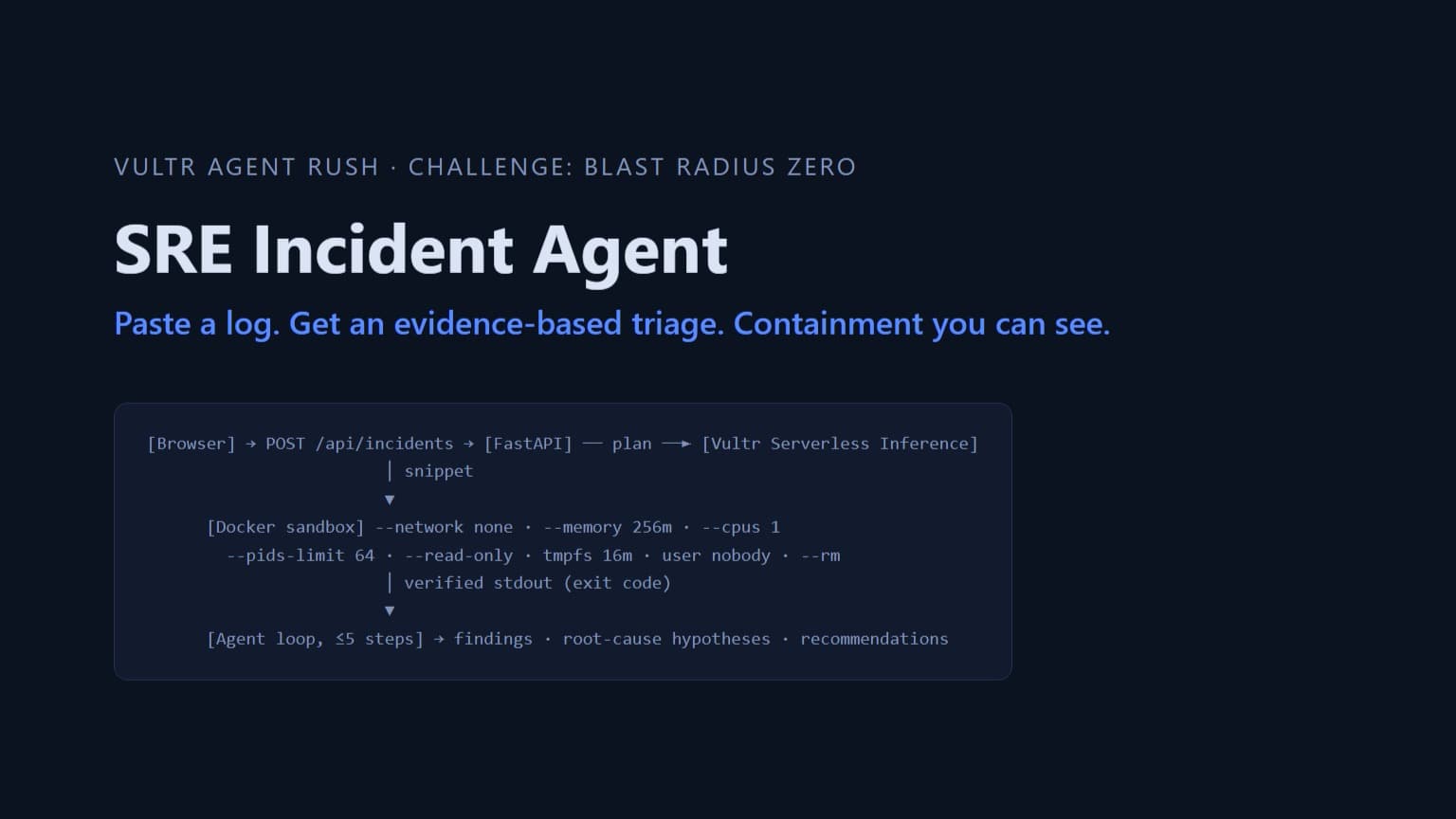
The problem. An on-call SRE facing a cryptic 500-line log spends 20–40 minutes of manual grep/correlate work to know what broke and what to do first. LLM assistants can draft guesses, but executing LLM-generated code on a real system is the classic blast-radius problem: run it blind, with network access and secrets in the environment, and a hallucinated diagnostic becomes an incident itself. What we built. SRE Incident Agent closes the loop safely. Paste a log β€” the LLM plans a diagnostic step, the step runs as real Python in an isolated Docker container, the verified stdout and exit code feed back into the agent's context, and after ≀5 steps it returns a triage report: findings backed by numbers from executed code, three ranked root-cause hypotheses, and an ordered runbook. Nothing the LLM claims is trusted unless an executed snippet printed it. Blast radius zero. The LLM-written code is the attack surface, closed in layers: a static guard refuses subprocess, sockets, URL fetches, file writes, eval/exec and host paths before anything runs (shown as BLOCKED Β· contained); each snippet runs in a one-shot container with --network none, 256 MB RAM, 1 CPU, 64 pids, read-only rootfs, uid nobody, no-new-privileges β€” destroyed after every run; secrets never enter the container; a hard 20 s kill per step. The video shows a live containment moment: a hallucinated exfiltration snippet blocked pre-execution. On Vultr. The full backend runs on a Vultr Compute VM (Amsterdam): FastAPI, the Docker sandbox runner, Caddy/TLS. All LLM calls go to Vultr Serverless Inference β€” primary deepseek-v4.1-flash-1017, whole-step fallback retries on mimo-v2.6-flash. Business case. The author supports storage systems and virtualization fleets already off vendor support, where every incident is triaged manually: this cuts incident triage from ~30 min to ~60 s, with evidence attached.