ElevenLabs

ElevenLabs is a voice technology research company, developing the most compelling AI speech software for publishers and creators. The goal is to instantly convert spoken audio between languages. ElevenLabs was founded in 2022 by best friends: Piotr, an ex-Google machine learning engineer, and Mati, an ex-Palantir deployment strategist. It's backed by Credo Ventures, Concept Ventures and other angel investors, founders, strategic operators and former executives from the industry.

General
Release date2022
AuthorElevenLabs
TypeVoice technology research

Products

Speech Synthesis

Speech Synthesis tool lets you convert any writing to professional audio. Powered by a deep learning model, Speech Synthesis lets you voice anything from a single sentence to a whole book in top quality, at a fraction of the time and resources traditionally involved in recording.

VoiceLab

Design entirely new synthetic voices or clone your own voice. The generative AI model lets you create completely new voices from scratch, while the voice cloning model learns any speech profile from just a minute of audio.

Resources

Useful resources on how to build with ElevenLabs

ElevenLabs - Helpful Resources

Check it out to become a ElevenLabs Master!


ElevenLabs top builders

Explore the top contributors showcasing the highest number of ElevenLabs app submissions within our community.

ElevenLabs AI technology page Hackathon projects

Discover innovative solutions crafted with ElevenLabs, developed by our community members during our engaging hackathons.

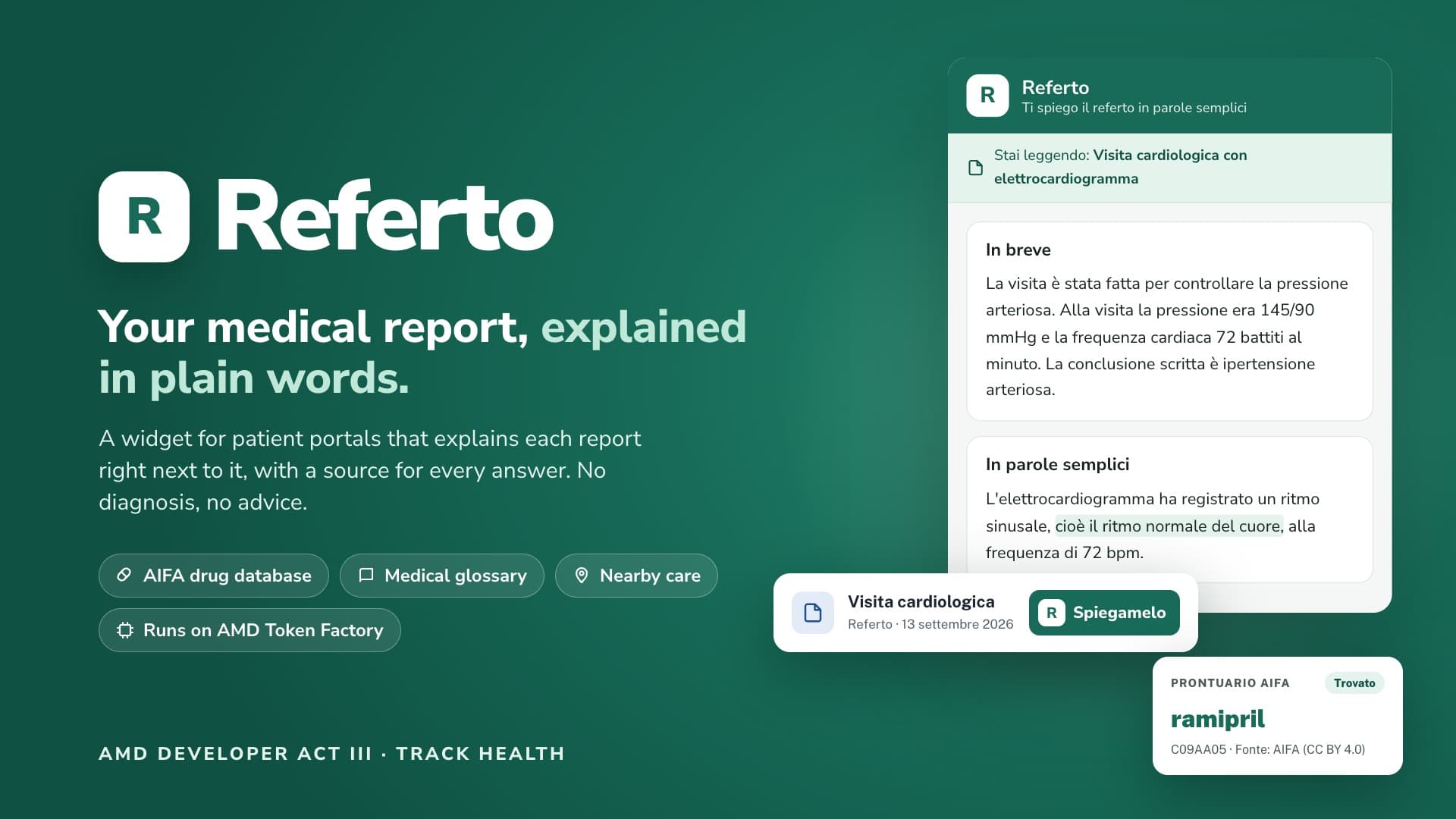
Referto: medical report, explained in plain words

Referto: medical report, explained in plain words

THE PROBLEM In Italy, every medical report reaches the patient's electronic health record within five days, often weeks before they can talk to a doctor. 58% of Italians struggle to understand health information (HLS19). So they search online, paste the report into a chatbot with no sources, or call a family doctor who is already overloaded: Italy is short of 5,700 GPs. The country invested €1.38 billion in the health record, yet only one patient in four opens it when a new report arrives. THE SOLUTION Referto is a widget next to the report, inside a clinic's patient portal. One click on "Explain this to me" and the patient gets: - a summary and a plain-language explanation of the report; - the doctor's instructions in a separate box, linked to the document; - answers to their own questions from a medical glossary, with the source; - every medicine the doctor wrote, matched to the official AIFA database, with the leaflet and answers that cite its section; - the nearest facilities for the report's specialty, on a map from open data. The agent runs on an open model (DeepSeek V4 Flash) on AMD Token Factory. TRUST BY DESIGN Referto never diagnoses, never suggests treatments and never adds medicines: it explains only what is written. The model rewrites; sources decide what is true. Code adds guardrails: sources a tool did not return are removed, words not in the report get a fixed answer, and medicines are matched by code, not by the model. The last word always belongs to the doctor. BUSINESS VALUE Every report understood is one less call to the doctor and one more reason to open the health record. Referto enters through the portals that already deliver reports: GP practices, then private labs, then regional health records. Italian digital health is worth €2.7 billion a year; with the European Health Data Space, the need reaches 450 million Europeans.

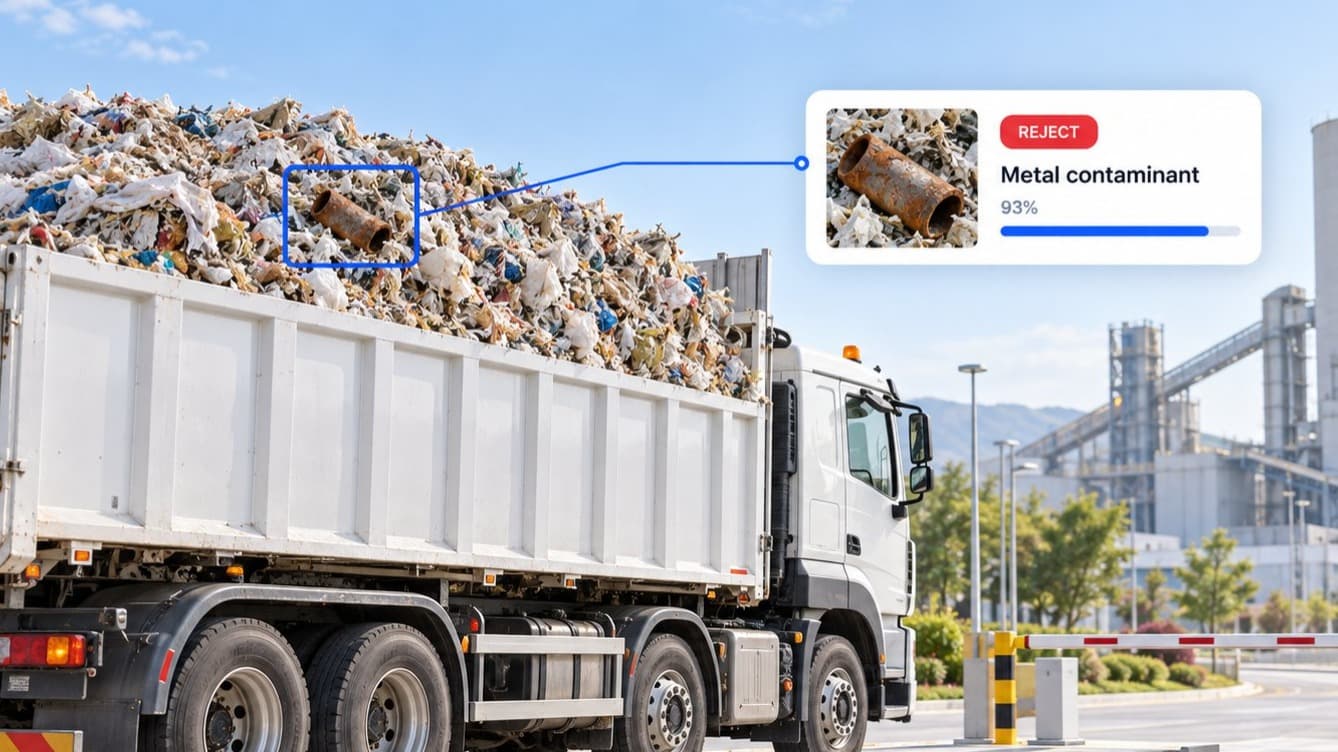
Lynceus - AI Gate Inspector for RDF Trucks

Lynceus - AI Gate Inspector for RDF Trucks

Cement plants burn refuse-derived fuel (RDF) to replace coal, but every truck of shredded waste can hide metal, stone or tyres. One metal chunk that reaches the shredder can stop the kiln, costing up to Rp 798 M per incident. Today a gate officer checks each load by eye and keeps no record. Lynceus moves that check to the weighbridge, before the load is tipped. The operator uploads the load photo and the waybill. A vision model on AMD Token Factory reads the waybill and auto-fills the register (unreadable fields stay empty, never guessed), then finds and boxes contaminants in the load. A YOLO26m detector on the gate PC’s CPU gives a second opinion. The model observes; the rule engine decides. Six gate checks (visual contaminants, waybill, waybill vs load, gas sensors, weight, detector) produce one verdict that says which check failed and why. Each verdict comes with SOP-cited next steps, one-click supplier notice or escalation, and Pythia, an assistant that answers only from plant documents with citations, or says “cannot answer”. Every inspection is sealed as a tamper-evident SHA-256 audit record. Measured live on 80 labelled RealWaste photos: 19 of 20 metal loads stopped, 35 of 40 clean loads passed, ~20 s median to a verdict. Per 1,000 trucks, hard loads reaching the shredder drop from 6 to 1 and trucks checked by hand from 1,000 to 142. All live AI runs on AMD GPUs via AMD Token Factory (DeepSeek-V4-Flash-Vision-Exp, DeepSeek-V4-Flash), with Google Gemma 4 as the fallback vision model and YOLO26m fine-tuned on Google Colab. Unlike magnets or sorting-line AI, Lynceus acts before tipping. Target market: Indonesia first, then the EU, at €500 per gate per month. Built by Rafi Cahya Mahardika and Muhammad Muqorrobin Al Anshori for the AMD Developer Hackathon ACT III, Intelligent Industry. lynceus.web.id

ShelfReady: Trust Layer for Product Data

ShelfReady: Trust Layer for Product Data

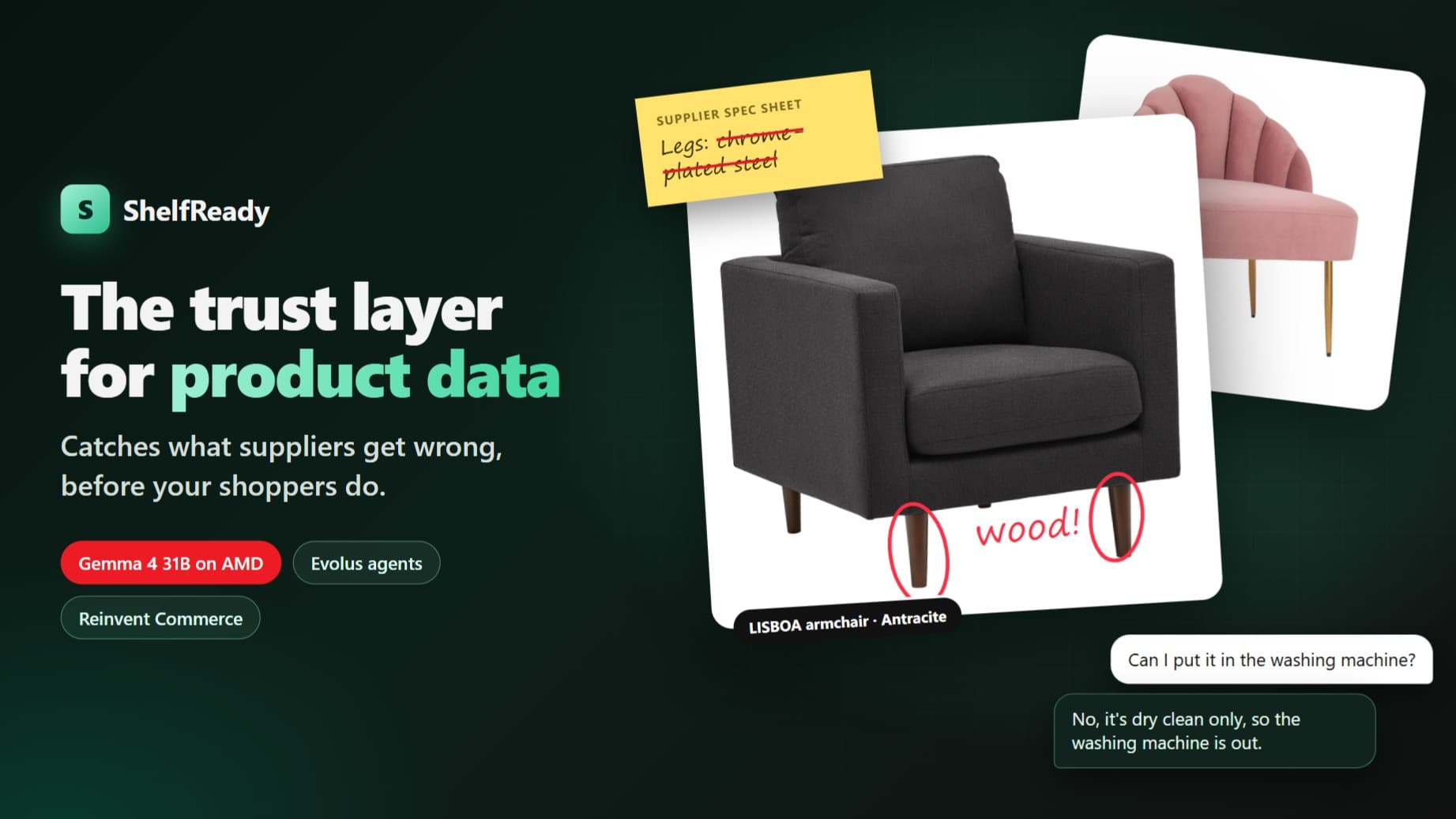
Online shops copy product data from supplier emails: a spec sheet PDF, some photos, a care label, a dimension drawing. These often contradict each other. A wrong width, colour or washing instruction on a product page turns into a return: 60.4% of German online shoppers have returned items because the description or photos did not match (KPMG/EHI 2025). Since December 2024 the EU General Product Safety Regulation also requires manufacturer details, an EU responsible person and safety warnings in the shopper's language on every offer. ShelfReady is the trust layer between supplier data and the shop. Gemma 4 31B, running on AMD, extracts the spec and reads every photo, label and drawing, drawing boxes on what it sees. Seventeen checks in plain Python then compare the supplier's claims with its own evidence and with EU listing rules. What the evidence settles (a width the supplier's own drawing shows) collapses into one line; everything else goes to a person with the spec sheet and the photo side by side and the contradiction highlighted. Open facts are held back instead of guessed. The listing, safety warnings and alt text for every photo are written from verified facts only, translated into seven languages and checked in code (numbers, units, names, glossary). A publish gate blocks anything with an open legal item. Evolus agents, on the same Gemma 4 31B, write the emails that ask suppliers the open questions and answer shoppers on the shop page from the verified facts only. Measured, not claimed: on 25 supplier submissions with 59 planted defects, ShelfReady found 57 (recall 0.966, precision 0.983) with no false alarm on clean products. On 250 real Amazon Berkeley Objects listings it audited 900 photos; a person confirmed 29 of 30 photo findings. Video narration voice: ElevenLabs.