Generative Agents

Generative Agents are computer programs designed to replicate human actions and responses within interactive software. To create believable individual and group behavior, they utilize memory, reflection, and planning in combination. These agents have the ability to recall past experiences, make inferences about themselves and others, and devise strategies based on their surroundings. They have a wide range of applications, including creating immersive environments, rehearsing interpersonal communication, and prototyping. In a simulated world resembling The Sims, automated agents can interact, build relationships, and collaborate on group tasks while users watch and intervene as necessary.

General
Relese dateApril 7, 2023
TypeAutonomous Agent Simulation

Start building with Generative Agents

We have collected the best Generative Agents libraries and resources to help you get started to build with Generative Agents today. To see what others are building with Generative Agents, check out the community built Generative Agents Use Cases and Applications.

Generative Agents Tutorials


Generative Agents resources

Kickstart your development with Generative Agents.


Generative Agents top builders

Explore the top contributors showcasing the highest number of Generative Agents app submissions within our community.

Generative Agents AI technology page Hackathon projects

Discover innovative solutions crafted with Generative Agents, developed by our community members during our engaging hackathons.

clawback

clawback

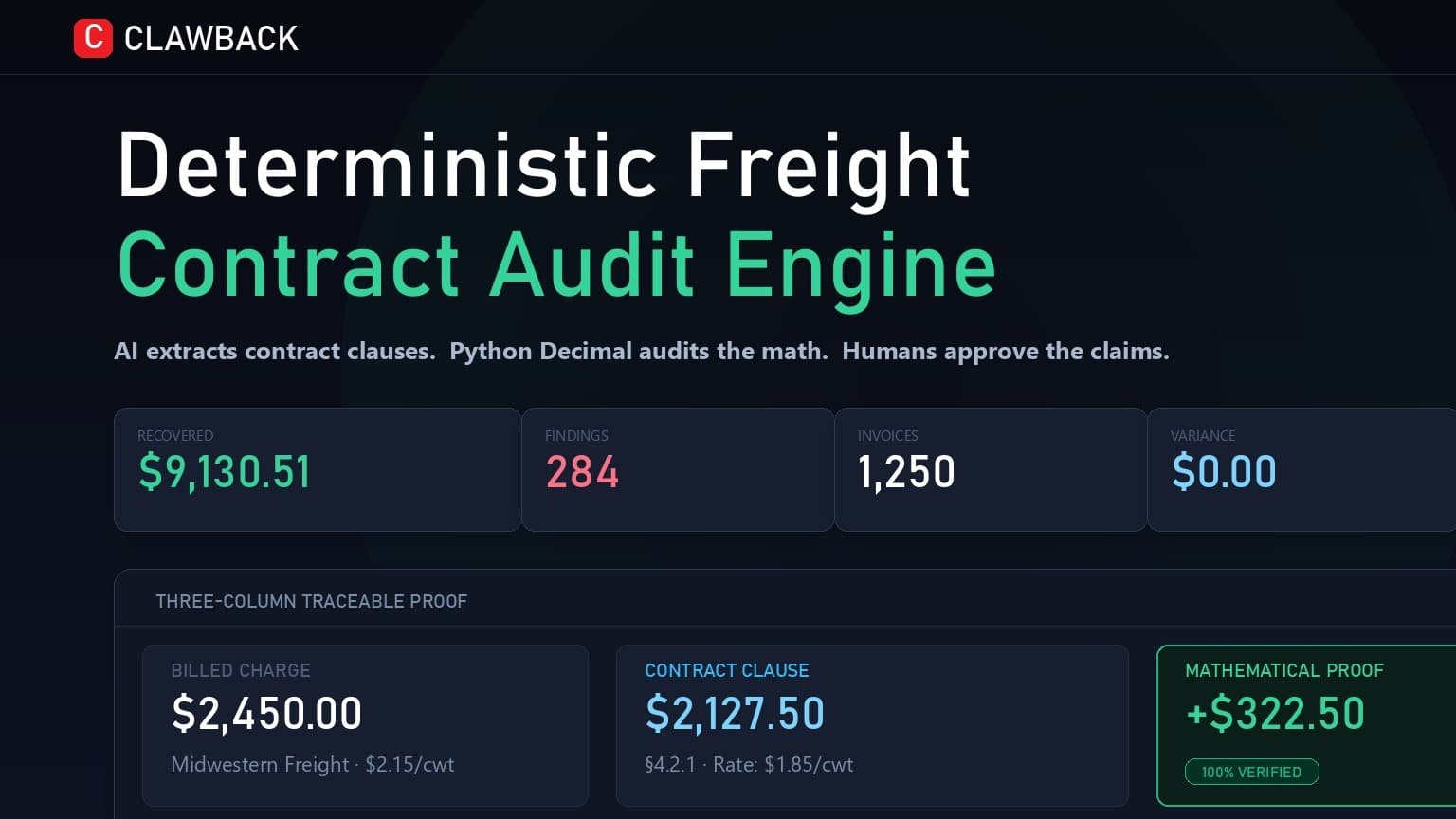
The Problem Shippers pay carrier invoices with thousands of charges, and nobody has time to check each one against the negotiated contract. Audit vendors report that freight audits recover about 3 to 7 percent of freight spend, and carriers often allow only a short dispute window, commonly around 15 days for parcel. Outsourced audit firms commonly take 20 to 50 percent of what they recover. These figures come from vendor sources and are indicative only. Why This is a Commerce Track Project Most commerce tools chase top-line revenue growth. Clawback protects margin from the cost side. In commercial logistics and supply chain operations, freight spend represents 8 to 15 percent of total cost of goods sold (COGS). A dollar recovered from an overcharge drops directly to pre-tax net margin. How AMD is Used Model & Host: The model that reads contracts and normalizes messy invoice charge descriptions is google/gemma-2-9b-it, hosted on AMD Developer Cloud / AMD Token Factory infrastructure (notebooks.amd.com). Replay Mode: When offline or if API quotas are exhausted, a deterministic replay mode serves recorded outputs from real AMD calls, visibly labeled with a persistent REPLAY badge. Workload Concurrency: Utilizes k=3 parallel self-consistency consensus extraction and batch charge-description normalization, fully utilizing AMD ROCm GPU concurrency. Measured Results (Synthetic Benchmark) Source: benchmark/results.json (Mode: replay / baseline; Run Date: October 16, 2026). Accuracy: Audit Recall: 100.00% (284 of 284 planted errors detected) Audit Precision: 100.00% (0 false positives) True Positives: 284 | False Positives: 0 | False Negatives: 0 Planted Ground Truth: $9,130.51 USD Recovered Overcharges: $9,130.51 USD Dollar Variance: $0.00 (0.00%) Note: These results prove the pipeline and deterministic arithmetic engine work as designed on synthetic benchmark data. They are not evidence of real-world carrier recovery rates.

Factory Agent: AI Quality & Maintenance Assistant

Factory Agent: AI Quality & Maintenance Assistant

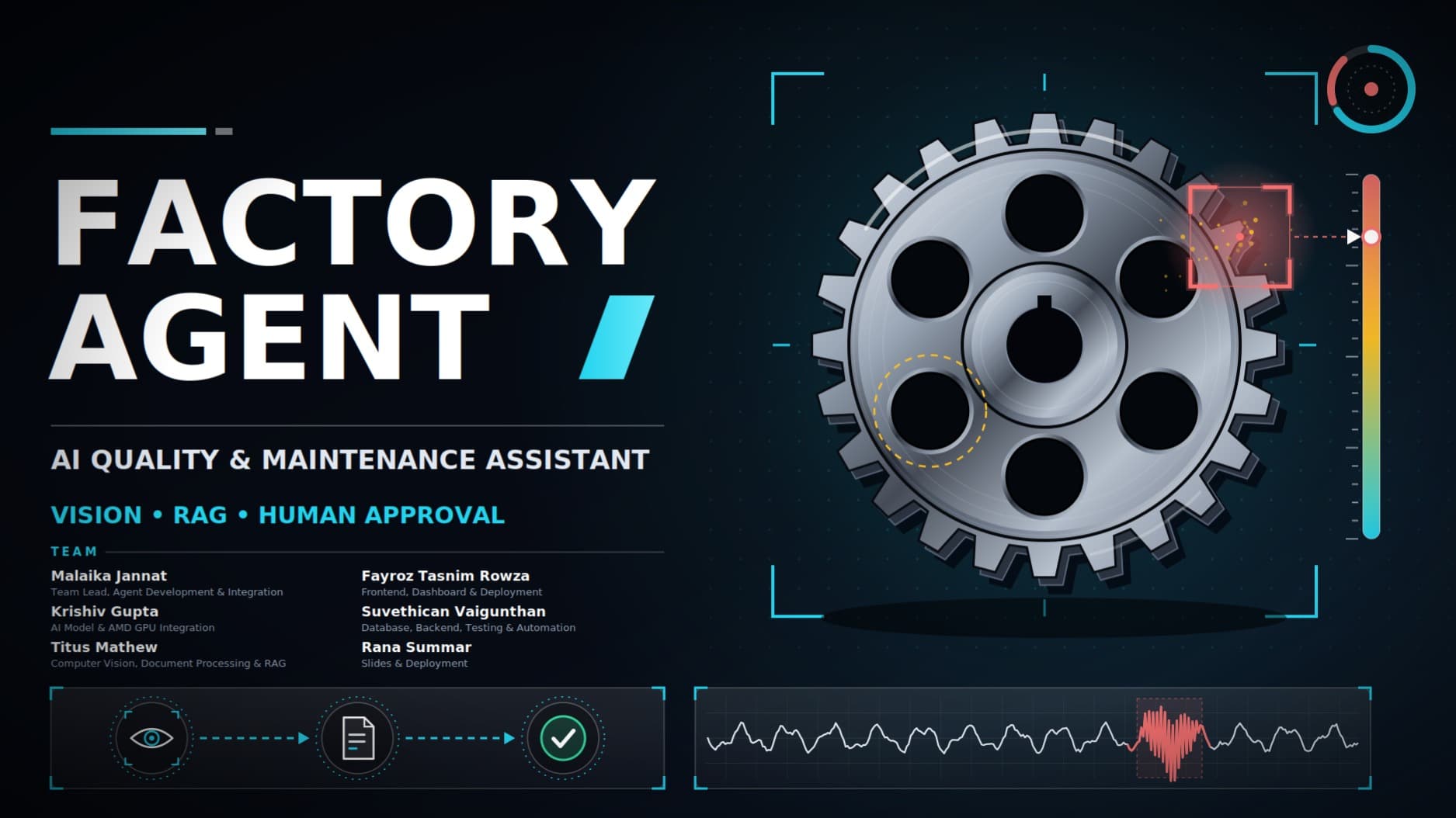
Factory Agent is an end-to-end AI quality inspection and industrial maintenance assistant designed for modern manufacturing environments. It addresses costly equipment downtime and the safety risks of unverified AI recommendations through multimodal defect detection, retrieval-augmented generation (RAG), evidence-grounded diagnosis, and human-in-the-loop governance. The system accepts machine-part photographs, sensor telemetry reports in CSV, JSON, or TXT formats, and technical inspection documents in TXT or PDF formats, including OCR-based text extraction. For visual inspection, Factory Agent combines an advisory local CNN with AMD Token Factory vision models, including Qwen3.8-Flash-Next and Gemma-4-31B-IT. It evaluates individual model predictions rather than averaging confidence scores, flagging low-confidence results and disagreements as UNVERIFIED for expert review. Its RAG pipeline retrieves relevant maintenance procedures from technical manuals. Primary and fallback language models, MiMo-V2.6-Flash and DeepSeek-V4-Flash, generate diagnostic explanations and repair recommendations grounded in retrieved evidence. The system validates recommendations against source manual text and provides citations identifying relevant manuals and pages where available. A human-in-the-loop interface enables plant managers to review predictions, examine supporting evidence, and approve or reject proposed maintenance actions. Only approved cases proceed to Evolus automation workflows for maintenance work-order generation. Built with Next.js, React, TypeScript, FastAPI, PyTorch, and Docker, Factory Agent supports cloud integrations and an offline mock mode for demonstrations and development without API keys. By combining automation, traceable evidence, and human oversight, Factory Agent aims to make industrial AI safer, more transparent, auditable, and practical.

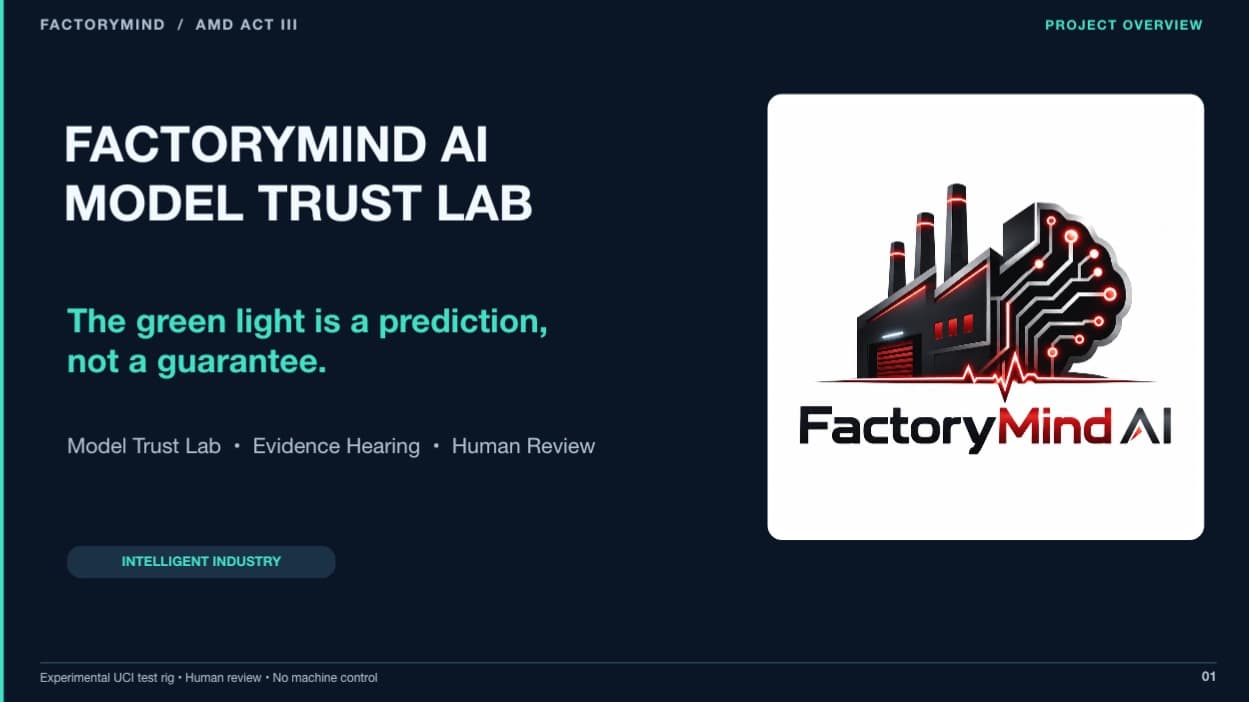
FactoryMind AI — Model Trust Lab

FactoryMind AI — Model Trust Lab

FactoryMind AI — Model Trust Lab helps maintenance engineers, reliability teams, and factory operations managers evaluate machine-learning predictions before acting on them. It addresses a practical risk: a green “Healthy” prediction can still be wrong when operating cycles are correlated and accuracy overstates reliability. The prototype uses the UCI Condition Monitoring of Hydraulic Systems dataset: 2,205 one-minute hydraulic test-rig cycles and 30 engineered pressure, flow, temperature, and vibration features. A Random Forest predicts valve condition. Random holdout accuracy is 98.01%, while five-fold blocked validation with purging reports 82.86%. Across blocked folds, 260 non-optimal cycles were incorrectly classified as Optimal. FactoryMind prioritizes these false-green predictions for human review. At a 20% review budget, confidence ranking identifies 136 of the 260 errors by reviewing 266 of 1,344 predicted-healthy cycles. The Model Trust Lab also tests 50 hypothetical sensor-gain scenarios. Stable predictions can still be wrong, and the initial stress-based ranking did not outperform confidence-only review. This negative result is reported openly. For each selected cycle, an operator can inspect sensor evidence, review the prediction, request an AMD Token Factory Evidence Hearing using DeepSeek-V4-Flash, and approve or reject an inspection recommendation. The hosted model selects evidence and safe review checks from a bounded schema; measurements come from the recorded experiment. Decisions are stored in SQLite and exported as checksum-verified evidence records. No machine-control commands are issued. FactoryMind demonstrates evidence-first model review for industrial maintenance workflows. Results are retrospective test-rig measurements, not proof of factory safety, downtime reduction, or cost savings. Physical validation, independent-rig testing, calibration, security controls, and operator studies are required before real-plant deployment.

AI-Sec RedTeam: Autonomous LLM Auditor

AI-Sec RedTeam: Autonomous LLM Auditor

As enterprises deploy autonomous customer-facing chatbots and agents, they introduce critical security risks: prompt injection, boundary violations, and unauthorized exposure of internal system prompts and tools. Traditional static testing cannot keep pace with dynamic LLM behaviors. AI-Sec RedTeam solves this by delivering an autonomous, end-to-end security and compliance auditing system: 1. Dynamic Probing & Reconnaissance: The system interfaces with live target endpoints, executing adaptive multi-turn reconnaissance and boundary stress-testing. 2. Multi-Agent Reasoning Pipeline: Leveraged on Evolus AI and accelerated by open models (Google Gemma) hosted on AMD ROCm/Token Factory infrastructure, the audit pipeline orchestrates four specialized agents: - ReconAgent: Extracts the target profile, constraints, and observable guardrails. - PlannerAgent: Formulates attack hypotheses mapped against OWASP Top 10 for LLMs. - BoundaryProber: Synthesizes high-impact adversarial probes targeting specific logic gaps. - ExplainJudge: Evaluates the complete interaction transcript against business policies, producing a structured JSON audit verdict with severity ratings and evidence quotes. 3. Automated Remediation: Beyond scoring, ExplainJudge synthesizes concrete, hardened system prompt patches to immediately close detected vulnerabilities. Built with a containerized Python/Streamlit architecture communicating via the Evolus REST API, AI-Sec RedTeam transforms manual red-teaming into a scalable, continuous compliance workflow for modern enterprises on AMD hardware.