Codey

Introducing Codey, a cutting-edge AI-driven coding assistant that reshapes software development by enhancing productivity and streamlining workflows. Developed by Google AI and built on the powerful PaLM 2, Codey supports over 20 programming languages, including Python, Java, JavaScript, Go, Google Standard SQL, and TypeScript. Leveraging large language models, Codey assists developers in a variety of coding tasks, optimizing speed, improving code quality, and bridging skill gaps.

General
Release date2024
AuthorGoogle AI
TypeAI-driven Coding Assistant

Key Capabilities

  • Wide Language Support: Codey is designed to work with over 20 programming languages, offering assistance for a diverse range of development scenarios.
  • Advanced Code Completion: Codey delivers expertly crafted code suggestions based on the developer's input and context, significantly accelerating the coding process.
  • Dynamic Code Generation: By sequentially generating code in response to developers' natural language prompts, Codey streamlines the coding experience and saves valuable time and effort.
  • Interactive Code Chat: Developers can leverage Codey's chat functionality to interact with an intelligent bot, addressing debugger issues, documentation, learning new concepts, and resolving code-related queries, thus overcoming development challenges with ease.

Wide-Ranging Applications

Codey's advanced capabilities are integrated into numerous Google platforms, such as Colab, Android Studio, Google Cloud, and Google Search, providing an array of benefits to developers, including:

  • Accelerating coding speeds with context-sensitive suggestions.
  • Elevating code quality through AI-assisted code snippets.
  • Balancing skill gaps by offering accessible guidance and support to both novice and expert developers.

Codey top builders

Explore the top contributors showcasing the highest number of Codey app submissions within our community.

Google Codey AI technology Hackathon projects

Discover innovative solutions crafted with Codey, developed by our community members during our engaging hackathons.

Culltron CivicOps

Culltron CivicOps

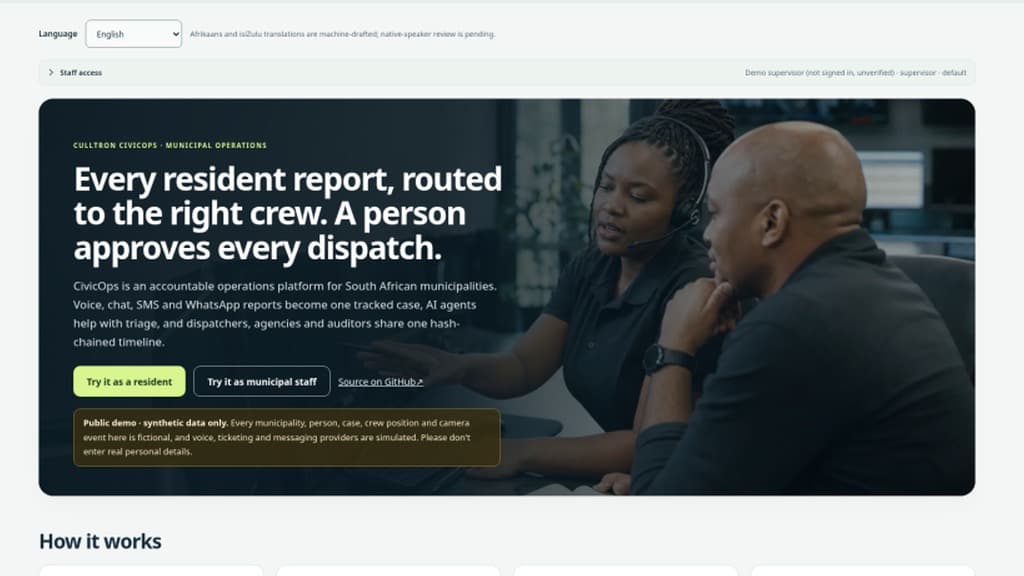
The problem. In a South African storm, municipal call centres flood. Reports arrive by phone, WhatsApp, email and walk-ins, and get re-typed, lost or duplicated. Residents never learn what happened, and control rooms cannot show who decided what. What CivicOps does. One front door: residents report by voice, chat, SMS, WhatsApp, web form or Open311 and get a reference number. On the live demo the resident agent is an ElevenLabs conversational agent using short-lived signed sessions. Bounded agents (Gemini 3.5 Flash-Lite, with a deterministic fallback) extract facts, triage, flag duplicates, recommend an eligible crew and draft resident updates, recording provider, model, confidence and reasoning. Agents cannot approve, assign or send anything: a dispatcher approves and assigns, and a supervisor names the incident commander and decides mutual aid. A live map shows aggregated operations only, with no person tracking. Multiple agencies share one incident and timeline. SOS needs a deliberate 3-second hold and never replaces 10111, 10177 or 112. Every action goes into an append-only SHA-256 hash-chained audit trail verifiable in the browser. Hard spend caps switch the demo to a labelled simulation. Honest scope. The demo uses synthetic data (EXPLICIT DEMO); email goes to an outbox only and field responses are simulated; Afrikaans and isiZulu translations await native review. An AMD Instinct/vLLM open-model path is implemented but was not run on AMD hardware for this event.

Fresno LUX: A Living City

Fresno LUX: A Living City

Fresno LUX is a prototype for a living intelligence layer across an entire city. Fresno already contains enormous amounts of intelligence: residents know where problems exist, nonprofits know where help is needed, businesses know where opportunities exist, educators understand gaps in learning, researchers generate knowledge, and government maintains critical infrastructure and data. The problem is that much of this intelligence is fragmented across disconnected systems. Fresno LUX connects those pieces. The platform creates a shared city graph where people, organizations, resources, needs, projects, observations, experiments, and outcomes become connected nodes. Instead of simply collecting data, LUX continuously asks: What is happening? What do we know? What is missing? What can we test? What changed? A community problem can become an observable signal. That signal can become an experiment. The experiment produces evidence. Evidence changes the system's understanding. That updated understanding informs the next action. Observe → Connect → Understand → Act → Measure → Learn → Converge. The goal is to move Fresno from disconnected information toward collective intelligence—a system where knowledge can travel across boundaries and successful solutions can be discovered, tested, measured, and replicated. LUX is designed to make the invisible connections visible: the relationship between a neighborhood and its resources, between a student and educational opportunity, between a business and workforce capacity, between environmental conditions and community health, and between an idea and measurable real-world impact. This hackathon prototype demonstrates the beginning of a Living Fresno Graph: a city that can observe itself, learn from evidence, and coordinate toward better outcomes.

SheCare - AI Women's Health Companion

SheCare - AI Women's Health Companion

SheCare is an AI-powered women's health companion built to close a critical gap in healthcare accessibility. According to UNICEF and WaterAid, more than a third of girls in South Asia miss school during their periods due to lack of sanitation and menstrual education, and 1.2 billion women globally lack access to basic hygiene resources. Beyond menstrual health, conditions like anemia, hair fall, and breast cancer are frequently overlooked or misdiagnosed due to stigma and limited access to reliable information. Most existing health apps track symptoms in isolation, missing patterns that span multiple conditions. SheCare solves this with four core modules: a period tracker with cycle prediction and irregularity detection, an AI symptom triage chatbot, a breast cancer self-exam guide with symptom checking, a hair fall photo-timeline tracker with root-cause analysis, and an anemia/weakness risk checker with localized dietary recommendations. At its core is the Unified AI Health Agent, powered by a Neo4j knowledge graph that connects symptoms, conditions, and modules together. Rather than treating each health concern separately, SheCare identifies cross-condition patterns, for example, linking heavy periods, hair fall, and fatigue to flag a possible risk of anemia or PCOS and recommend medical consultation. Built with React, FastAPI, Anthropic's Claude API, and Neo4j AuraDB, SheCare demonstrates how agentic AI and knowledge graphs can move beyond simple tracking toward genuinely intelligent, holistic health insights, making early detection and informed care more accessible to women everywhere.

AetherDev Pro

AetherDev Pro

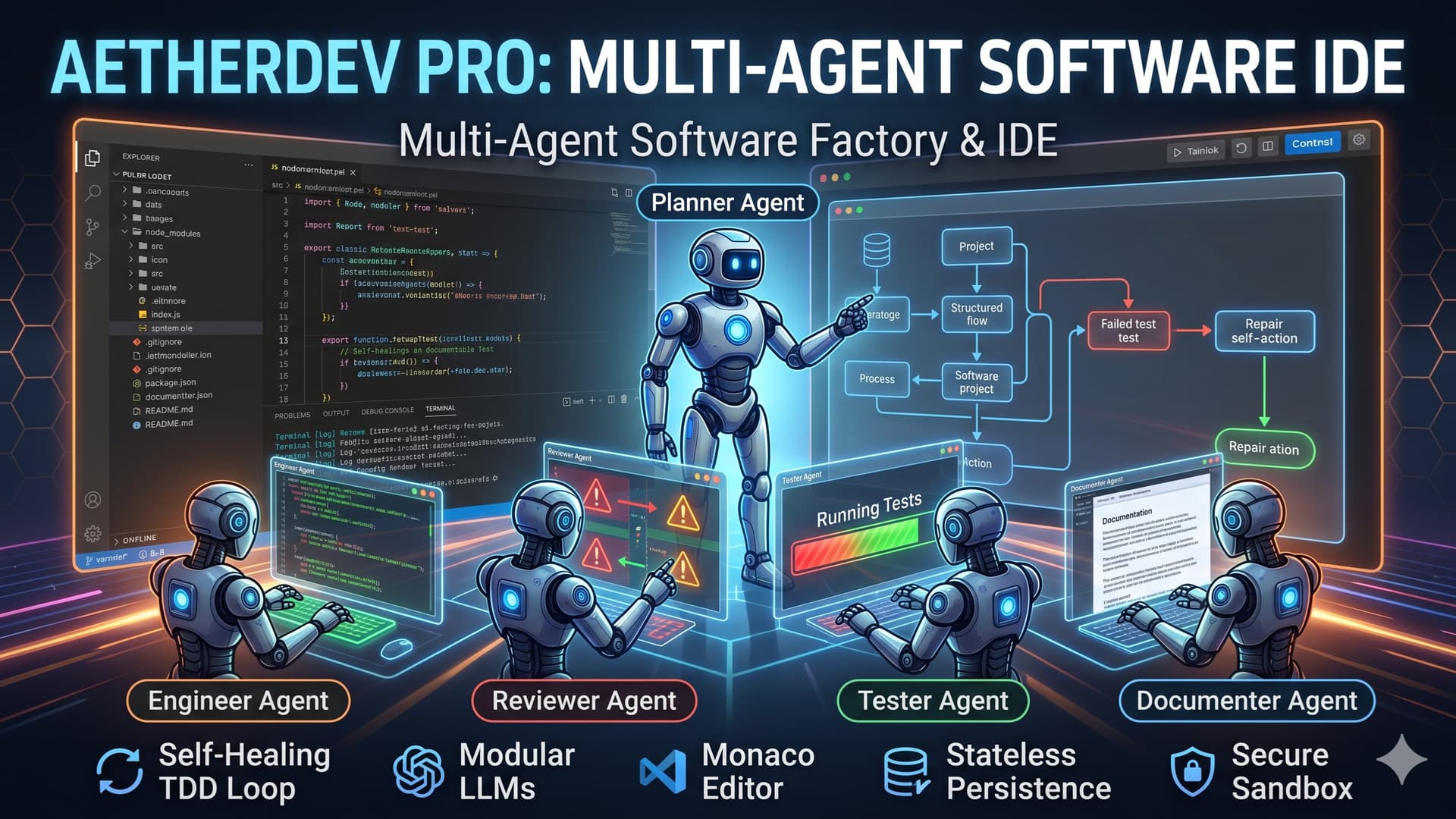
AetherDev Pro is an advanced, production-ready multi-agent software development platform and interactive IDE designed for automated software engineering workflows. Built on a Flask backend and a premium glassmorphic HTML/CSS/JS frontend, the platform integrates Microsoft Monaco Editor (the core engine of VS Code) to allow developers to view, edit, and save generated files in real-time. Key Features & Agent Workflow: 1. **Multi-Model Agent Teams**: Users can customize their AI engineering team by routing specific LLMs (e.g. Google Gemini 1.5 Pro, Llama 3.3 70B, GPT-4o) to specialized roles: - **Planner Agent**: Analyzes prompts and outputs structural design layouts and DAGs. - **Engineer Agent**: Automatically implements code for planned files. - **Reviewer Agent**: Evaluates syntax, error handling, and logical correctness, requesting iterative improvements. - **Tester Agent**: Autonomously writes test suites using python's unittest framework. - **Documenter Agent**: Generates comprehensive README files and code documentation. 2. **Self-Healing Code Compilation (TDD Loop)**: AetherDev Pro executes generated test suites in a secure local sandbox subprocess. If any test fails, the error traceback is dynamically parsed and fed back to the Engineer agent with instructions to repair the codebase. This loop repeats autonomously until all tests pass, ensuring that the final output is verified and functional. 3. **Stateless Persistence (SQLite)**: All sessions, file trees, source contents, run records, and terminal logs are persisted in a local SQLite database. This keeps the application robust, resilient to server restarts (such as on cloud platforms like Render), and allows users to resume past projects seamlessly.