Anomalib

Anomalib is an open-source deep learning library focused on visual anomaly detection, the task of finding and localizing defects or irregularities in images and video. First released on PyPI in December 2021, it is maintained under Intel's Open Edge Platform GitHub organization (formerly the OpenVINO Toolkit org) and ships a large collection of state-of-the-art anomaly detection algorithms alongside tools for experiment management, hyperparameter optimization, and edge inference.

General
Release dateDecember 2021 (first PyPI release)
DeveloperIntel (Open Edge Platform)
TypeOpen-source anomaly detection library
LicenseApache License 2.0
GitHubopen-edge-platform/anomalib
DocumentationAnomalib Documentation

Core Features

  • State-of-the-art algorithm collection — implements a wide range of visual anomaly detection approaches in a single, benchmarkable codebase.
  • Multiple inference backends — trained models export and run through Torch, Lightning, Gradio, or OpenVINO Intermediate Representation.
  • Anomalib Studio — a low-code and no-code web application for training and deploying anomaly detection models without writing Python.
  • Edge-ready export — built-in export to OpenVINO IR for accelerated inference on Intel CPUs, GPUs, and NPUs.

Tools and Resources


Ecosystem and Integrations


Start with the Anomalib documentation or the GitHub repository.

Anomalib top builders

Explore the top contributors showcasing the highest number of Anomalib app submissions within our community.

intel Anomalib AI technology Hackathon projects

Discover innovative solutions crafted with Anomalib, developed by our community members during our engaging hackathons.

PitPulse Edge — Haul-Fleet Fault Triage

PitPulse Edge — Haul-Fleet Fault Triage

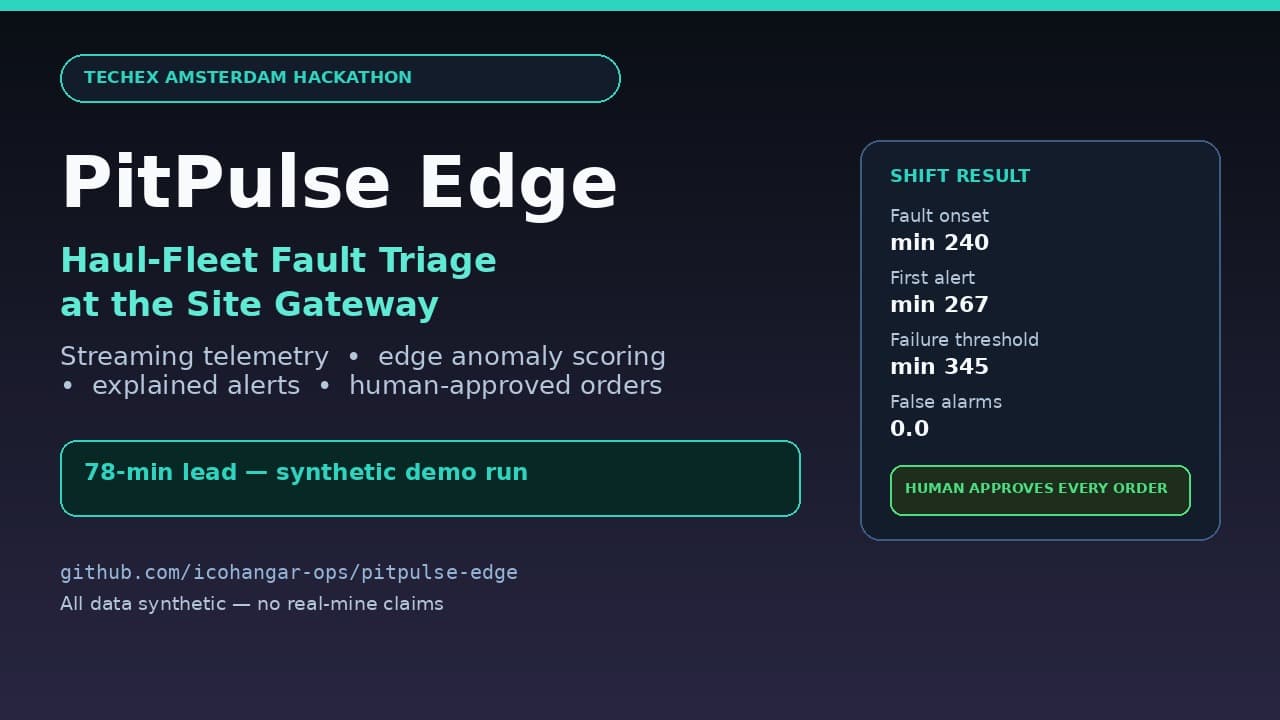
A single unplanned haul-truck failure can strand a loaded truck on a ramp and cost hours of ore movement, yet no one can watch dozens of signals across a whole fleet at once. PitPulse Edge is an edge-style triage board for a mine maintenance lead: a synthetic telemetry simulator streams six haul trucks over a 480-minute shift (temperatures, vibration, tyre pressure, hydraulic pressure, fuel and cycle times) with ground-truth fault injection, and lightweight CPU-only models that could run on a site gateway — per-signal calibrated z-scores plus an IsolationForest — score every truck every minute from 0 to 100. Each alert explains itself in plain language from the actual signal contributions (for example, vibration 6.0 sigma above normal), never from a free-text model, and a human dispatcher approves or dismisses a drafted work order (inspect or replace, urgency, parts hint) written to an append-only, hash-chained decision log. In the default synthetic bearing-overheat run the fault starts at minute 240, PitPulse first alerts at minute 267, the failure threshold is crossed at minute 345 — a 78-minute lead — with a 0.0 false-alarm rate on healthy trucks and an estimated $38,250 of avoided downtime from the shown formula (6.0h unplanned minus 1.5h planned, at an editable $8,500/hour). All data is synthetic with published generator assumptions; no real mine is claimed. The board replays the whole shift, ranks alerts by risk, and produces the shift report, so the value is measurable without sending raw telemetry to a cloud LLM. Buyer: the maintenance lead at a miner or mining contractor, priced per site gateway. Public MIT repo, 36 pytest tests, Streamlit demo.

Owami

Owami

Owami Intelligence is an AI-native cookbook and intelligent cooking platform built with LLMs as AI software development agents. Owami combines personalized recipe recommendations, ingredient intelligence, multimodal food recognition, AI-assisted recipe creation and adaptation, cooking history, and Cookist Mode, a hands-busy voice-guided cooking experience. The project demonstrates two layers of intelligence: product intelligence that helps people decide what to cook and how to cook it, and engineering intelligence demonstrated through the LLM's ability to understand the codebase, plan features, generate and modify code, create tests, debug issues, improve documentation, and support the software development lifecycle. Users can enter ingredients they already have, photograph ingredients, receive personalized recipe suggestions, adapt recipes to their needs, and interact with recipes through voice while cooking. Owami uses user preferences, cooking history, likes, available ingredients, and contextual signals to make recommendations more relevant. The hackathon demonstrates a complete journey from product requirement to working software: a feature is described, agents analyses the existing Owami codebase, plans the implementation, assists with development, generates and validates tests, helps identify and resolve issues, and updates documentation. The resulting functionality is then experienced directly by the user inside Owami. Rather than presenting AI as a simple chatbot, Owami Intelligence explores how agentic AI can become part of both the product experience and the software engineering lifecycle. The result is a practical demonstration of how an existing full-stack application can evolve into a more intelligent, multimodal and continuously improvable product while showcasing the potential of LLMs to accelerate real-world software development.