Kraken REST API

The Kraken REST API provides HTTP-based access to Kraken's spot and futures markets, account data, and trading operations. It covers public market data endpoints (no authentication required) and private endpoints for account management and order execution (HMAC-SHA512 authenticated). The API supports Spot, Futures, Custody, and Embed products, each with separate base URLs.

General
DeveloperKraken (Payward Inc.)
TypeREST API
LicenseCommercial API (free with Kraken account)
Documentationdocs.kraken.com
GitHubkrakenfx/api-go

Core Features

  • Public and private endpoints: public market data requires no authentication; private endpoints use HMAC-SHA512 signing.
  • Multiple product APIs: Spot, Futures, Custody, and Embed each have dedicated endpoints.
  • Tiered rate limiting: per-API-key counter with decay rates based on account tier (Intermediate or Pro).
  • Subaccount support: master accounts can manage subaccounts programmatically.
  • Earn and staking: endpoints for managing yield-generating positions.

Endpoints

Spot REST base URL: https://api.kraken.com/0/

CategoryEndpoints
PublicTicker, OHLC, order book, recent trades, spreads, asset pairs, system status
Private: AccountBalance, trade balance, open/closed orders, trade history, ledger entries
Private: TradingAdd order, amend order, cancel order, cancel all orders, batch orders
Private: FundingDeposit addresses, deposit methods, withdrawal info, withdraw funds
Private: EarnStaking and yield positions

Authentication

Spot REST authentication uses HMAC-SHA512:

  1. Generate a nonce (always-increasing unsigned 64-bit integer; millisecond UNIX timestamps recommended)
  2. Compute: SHA256(nonce + POST body data)
  3. Compute: HMAC-SHA512(URI path + SHA256 result, base64-decoded private key)
  4. Send API-Key header (public key) and API-Sign header (base64-encoded HMAC result)

The private key is never transmitted directly.


Rate Limits (Spot REST)

TierMax CounterDecay Rate
Intermediate200.5 per second
Pro201 per second

Ledger and trade history calls add 4 to the counter; all other private calls add 1. Order placement and cancellation use a separate trading rate limiter. Exceeding limits returns EAPI:Rate limit exceeded. Rate limits are shared across REST, WebSocket, and FIX for the same API key.


Tools and Resources


Ecosystem and Integrations

  • API keys are generated in Kraken account settings with configurable permissions (read-only, trading, funding).
  • Commercial redistribution of Kraken market data requires prior approval from [email protected].
  • Community SDKs available for Python, Go, C++, and Julia (listed in official documentation).

Generate API keys in your Kraken account settings and follow the REST quickstart to place your first programmatic order.

rest api top builders

Explore the top contributors showcasing the highest number of rest api app submissions within our community.

kraken rest api AI technology Hackathon projects

Discover innovative solutions crafted with rest api, developed by our community members during our engaging hackathons.

PayablesPilot

PayablesPilot

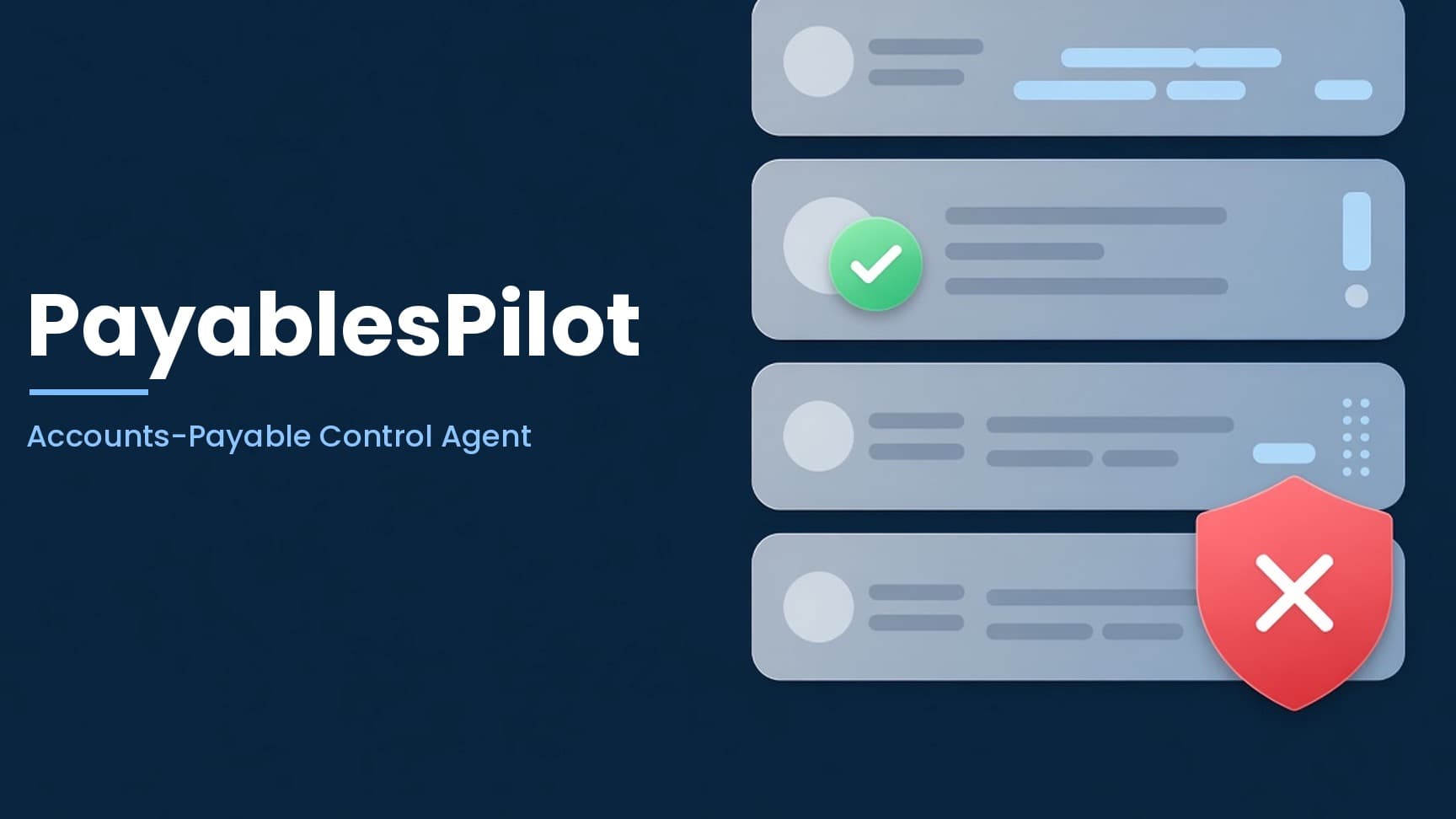
Companies lose money on supplier invoices in three quiet ways: paying the same invoice twice, paying for goods that never arrived or at a price nobody agreed, and paying a fraudster who swapped the bank details on an invoice. In a small finance team these checks are manual and easy to miss. PayablesPilot is an accounts-payable operations agent that runs the pre-payment control workflow end to end. Invoices arrive by web form or JSON API and are evaluated immediately. A deterministic three-way match compares each invoice with its purchase order and goods receipt: quantities are summed across all invoices on a PO, so it can never be billed beyond goods received, and unit prices are checked within a configurable tolerance (2% or £1.00). An exact invoice-number resubmission is blocked; a same-amount invoice from the same supplier within 7 days is held as a possible duplicate. The bank account on the invoice must equal the supplier master record — a mismatch is held as a possible payment-diversion attempt. Every failure lands in an exception queue with the rule, the observed value and the expected value, plus a drafted supplier follow-up (draft only). Matched invoices are grouped into a payment pack ordered by due date for HUMAN approval; the agent never executes payments. Every decision is written to an audit trail; each invoice page shows every check, so a decision can be re-performed by hand. On the live demo (fictional data, labelled): 9 invoices, 2 payable, 6 held with exact reasons, 1 duplicate blocked; payment pack £860.00, human approval recorded in the audit trail. Approval is simulated and initiates no transfer. Vultr usage: a Vultr Cloud Compute VM in London (1 vCPU / 1 GB) is the central control point — it hosts the app, database and audit trail and serves the public demo. Python 3 standard library only, SQLite, integer cents, 14 unit tests. Serverless Inference is intentionally not used: payment verdicts must be deterministic, never an LLM's opinion.

SRE Incident Agent — Blast Radius Zero

SRE Incident Agent — Blast Radius Zero

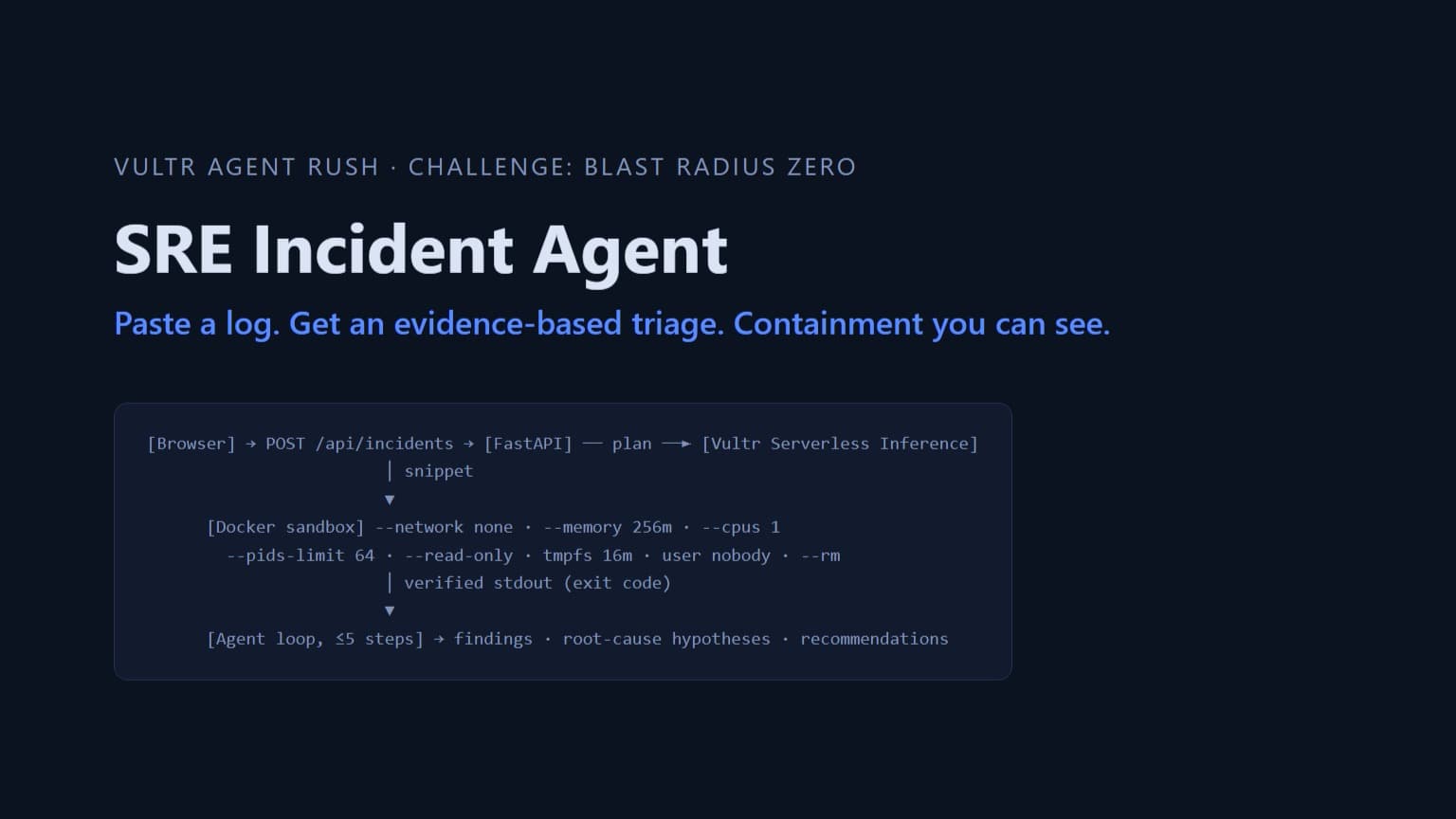
The problem. An on-call SRE facing a cryptic 500-line log spends 20–40 minutes of manual grep/correlate work to know what broke and what to do first. LLM assistants can draft guesses, but executing LLM-generated code on a real system is the classic blast-radius problem: run it blind, with network access and secrets in the environment, and a hallucinated diagnostic becomes an incident itself. What we built. SRE Incident Agent closes the loop safely. Paste a log — the LLM plans a diagnostic step, the step runs as real Python in an isolated Docker container, the verified stdout and exit code feed back into the agent's context, and after ≤5 steps it returns a triage report: findings backed by numbers from executed code, three ranked root-cause hypotheses, and an ordered runbook. Nothing the LLM claims is trusted unless an executed snippet printed it. Blast radius zero. The LLM-written code is the attack surface, closed in layers: a static guard refuses subprocess, sockets, URL fetches, file writes, eval/exec and host paths before anything runs (shown as BLOCKED · contained); each snippet runs in a one-shot container with --network none, 256 MB RAM, 1 CPU, 64 pids, read-only rootfs, uid nobody, no-new-privileges — destroyed after every run; secrets never enter the container; a hard 20 s kill per step. The video shows a live containment moment: a hallucinated exfiltration snippet blocked pre-execution. On Vultr. The full backend runs on a Vultr Compute VM (Amsterdam): FastAPI, the Docker sandbox runner, Caddy/TLS. All LLM calls go to Vultr Serverless Inference — primary deepseek-v4.1-flash-1017, whole-step fallback retries on mimo-v2.6-flash. Business case. The author supports storage systems and virtualization fleets already off vendor support, where every incident is triaged manually: this cuts incident triage from ~30 min to ~60 s, with evidence attached.

Agent_Trap_Evals

Agent_Trap_Evals

The problem: agents rarely fail hard questions. They fail chores. They report "backup verified" because the log says success, while the archive is truncated. These false claims slip out during routine work, and a real shell makes them dangerous. What Receipts does: you give it a real task, like checking a backup or triaging a failing build. A control layer plans the work and runs every action in an isolated Vultr sandbox [gVisor pods on VKE]. The sandbox has no secrets, has time and memory caps, and is destroyed after each task. Every command's output, exit code, and files become a receipt. Before any claim reaches you, a verifier checks it against those receipts: did the agent check the layer that matters, or just the easy one? An unsupported claim is blocked and sent back to be verified, or reported as unverified. You get the answer together with its proof. Containment: [demo moment, e.g. the agent runs rm -rf / and the sandbox absorbs it; the host is untouched]. Measured: we score Receipts with agent-trap-evals, an open-source trap set we built before the hackathon from real agent incidents. Verifier off vs. on: [X/Y vs. X/Y caught], [n] false alarms on honest controls. For: platform and DevOps teams putting agents on operational work, where a confident false "done" costs more than a slow answer. Sandboxes like E2B contain actions but don't check claims. Eval tools score offline but don't stop a bad claim at runtime. Receipts does both, live. [Business model; next steps.] All LLM calls use Vultr Serverless Inference.

Jarvis

Jarvis

It is a very powerful ai chatbot which can run using your hand movements and run on various environments to perform your various tasks visually using 3D visualisation and remind you of anything anytime just using commands and many more to come.JARVIS is not just an AI assistant; it is an ambitious step toward building a futuristic digital intelligence inspired by the possibilities of Tony Stark’s legendary technology. Designed as an expanding ecosystem of intelligent environments, JARVIS combines conversational AI, futuristic interfaces, visual intelligence, scientific simulations, and centralized command capabilities into one powerful web-based platform. Its six environments—Main JARVIS, Velve, Terranexus, Command Centre, Vision Intelligence, and Ultron—represent different dimensions of an interconnected digital universe. From exploring scientific experiments and mechanical simulations to visual intelligence and advanced system interaction, every environment expands what a personal AI ecosystem can become. JARVIS aims to transform the way humans interact with technology, bringing multiple intelligent capabilities together through a unified interface. Its long-term vision reaches beyond answering questions toward helping users interact with digital tools, navigate complex information, and manage technological workflows. Built with the ambition to evolve continuously, JARVIS represents a bold vision of a world where AI is not merely something you talk to—it becomes the intelligent interface connecting you to your digital universe. JARVIS: One Intelligence. Multiple Environments. An Entire Digital Universe at Your Command.