Langflow

Langflow is an innovative technology provider specializing in the integration and interaction with language models. Langflow's solutions facilitate effortless connection to various language models, enabling powerful and intuitive conversational interfaces.

General
AuthorLangflow
Repositoryhttps://github.com/langflow
Documentationhttps://docs.langflow.org/
TypeLanguage Model Integration Platform

Key Features

  • Provides robust APIs for easy integration with multiple language models, enhancing conversational applications
  • Delivers high performance and scalable solutions to manage conversational workflows
  • Simplifies development of language-driven applications with a minimal configuration requirement
  • Ensures efficient handling of multiple simultaneous conversations, maintaining performance as usage scales

Start building with Langflow's products

The Langflow API enables developers to easily connect to and manage language models, supporting a range of functionalities from basic querying to complex conversational interactions. The API is designed to be intuitive and developer-friendly, allowing for quick integration and robust support for diverse application needs.

List of Langflow's products

Langflow API

The Langflow API enables developers to easily connect to and manage language models, supporting a range of functionalities from basic querying to complex conversational interactions. The API is designed to be intuitive and developer-friendly, allowing for quick integration and robust support for diverse application needs.

Langflow Studio

Langflow Studio provides a comprehensive environment for designing, testing, and deploying language model interactions. The studio's user-friendly interface allows developers to visually construct dialog flows and fine-tune responses, ensuring that applications deliver natural and effective user interactions.

Langflow Hub

Langflow Hub serves as a central repository for pre-built language model templates and configuration presets. It offers developers a quick start to building applications with pre-configured setups for common use cases, from customer service bots to interactive educational guides.

Starter Projects

Basic Prompting

Prompts are inputs for a large language model (LLM), bridging human instructions and computational tasks. Enter natural language requests in a prompt to get answers, generate text, and solve problems.

๐Ÿ‘‰ Read more here: https://docs.langflow.org/starter-projects/basic-prompting

Blog Writer

The blog writer leverages dynamic, URL-based references to ensure the content is accurate and relevant. Use Langflow to build a blog writer with OpenAI that utilizes URLs for reference content.

๐Ÿ‘‰ Read more here: https://docs.langflow.org/starter-projects/blog-writer

Document QA

Build a question-and-answer chatbot with a document loaded from local memory.

๐Ÿ‘‰ Read more here: https://docs.langflow.org/starter-projects/document-qa

Memory Chatbot

Extend the basic prompting flow to include chat memory for unique SessionIDs.

๐Ÿ‘‰ Read more here: https://docs.langflow.org/starter-projects/memory-chatbot

Vector Store RAG

Retrieval Augmented Generation (RAG) is a method for training large language models (LLMs) on the specific dataset and querying it effectively. It utilizes a vector store to store embeddings of the data, enabling advanced and context-aware search capabilities.

๐Ÿ‘‰ Read more here: https://docs.langflow.org/starter-projects/vector-store-rag

System Requirements

Langflow is compatible with Linux, macOS, and Windows operating systems, requiring at least 4 GB of RAM and adequate storage for development data. A multicore processor is recommended to handle multiple requests efficiently, with a stable internet connection necessary for accessing cloud-based features. Modern web browsers with JavaScript enabled are required, while the use of GPU acceleration is optional but beneficial for optimizing performance.

langflow top builders

Explore the top contributors showcasing the highest number of langflow app submissions within our community.

langflow AI technology page Hackathon projects

Discover innovative solutions crafted with langflow, developed by our community members during our engaging hackathons.

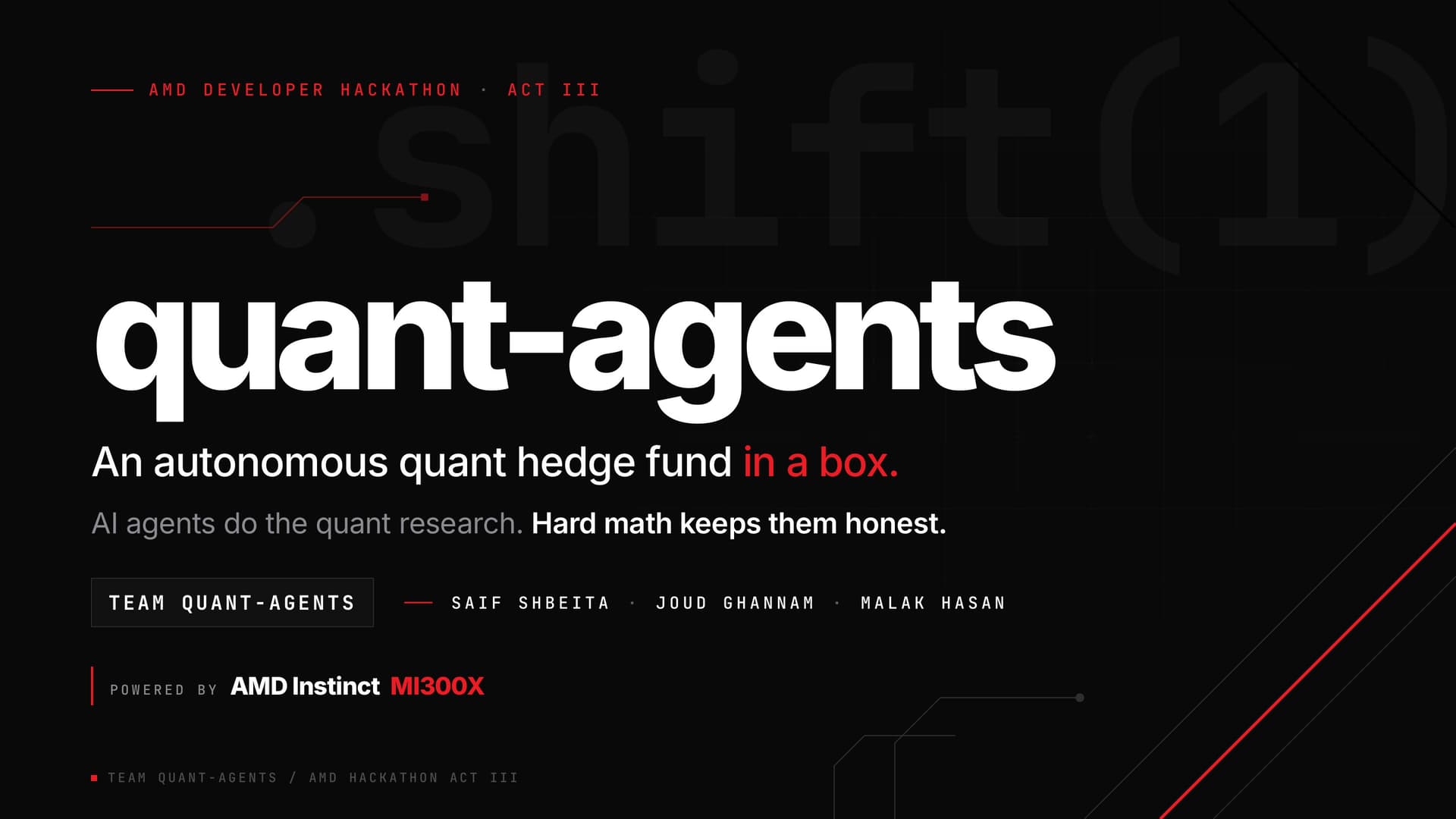
quant-agents: Autonomous Quant Research on AMD

quant-agents: Autonomous Quant Research on AMD

quant-agents is a local "Quant Hedge Fund in a Box": a multi-agent system that runs the full quant research loop end to end with zero cloud dependency. A LangGraph state machine routes work between four agents. The Ideator proposes a market hypothesis with an economic rationale, precise statistical entry and exit rules, and regime filters. The Coder turns it into a fully vectorized pandas/numpy generate_signals function (no loops, no iterrows). A sandbox executes the code on SPY daily data, lags every signal with .shift(1), and computes Sharpe, max drawdown, total return, and win rate. The Auditor acts as head of risk: it diagnoses tracebacks, rejects lookahead bias and curve-fitting, and demands structural fixes like regime filters or volatility-based sizing instead of parameter tweaking. A strategy only passes with Sharpe above 1.5 and drawdown under 15%, checked in code, not by the LLM. Survivors go to the Packager, which writes a production handoff report with documented code, Big-O analysis, execution edge cases, and a C++ translation plan (Eigen/Armadillo). The whole system runs on a single Qwen3.6-35B-A3B Mixture-of-Experts model served by vLLM on AMD Instinct MI300X with ROCm. Instead of loading four models and fragmenting HBM, all agents share one model and LangGraph swaps the persona per call. With only ~3B active parameters per token, the agent loop stays fast enough to iterate many times per strategy. Circuit breakers cap rework attempts and new ideas, so the system either finds a strategy that survives the audit or stops cleanly.

Clocket AI โ€“ Smart Developer Onboarding Assistant

Clocket AI โ€“ Smart Developer Onboarding Assistant

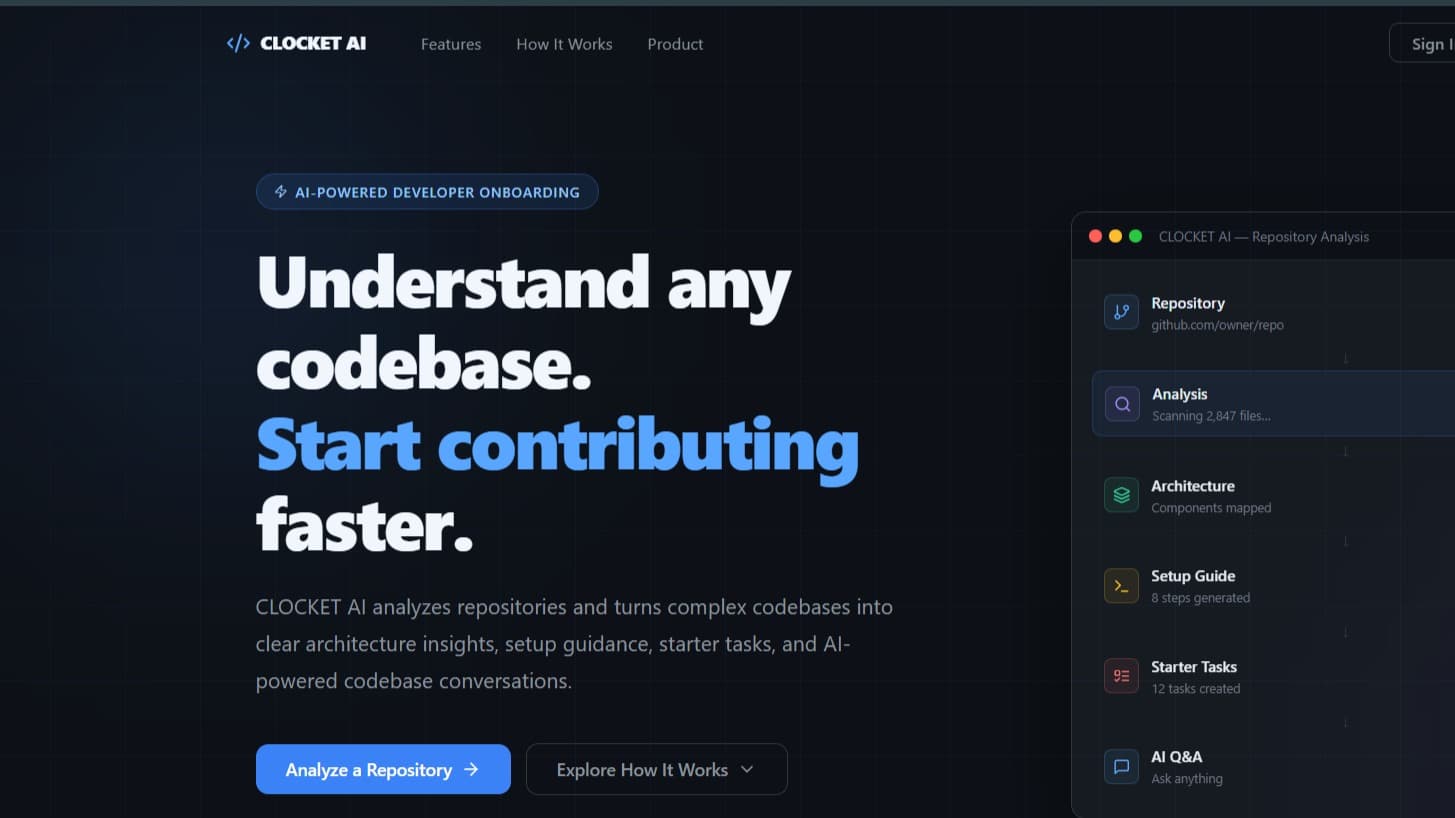
## Problem Joining an unfamiliar software project can take hours or even days. Developers must manually understand the repository structure, technology stack, architecture, dependencies, environment configuration, APIs, database usage, and contribution workflow. README files may be incomplete or outdated, making the onboarding process slow and difficult, especially for new developers. ## Solution Clocket AI is a Smart Developer Onboarding Assistant that automatically analyzes a public GitHub repository and converts the codebase into an interactive onboarding experience. A developer signs in, provides a GitHub repository URL, and starts an automated analysis. Clocket AI validates and scans the repository, detects its technologies and configuration, analyzes the architecture, generates an evidence-based setup guide, creates practical starter tasks, indexes relevant source files into a repository-scoped RAG system, and stores the results for the user. Developers can then explore the generated architecture, follow setup instructions, work through beginner/intermediate/advanced starter tasks, track their onboarding progress, and ask natural-language questions about the codebase. Answers are grounded in retrieved repository files and include source citations. ## Target Users The primary users are developers joining unfamiliar projects, interns, students learning existing codebases, engineering teams onboarding new members, and maintainers who want to make repositories easier to understand. ## Technology and Architecture The application uses a React/Vite frontend and FastAPI backend. LangGraph orchestrates a multi-stage analysis workflow including repository validation, cloning, deterministic static scanning, architecture analysis, setup-guide generation, onboarding-plan generation, task generation, RAG indexing, persistence, and cleanup. The system combines deterministic analysis with LLM reasoning rather than relying entirely on an LLM. Repository files are chunked and embedded using fastembed and stored in Supabase PostgreSQL with pgvector. Retrieval is filtered by both user and repository to maintain data isolation. Clocket AI also integrates the official GitHub MCP Server for repository access and custom MCP tools for saving analysis results and managing onboarding progress. ## What Makes It Unique Instead of simply generating a README or chatbot response, Clocket AI creates a complete, interactive onboarding workflow from the actual codebase. It combines repository analysis, Agentic RAG, MCP tools, architecture explanation, evidence-based setup instructions, actionable starter tasks, and progress tracking in one system. Security is also built into the architecture through Supabase authentication, Row Level Security, repository-scoped retrieval, server-side secrets, read-only GitHub MCP access, file-size limits, and prompt-injection-resistant handling of repository content. The application is deployed and available as a web application, making the onboarding workflow accessible without requiring developers to manually configure the system locally.