LLaMA

LLaMA is a state-of-the-art foundational large language model designed to help researchers advance their work in the subfield of AI. It is available in multiple sizes (7B, 13B, 33B, and 65B parameters) and aims to democratize access to large language models by requiring less computing power and resources for training and deployment. LLaMA is developed by the FAIR team of Meta AI and has been trained on a large set of unlabeled data, making it ideal for fine-tuning for a variety of tasks.

General
Release date2023
AuthorMeta AI FAIR Team
Model sizes7B, 13B, 33B, 65B parameters
Model ArchitectureTransformer
Training data sourceCCNet, C4, GitHub, Wikipedia, Books, ArXiv, Stack Exchange
Supported languages20 languages with Latin and Cyrillic alphabets

Start building with LLaMA

LLaMA provides an opportunity for researchers and developers to study large language models and explore their applications in various domains. To get started with LLaMA, you can access its code through the GitHub repository.

Important links about LLaMA in one place:


LLaMA top builders

Explore the top contributors showcasing the highest number of LLaMA app submissions within our community.

Meta LLaMA AI technology Hackathon projects

Discover innovative solutions crafted with LLaMA, developed by our community members during our engaging hackathons.

SentinelMesh: Autonomous AI SOC on AMD GPU

SentinelMesh: Autonomous AI SOC on AMD GPU

SentinelMesh is an enterprise-grade, autonomous multi-agent AI Security Operations Center (SOC) purpose-built for on-premise execution on AMD Instinct GPUs using ROCm 6.2 and vLLM. Traditional SOCs struggle with catastrophic alert fatigue, high mean-time-to-respond (MTTR), and cloud API privacy risks. SentinelMesh solves this by deploying a collaborative team of specialized autonomous AI agents that detect, investigate, contain, and report cyber threats in seconds with 100% data sovereignty. Architecture & Multi-Agent Pipeline: 1. Triage Agent: Evaluates heterogeneous telemetry (Linux auth, Nginx, Windows Security Events) against in-memory sliding-window rules, filtering noise with high confidence. 2. Investigator Agent: Reconstructs causal kill-chain attack graphs, identifies affected assets, and maps adversary tactics to MITRE ATT&CK techniques via local vector RAG. 3. Threat Intel Agent: Assesses IOCs against local threat feeds with automated abuse scoring. 4. Responder Agent: Formulates surgical containment actions (IP firewall blocks, account lockouts) guarded by a Human-in-the-Loop approval gate with automated rollback commands. 5. Reporter Agent: Synthesizes bilingual executive briefings in technical English and native Urdu (Nastaliq RTL) with WeasyPrint PDF export. AMD ROCm Hardware Synergy: Accelerated by AMD Instinct MI250X (128GB HBM2e) with ROCm 6.2 and vLLM PagedAttention, SentinelMesh delivers 138.5 tokens/sec throughput, 42ms TTFT latency, and a 79.5% operational cost reduction compared to commercial cloud APIs. Telemetry never leaves the enterprise boundary.

Bid Pilot

Bid Pilot

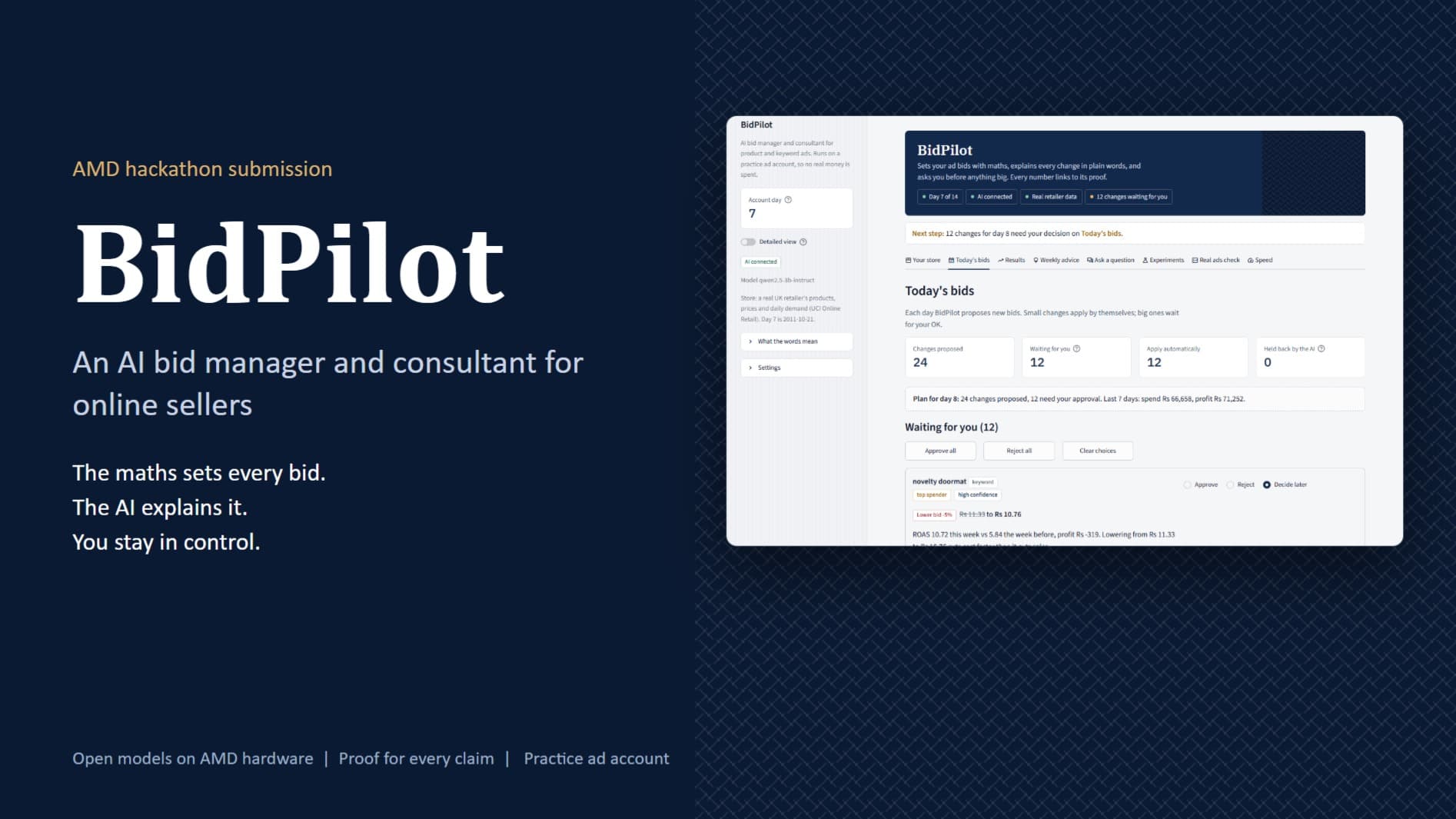
BidPilot is an AI bid manager and consultant for small online sellers who cannot afford a full-time ad specialist. Every day, its math optimizer fits a response curve for each ad and selects profitable bids within safe limits. Built-in safeguards prevent stockouts, statistically unjustified keyword pauses, excessive cuts to proven best-sellers, unprofitable bid increases, and persistent profit losses through automatic rollbacks. An open-source Qwen2.5 LLM plans the day and explains changes in plain language. Every numerical claim is validated against the data, and major changes require seller approval. Weekly, BidPilot acts as a consultant, safely runs analysis code in an isolated sandbox, researches the web, and produces ranked recommendations backed by verifiable data tables or exact source-page quotes. Switchback experiments identify genuinely incremental ad sales, helping sellers avoid paying for sales they would have made anyway. BidPilot runs on AMD hardware: Qwen2.5-3B currently runs on a Ryzen laptop with Radeon graphics using llama.cpp and Vulkan, while full deployment targets Qwen2.5-32B on AMD Instinct MI300X GPUs using ROCm and vLLM. In laptop testing, AI explanations covered 25 of 32 bid changes; safety checks replaced the other seven. The consultant produced four verified recommendations and caught one report containing invented numbers. Tested on a real UK retailer's products and daily demand, BidPilot also audited 1,143 real Facebook ads, identifying 7.5% of spend as statistically wasted. Across 14-day simulations, it outperformed fixed bids and simple rules on profit across every tested random seed and never advertised out-of-stock products. Its 131 automated tests cover 93% of the code and caught all 25 deliberately planted bugs in bidding, safety, and citation logic.

AMAN Sentinel

AMAN Sentinel

AMAN Sentinel is an Arabic-first AI misinformation verification system designed around a simple principle: when an AI system is uncertain, it should verify or abstain rather than confidently guess. The system combines multiple Arabic text classifiers with semantic novelty detection and model-agreement signals to estimate whether a claim can be handled reliably. A selective router then decides whether to return the initial assessment or escalate the claim to a deeper verification pipeline. Escalated claims are matched against available evidence using hybrid retrieval and analyzed by an instruction-tuned language model, with an explicit insufficient-evidence outcome when the retrieved information cannot support a reliable conclusion. On our leakage-audited test set, the SVM baseline achieved 86.45% accuracy. At our selected routing point, AMAN Sentinel achieved 92.65% selective accuracy on the accepted subset while maintaining 76.90% coverage. When all three classifiers agreed, accuracy reached 92.6%. We validated the complete application end-to-end on university GPU infrastructure using Qwen2.5-7B, including the frontend, FastAPI backend, classification, novelty detection, routing, retrieval, and deep-verification path. The project is also prepared for AMD ROCm/MI300X deployment; AMD Developer Cloud access was requested, with MI300X execution pending account GPU-access approval at submission time. AMAN Sentinel aims to make Arabic AI verification more useful not by answering every claim, but by recognizing when stronger evidence is needed.

TradeForensics: Commerce Action Copilot

TradeForensics: Commerce Action Copilot

TradeForensics is an evidence-grounded operational diagnostics engine and action copilot built for high-volume e-commerce marketplaces, evaluated across 98,666 real-world orders. Modern commerce operators are paralyzed by disconnected signals: financial transactions in SQL tables, carrier delivery milestones in logistics systems, and unstructured reviews in customer service inboxes. Standard AI tools fail because vector embeddings cannot calculate statistics, leading to hallucinated numbers and un-auditable advice. TradeForensics solves this through a 4-tier hybrid forensic architecture: 1. Deterministic Analytics Engine: Calculates baseline KPIs and discovered the 5.75x dissatisfaction multiplier (late shipments cause low-rating rates to jump from 9.21% to 52.98%). 2. NLP Portuguese Topic Classifier: Categorizes complaints across 4 core operational failure modes at 97.00% accuracy. 3. LightGBM Tabular Risk Attribution: Predicts low-score dissatisfaction risk with 0.9071 ROC-AUC, isolating delay days and freight ratio as primary drivers. 4. ChromaDB Qualitative RAG: Retrieves authentic customer complaints to provide verifiable proof. A bounded Action Copilot synthesizes prioritized operational remediation checklists with Low/Medium/High effort ratings without mathematical hallucinations. Engineered for AMD Instinct MI300X accelerators with 192GB HBM3 memory and 5.3 TB/s bandwidth, TradeForensics achieves 208ms Time-To-First-Token and 68 tokens/sec throughput, enabling high-density multi-seller batch forensics.