Llama 2

Developed by Meta and Microsoft, Llama 2, an advanced open-source large language model, stands as the successor to the previous model, Llama 1. As an expansive AI tool, it caters to the needs of developers, researchers, startups, and businesses. Released under a highly permissive community license, Llama 2 is available for both research and commercial use.

General
Release dateJuly 18, 2023
AuthorsMeta AI & Microsoft
Model sizes7B, 13B, 70B parameters
Model ArchitectureTransformer
Training data sourceMeta's extensive dataset
Supported languagesMultiple languages

Features of Llama 2

Llama 2 comes with significant improvements over Llama 1:

  1. Increased Training on Tokens: Llama 2 is trained on 40% more tokens, promising to deliver enhanced language understanding capabilities.
  2. Longer Context Length: With a longer context length of 4k tokens, Llama 2 is expected to maintain better context in prolonged conversations.
  3. Fine-Tuning for Dialogues: The versions of Llama 2 that are fine-tuned (Labelled Llama 2-Chat) are aimed at being optimized for dialogue applications using Reinforcement Learning from Human Feedback (RLHF).

Accessing and Using Llama 2

To utilize the potential of Llama 2, its code, pretrained models, and fine-tuned models can be accessed via the Huggingface.

Essential links pertaining to Llama 2:

Llama 2 Deployment

For an efficient deployment of Llama 2:

  • For the 7B models, "GPU [medium] - 1x Nvidia A10G" could be the choice.
  • For the 13B models, "GPU [xlarge] - 1x Nvidia A100" can be an option.
  • For the 70B models, "GPU [xxxlarge] - 8x Nvidia A100" might be suitable.

These deployments might be available on platforms like Microsoft Azure and Amazon Web Services (AWS).

Responsible Use of Llama 2

Although the use of Llama 2 is encouraged, it's crucial to follow the guidelines for responsible use. Red-teaming exercises might be utilized along with a transparency schematic, and responsible use guide and an acceptable use policy might also be provided to ensure secure and acceptable use of Llama 2. Participation in the Open Innovation AI Research Community and Llama Impact Challenge could be valuable for feedback and proposing improvements.

Conclusion

Llama 2, poised as the successor of the acclaimed Llama 1, signifies a new horizon in the landscape of large language models. The vast potential it holds is eagerly anticipated and it is hoped the global AI community will bring forth innovative and advantageous applications using Llama 2.

Llama 2 top builders

Explore the top contributors showcasing the highest number of Llama 2 app submissions within our community.

Meta Llama 2 AI technology Hackathon projects

Discover innovative solutions crafted with Llama 2, developed by our community members during our engaging hackathons.

Fresno LUX: A Living City

Fresno LUX: A Living City

Fresno LUX is a prototype for a living intelligence layer across an entire city. Fresno already contains enormous amounts of intelligence: residents know where problems exist, nonprofits know where help is needed, businesses know where opportunities exist, educators understand gaps in learning, researchers generate knowledge, and government maintains critical infrastructure and data. The problem is that much of this intelligence is fragmented across disconnected systems. Fresno LUX connects those pieces. The platform creates a shared city graph where people, organizations, resources, needs, projects, observations, experiments, and outcomes become connected nodes. Instead of simply collecting data, LUX continuously asks: What is happening? What do we know? What is missing? What can we test? What changed? A community problem can become an observable signal. That signal can become an experiment. The experiment produces evidence. Evidence changes the system's understanding. That updated understanding informs the next action. Observe → Connect → Understand → Act → Measure → Learn → Converge. The goal is to move Fresno from disconnected information toward collective intelligence—a system where knowledge can travel across boundaries and successful solutions can be discovered, tested, measured, and replicated. LUX is designed to make the invisible connections visible: the relationship between a neighborhood and its resources, between a student and educational opportunity, between a business and workforce capacity, between environmental conditions and community health, and between an idea and measurable real-world impact. This hackathon prototype demonstrates the beginning of a Living Fresno Graph: a city that can observe itself, learn from evidence, and coordinate toward better outcomes.

Probably runs on Samsung S25

Probably runs on Samsung S25

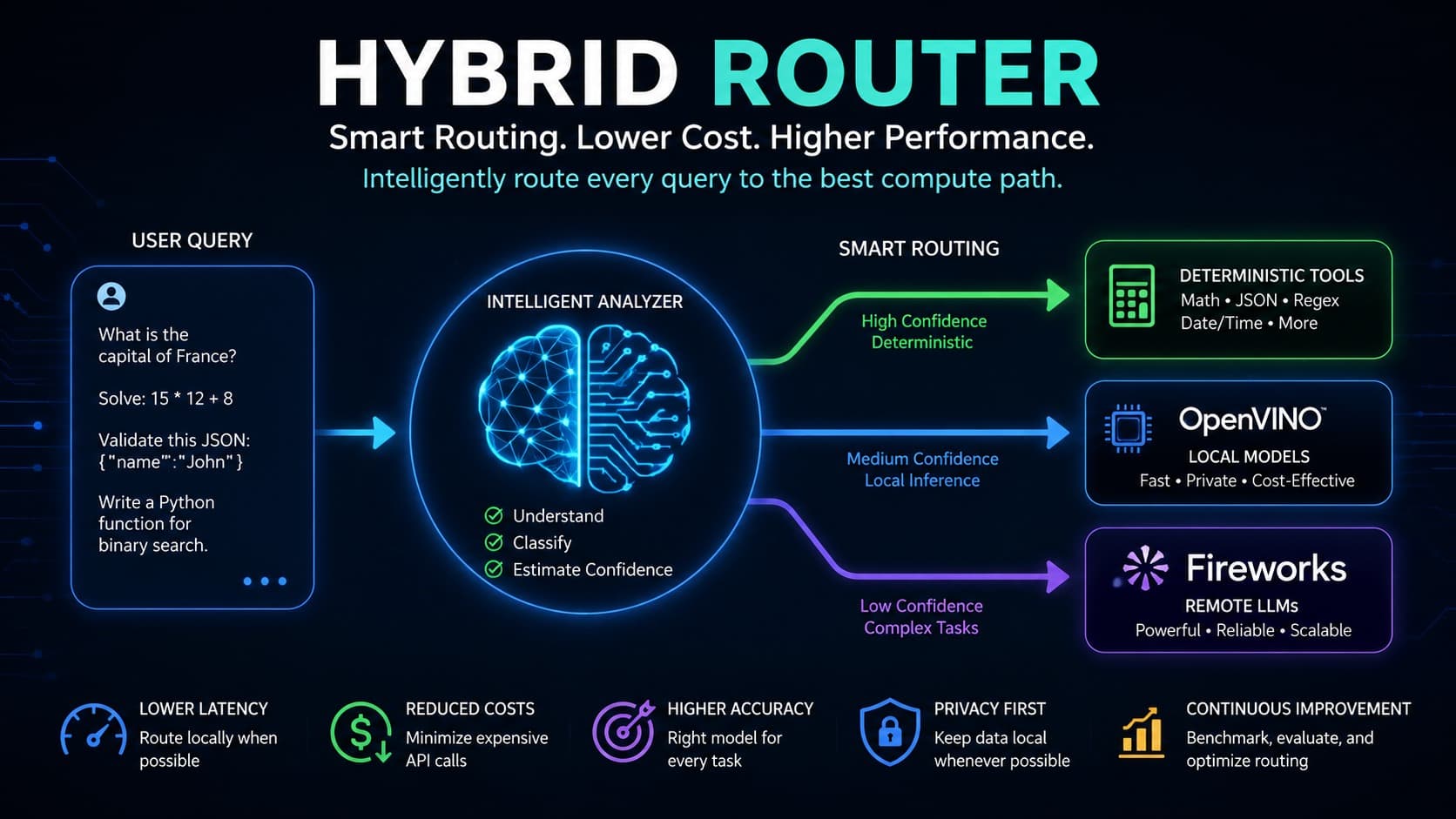
Hybrid Router is an intelligent AI inference system that dynamically selects the best execution path for each user query instead of relying on a single large language model. The system first analyzes the incoming prompt to identify the task type, estimate its complexity, and determine whether it can be solved deterministically or requires generative AI. For structured tasks such as mathematical calculations, JSON validation, regular expression verification, and date/time operations, the router invokes specialized deterministic tools that produce fast, accurate, and reproducible results without consuming LLM tokens. For more complex natural language and coding tasks, the router attempts local inference using OpenVINO-optimized models running on Intel hardware, reducing latency and API costs. If the local model is unlikely to provide a sufficiently reliable answer or the task exceeds its capabilities, the system automatically falls back to Fireworks AI models for high-quality remote inference. The routing decisions are driven by task classification, confidence estimation, and configurable thresholds, allowing the system to balance accuracy, response time, and operational cost. The architecture is modular, making it easy to add new tools, local models, or routing strategies in the future. The project also includes benchmarking and evaluation components that measure routing accuracy, latency, model utilization, and fallback frequency to continuously improve routing performance. By combining deterministic tools, local inference, and cloud-based language models into a single adaptive pipeline, Hybrid Router delivers efficient, scalable, and cost-aware AI inference while maintaining high response quality across a wide range of tasks.