Llama 3.2

Llama 3.2 is Meta’s latest advancement in open-source large language models (LLMs), designed to make AI more accessible across various platforms and tasks, especially with its new multimodal capabilities. This version focuses on lightweight models optimized for edge devices, while also introducing the ability to process both text and images, broadening the scope of AI applications.

General
AuthorMeta
Release dateSeptember 2024
Websitehttps://www.llama.com/
Documentationhttps://www.llama.com/docs/overview
CollectionLlama 3.2 meta-llama Collection
Model Sizes1B, 3B, 11B, 90B parameters
Technology TypeLarge Language Model (LLM), Multimodal

Key Features

  • Multimodal Processing: Llama 3.2 can handle both text and image inputs, making it useful for visual understanding tasks such as document analysis, image captioning, and visual question answering.

  • Lightweight Models for Edge Devices: The 1B and 3B parameter models are optimized for mobile and IoT devices, allowing for real-time AI applications on low-powered hardware. These models support a context length of 12K tokens and are compatible with hardware from Qualcomm and MediaTek, making them versatile for edge deployments.

  • Vision-Centric Models: The 11B and 90B models introduce vision capabilities to Llama, enabling advanced applications like augmented reality (AR) and complex image recognition.

  • On-Device AI: These models are specifically designed to run efficiently on ARM-based devices, bringing powerful AI capabilities to mobile and edge environments without needing extensive cloud infrastructure.

Applications

  • Multimodal AI Tasks: Llama 3.2’s multimodal capabilities allow it to analyze both text and images, which opens up opportunities in fields like:

  • Document Analysis: Automatically process and extract information from scanned documents.

  • Image Captioning and Object Recognition: Generate descriptions or identify objects within images.

  • Visual Question Answering: Answer questions based on visual inputs, making it a valuable tool for accessibility and automation in various industries.

  • On-Device AI: Due to its lightweight architecture, Llama 3.2 can be deployed on mobile devices or IoT systems for real-time processing, even in environments with limited resources or no internet connection.

  • AR and Vision-Based Applications: Developers can integrate Llama 3.2 into augmented reality systems, where quick image recognition or contextual understanding is essential.

Start Building with Llama 3.2

Getting started with Llama 3.2 is easy, whether you're a seasoned developer or just starting out with AI. Meta provides a comprehensive set of resources, including detailed documentation, setup guides, and tutorials to help you integrate Llama 3.2 into your applications. You can choose from various model sizes depending on your use case, whether it’s running locally on your device or deploying in a large-scale cloud environment. Llama 3.2’s open-source nature allows for customization and fine-tuning for specialized needs.

👉 Start building with Llama 3.2

Llama 3.2 top builders

Explore the top contributors showcasing the highest number of Llama 3.2 app submissions within our community.

Meta Llama 3.2 AI technology Hackathon projects

Discover innovative solutions crafted with Llama 3.2, developed by our community members during our engaging hackathons.

Foreman: Find it. Explain it. Fix it.

Foreman: Find it. Explain it. Fix it.

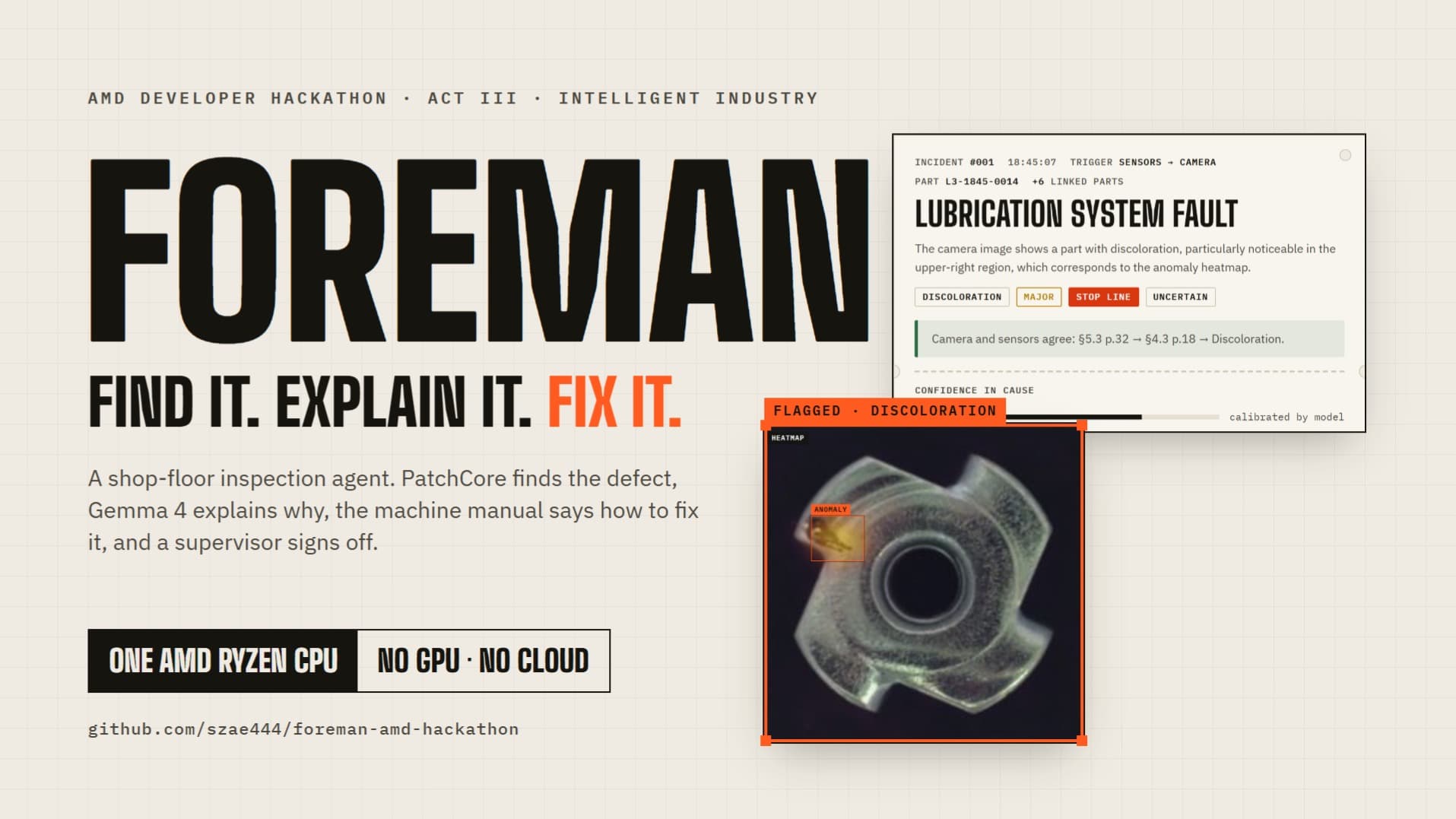
On a metal-forming line, a worn die or failing lubrication costs twice: scrap made before anyone notices, then downtime while a technician works out what the symptom means. Cameras can say a part is bad, but not why. That answer lives in a thick manual and in senior technicians' heads. Foreman takes a plant from "this part looks wrong" to an approved work order: 1. Detect: PatchCore, trained only on good parts, scores every part and outlines the defect on a heatmap. 2. Fuse: press sensors are checked against the machine's baseline with plain statistics. 3. Retrieve: the manual sections that match the defect and sensor pattern. 4. Reason: Gemma 4 vision reads the photo, heatmap, sensors and manual, and writes the cause with a confidence, the evidence, what it ruled out, repair steps and an operator message. 5. Verify: every manual citation is checked against what the model was shown. 6. Approve: a supervisor signs off, and the sensors return to normal. Sensors usually drift before the camera sees bad parts, so Foreman raises an early warning first and escalates the same incident when the camera confirms it. Why AMD: everything runs on one AMD Ryzen 7 7435HS CPU, with no GPU and no cloud. Gemma 4 E2B runs on llama.cpp and PatchCore on PyTorch, both CPU-only. Camera images never leave the building, which many manufacturers require. A ROCm + vLLM setup for Gemma 4 31B on AMD Instinct MI300X is included for scale; it is built but not yet run. Measured on the Ryzen: 0.996 image AUROC on MVTec AD metal_nut, 0% false alarms, about 184 ms per part. In the live eval, 12 of 12 faults got the right defect, camera/sensor agreement and manual citation. Median diagnosis time is 2.8 minutes, with 34 automated tests.

GroomNote AI — Voice Handover for Pet Groomers

GroomNote AI — Voice Handover for Pet Groomers

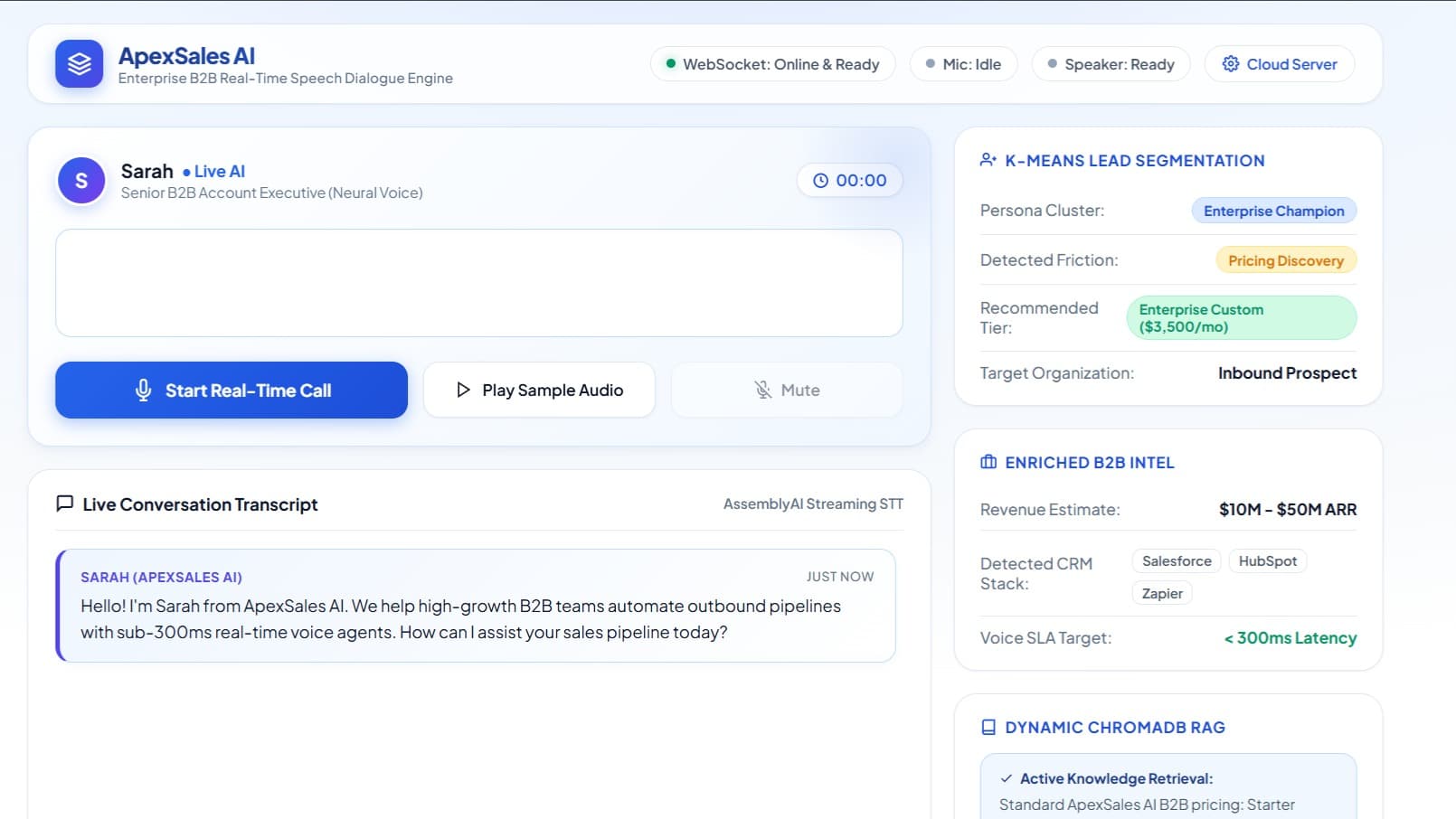
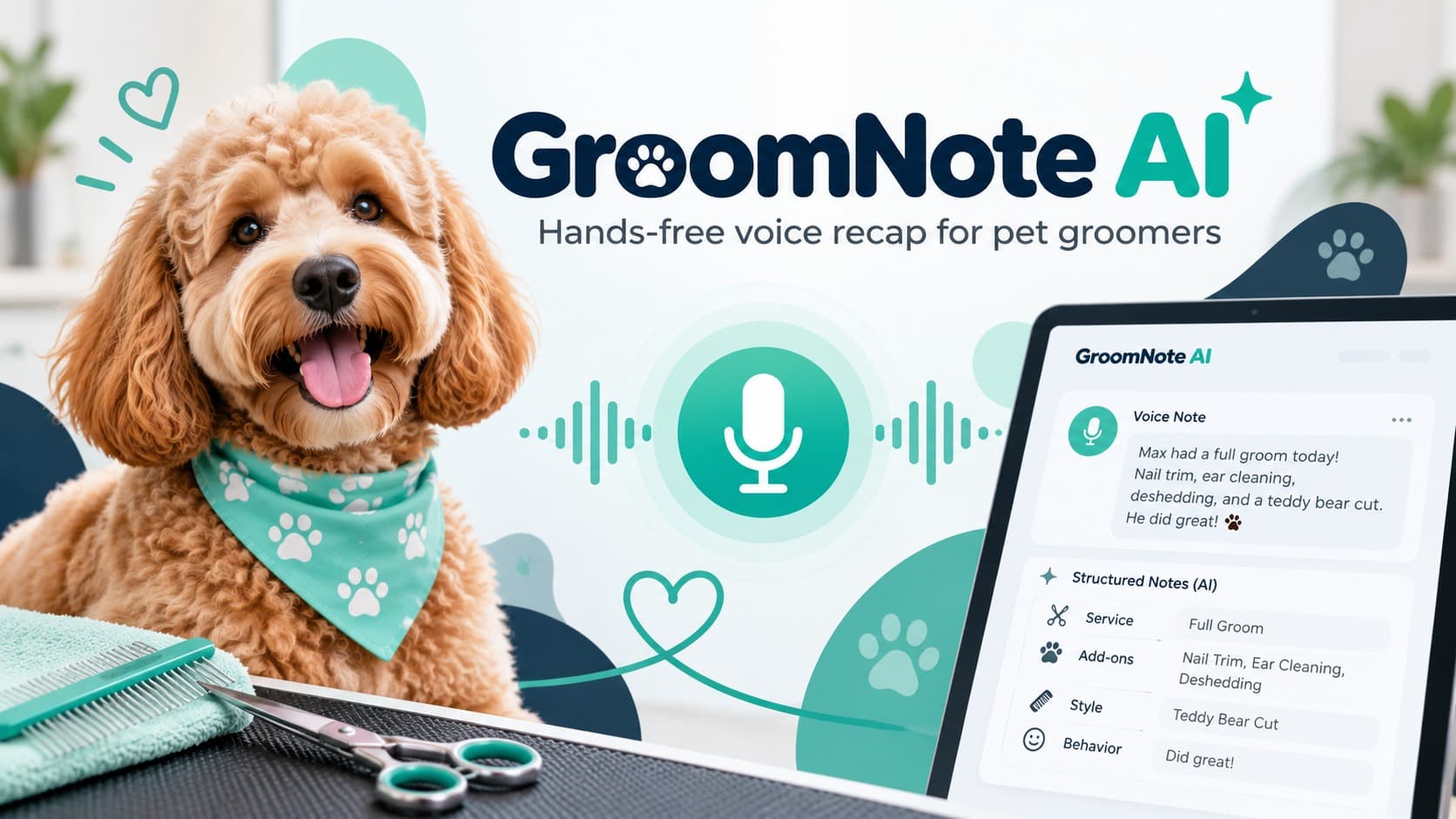
Pet groomers finish every appointment with useful details still fresh in their memory: what was done, what the owner requested, how the pet reacted, what handling technique worked, and what the next groomer should know. Yet this knowledge is often recorded poorly or not at all because the grooming floor is busy, wet, noisy, and fast-moving. This is not a purely imagined problem. In my product research, including grooming-software discussions, community feedback, and adjacent service-business workflows, I repeatedly found the same pattern: many businesses already use digital systems, but frontline staff still delay or skip detailed updates when documentation interrupts the work itself. The opportunity is not to replace existing salon software, but to solve this last-mile handover gap with a faster input method. GroomNote AI is a voice-first handover assistant. The groomer speaks naturally after the appointment. AssemblyAI Streaming STT captures the conversation, while GroomNote identifies important missing information and asks a short follow-up only when needed. It then produces a structured handover covering services, owner requests, behavior, handling techniques, outcomes, and guidance for the next visit. The groomer can review, correct, approve, and save the final note. If I win the prize, I will use it to expand this prototype into a more complete product, test integrations with existing grooming software, and start speaking directly with real grooming businesses to validate workflows, pricing, and adoption. Finish the groom. Just talk. Pass it on.

JARVIS AI – Agentic Computer Automation

JARVIS AI – Agentic Computer Automation

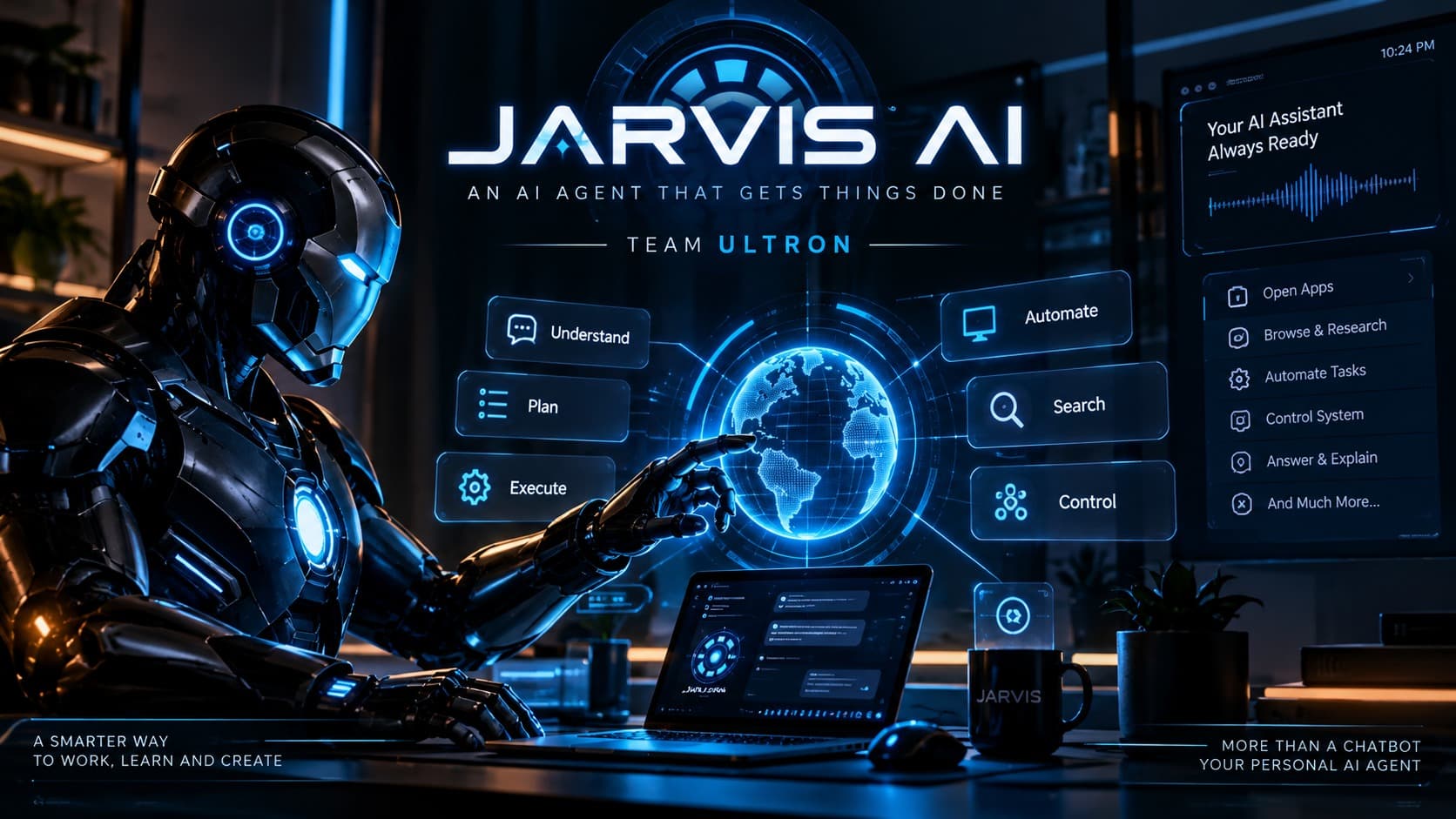
Modern computer users spend significant time performing repetitive digital tasks such as opening applications, searching the web, navigating websites, managing files, executing commands, and switching between multiple tools. Traditional AI assistants can understand questions and generate responses, but they often stop at providing instructions. Conventional automation scripts, on the other hand, are usually rigid, task-specific, and difficult to adapt when the workflow changes. This creates a gap between understanding user intent and actually completing computer-based tasks. JARVIS AI addresses this gap through an agentic AI approach that transforms natural-language intent into controlled, verified computer actions. Instead of simply answering “how to do something,” JARVIS determines what needs to be done, selects the appropriate tools, executes actions, observes their results, verifies the outcome, and dynamically replans when necessary. Users interact with JARVIS through natural-language commands. A user can describe a goal such as opening an application, searching for information, creating or modifying files, navigating a website, executing a terminal task, or combining several actions into one workflow. The system's planner decomposes the request into actionable steps and routes each step through a controlled Tool Registry. Available capabilities include browser automation, web information extraction, filesystem operations, terminal commands, desktop interaction, keyboard and mouse control, application management, system information, and local memory. What makes JARVIS unique is its closed-loop agent architecture. The system follows a continuous **Understand → Plan → Execute → Observe → Verify → Replan** workflow rather than relying on a fixed sequence of commands. This allows it to respond to tool results and recover from failures instead of blindly continuing. A dedicated safety layer adds risk classification, confirmation requirements, path validation, command restrictions, secret redaction, retry limits, and controlled tool access, making computer automation more responsible and predictable. The primary target users are students, developers, researchers, professionals, and power users who regularly perform repetitive computer workflows. Students can automate research and file-management tasks, developers can streamline project setup and development workflows, and professionals can reduce repetitive desktop and browser operations. JARVIS is designed to improve productivity by reducing manual clicks, context switching, and repetitive work while maintaining user control. Its modular architecture also makes it extensible: new tools and capabilities can be added without redesigning the entire agent. Future development can expand JARVIS toward voice-first interaction, specialized sub-agents, scheduled automation, richer application integrations, visual screen understanding, audit logs, and advanced policy controls. JARVIS AI moves computer assistance from “AI that tells you what to do” toward “AI that understands what you want and safely helps get it done.”