Llama 4

Llama 4 is Meta AI’s newest open-weight model series.
It introduces Mixture-of-Experts (MoE) routing for efficient inference, accepts both text and images natively, and stretches context windows to record-breaking lengths—10 M tokens in the Scout variant. Meta positions Llama 4 as a research-friendly, production-ready alternative to proprietary frontier models, while keeping the code and weights downloadable from its GitHub repos and the official llama.com portal.

General
Release date5 Apr 2025
DeveloperMeta AI
TypeOpen-weight multimodal LLM
LicenseLlama 4 Community License
GitHubmeta-llama/llama-models

Core Features

  • Mixture-of-Experts architecture – Each query activates a subset of specialised “experts,” yielding higher throughput per FLOP while scaling to trillions of total parameters (TechCrunch).
  • Native multimodality – Models ingest both text and images without external adapters (The Verge).
  • Extended context windows – Scout handles up to 10 M tokens; Maverick supports 1 M tokens (llm-stats).
  • Multilingual training – Optimised across 200+ languages for global deployments (Data Scientist Guide).
  • Fine-tunable & agent-ready – Models ship with recipes for supervised fine-tuning, LoRA, and RAG inside the Llama Cookbook.

Model Variants

VariantActive ParamsExpertsTotal ParamsContext WindowBest for
Scout17 B16109 B10 M tokensLong-context RAG, document analysis (stats)
Maverick17 B128400 B1 M tokensCoding & reasoning tasks, general chat (Oracle Docs)
Behemoth288 B*16~2 TTBAHigh-end STEM, under training (not yet released)

Tools & Resources


Ecosystem & Integrations

  • Meta AI assistant now runs Llama 4 across WhatsApp, Messenger, Instagram, and web chat (The Verge).
  • OCI Generative AI offers managed Scout & Maverick endpoints for enterprise workloads (Oracle Docs).
  • Community hosting – Providers such as DeepInfra, Groq, and Together price Llama 4 as low as $0.08 / 1 M input tokens (llm-stats).
  • Research & open-source – Thousands of fine-tuned checkpoints already live on Hugging Face; Meta’s annual LlamaCon (29 Apr 2025) spotlights academic collaborations (TechCrunch).

Llama 4 pushes open-weight LLMs into frontier-model territory—combining trillion-scale capacity with permissive licensing. Start experimenting by cloning the GitHub repo, reading the cookbook, or provisioning a managed endpoint on Oracle OCI.

Llama 4 top builders

Explore the top contributors showcasing the highest number of Llama 4 app submissions within our community.

Meta Llama 4 AI technology Hackathon projects

Discover innovative solutions crafted with Llama 4, developed by our community members during our engaging hackathons.

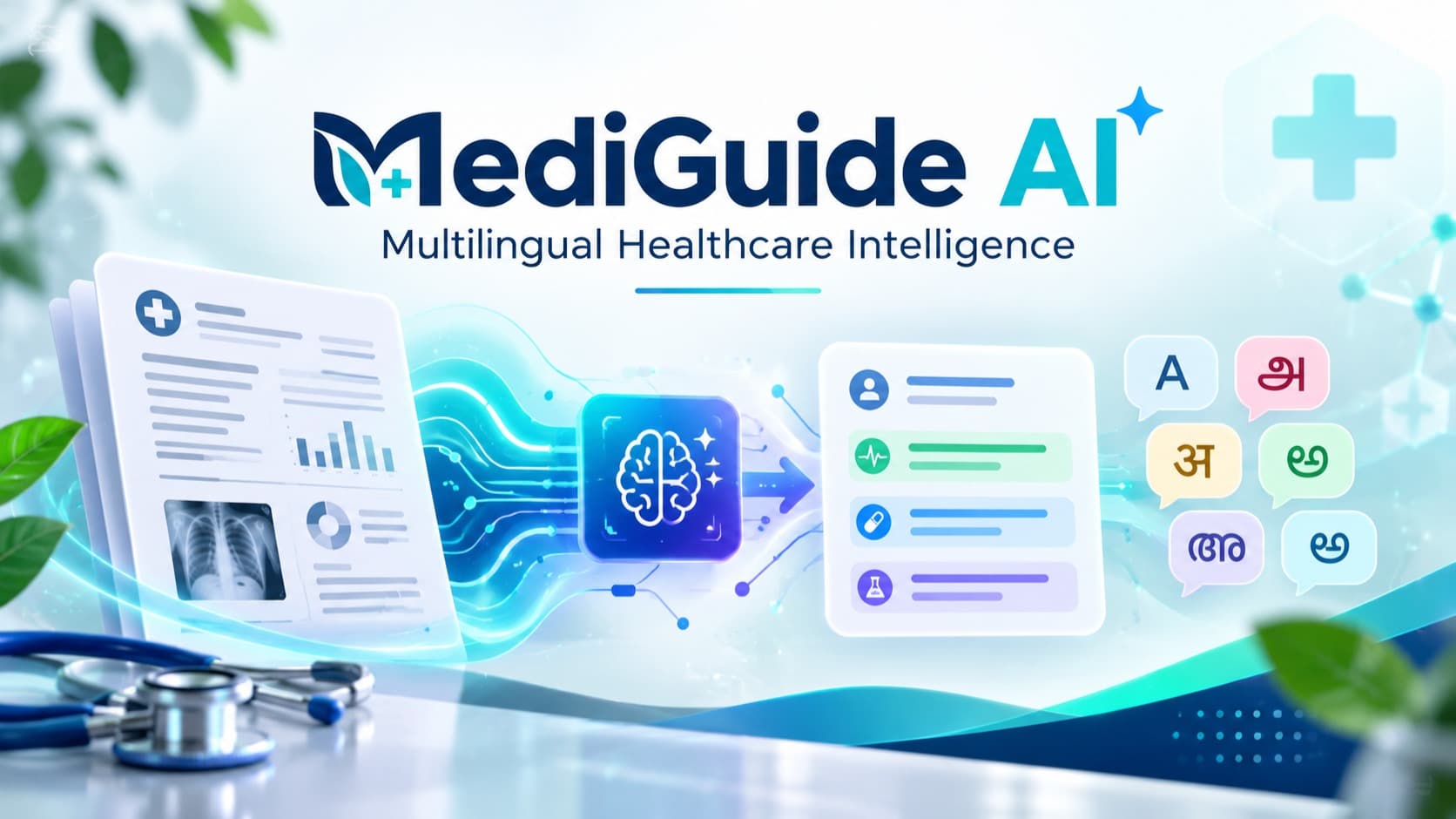
MediGuide AI Multilingual Healthcare Intelligence

MediGuide AI Multilingual Healthcare Intelligence

## MediGuide AI – Multilingual Healthcare Intelligence MediGuide AI is an AI-powered healthcare accessibility platform designed to help patients understand complex medical reports in their preferred language. ### The Problem Medical reports often contain complex terminology that patients struggle to understand. Language barriers can make healthcare information even more difficult to access, affecting patients' ability to prepare for consultations and ask informed questions. ### Our Solution MediGuide AI transforms medical documents into more accessible, patient-friendly information through an intelligent document-processing pipeline. ### Key Features - **Medical Document Extraction:** Uses PaddleOCR and text extraction to process uploaded medical reports. - **Clinical Entity Recognition:** Identifies important medical terms and entities using a pretrained biomedical NER model. - **Report Summarization:** Produces concise summaries to make medical information easier to review. - **Multilingual Accessibility:** Supports English, Tamil, Hindi, Telugu, Malayalam, and Kannada. - **AI Health Assistant:** Helps patients understand medical terminology and prepare questions for their doctors. - **Emergency Awareness:** Detects potentially urgent symptom descriptions and advises users to seek appropriate medical care. ### Technology Stack - Frontend: React - Backend: Python, FastAPI - OCR: PaddleOCR and PyMuPDF - NLP: Transformers and biomedical named entity recognition - Database: SQLite - Multilingual processing: Local language detection and translation components ### Innovation and Impact MediGuide AI combines medical document processing, clinical NLP, summarization, and multilingual accessibility in one platform. It aims to reduce language barriers and help patients participate more confidently in healthcare discussions. MediGuide AI is an educational support tool, not a replacement for professional medical advice, diagnosis, or treatment.

Readback: Proof of Understanding at Discharge

Readback: Proof of Understanding at Discharge

Pilots read back safety-critical instructions before acting on them. Patients go home with a discharge sheet, and often nobody has time to check what they understood. Misunderstood medication and follow-up instructions are a preventable cause of harm and readmission. Nurses know that teach-back helps, but rarely have the minutes it takes. Readback is an AI agent that turns a discharge summary into proof of understanding. It reads the document (PDF or photo), builds a plain-language care plan in which every line links to the sentence it came from, and explains it to the patient in their own language, by voice or text. Then it does what a leaflet cannot: it asks the patient to explain the plan back (which medicine, how much, when, which warning signs, when to return) and checks each answer against the source. Gaps are explained again and re-asked. The nurse gets a one-page report: what the patient understood, what they got wrong, and what Readback could not verify. Readback never diagnoses and never adds advice; it only restates what the clinician wrote. Illegible, ambiguous or unsupported content is flagged, not guessed. High-risk medicines always go to human review, and a clinician signs off before the patient leaves. Every model is open-weight and runs on AMD GPUs in AMD Developer Cloud with ROCm and vLLM: a vision-language model reads the document, a language model grounds the plan and scores the teach-back, and speech models handle voice. Nothing is sent to a closed API, so patient data stays on infrastructure the hospital controls. The result is measurable: the share of key instructions a patient can correctly repeat before and after a session, and nurse minutes saved per discharge.

Bob Simulator Resilience Engine

Bob Simulator Resilience Engine

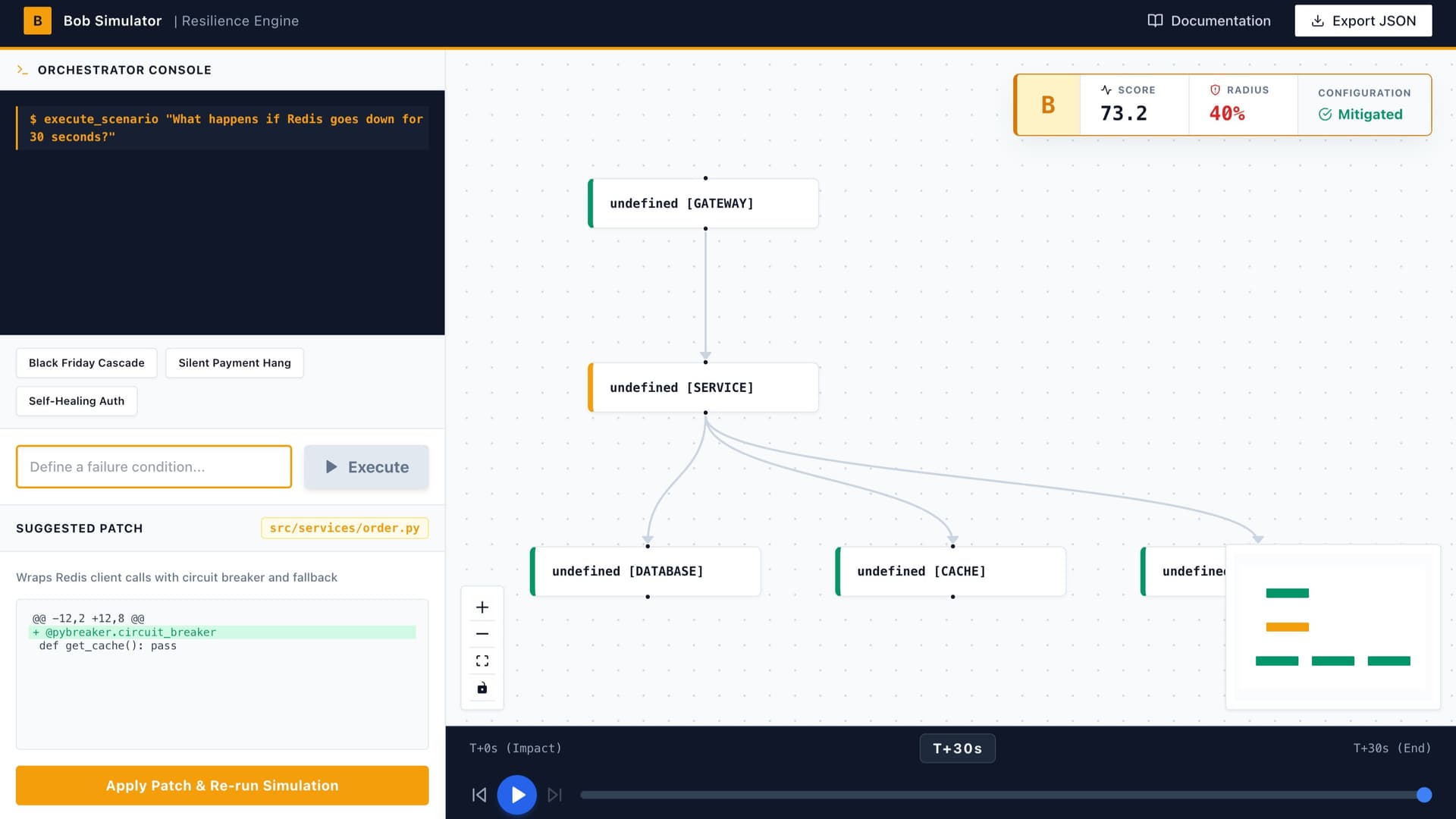
Problem & Challenge Modern distributed systems are fragile. A single degraded dependency—like a slow cache or a hung third-party payment API—can easily cascade into a catastrophic, system-wide outage through thread starvation or retry storms. Currently, engineering teams discover these hidden vulnerabilities the hard way: during costly production incidents or through traditional chaos engineering, which requires deploying complex, high-risk fault injection tools into live cloud environments. The Solution Bob Simulator is an AI-powered digital twin and resilience testing platform that allows teams to safely "break" their software before it ever reaches production. Leveraging an IBM Bob-powered multi-agent system, the platform analyzes an application's architecture to deterministically simulate realistic failure scenarios. It maps the cascading blast radius and automatically generates the exact code patches required to self-heal the system. Target Users The platform is built for Software Engineers, Site Reliability Engineers (SREs), System Architects, and DevOps teams who design, build, or maintain microservices and distributed systems. How Users Interact Users interface with a classic, enterprise-grade dashboard featuring a visual topology graph. Interaction follows a continuous Understand → Break → Observe → Fix → Re-run loop: Inject: A user types a natural-language scenario into the execution console (e.g., "What happens if the Stripe API hangs for 30 seconds during peak traffic?"). Observe: The engine calculates the blast radius. Users use a timeline scrubber to step through the exact failure cascade visually, watching healthy nodes turn red as timeouts propagate. Analyze: A live Resilience Scorecard updates with quantitative metrics, grading the system's fault isolation and recovery efficiency. Fix: The system presents an AI-generated, AST-aware code patch—such as adding a circuit breaker or exponential backoff—which the user can apply with one click to rerun the simulation and verify the mitigation. What Makes it Creative and Unique Bob Simulator shifts chaos engineering completely to the left. Instead of physically breaking live environments, it uses specialized LLM subagents (Propagation, Bottleneck, and Recovery) to mathematically model failures against a statically parsed "digital twin" of the codebase. It doesn't just point out architectural flaws; it acts as an automated resilience engineer by generating polyglot, production-ready Git diffs tailored exactly to the project's tech stack (TypeScript, Python, Go, Java, etc.). Effectiveness & Efficiency By simulating complex cascading failures locally, Bob Simulator eliminates the infrastructure costs, tooling overhead, and risks associated with traditional fault injection. What normally takes weeks of post-mortem analysis and ticket triaging is reduced to seconds. Teams can proactively identify single points of failure, apply battle-tested resilience patterns, and empirically prove their architecture is hardened—drastically reducing the frequency and severity of future production outages.

Fresno LUX: A Living City

Fresno LUX: A Living City

Fresno LUX is a prototype for a living intelligence layer across an entire city. Fresno already contains enormous amounts of intelligence: residents know where problems exist, nonprofits know where help is needed, businesses know where opportunities exist, educators understand gaps in learning, researchers generate knowledge, and government maintains critical infrastructure and data. The problem is that much of this intelligence is fragmented across disconnected systems. Fresno LUX connects those pieces. The platform creates a shared city graph where people, organizations, resources, needs, projects, observations, experiments, and outcomes become connected nodes. Instead of simply collecting data, LUX continuously asks: What is happening? What do we know? What is missing? What can we test? What changed? A community problem can become an observable signal. That signal can become an experiment. The experiment produces evidence. Evidence changes the system's understanding. That updated understanding informs the next action. Observe → Connect → Understand → Act → Measure → Learn → Converge. The goal is to move Fresno from disconnected information toward collective intelligence—a system where knowledge can travel across boundaries and successful solutions can be discovered, tested, measured, and replicated. LUX is designed to make the invisible connections visible: the relationship between a neighborhood and its resources, between a student and educational opportunity, between a business and workforce capacity, between environmental conditions and community health, and between an idea and measurable real-world impact. This hackathon prototype demonstrates the beginning of a Living Fresno Graph: a city that can observe itself, learn from evidence, and coordinate toward better outcomes.