SeamlessM4T

SeamlessM4T is a cutting-edge AI model developed by Meta AI, designed for seamless speech and text translation across more than 100 languages. Whether you need speech-to-speech, speech-to-text, or text-to-text translation, SeamlessM4T offers state-of-the-art capabilities to meet your communication needs.

General
AuthorMeta AI
Repositoryhttps://github.com/metaai/seamlessm4t
TypeMultilingual AI Model

Start building with SeamlessM4T

We have compiled essential resources to help you kickstart your journey with SeamlessM4T. Dive into the world of multilingual translation and discover how you can leverage SeamlessM4T's power in your applications.


Hackathon Preparation

If you're gearing up for a hackathon or want to experiment with SeamlessM4T, here's what you can do:

  • Access the Code: Visit the GitHub repo to access the source code of SeamlessM4T. You can explore the codebase, contribute, or use it as a reference for your projects.
  • Try the Demo: Head over to HuggingFace to experience the capabilities of SeamlessM4T in action. The demo allows you to experiment with various translation scenarios.
  • Build Your Applications: Leverage SeamlessM4T to build your own applications or integrations. Whether it's language translation, speech recognition, or text analysis, SeamlessM4T can power your AI projects.
  • Responsible AI: Ensure you follow best practices for responsible AI development. Be mindful of issues related to model bias and toxicity, and refer to Meta's responsible AI framework for guidance.

For more in-depth insights and updates about SeamlessM4T, explore the Meta AI blog.


SeamlessM4T top builders

Explore the top contributors showcasing the highest number of SeamlessM4T app submissions within our community.

Meta SeamlessM4T AI technology Hackathon projects

Discover innovative solutions crafted with SeamlessM4T, developed by our community members during our engaging hackathons.

Fresno LUX: A Living City

Fresno LUX: A Living City

Fresno LUX is a prototype for a living intelligence layer across an entire city. Fresno already contains enormous amounts of intelligence: residents know where problems exist, nonprofits know where help is needed, businesses know where opportunities exist, educators understand gaps in learning, researchers generate knowledge, and government maintains critical infrastructure and data. The problem is that much of this intelligence is fragmented across disconnected systems. Fresno LUX connects those pieces. The platform creates a shared city graph where people, organizations, resources, needs, projects, observations, experiments, and outcomes become connected nodes. Instead of simply collecting data, LUX continuously asks: What is happening? What do we know? What is missing? What can we test? What changed? A community problem can become an observable signal. That signal can become an experiment. The experiment produces evidence. Evidence changes the system's understanding. That updated understanding informs the next action. Observe → Connect → Understand → Act → Measure → Learn → Converge. The goal is to move Fresno from disconnected information toward collective intelligence—a system where knowledge can travel across boundaries and successful solutions can be discovered, tested, measured, and replicated. LUX is designed to make the invisible connections visible: the relationship between a neighborhood and its resources, between a student and educational opportunity, between a business and workforce capacity, between environmental conditions and community health, and between an idea and measurable real-world impact. This hackathon prototype demonstrates the beginning of a Living Fresno Graph: a city that can observe itself, learn from evidence, and coordinate toward better outcomes.

AEGIS Sentinel: Multi-Agent Emergency Terminal

AEGIS Sentinel: Multi-Agent Emergency Terminal

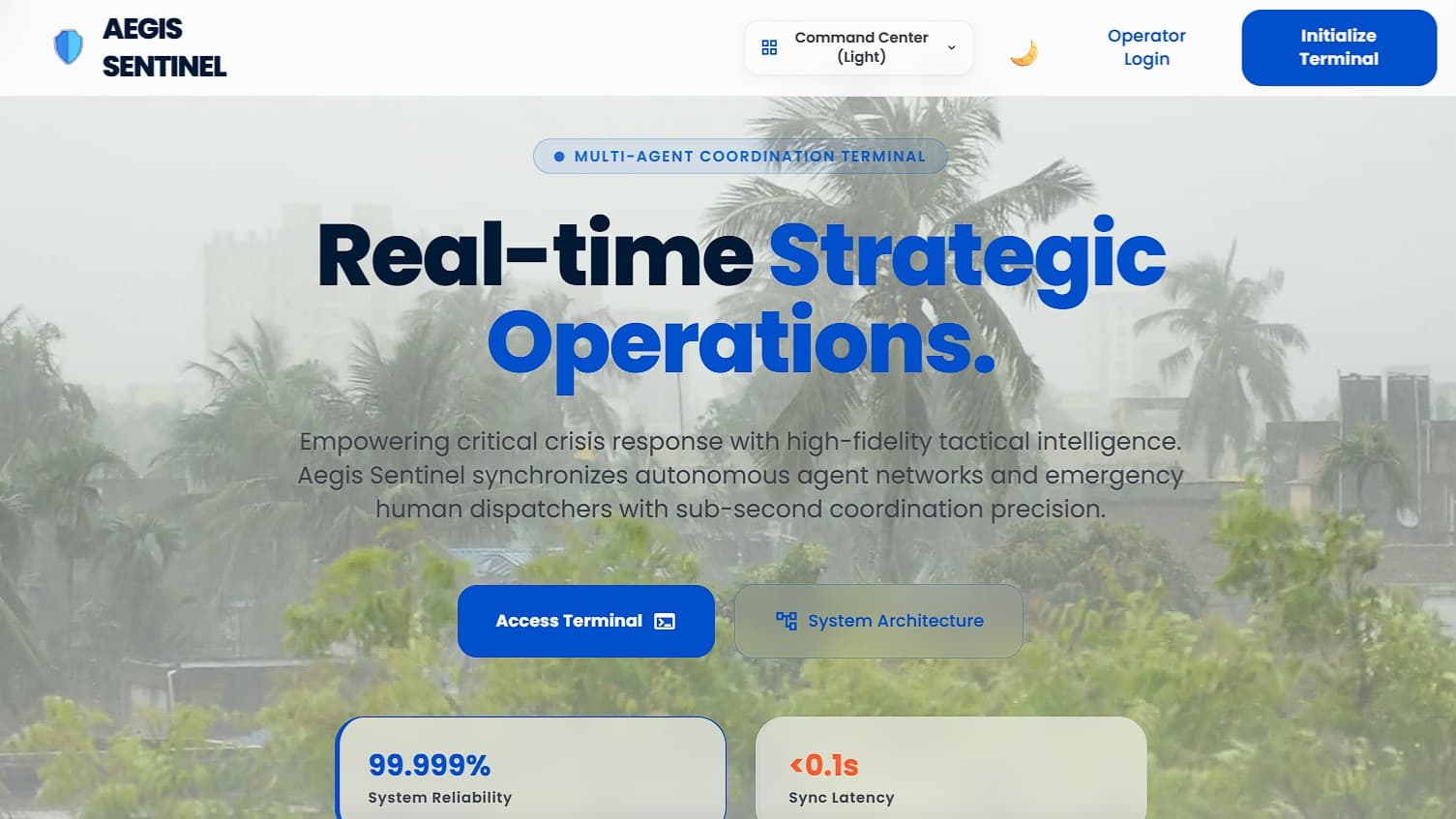
AEGIS Sentinel is a premium, real-time crisis coordination and spatial tracking dashboard built to solve communication blindness during regional disasters. During natural emergencies, survivors and dispatchers face network outages, rumor pollution, and static, cross-country evacuation paths that lead directly into hazard zones. AEGIS Sentinel addresses these challenges by deploying a collaborative, parallel multi-agent pipeline. The ASR Ingestion Agent processes dispatcher feeds using Speechmatics' Enhanced ASR. The Web Search Agent scrapes live reports matching the geolocalized city using Bright Data and Google News RSS feeds. The AI Reasoning Agent (Gemini 3.5) filters out rumors, evaluates threat details, extracts coordinates, and assigns verification scores. Finally, the Automation Agent registers threats in Cognee Graph Memory and triggers custom webhooks. Key Features: - One-Click Geocentric Localization: Automatically centers Leaflet dark maps via network/GPS/IP Geolocation, reverse-geocodes via OSM Nominatim, and queries custom Indian Cities and GeoDB API caching routes. - Proximity-Constrained Evacuation: If standard shelters are over 50km away, the system projects a virtual municipal shelter 1.5km away, drawing neon-green dashed paths. - Acoustic SOS Siren: Employs Web Audio API oscillators to emit European safety horns for search-and-rescue. - Walkie-Talkie Speech warnings: Synthesizes automated alerts with simulated radio beeps and trailing white-noise static squelches. - Live Background SMTP Dispatch: Fires comprehensive advisory emails listing active threats directly to operator inboxes asynchronously.