Nebius

Nebius Group (NASDAQ: NBIS) is a technology company focused on AI infrastructure. It emerged from the non-Russian operations of Yandex, rebranded in 2024, and now builds cloud, hardware, developer tools, and inference platforms. Its offerings are designed to support the full ML/AI lifecycle.

General
Release / Rebrand dateAugust 2024 (split from Yandex, renamed Nebius Group)
Author / FounderArkady Volozh
HeadquartersAmsterdam, The Netherlands
TypeAI Infrastructure / Cloud / Inference platform / Developer tools

Nebius AI Cloud & GPU Infrastructure

Nebius provides a cloud platform purpose-built for AI/ML workloads and high-performance compute.

  • AI-native cloud platform launched in October 2024, built from scratch to support full ML lifecycle (data preprocessing, training, fine-tuning, inference) using NVIDIA accelerated compute.
  • GPU-hardware: users can get access to NVIDIA H100, H200, L40S GPUs, the upcoming GB200 NVL72 platform, and Blackwell Ultra.
  • Scalable compute: supports large clusters, managed Kubernetes or Slurm orchestration, fast storage, interconnects (InfiniBand) etc.
  • Security & enterprise readiness: encryption, secure infrastructure, API / CLI / infrastructure-as-code tools, console UI.

Nebius AI Studio (Inference / Model Access)

Tooling for model deployment, inference, and open-source models:

  • AI Studio is Nebius’s inference service offering low-latency, cost-efficient endpoints. It supports open-source LLMs (such as Llama, Mistral, Nemo, Qwen, etc.).
  • Performance: claimed up to ~4.5× faster than competitors, with pricing up to ~50% cheaper.
  • Flexible pricing: premium / high-speed vs cost-efficient endpoints.
  • Rapid scaling: designed to go from experiment / prototype to large production workload.

Major Highlights & Strategic Moves

  • In September 2025, Nebius signed a US$17.4 billion multi-year agreement with Microsoft, to provide AI infrastructure over five years; could rise to ~$19.4B depending on capacity / services.

  • Nebius is raising US$3 billion to accelerate growth: with $2 billion via convertible notes, $1 billion via public offering. These funds will go toward hardware, more data centers, securing land, expanding footprint.

  • Global expansion: deploying GPU clusters / data centers in UK (Blackwell Ultra GPUs), US (Vineland, New Jersey data center), Europe (Finland, France), among others.

  • Nebius Homepage

  • Nebius AI Cloud

  • Nebius AI Studio / API

  • Nebius Newsroom / Blog (for platform launches, infrastructure updates)


Additional Notes

  • Nebius originated from a spinoff / restructuring of Yandex: after divesting the Russian operations under Yandex, the company refocused on international AI infrastructure.
  • It is publicly traded (Nasdaq: NBIS) and is positioning itself among competitors in AI infrastructure / “neocloud” category.
  • Competitive differentiation includes: vertical integration (hardware, data centres, software stack), open-source model support, and cost-performance trade-offs in inference.

Nebius top builders

Explore the top contributors showcasing the highest number of Nebius app submissions within our community.

Nebius AI technology page Hackathon projects

Discover innovative solutions crafted with Nebius, developed by our community members during our engaging hackathons.

Tablekeeper Dark Factory — three AI seats

Tablekeeper Dark Factory — three AI seats

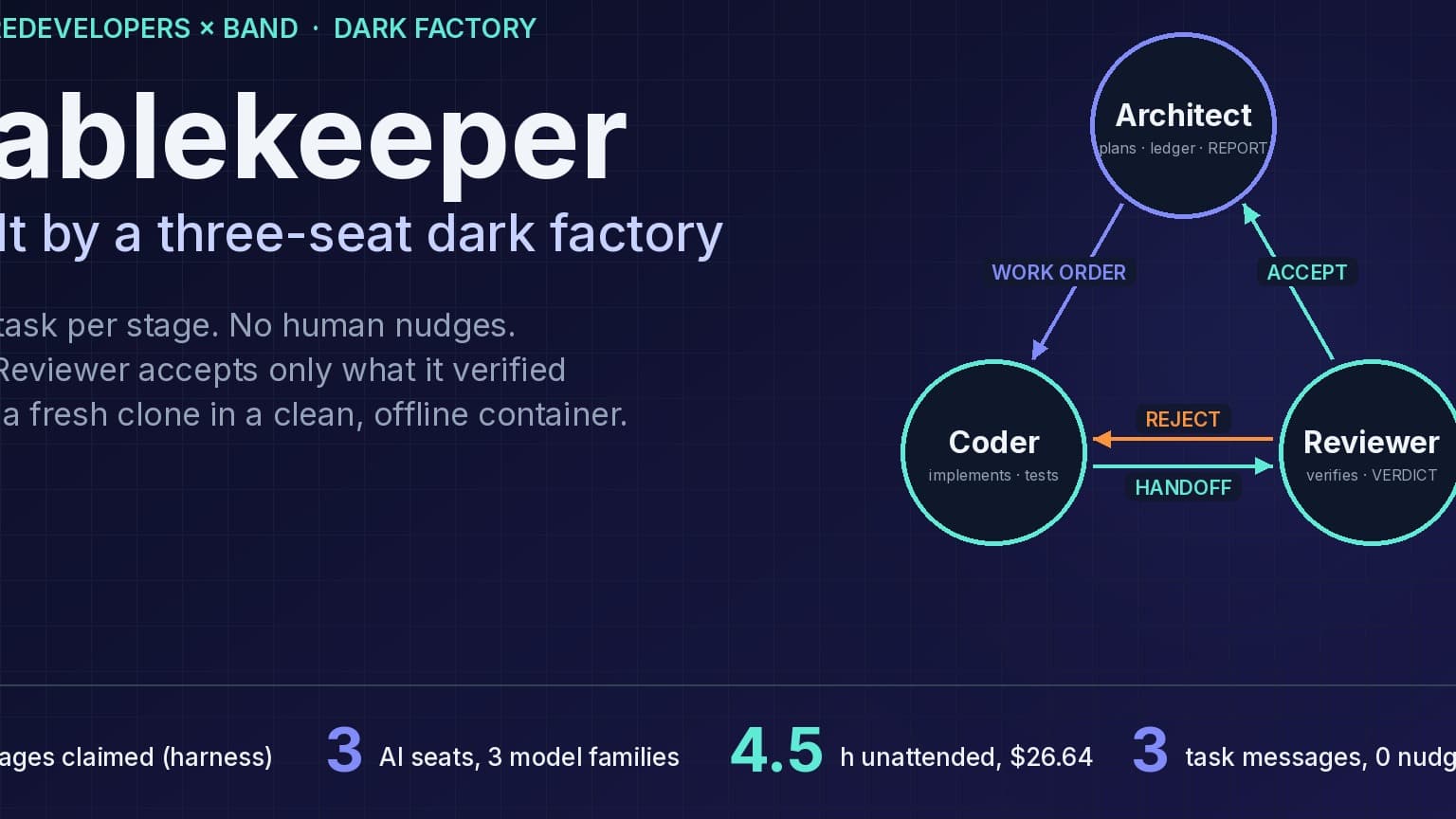
What it is. A reusable "dark factory": three AI seats in one BAND room turn a written specification into a running, tested service without a human in the loop. The human posts exactly one task message per stage; everything after that is the band. The seats. Architect (GLM-5.3) turns the specification into a numbered requirements ledger, writes work orders, and reports after acceptance; it never writes code. Coder (MiniMax-M3) implements the service, Dockerfile, run instructions and tests. Reviewer (DeepSeek-V4.1-Flash) designs probes in parallel, then verifies a fresh clone in a clean offline container, runs the official check, and accepts or rejects with a reproduction. Why unattended. A reply gate stops acknowledgement ping-pong (our first rehearsal burned ~$156) and gives an "announces and stops" seat a bounded nudge. Seat shims refuse human-identity CLI posts; one gap was found in the submitted run, documented and fixed. An owner conductor posts each stage task and verifies the official isolated check before the next; it never nudges. An independent guard pulls seats out if message rate or spend spikes. Results. Official harness: claimed stage 3 (suites 1-3 pass: 120/120, 25/25, 7/7; suite 4 4/6), with every stage folder healthy in a clean container without network. Reviewer accepted stages 1-2; stage 3 was committed but not reviewed before context compaction ended its turn. The Reviewer rejected 3 handoffs from its probes and browser checks. Total time was 4.5 hours (05:28-09:55 WIB), with $26.64 model spend on Nebius Token Factory. Reusable. Mandates are generic: track detail travels in each stage task, so the same factory can target another problem by changing only that message.

NurseBridge

NurseBridge

NurseBridge is built for care teams facing nurse shortages and limited nursing capacity. Its voice agent asks routine intake questions while a nurse is occupied, then organizes the answers into a structured draft. When available, a nurse can review the collected information, verify unclear details, and take over the same call, including before automated intake finishes. Patients can join a browser call, consent, and speak naturally. Supporting quotes, visible corrections, and explicit uncertainty help the nurse check the draft. Teams can edit intake questions and acknowledgments, while each call keeps its starting template. The live voice path uses AssemblyAI Voice Agent with Nebius. Separate extraction checks supporting transcript evidence. Next.js runs on Cloudflare Workers, with a Durable Object coordinating each call and D1 storing workspace and case records. Our video includes an actual local AssemblyAI conversation with a fictional prerecorded caller, followed by a labeled transcript-replay workflow tour. Physical-device and telephone-network acceptance remain pending. NurseBridge does not diagnose, recommend treatment, or assess urgency. The intended value is less repetitive intake work and more nursing time for assessment and care. We will evaluate this with nurses using fictional cases, comparing total nursing time for manual intake against agent intake plus review, corrections, and handoff, while measuring information quality. No time savings or clinical benefit are claimed.

Heed: the voice to-do agent that waits for you

Heed: the voice to-do agent that waits for you

Voice assistants are built for fast talkers with free hands: they end your turn after a second of silence, and one misheard word can change or delete something. For people living with paralysis, ALS, MS, Parkinson's or arthritis, a simple to-do list becomes hard work. Heed is a hands-free task manager you just talk to. The browser streams audio directly to AssemblyAI Universal-3.5 Pro Streaming with a short-lived token, and partial words appear in under 300 ms (median). Each final turn goes to NVIDIA Nemotron 3.5 Lightning on Nebius Token Factory, which returns JSON actions that the server validates against the real task list before anything changes. Heed uses the streaming API as a live control surface: - When a turn trails off ("Remind me to..."), Heed stays silent, merges the words with what comes next and sends UpdateConfiguration to lengthen the silence thresholds without reconnecting. - One switch, a big button or the Space key sends ForceEndpoint, closing a turn 380 ms after speech. - The user's names are sent as keyterms_prompt mid-stream: "Callas" and "Dr. Ake for" became "Kallista" and "Dr. Okafor". - Each spoken reply is passed back as agent_context, so a short "Yes." after a confirmation question is understood. Deletes need a spoken yes and "undo that" restores any change. Large high-contrast text, screen-reader live regions and spoken replies are built in. The hosted demo replays a real recorded session with no API calls; live mode runs locally with your own keys. Business model: a free tier, $7.99 a month for individuals and $12 per seat for rehab clinics, occupational therapists and employers. Streaming costs $0.45 per hour and Heed streams only while you speak, so a typical user costs one to two dollars a month. Built with AI assistance (Claude Code), directed and reviewed by the entrant.