GPT-4 Vision: Enhancing AI with Visual Understanding

Discover the groundbreaking integration of GPT-4 Vision, an innovative addition to the GPT-4 series. Witness AI's transformative leap into the visual realm, elevating its capabilities across diverse domains.

General
Release dateSeptember 25, 2023
AuthorOpenAI
DocumentationOpenAI's Guide
TypeAI Model with Visual Understanding

Overview

GPT-4 Vision seamlessly integrates visual interpretation into the GPT-4 framework, expanding the model's capabilities beyond language understanding. It empowers AI to process diverse visual data alongside textual inputs.

Visionary Integration

GPT-4 Vision blends language reasoning with image analysis, introducing unparalleled capabilities to AI systems.

Capabilities

Discover the transformative abilities of GPT-4 Vision across various domains and tasks:

1. Visual Understanding

Object Detection

Accurate identification and analysis of objects within images, showcasing proficiency in comprehensive image understanding.

Visual Question Answering

Adept handling of follow-up questions based on visual prompts, offering insightful information and suggestions.

2. Multifaceted Processing

Multiple Condition Processing

Interpreting and responding to multiple instructions simultaneously, demonstrating versatility in handling complex queries.

Data Analysis

Enhanced data comprehension and analysis, providing valuable insights when presented with visual data, including graphs and charts.

3. Language and Visual Fusion

Text Deciphering

Proficiency in deciphering handwritten notes and challenging text, maintaining high accuracy even in difficult scenarios.


Addressing Challenges

Mitigating Limitations

While pioneering in vision integration, GPT-4 faces inherent challenges:

  • Reliability Issues: Occasional inaccuracies or hallucinations in visual interpretations.
  • Overreliance Concerns: Potential for users to overly trust inaccurate responses.
  • Complex Reasoning: Challenges in nuanced, multifaceted visual tasks.

Safety Measures

OpenAI implements safety measures, including safety reward signals during training and reinforcement learning, to mitigate risks associated with inaccurate or unsafe outputs.


GPT-4 Vision Resources

Explore GPT-4 Vision's detailed documentation and quick start guides for insights, usage guidelines, and safety measures:


GPT-4 Vision Tutorials


GPT-4 Vision top builders

Explore the top contributors showcasing the highest number of GPT-4 Vision app submissions within our community.

OpenAI GPT-4 Vision AI technology Hackathon projects

Discover innovative solutions crafted with GPT-4 Vision, developed by our community members during our engaging hackathons.

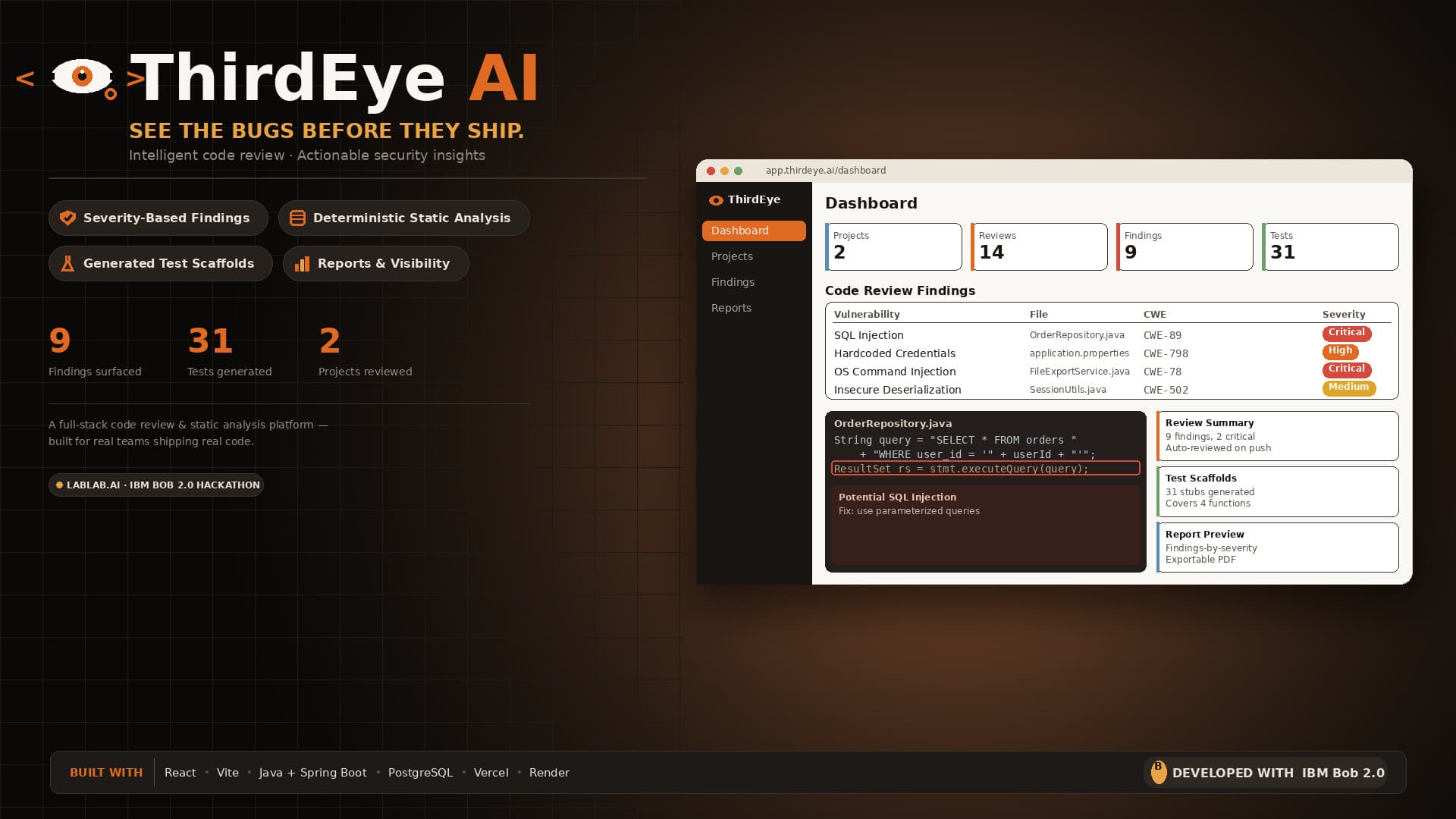
ThirdEye AI - See the bugs before they ship.

ThirdEye AI - See the bugs before they ship.

Problem & Solution Statement Software developers frequently spend considerable time reviewing code changes, identifying potential security vulnerabilities, understanding bugs, and preparing test cases. Manual code reviews can be time-consuming, and issues may go unnoticed when development teams work under tight deadlines. Review findings, suggested corrections, and test preparation are often handled across separate tools, making it difficult to maintain a structured workflow. ThirdEye AI addresses this challenge by providing a centralized platform for code review, findings management, and test generation support. Developers can select a project, submit code changes, and review the resulting analysis through an interactive dashboard. Findings are organized by severity and category, with descriptions and suggested corrections to help developers understand and address potential issues. The platform also supports generating test stubs based on identified findings, helping developers prepare tests for scenarios that require attention. ThirdEye AI incorporates IBM Bob 2.0 into its development and workflow. IBM Bob assisted our team with implementation, debugging, API development, and integration. We also developed an MCP-based integration to expose supported ThirdEye functionality to Bob, allowing it to interact with project information, reviews, findings, and test generation workflows through available tools. Our solution focuses on making code review more accessible, structured, and actionable. By bringing analysis, findings, and test preparation together, ThirdEye AI aims to help developers identify potential problems earlier in the development process and improve the consistency of their review workflows. ThirdEye AI is designed for individual developers, student teams, and software development teams seeking a more organized approach to reviewing code and preparing tests.

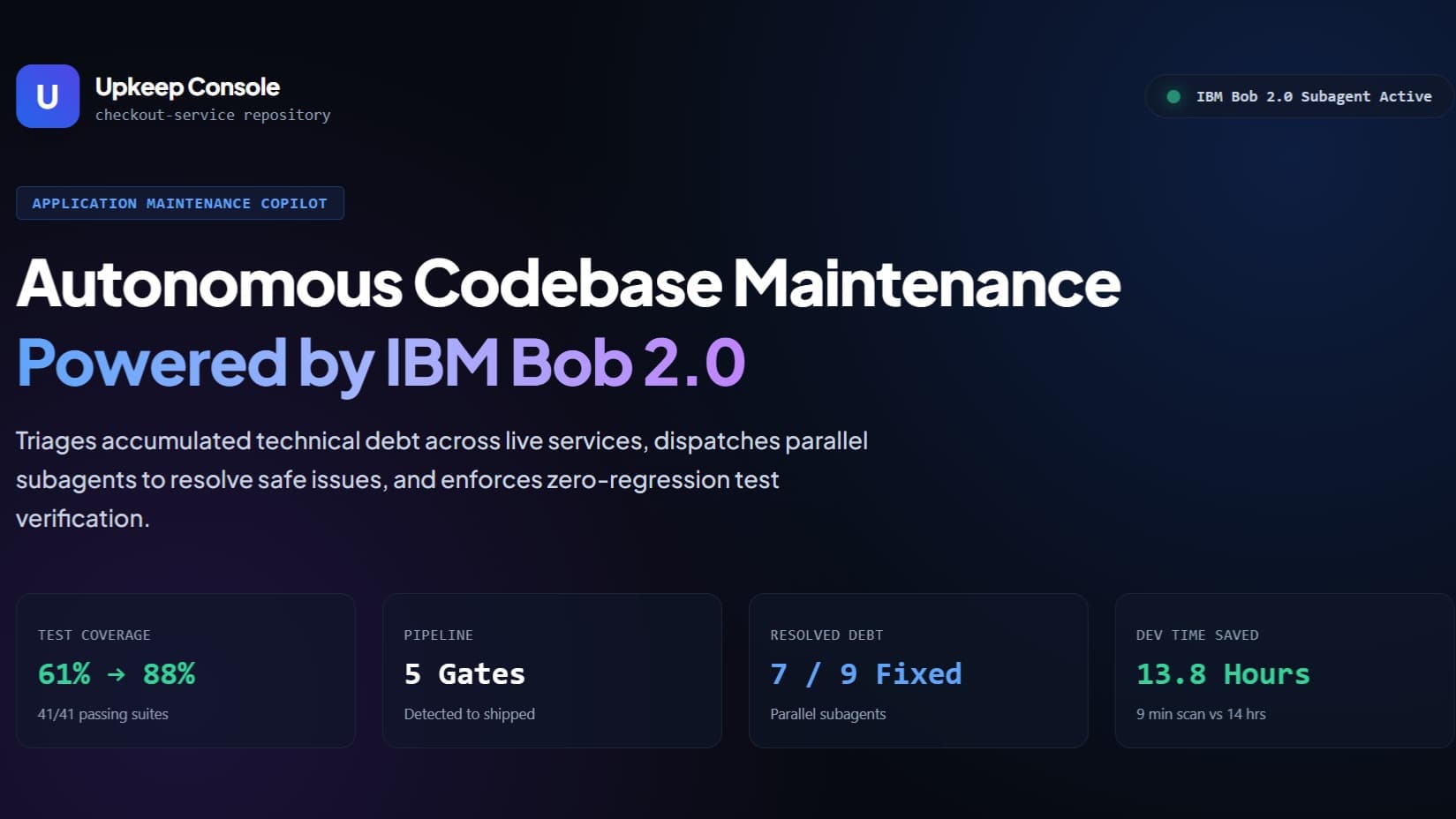
Upkeep Console Codebase Maintenance Copilot

Upkeep Console Codebase Maintenance Copilot

Problem Statement: In fast-paced software development, technical debt is always visible, but engineering teams rarely have the dedicated bandwidth to fix it until an outage occurs, a pull request review slows down, or a new engineer questions legacy functions. Stale dependencies with known vulnerabilities, dead code branches, unhandled promise rejections, and missing retry timeouts accumulate quietly over time. Traditional manual audits take 14+ hours per repository and result in ad-hoc, inconsistent patches that frequently introduce unexpected regressions. Our Solution: Upkeep Console is an autonomous codebase maintenance copilot built on IBM Bob 2.0 that transforms reactive maintenance into a scheduled, auditable, and automated workflow. Instead of waiting for technical debt to cause system failure, Upkeep points Bob 2.0 at live service repositories (demonstrated on checkout-service) to proactively detect, classify, and resolve maintenance debt before it becomes critical. Target Users & Workflow: Target users include backend engineers, DevOps leads, and repository maintainers responsible for enterprise microservices. The maintenance workflow operates through a structured 5-gate pipeline: 1. Detected: Bob scans the entire repository to uncover stale dependencies, dead branches, and untested execution paths. 2. Triaged: Every identified issue receives an objective risk and effort score; nothing is modified prior to classification. 3. Bob Fixing: Items marked safe are dispatched to parallel Bob subagents, each resolving issues on its own isolated branch. 4. Verified: Every automated fix is re-run against the full test suite before being marked complete. 5. Shipped: Verified fixes ship with clear changelogs, while high-risk structural decisions are cleanly handed off to maintainers. Creativity, Uniqueness & Impact: Upkeep Console combines repository-level context with an interactive, in-browser static analyzer that checks for exposed secrets, unhandled promises, and console leftovers. In live demonstration benchmarks on checkout-service, Upkeep resolved 7 out of 9 debt items autonomously, raised test coverage from 61% to 88%, eliminated all known CVEs and dead code branches, and passed 41/41 regression tests in just 9 minutes—saving over 13.8 hours of manual engineering effort.

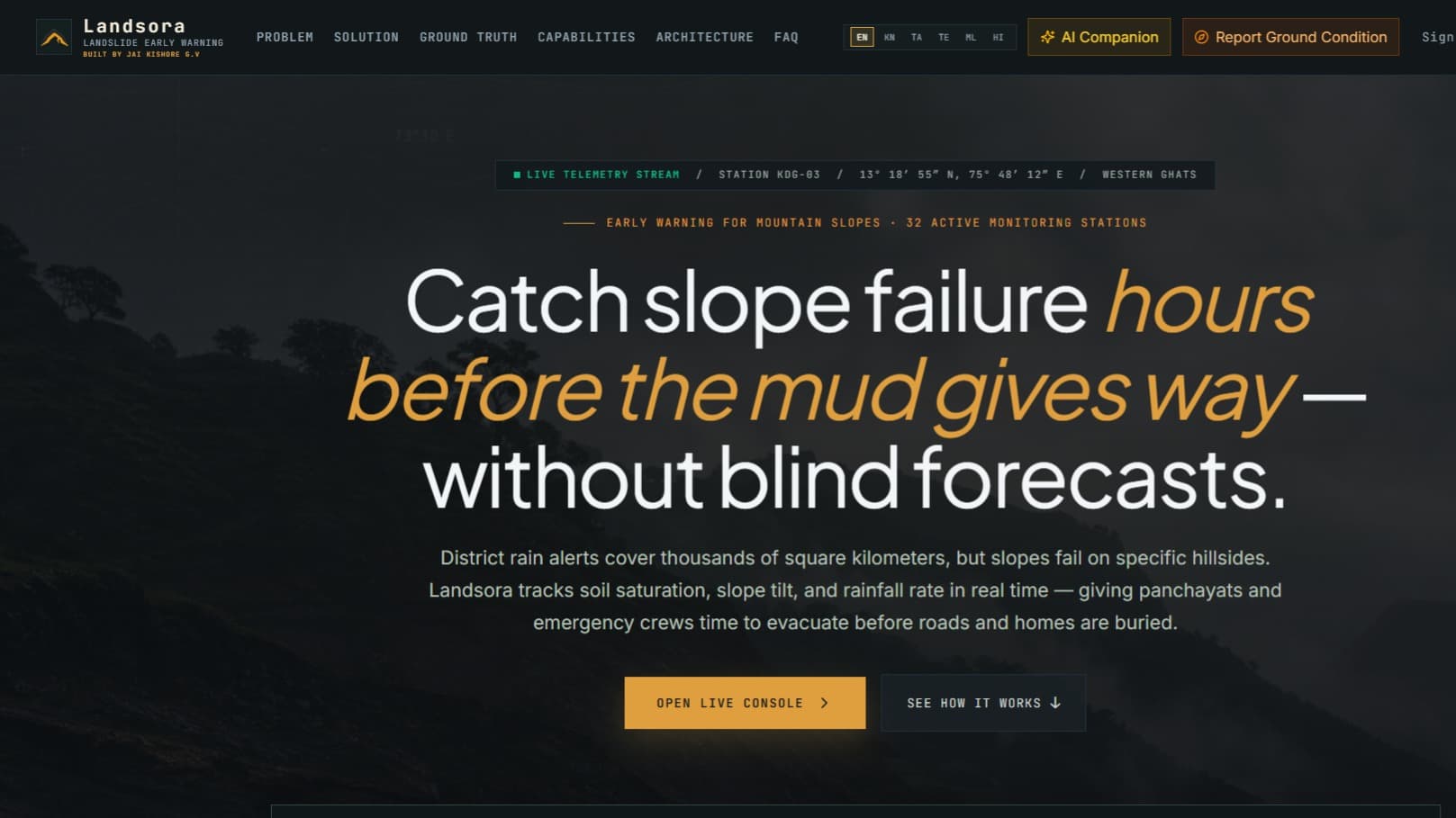
landSora

landSora

Landsora – Detailed Website Description Landsora is an AI-powered landslide prediction, risk monitoring, and early warning platform designed to help communities, authorities, and disaster-management teams identify and respond to potential landslide hazards before they become critical. The platform brings together important environmental and geographical factors such as rainfall, terrain characteristics, soil conditions, historical landslide information, and other environmental data to assess the likelihood of landslide activity in vulnerable regions. Instead of presenting complex environmental information in a difficult format, Landsora organizes it into an easy-to-understand interface that helps users quickly recognize areas that may require attention. A major feature of Landsora is its risk-mapping system, which can represent different levels of landslide risk on a map. Areas can be categorized into levels such as Low, Moderate, High, and Critical, allowing users to visually understand which locations are more vulnerable. This can help disaster-management teams prioritize monitoring and preparedness activities. The platform also focuses on early warning and decision support. When environmental conditions indicate an increased risk, the system can provide alerts so that appropriate preventive actions can be considered. By combining prediction, mapping, monitoring, and alerts in one platform, Landsora aims to reduce the impact of landslides and improve preparedness. Overall, Landsora acts as a centralized digital platform for landslide risk assessment and early warning, using AI and environmental data to transform complex information into understandable risk insights. Its goal is to support early detection, faster decision-making, better preparedness, and improved disaster-response planning, particularly in landslide-prone areas.

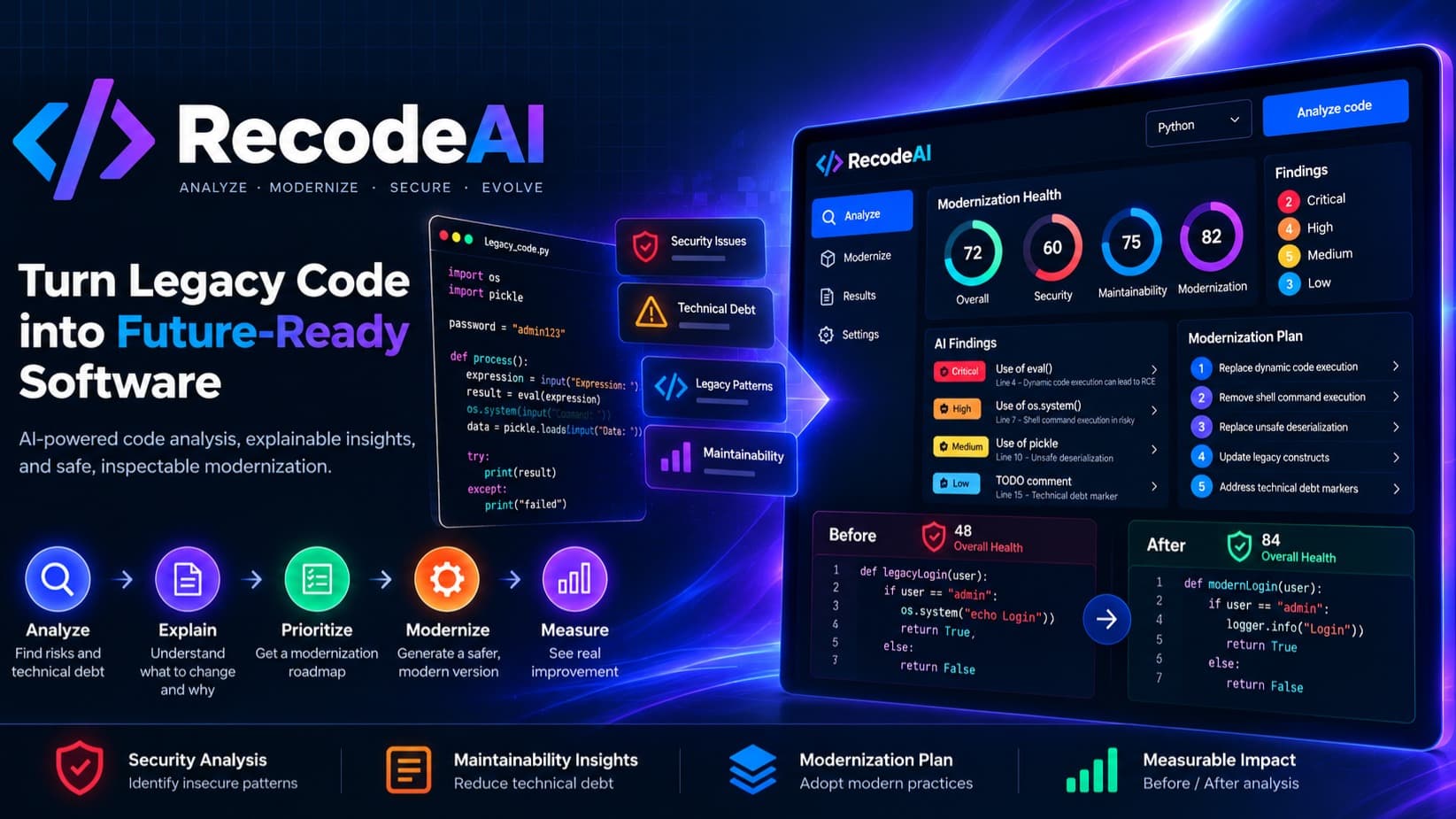
RecodeAI — Legacy Code Modernization Engine

RecodeAI — Legacy Code Modernization Engine

RecodeAI is an explainable legacy-code modernization platform designed to help developers understand, prioritize, and modernize aging software systems. Organizations and development teams often depend on legacy applications that still perform critical functions but contain outdated APIs, insecure programming patterns, deprecated language features, poor observability, and growing technical debt. Modernizing these systems manually is expensive and risky because developers must first understand what should change, why it should change, and whether a proposed modification could alter existing behavior. RecodeAI turns this process into an interactive modernization workflow. A developer submits legacy source code and selects its programming language. RecodeAI analyzes the code using a deterministic static-analysis engine and identifies modernization concerns across categories such as security, maintainability, legacy constructs, code quality, and observability. Each finding includes its severity, location, explanation, and recommended remediation. Rather than simply generating replacement code, RecodeAI calculates explainable security, maintainability, modernization, and overall health scores. It then converts its findings into a prioritized modernization plan so developers can understand which problems should be addressed first. For transformations that can be performed safely, RecodeAI can generate a modernized version of the source code and display a before-and-after diff. Potentially behavior-changing fixes are intentionally reported for developer review rather than being silently rewritten. The primary users are developers, engineering teams, students maintaining older applications, and organizations planning software modernization initiatives. What makes RecodeAI different is its focus on explainable and conservative modernization. Instead of treating legacy modernization as a black-box “rewrite my code” operation, RecodeAI separates detection, risk assessment, planning, transformation, and validation. This keeps developers in control while making modernization significantly faster and easier to understand. The MVP supports Python, Java, and JavaScript and is designed with an extensible analysis architecture so additional languages, modernization rules, and AI-assisted capabilities can be introduced without redesigning the core system.

GPT-4 Vision: Enhancing AI with Visual Understanding