GPT-3.5

GPT-3.5 is a set of models that improve on GPT-3 and can understand as well as generate natural language or code. It is an autoregressive language model (LLM) from OpenAI that uses deep learning to produce human-like text. It is a fine-tuned version of GPT-3, the third-generation language prediction model in the GPT series created by OpenAI. GPT-3.5 has garnered significant attention and acclaim for its unparalleled ability to understand and generate human-like text. With an astounding 175 billion parameters at its disposal, GPT-3.5 stands as one of the most expansive and powerful language models ever constructed at the time of its release.

GPT-3.5's exceptional performance is not only limited to its sheer size but also stems from its highly refined architecture. Harnessing the power of deep learning, GPT-3.5 delivers consistently accurate and relevant results, elevating the standard for language models and establishing itself as a trailblazer in the field of artificial intelligence.

General
Relese dateMarch 15, 2022
AuthorOpenAI
TypeAutoregressive, Transformer, Language model

Start building with OpenAI GPT-3.5

OpenAI GPT-3 has a rich ecosystem of libraries and resources to help you get started. We have collected the best GPT-3.5 libraries and resources to help you get started to build with GPT-3 today. To see what others are building with GPT-3, check out the community built GPT-3 Use Cases and Applications.

OpenAI GPT-3.5 Tutorials

OpenAI GPT-3.5 Boilerplates

Kickstart your development with a GPT-3.5 based boilerplate. Boilerplates is a great way to headstart when building your next project with GPT-3.


OpenAI GPT-3.5 Libraries

A curated list of libraries and technologies to help you build great projects with GPT-3.5.


GPT-3.5 top builders

Explore the top contributors showcasing the highest number of GPT-3.5 app submissions within our community.

OpenAI GPT-3.5 AI technology Hackathon projects

Discover innovative solutions crafted with GPT-3.5, developed by our community members during our engaging hackathons.

Architectural Pre-Flight

Architectural Pre-Flight

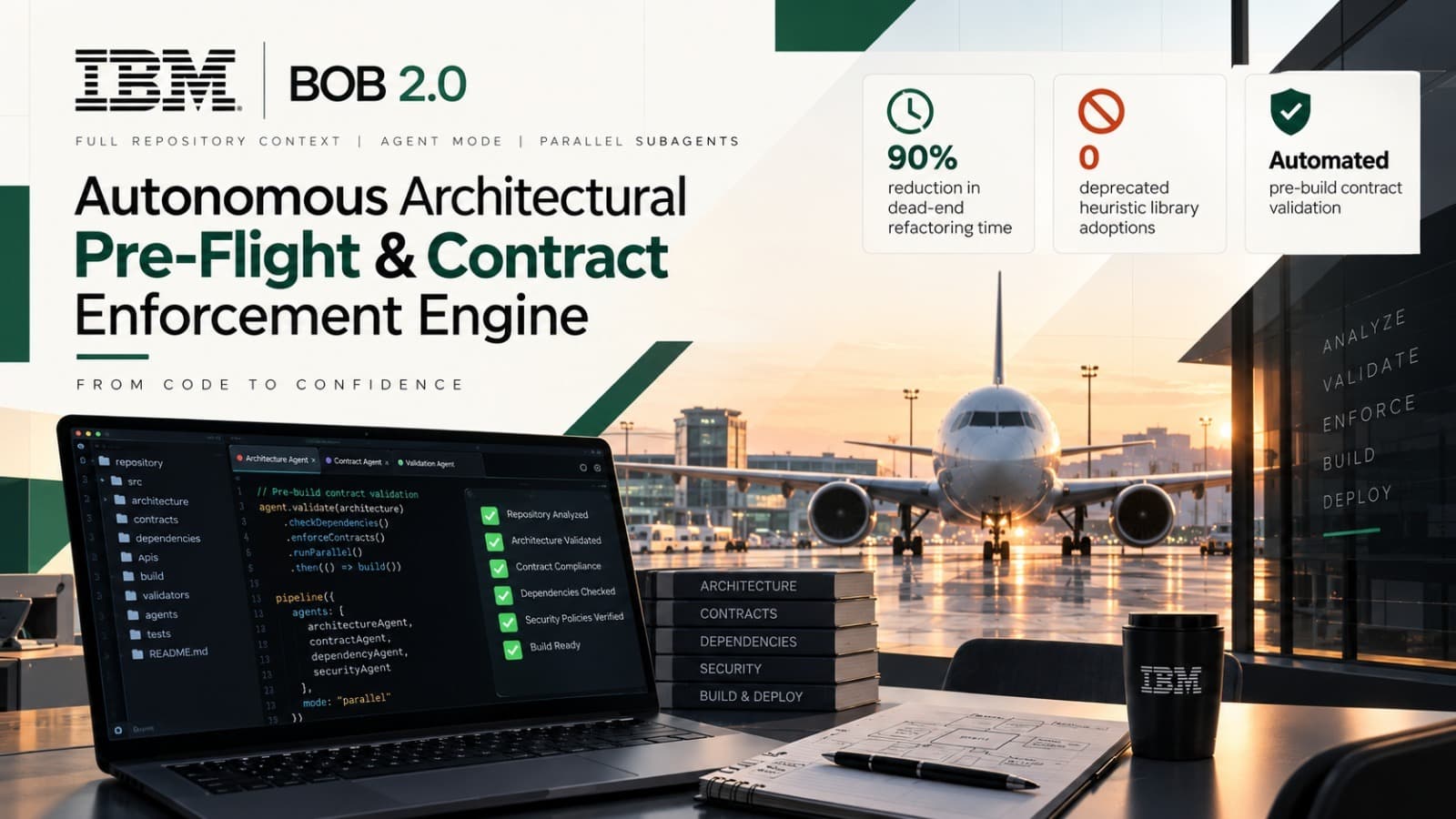
Problem and Challenge Modern AI coding agents and developers generate code faster than teams can manually validate its architectural consequences. This speed often bypasses repository context, resulting in broken service boundaries, duplicate abstractions, renamed fields that break downstream consumers, and deprecated dependencies. These issues are traditionally discovered only after implementation has already created high refactoring costs and technical debt. Solution Architectural Pre-Flight is an AI-assisted engineering governance layer built on IBM Bob 2.0 that sits before implementation. Instead of immediately allowing a coding agent to write code, the system ingests natural-language change requests, maps them against a repository knowledge graph, and runs parallel specialist subagents to evaluate architecture rules, contracts, dependencies, and downstream impact. Target Users Software developers working in large or unfamiliar repositories. Technical leads and architects needing enforceable guardrails. Engineering teams leveraging AI coding agents who want to prevent convention violations. How Users Interact With It Developers submit a natural-language change request via IBM Bob's Plan mode or CLI. The system executes parallel analysis across specialist agents, evaluating policies and contracts. It outputs a clear decision gate: PASS, REVIEW, or BLOCK. If blocked, developers review verifiable evidence, click to generate an AI remediation plan, approve the adjustments, and hand off execution to IBM Bob for compliant implementation and post-flight verification. Creativity and Uniqueness Unlike post-commit linters or traditional static analysis tools, Architectural Pre-Flight acts as an active pre-implementation decision gate. It uniquely combines repository-wide knowledge graphs, architecture-as-code policies, and IBM Bob 2.0's subagent orchestration to answer a fundamental question: Should this change be built at all? Effectiveness and Efficiency By shifting validation left of implementation, the platform targets a dramatic reduction in dead-end refactoring time, enforces zero tolerance for policy-violating dependencies, and achieves automated pre-build contract validation—turning AI coding from generate first, debug later into validate first, build confidently.

ReleaseRadar — AI Release Risk Analyzer

ReleaseRadar — AI Release Risk Analyzer

ReleaseRadar is an AI-powered release readiness platform designed to solve a common software engineering problem: release checks are often fragmented across code review, testing, and dependency analysis. Before releasing a change, developers may need to manually inspect code quality, verify whether the changed functionality has sufficient test coverage, and review dependency-related risks. These checks can take time, require multiple tools, and make it difficult to maintain one clear view of the overall release risk. ReleaseRadar brings these activities into one unified workflow. The platform uses three specialized AI analysis workflows: Code Review, Test Coverage Analysis, and Dependency Risk Analysis. These checks can operate in parallel and their findings are combined into a single release-confidence view. Instead of reading multiple disconnected reports, developers can understand what changed, which risks were detected, what needs attention, and whether additional review is required. The target users are software developers, engineering teams, release engineers, and teams working with CI/CD and Pull Request workflows. The user interacts with ReleaseRadar through a web dashboard. From the dashboard, a user can trigger an analysis, inspect the different risk categories, review AI-generated findings and recommendations, and understand the overall release status. The creative aspect of the project is the combination of multiple specialized AI checks into one release-readiness workflow. Rather than treating code review, testing, and dependency analysis as separate activities, ReleaseRadar treats them as complementary signals that contribute to one release decision-support layer. The project is built with a modern web architecture using a frontend dashboard and a Node.js/Express backend with REST APIs. The modular design allows individual analysis modules to be extended and integrated into future CI/CD or Pull Request workflows. The core concept is simple: One PR in. Three risks out. One unified release view.

NyayaSathi DevFlow

NyayaSathi DevFlow

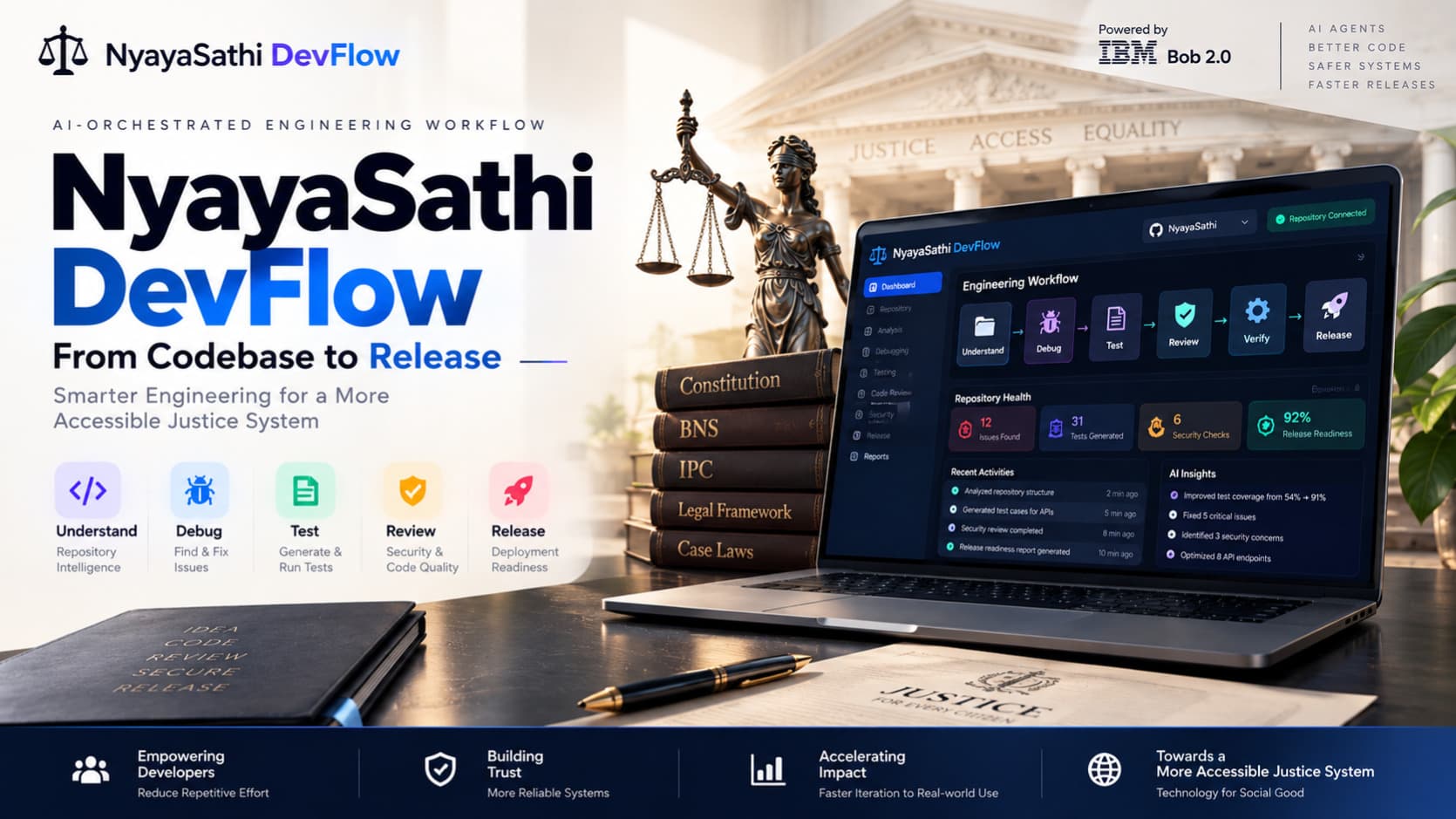
Modern AI applications are no longer simple codebases. They combine frontend applications, backend APIs, databases, external services, AI pipelines, dependencies, authentication, and configuration. As these systems evolve, developers spend significant time understanding repositories, locating bugs, writing tests, reviewing changes, investigating security issues, and validating whether a change is safe to release. NyayaSathi DevFlow addresses this problem by turning IBM Bob 2.0 into an AI-powered engineering workflow for the NyayaSathi platform. NyayaSathi is an AI-powered legal assistance application with intelligent legal information retrieval, document generation, multilingual assistance, and backend services. Its multi-component architecture provides a realistic environment for demonstrating how AI can assist developers throughout the software lifecycle. Instead of treating Bob as a simple coding chatbot, NyayaSathi DevFlow uses its agentic capabilities to coordinate a sequence of engineering tasks. The workflow begins with repository understanding, where Bob analyzes the project structure, dependencies, important modules, APIs, documentation, and configuration. Specialized tasks can then investigate bugs, identify missing test coverage, generate tests, review code, inspect security risks, and validate fixes. Parallel tasks and subagents allow different areas of the project to be investigated independently before their findings are consolidated. The developer interacts with the system through an engineering dashboard where they can initiate an audit, inspect findings, review AI-generated recommendations, execute tests, and track release readiness. Rather than replacing the developer, the system reduces repetitive investigation and verification work while keeping the developer in control of code changes and final decisions. The final workflow transforms a repository from an unfamiliar codebase into an actionable engineering report: understand the system, identify issues, generate or improve tests, review changes, verify fixes, and assess release readiness. The prototype demonstrates how IBM Bob 2.0 can move beyond code generation toward an orchestrated software-engineering workflow that improves developer productivity, reduces repetitive effort, and helps teams maintain complex AI-powered applications more systematically.

Technical Debt Detection & Remediation Assistant

Technical Debt Detection & Remediation Assistant

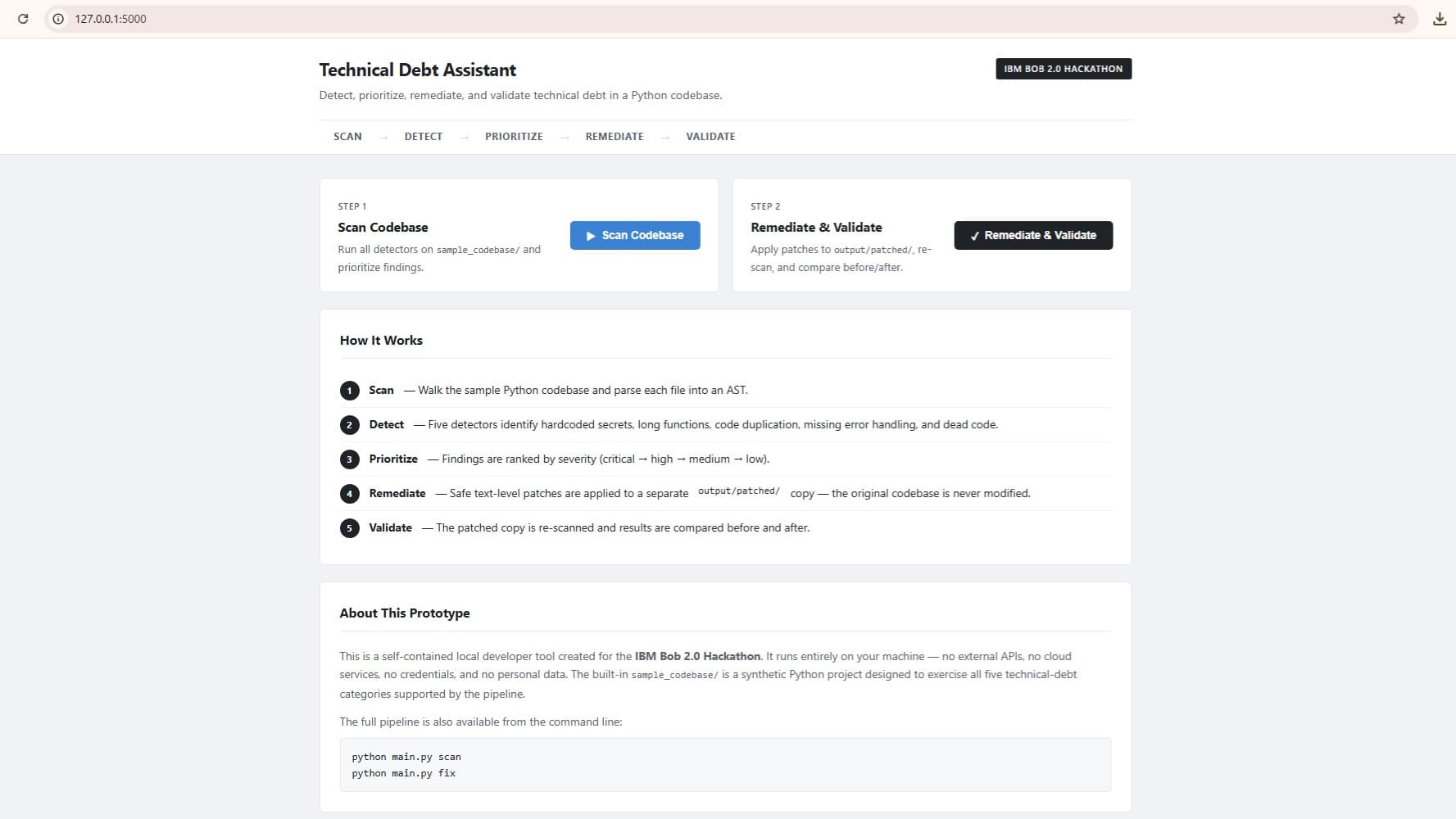
Problem: As codebases grow, developers can accumulate technical debt such as hardcoded secrets, duplicated code, long functions, missing error handling, and dead code. Finding, prioritizing, and addressing these issues manually can increase maintenance effort and rework. Solution: Technical Debt Detection & Remediation Assistant is a local developer tool that provides a complete workflow: Scan → Detect → Prioritize → Remediate → Validate. It analyzes a built-in synthetic Python codebase, detects five categories of technical debt, assigns severity levels, and presents the findings through a lightweight Flask web interface. The system then creates safe text-level remediation patches in a separate output/patched directory, leaving the original codebase unchanged. The patched code is rescanned to validate the changes and compare the results before and after remediation. In the demonstrated sample, the system identifies 10 findings, including 1 critical, 3 high, 1 medium, and 5 low-severity findings. After remediation, 8 findings are resolved and 2 remain, with the remaining limitations clearly reported. Target users: Developers and students working with Python codebases who want a simple way to understand and address common technical-debt issues. Creative approach: Rather than only reporting problems, the project connects detection with prioritization, remediation, and validation in one workflow. It also uses a safe separate patched copy so the original sample codebase is preserved. The prototype runs locally with no external APIs, cloud services, credentials, or personal data.