GPT-5

Overview

Launched on August 7, 2025 by OpenAI, GPT-5 serves as the company’s new flagship general-purpose model, replacing previous versions such as GPT-4o, GPT-4.5, GPT-4.1, and the o-series models. Available to both free and paid ChatGPT users, as well as through the OpenAI API, GPT-5 introduces a dynamic, intelligent routing system that selects the optimal reasoning pathway for each input.

OpenAI positions GPT-5 as a significant step toward artificial general intelligence (AGI)—not because it embodies AGI—but as an advanced iteration improving reasoning, utility, and personalization.


Key Features

  1. Intelligent Model Routing
    GPT-5 operates as a unified architecture consisting of a fast, high-throughput model (e.g., gpt-5-main, gpt-5-main-mini) paired with deeply reasoning variants (e.g., gpt-5-thinking, gpt-5-thinking-mini, gpt-5-thinking-nano, gpt-5-thinking-pro). A real-time router automatically assigns the best variant per query.

  2. Massive Context Window
    Capable of handling extremely large input sequences—up to 256,000 tokens in some configurations—GPT-5 supports extended dialogue, document-level tasks, and complex reasoning.

  3. Multimodal Proficiency
    GPT-5 natively processes text, images, audio, and video inputs and outputs, enabling more nuanced, context-aware interaction across formats.

  4. Advanced Reasoning & Safety

    • Significantly reduces hallucinations—about 45% fewer factual errors compared to GPT-4o.
    • Introduces “safe completions,” offering partial or safer responses when faced with unsafe or poorly specified requests.
    • Emphasizes transparency—GPT-5 is designed to admit its limitations and avoid misleading or overly flattering responses.
  5. Personality Customization
    Users can select chat personalities like Cynic, Robot, Listener, or Nerd to influence tone and engagement style.

  6. Balanced Speed & Depth
    GPT-5 automatically calibrates how much “thinking” is needed versus quick responses, eliminating the traditional speed-intelligence trade-off.

  7. Developer & API Enhancements

    • Offers variants tailored for developers: full model, mini, nano, with decreasing compute cost but respectable capability.
    • Introduces new parameters like “verbosity” and “minimal reasoning” modes in its API.
    • Powers advanced agentic tasks—writing UI, generating structured code, tool chains, and full applications with minimal prompting.
  8. Extended Ecosystem Integration

    • Integrated into ChatGPT, Microsoft Copilot, and accessible via OpenAI API.
    • Embedded into productivity tools like Gmail, Google Calendar, Teams, GitHub via “Connectors” (beta since August 11).
    • Adopted by enterprises such as Uber, BBVA, Oscar Health, GitLab, Notion, and others.

Variants and Access Tiers

Variants

  • Full (Standard) GPT-5 – Highest capability for deep reasoning and complex tasks.
  • Mini – Compact, cost-effective, yet powerful variant.
  • Nano – Ultra-lightweight for high-volume, low-latency use cases; may be up to 25x less expensive than full model.
  • Thinking Variants – Include gpt-5-thinking, thinking-mini, thinking-nano, and thinking-pro (the latter available via parallel test-time compute in ChatGPT).

Access Tiers

  • Free Users: Default access to mini or limited usage; GPT-5 is available with usage caps.
  • Plus Subscribers: Higher usage limits and access to legacy model choices (like GPT-4o) restored due to user demand.
  • Pro Users: Full access including GPT-5 Pro capabilities and unlimited usage.

Applications

  • Coding & Software Development – Exceptional for coding tasks, from writing to debugging to generating front-end UI.
  • Content & Writing – Enhanced prose, contextual awareness, tone customization via personalities.
  • Research & Complex Reasoning – Handles academic-grade logic, math, multi-step workflows owing to deep reasoning support.
  • Multimodal Projects – Support across text, image, audio, video makes GPT-5 suitable for richer media tasks.
  • Productivity Workflows – Automations integrated into calendar, email, coding, and enterprise tasks.
  • Safety-sensitive Domains – The “safe completions” mechanism and deeper reasoning support safer handling of sensitive queries.

Reception & Critique

Praise

Lauded for smoother user experience, advanced reasoning, improved safety, and broad accessibility. CEO Sam Altman called it “the best model in the world” and “a significant step” toward AGI.

Criticisms

  • Some users found the conversational tone “colder,” less emotionally engaging than GPT-4o.
  • Occasional inconsistencies due to router misconfigurations were reported; OpenAI acknowledged and corrected these glitches.
  • Analysts noted its evolutionary rather than revolutionary nature—more refined than transformative.

GPT-5 top builders

Explore the top contributors showcasing the highest number of GPT-5 app submissions within our community.

OpenAI GPT-5 AI technology Hackathon projects

Discover innovative solutions crafted with GPT-5, developed by our community members during our engaging hackathons.

CommerceOS

CommerceOS

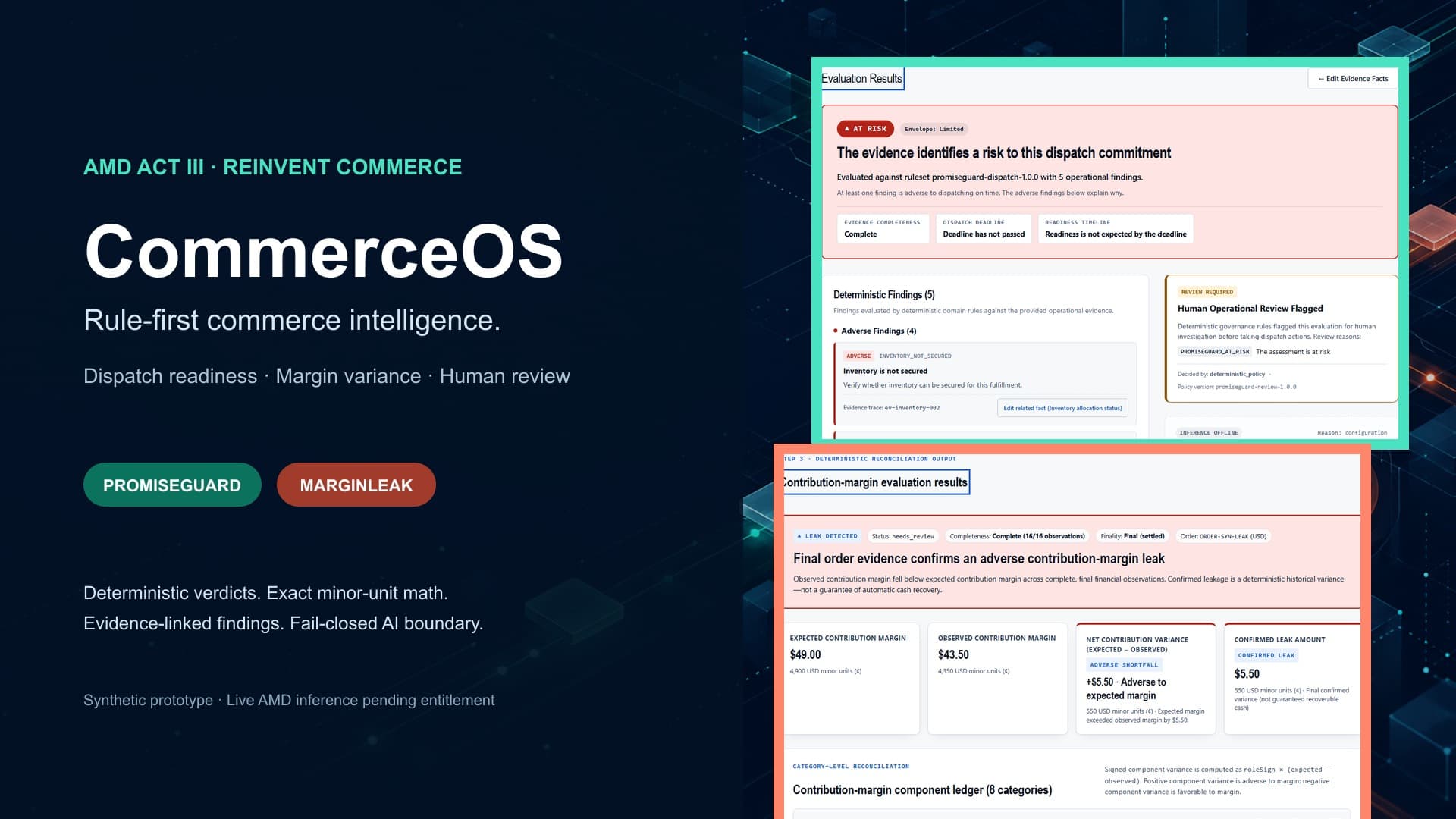
CommerceOS — Evidence-First Commerce Intelligence CommerceOS is a unified decision-support platform designed to help e-commerce businesses improve operational reliability and understand where order profitability changes. PromiseGuard analyzes inventory readiness, fulfillment conditions, delivery commitments, deadlines, and operational blockers. It determines whether an order's dispatch promise is supported, at risk, or indeterminate, providing explainable findings and human-review guidance. MarginLeak identifies contribution-margin discrepancies by comparing expected and observed order economics across eight revenue and cost categories. It uses precise financial calculations to distinguish confirmed margin leakage, favorable cost offsets, provisional evidence, and missing information. Instead of inventing numbers, it clearly communicates uncertainty. Both modules follow a deterministic, evidence-first architecture with transparent evaluation rules, structured contracts, and traceable outcomes. The application includes an interactive synthetic PromiseGuard demonstration and a development-only MarginLeak analysis workspace. Production restrictions prevent unfinished capabilities from being presented as operational. Built using Next.js, React, TypeScript, Zod, and automated testing, CommerceOS is deployed on Vercel and released under the MIT license. The architecture also provides a secure boundary for optional future AI-generated recommendations. AMD Token Factory authentication remains pending organizer authorization; live AMD inference has not yet been activated. Our vision: Make commerce decisions more reliable, financially transparent, and accountable, while keeping human oversight at the center of critical business operations.

FactoryMind AI — Model Trust Lab

FactoryMind AI — Model Trust Lab

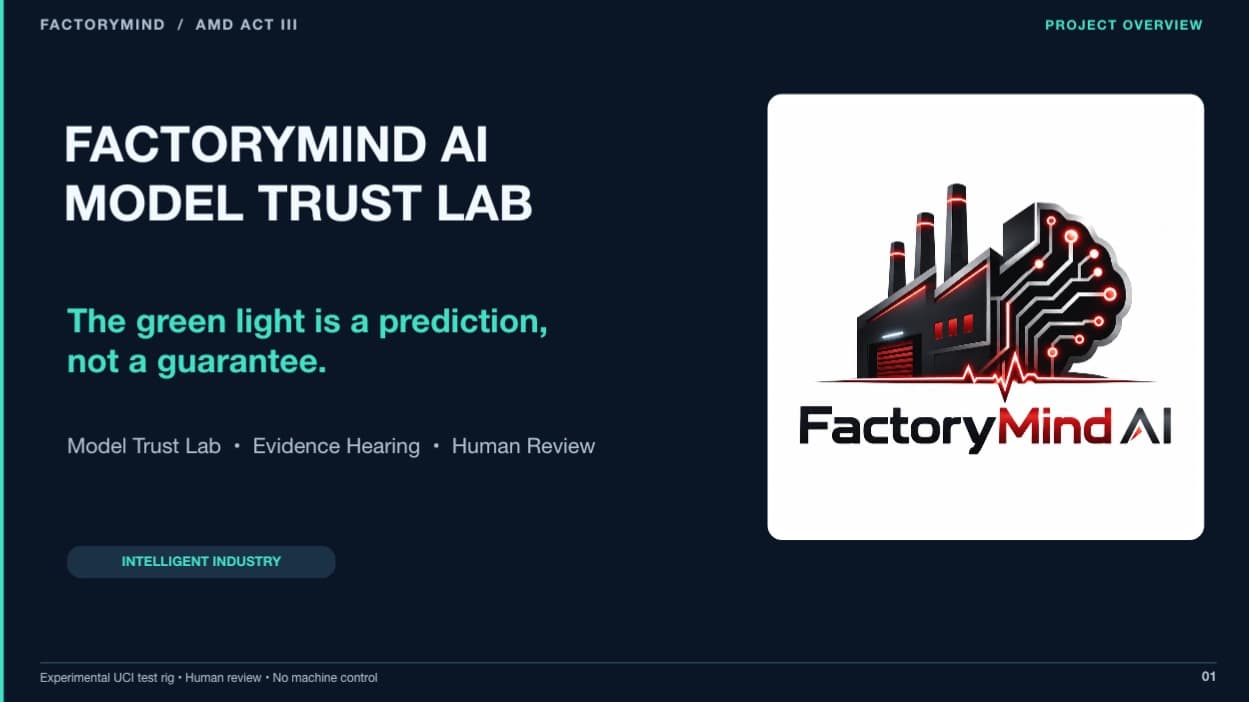
FactoryMind AI — Model Trust Lab helps maintenance engineers, reliability teams, and factory operations managers evaluate machine-learning predictions before acting on them. It addresses a practical risk: a green “Healthy” prediction can still be wrong when operating cycles are correlated and accuracy overstates reliability. The prototype uses the UCI Condition Monitoring of Hydraulic Systems dataset: 2,205 one-minute hydraulic test-rig cycles and 30 engineered pressure, flow, temperature, and vibration features. A Random Forest predicts valve condition. Random holdout accuracy is 98.01%, while five-fold blocked validation with purging reports 82.86%. Across blocked folds, 260 non-optimal cycles were incorrectly classified as Optimal. FactoryMind prioritizes these false-green predictions for human review. At a 20% review budget, confidence ranking identifies 136 of the 260 errors by reviewing 266 of 1,344 predicted-healthy cycles. The Model Trust Lab also tests 50 hypothetical sensor-gain scenarios. Stable predictions can still be wrong, and the initial stress-based ranking did not outperform confidence-only review. This negative result is reported openly. For each selected cycle, an operator can inspect sensor evidence, review the prediction, request an AMD Token Factory Evidence Hearing using DeepSeek-V4-Flash, and approve or reject an inspection recommendation. The hosted model selects evidence and safe review checks from a bounded schema; measurements come from the recorded experiment. Decisions are stored in SQLite and exported as checksum-verified evidence records. No machine-control commands are issued. FactoryMind demonstrates evidence-first model review for industrial maintenance workflows. Results are retrospective test-rig measurements, not proof of factory safety, downtime reduction, or cost savings. Physical validation, independent-rig testing, calibration, security controls, and operator studies are required before real-plant deployment.

AnalystOS — Your AI-Powered Business Analyst

AnalystOS — Your AI-Powered Business Analyst

AnalystOS — From Questions to Clarity Businesses have plenty of data, but finding meaningful answers is still difficult. Dashboards show what is happening, yet understanding why often requires hours of analysis, technical expertise, and investigation across multiple data sources. AnalystOS is your AI-powered business analyst, helping turn business questions into evidence-backed insights. Ask questions in plain language, such as “Why did sales decline this month?” AnalystOS helps investigate the question, examine relevant data, explore contributing factors, and bring the findings together into an understandable outcome. More than a chatbot, AnalystOS provides a workspace for ongoing investigations. Each Analysis preserves relevant discoveries, assumptions, decisions, unresolved questions, and analytical assets, allowing users to revisit previous work and build on it through follow-up conversations. Key capabilities: • Investigate business questions beyond a single response. • Explore the factors behind sales, customer, product, and marketing trends. • Connect findings to supporting evidence, queries, and results. • Preserve analytical context across conversations. • Create reusable assets, including findings, tables, charts, and queries. • Keep people in control of conclusions and business decisions. Designed initially for commerce analytics, AnalystOS helps teams explore business performance without requiring every user to write queries or understand complex database structures. Our vision is to make business intelligence an ongoing process of asking better questions, investigating evidence, and building lasting knowledge. AnalystOS brings this process into one intelligent workspace, helping businesses spend less effort finding answers and more effort understanding what those answers mean.

MediGuide AI Multilingual Healthcare Intelligence

MediGuide AI Multilingual Healthcare Intelligence

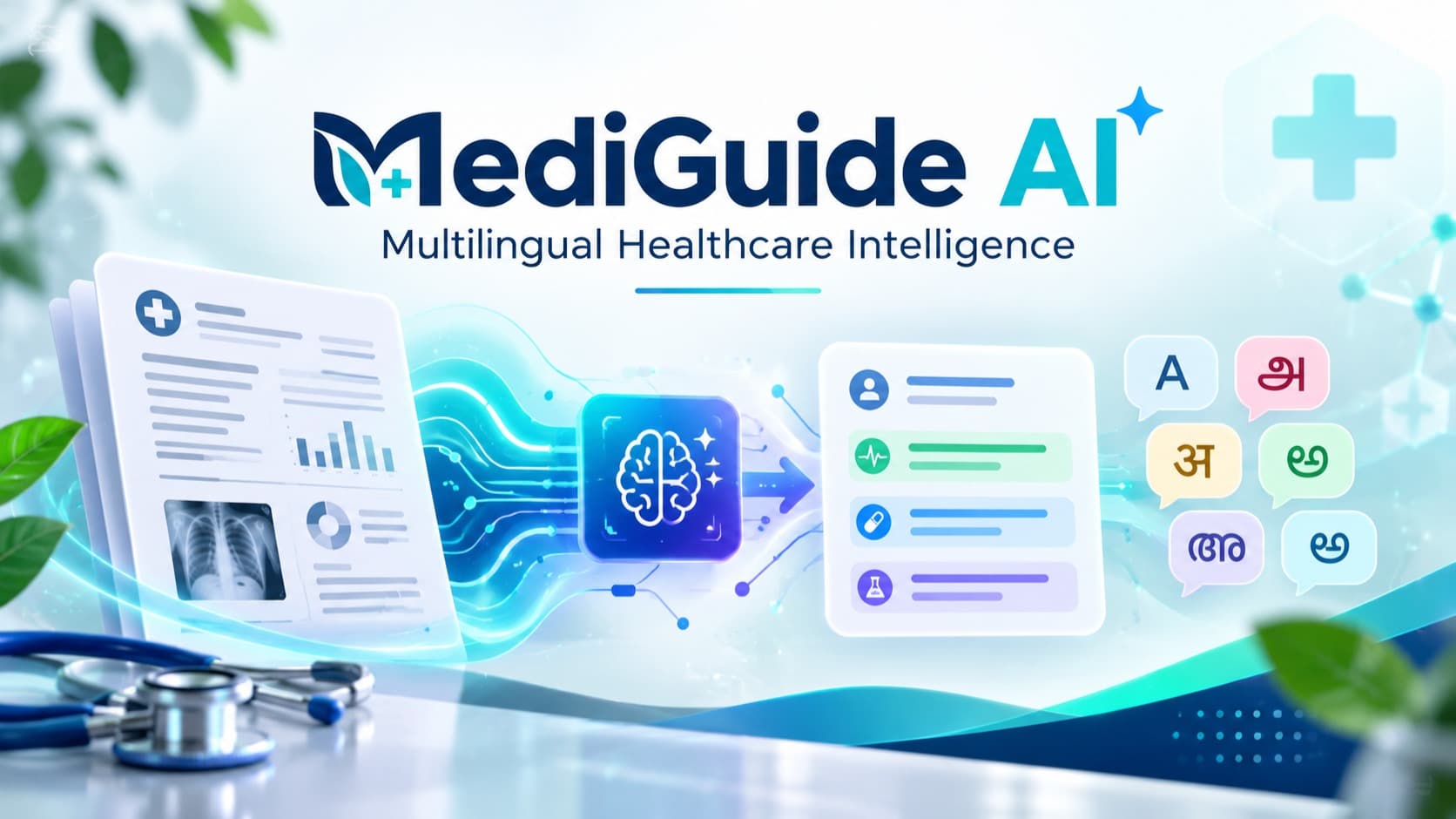
## MediGuide AI – Multilingual Healthcare Intelligence MediGuide AI is an AI-powered healthcare accessibility platform designed to help patients understand complex medical reports in their preferred language. ### The Problem Medical reports often contain complex terminology that patients struggle to understand. Language barriers can make healthcare information even more difficult to access, affecting patients' ability to prepare for consultations and ask informed questions. ### Our Solution MediGuide AI transforms medical documents into more accessible, patient-friendly information through an intelligent document-processing pipeline. ### Key Features - **Medical Document Extraction:** Uses PaddleOCR and text extraction to process uploaded medical reports. - **Clinical Entity Recognition:** Identifies important medical terms and entities using a pretrained biomedical NER model. - **Report Summarization:** Produces concise summaries to make medical information easier to review. - **Multilingual Accessibility:** Supports English, Tamil, Hindi, Telugu, Malayalam, and Kannada. - **AI Health Assistant:** Helps patients understand medical terminology and prepare questions for their doctors. - **Emergency Awareness:** Detects potentially urgent symptom descriptions and advises users to seek appropriate medical care. ### Technology Stack - Frontend: React - Backend: Python, FastAPI - OCR: PaddleOCR and PyMuPDF - NLP: Transformers and biomedical named entity recognition - Database: SQLite - Multilingual processing: Local language detection and translation components ### Innovation and Impact MediGuide AI combines medical document processing, clinical NLP, summarization, and multilingual accessibility in one platform. It aims to reduce language barriers and help patients participate more confidently in healthcare discussions. MediGuide AI is an educational support tool, not a replacement for professional medical advice, diagnosis, or treatment.