OpenAI gym

Gym is a toolkit from OpenAI that offers a wide array of simulated environments (e.g. Atari games, board games, 2D and 3D physical simulations) for you to train agents, benchmark them, and create new Reinforcement Learning algorithms.

General
Relese dateApril 27, 2016
AuthorOpenAI
Repositoryhttps://github.com/openai/gym
TypeReinforcement Learning

Libraries

A curated list of libraries and technologies to help you play with OpenAI Gym.

  • Gym Library Gym is a standard API for reinforcement learning, and a diverse collection of reference environments
  • OpenAI Gym repository Gym is an open source Python library for developing and comparing reinforcement learning algorithms by providing a standard API to communicate between learning algorithms and environments, as well as a standard set of environments compliant with that API. Since its release, Gym's API has become the field standard for doing this.
  • Gymnasium Gymnasium is an open source Python library for developing and comparing reinforcement learning algorithms by providing a standard API to communicate between learning algorithms and environments, as well as a standard set of environments compliant with that API. This is a fork of OpenAI's Gym library

OpenAI gym top builders

Explore the top contributors showcasing the highest number of OpenAI gym app submissions within our community.

OpenAI OpenAI gym AI technology Hackathon projects

Discover innovative solutions crafted with OpenAI gym, developed by our community members during our engaging hackathons.

Ariadne

Ariadne

Ariadne is a production-grade, proof-grounded web information retrieval agent. Most LLM-based web agents suffer from a critical flaw: they hallucinate. When they cannot find an answer, they guess, leaving users with confident but fabricated lies. Ariadne solves this using a strict "Proof or Silence" architecture. When given a starting URL and a natural language question, Ariadne navigates the website using information-scent scoring. It extracts candidate answers using a three-tier pipeline: deterministic schema.org JSON-LD parsing, LLM-based reading comprehension (via the Gemini API), and a conservative rule-based fallback. Crucially, Ariadne is built with generator-verifier separation. The LLM that extracts the answer is never allowed to declare it correct. An independent Verifier enforces a strict verbatim-quote gate (the quote must exist exactly in the fetched HTML), an attribute-attachment gate, and an independent entailment check. If any gate fails, the agent explicitly returns "not_found". Every successful query returns a "proof object" containing the answer, the exact source quote, the URL, and a SHA-256 content hash, ensuring 100% auditability. If no proof exists, it refuses to guess. Engineered for hostile web environments, Ariadne includes SSRF guards to block private IP fetching, NFC Unicode normalization for international text matching, and strict body-size limits to prevent DOM/resource exhaustion. Packaged on the mandated ROCm base image, Ariadne leverages GPU-accelerated inference via Gemini, ensuring rapid, deterministic, and hallucination-free retrieval that enterprise applications can actually trust.

SnapSell

SnapSell

SnapSell helps individual resellers turn a video of their goods into a practical selling workflow. Upload an English-narrated inventory video, review AI-extracted product drafts and photos, research comparable asking prices, and prepare listings for eBay, Facebook Marketplace and Craigslist. AMD Token Factory powers visual inventory extraction, product identity research, research planning, buyer-intent classification and evidence summaries. Local Whisper transcribes narration. Task-specific routing, bounded concurrency and intent reuse reduce repeated inference, while an execution dashboard exposes measured usage. The application uses Next.js, a Python backend and persistent SQLite storage. Pricing is computed from retrieved merchant evidence rather than invented by a language model: matching-source requirements, merchant-balanced recency weights, outlier filtering and weighted quartiles produce asking-price positions constrained by recorded costs, fees and seller minimums. Asking prices are clearly distinguished from completed sales, and forecasts remain unavailable without sufficient observed outcomes. Sellers review listing kits and buyer reply drafts before using them. Facebook Marketplace and Craigslist posting is manual; eBay API publication requires configured developer credentials and seller authorization. Pickup scheduling, Google Calendar integration and recorded sale contribution connect preparation to measurable outcomes. Contribution is calculated from actual recorded sale price, fees and acquisition cost; revenue uplift has not yet been established. Built on the MIT-licensed CollinQ/sbhacks2025 foundation, SnapSell extends video-to-listing automation into an evidence-based commerce workspace for Track 3: Reinvent Commerce.

DevPilot — AI Developer Project Doctor

DevPilot — AI Developer Project Doctor

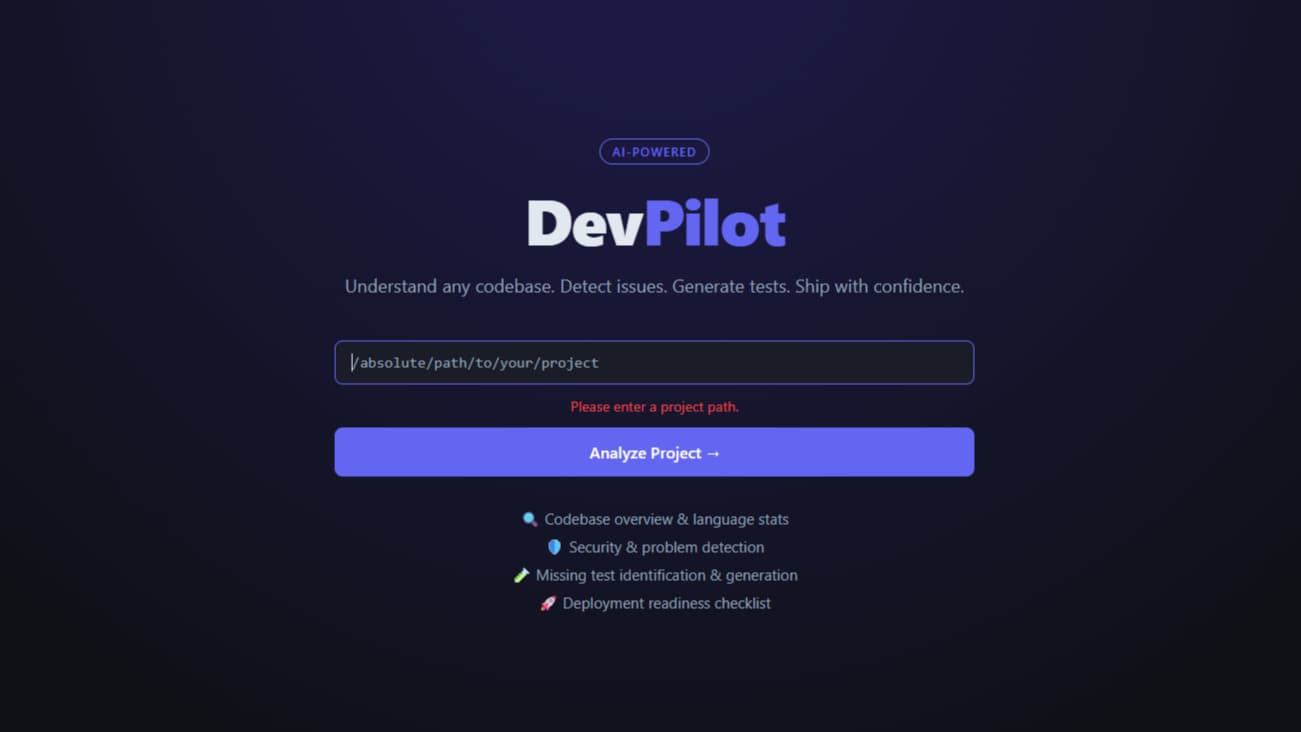
DevPilot is an AI-assisted developer productivity tool designed to help developers understand an existing software project and identify problems before they reach deployment. Developers working with unfamiliar or growing codebases often have to manually understand project structure, search for potential code issues, determine where tests are missing, and verify whether a project is prepared for deployment. This process can be time-consuming and easy to overlook. DevPilot provides a single workflow for these tasks. A developer enters the local project path, and DevPilot analyzes the codebase and presents the results through an interactive dashboard. The solution performs real local project analysis, including file and line statistics, programming-language detection, technology-stack detection, and a structured project file tree. It then performs real pattern-based issue detection to identify potential problems such as hardcoded credentials, unsafe eval usage, bare exception handling, debugging statements, console logging, shell execution patterns, TODO/FIXME markers, and hardcoded external HTTP URLs. DevPilot also identifies potential test gaps by detecting functions in source files that do not have corresponding test files. It generates starter test skeletons for Python using pytest and JavaScript/TypeScript using Jest or Vitest. The resulting coverage value is presented as a heuristic estimate based on test-file presence rather than executed test coverage. The deployment-readiness module checks real project files and directories for configuration, containerization, CI/CD, documentation, dependencies, version control, and testing indicators. It produces a readiness score and identifies deployment blockers. The final AI Insights experience derives actionable insights from the real analysis results, including security findings, test coverage concerns, deployment blockers, code-quality observations, and project statistics. The target users are developers, students, engineering teams, and anyone working with an unfamiliar or evolving software project. What makes DevPilot distinctive is the combination of several developer-maintenance workflows into one simple project-health experience: understand the codebase, find problems, identify testing gaps, and assess deployment readiness from one analysis. The project was developed iteratively with IBM Bob 2.0 as a core development tool, using it for planning, implementation, debugging, validation, and refinement throughout the development process.

Bimanual VLA on Intel

Bimanual VLA on Intel

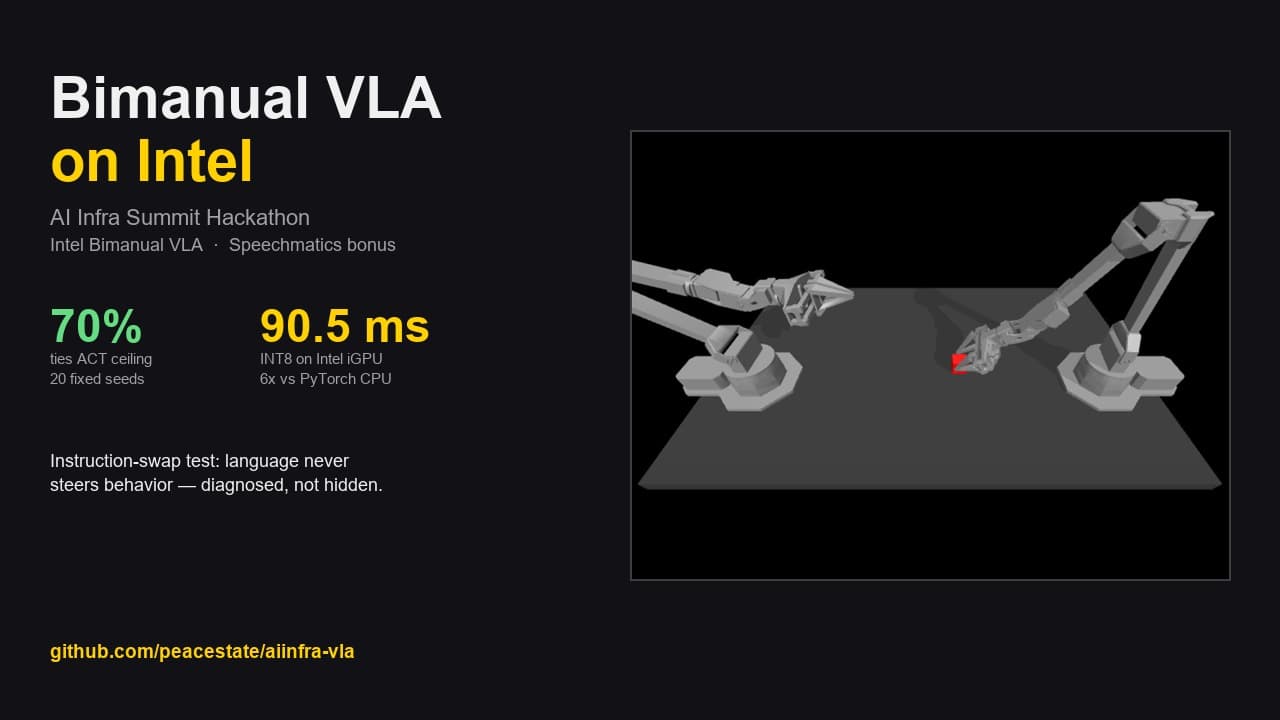
We trained LangACT — stock ACT (a 52M-parameter bimanual manipulation policy) with a language instruction written into an internal slot the architecture already has but never uses. This costs 0.2% more parameters and 0ms of inference time, since the instruction is a known string embedded once and cached. Trained from 15,000 to 200,000 steps across 5 chained Kaggle T4 sessions, it reaches 70% closed-loop success on the standard AlohaTransferCube-v0 bimanual benchmark (MuJoCo, 20 fixed seeds) — tying the no-language ACT baseline exactly. Then we ran the test that actually matters: the instruction-swap test. Feed the model the wrong instruction while running the same task. If language steers behavior, success should collapse. We ran this at three checkpoints (125k, 150k, 200k steps). At 150k and 200k, the swapped-instruction run produced the exact same per-seed outcomes as the correct instruction — every time. We diagnosed why: every training episode pairs one task with one instruction 1:1, so the visual scene alone fully determines behavior, and nothing ever rewards reading the sentence. Rather than hide this, we built the voice interface around it. Speechmatics STT transcribes the spoken command, keyword matching resolves it to a known task, and that task actually runs — Speechmatics TTS confirms the true outcome. If asked for a task the system can't do (peg insertion, measured 0/20), it declines honestly instead of failing silently. Exported to OpenVINO INT8 (NNCF, 3.9x smaller), verified with official benchmark_app numbers: 239ms (fp32 CPU) to 71ms (INT8, Intel iGPU) — a real 3.4x speedup, on our own Core i3 laptop, no NPU, disclosed plainly. Fully reproducible: public checkpoint, verified end-to-end from a fresh clone.

Fresno LUX: A Living City

Fresno LUX: A Living City

Fresno LUX is a prototype for a living intelligence layer across an entire city. Fresno already contains enormous amounts of intelligence: residents know where problems exist, nonprofits know where help is needed, businesses know where opportunities exist, educators understand gaps in learning, researchers generate knowledge, and government maintains critical infrastructure and data. The problem is that much of this intelligence is fragmented across disconnected systems. Fresno LUX connects those pieces. The platform creates a shared city graph where people, organizations, resources, needs, projects, observations, experiments, and outcomes become connected nodes. Instead of simply collecting data, LUX continuously asks: What is happening? What do we know? What is missing? What can we test? What changed? A community problem can become an observable signal. That signal can become an experiment. The experiment produces evidence. Evidence changes the system's understanding. That updated understanding informs the next action. Observe → Connect → Understand → Act → Measure → Learn → Converge. The goal is to move Fresno from disconnected information toward collective intelligence—a system where knowledge can travel across boundaries and successful solutions can be discovered, tested, measured, and replicated. LUX is designed to make the invisible connections visible: the relationship between a neighborhood and its resources, between a student and educational opportunity, between a business and workforce capacity, between environmental conditions and community health, and between an idea and measurable real-world impact. This hackathon prototype demonstrates the beginning of a Living Fresno Graph: a city that can observe itself, learn from evidence, and coordinate toward better outcomes.