OpenAI Shap-E

Shap-E directly generates the parameters of implicit functions that can be rendered as both textured meshes and neural radiance fields

General
Relese dateMay, 2023
AuthorOpenAI
Research Paperhttps://arxiv.org/abs/2305.02463
Repositoryhttps://github.com/openai/shap-e
Typeconditional generative model for 3D assets

OpenAI Shap-E Tutorials


Libraries

A curated list of libraries and technologies to help you play with OpenAI Shap-E.

Shap-E top builders

Explore the top contributors showcasing the highest number of Shap-E app submissions within our community.

OpenAI Shap-E AI technology Hackathon projects

Discover innovative solutions crafted with Shap-E, developed by our community members during our engaging hackathons.

LaunderGraph: AI-Powered AML Investigation

LaunderGraph: AI-Powered AML Investigation

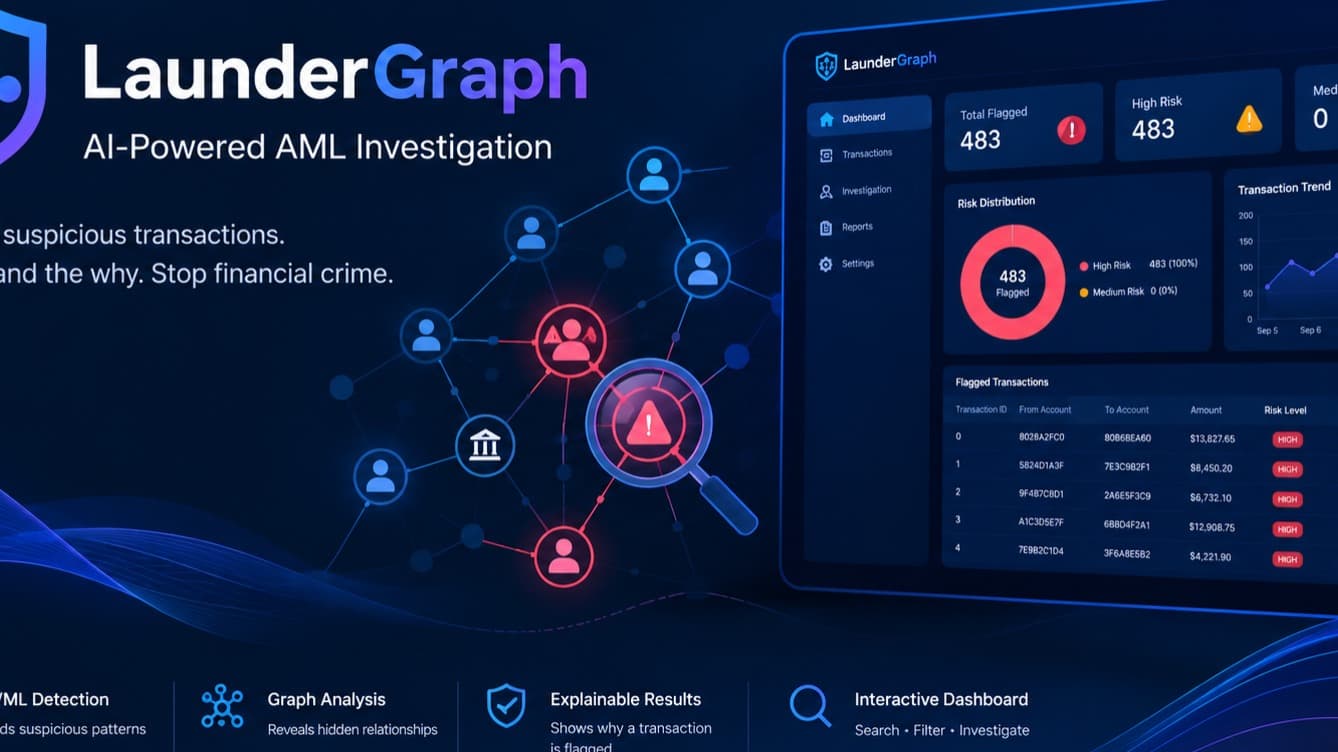
Money laundering can involve complex transaction patterns that are difficult to identify through manual review alone. Financial institutions and investigators may need to examine large volumes of transactions while distinguishing genuinely suspicious activity from normal financial behavior. This creates challenges in scalability, prioritization, and explainability. LaunderGraph addresses this problem through an AI-powered Anti-Money Laundering investigation platform. The system processes transaction data, constructs relationships between accounts, engineers transaction and graph-based features, and applies machine-learning techniques to identify transactions that may require further investigation. Instead of simply producing a binary prediction, LaunderGraph provides an investigation-oriented risk output. Each flagged transaction includes a risk score, risk level, and contributing reasons so that investigators can understand why the system considered a transaction suspicious. The system also provides an interactive dashboard where users can view flagged transactions, search and filter cases, examine transaction details, and organize investigations. The target users are AML analysts, financial investigators, compliance teams, and organizations that need to review large transaction datasets efficiently. Users interact with the system through the dashboard, where they can explore flagged transactions, inspect account-to-account activity, review risk explanations, and manage investigation information. What makes LaunderGraph distinctive is its combination of transaction analysis, graph-based financial relationships, machine-learning detection, and explainability within one investigation workflow. Rather than treating the model as a black box, the platform exposes meaningful reasons behind its risk signals, helping investigators focus their attention where it is most needed. The system is designed as a modular pipeline: transaction preprocessing, feature engineering, graph construction, ML-based detection, explainability, backend APIs, and an interactive frontend dashboard. This allows the analytical pipeline and investigation interface to work together while remaining extensible for future improvements. LaunderGraph is intended to support investigators rather than replace human judgment. A flagged or high-risk transaction is an investigation signal, not proof of money laundering. The goal is to reduce the effort required to identify and investigate potentially suspicious activity while making the process more transparent and scalable

MalwareLens: Explainable Android Malware Detection

MalwareLens: Explainable Android Malware Detection

Android malware detection often ends with a simple classification label, leaving users with little insight into why a model reached that decision. MalwareLens addresses this interpretability gap by combining behavioral machine learning with explainable AI. MalwareLens uses 470 behavioral features from the CICMalDroid 2020 dataset and a HistGradientBoosting classifier to distinguish five categories: Adware, Banking malware, SMS malware, Riskware, and Benign. The final model achieved 96.72% accuracy and a 0.9607 macro F1 score on a locked test set. During dataset preparation, duplicate and conflicting feature vectors were identified and handled, followed by a group-aware stratified split to prevent feature-vector leakage between training and testing. The key feature of MalwareLens is explainability. For every prediction, the application provides class probabilities and SHAP-based feature contributions, showing which behavioral signals pushed the model toward or away from a class. These explanations are presented in the model's raw boosting-score space and are intended to explain the model's reasoning rather than serve as proof that an individual behavior is malicious. The project is deployed as a Streamlit web application and supports validated behavioral-feature CSV inputs and demo test cases. It also includes a CopperDroid-style JSON feature extractor for compatible structured behavioral reports. MalwareLens does not currently execute or directly analyze arbitrary APK files; it operates on extracted behavioral information.

Fresno LUX: A Living City

Fresno LUX: A Living City

Fresno LUX is a prototype for a living intelligence layer across an entire city. Fresno already contains enormous amounts of intelligence: residents know where problems exist, nonprofits know where help is needed, businesses know where opportunities exist, educators understand gaps in learning, researchers generate knowledge, and government maintains critical infrastructure and data. The problem is that much of this intelligence is fragmented across disconnected systems. Fresno LUX connects those pieces. The platform creates a shared city graph where people, organizations, resources, needs, projects, observations, experiments, and outcomes become connected nodes. Instead of simply collecting data, LUX continuously asks: What is happening? What do we know? What is missing? What can we test? What changed? A community problem can become an observable signal. That signal can become an experiment. The experiment produces evidence. Evidence changes the system's understanding. That updated understanding informs the next action. Observe → Connect → Understand → Act → Measure → Learn → Converge. The goal is to move Fresno from disconnected information toward collective intelligence—a system where knowledge can travel across boundaries and successful solutions can be discovered, tested, measured, and replicated. LUX is designed to make the invisible connections visible: the relationship between a neighborhood and its resources, between a student and educational opportunity, between a business and workforce capacity, between environmental conditions and community health, and between an idea and measurable real-world impact. This hackathon prototype demonstrates the beginning of a Living Fresno Graph: a city that can observe itself, learn from evidence, and coordinate toward better outcomes.

AMR Guardian AI Antimicrobial Resistance Predictor

AMR Guardian AI Antimicrobial Resistance Predictor

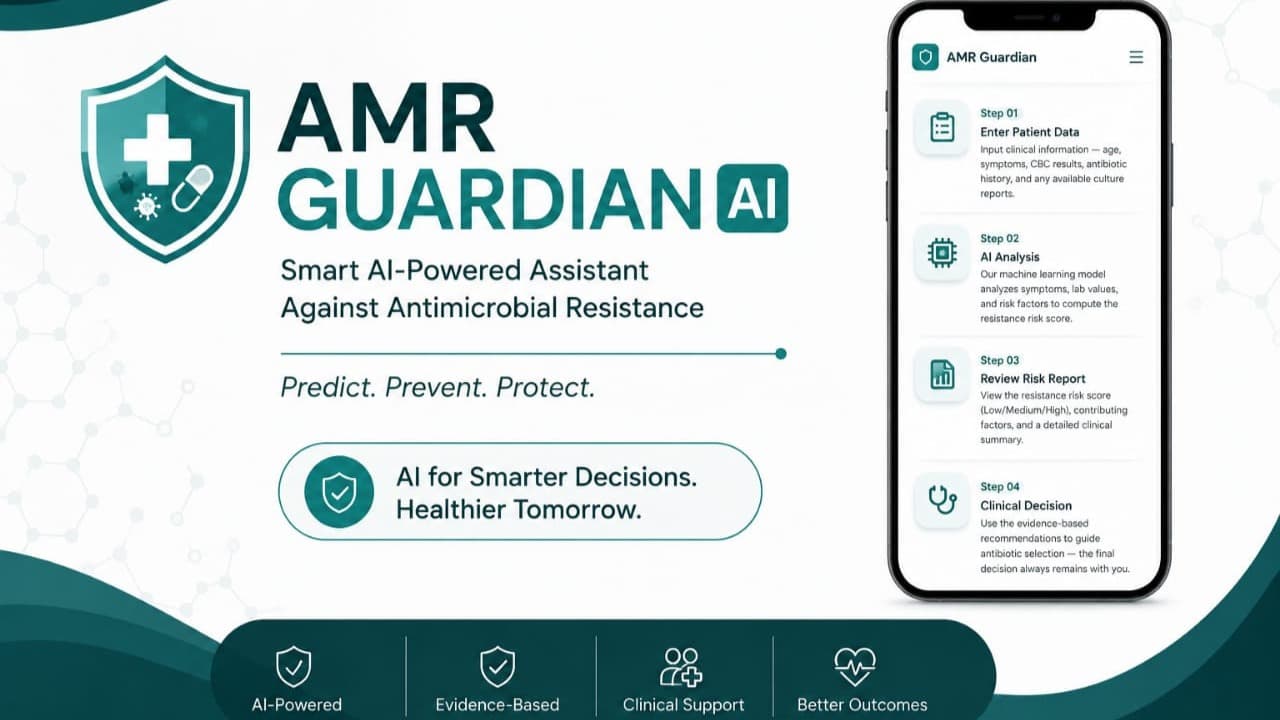
AMR Guardian AI is an AI powered clinical decision support system designed to help healthcare professionals identify and assess the risk of antimicrobial resistance at an early stage. The project addresses a critical healthcare challenge where inappropriate or unnecessary antibiotic use can contribute to the development and spread of resistant infections. The system analyzes multiple patient specific factors, including age, symptoms, basic laboratory results, previous antibiotic use, and culture information. It combines these inputs to generate an antimicrobial resistance risk assessment and presents the results through a clear, user friendly dashboard. The platform provides a risk score, risk level, infection category, severity assessment, clinical summary, confidence score, key findings, major risk factors, and feature importance. It also provides culture testing, follow up, isolation, and antibiotic stewardship recommendations. These explainable outputs help users understand why a patient may have an elevated resistance risk instead of receiving a simple unexplained prediction. AMR Guardian AI uses React for the frontend, Supabase for authentication and database management, and AI powered analysis for generating clinically relevant insights. The dashboard presents patient analyses, AMR risk trends, infection distributions, and recent assessment records in an organized interface. The project is designed as a decision support prototype. Its purpose is to demonstrate how AI can support earlier risk assessment, improve antimicrobial stewardship, and encourage more informed antibiotic use. AMR Guardian AI combines biotechnology, clinical data analysis, artificial intelligence, and modern web development into one practical solution. It demonstrates how intelligent data driven tools can support healthcare professionals in addressing antimicrobial resistance and building more responsible approaches to antibiotic treatment.