Qwen-Image-2.0

Qwen-Image-2.0 is Alibaba Cloud's second-generation image foundation model, released on February 10, 2026. It combines image generation and editing into a single model, replacing the separate pipelines required by earlier approaches. The architecture pairs an 8B Qwen3-VL encoder with a 7B diffusion decoder, producing a leaner design than its predecessor (which used 20B parameters) while achieving higher benchmark scores. It supports native 2048x2048 resolution output.

General
Release date10 Feb 2026
DeveloperQwen / Alibaba Cloud
TypeImage generation and editing model
Architecture8B Qwen3-VL encoder + 7B diffusion decoder
GitHubQwenLM/Qwen-Image
Documentationqwenlm.github.io

Core Features

  • Unified generation and editing: a single model handles both text-to-image generation and instruction-based image editing without switching pipelines.
  • Native 2K resolution: generates images at up to 2048x2048 pixels natively.
  • Professional typography: supports up to 1,000-token prompt instructions for text-heavy visuals, generating accurate text in posters, infographics, slides, and comics.
  • Photorealism: produces fine-grained detail at 2K including skin texture, fabric weave, and natural foliage.
  • Efficient architecture: 7B active parameters vs. 20B in Qwen-Image 1.0, with faster inference and higher quality.

Benchmarks

BenchmarkQwen-Image-2.0FLUX.1 (12B)
DPG-Bench88.3283.84
AI Arena (text-to-image)#1
AI Arena (image editing)#1

Tools and Resources


Ecosystem and Integrations

  • Accessible via Alibaba Cloud DashScope API for programmatic generation and editing.
  • Available through Qwen Studio for no-code testing.
  • The encoder backbone (Qwen3-VL) is the same model used for vision-language understanding tasks.

To get started, visit Qwen Studio for a live demo, or use the Qwen API Platform for API access with the DashScope SDK.

Qwen-Image-2.0 top builders

Explore the top contributors showcasing the highest number of Qwen-Image-2.0 app submissions within our community.

Qwen Qwen-Image-2.0 AI technology Hackathon projects

Discover innovative solutions crafted with Qwen-Image-2.0, developed by our community members during our engaging hackathons.

Optiseek

Optiseek

Mini Challenge 2: OCR Image: b3panda3/optiseek:latest Optiseek extracts text from PNG/JPEG/TIFF license plates and traffic signs using Qwen2.5-VL-3B-Instruct on AMD ROCm, returning strict JSON with text and confidence. Categories: US/Chinese plates, stop signs, speed limits, advisory speeds, and work zone signs. Preserves relevant text while filtering US state names and slogans. Architecture: PIL adaptive preprocessing → Qwen2.5-VL (bf16) → rule-based postprocessing → JSON. Results: 10/10 samples passed (200/200 points); 17.2s/image average; ~8 GiB peak VRAM; ~25 GiB Docker image. Engineering: Patched Transformers caching_allocator_warmup for MI300X VF memory limits; used a 3B model for VF compatibility. Mini Challenge 3: RAG Image: b3panda3/optiseek-rag:latest Optiseek RAG indexes PDF, DOCX, XLSX, CSV, TXT, LOG, PY, PNG, and JPG files. It answers questions with exact citations and abstains when evidence is missing. VLM extraction handles text in diagrams, pinout charts, and asset labels. Robustly handles unreadable files, encrypted PDFs, empty directories, and unknown formats. Architecture: Resident Qwen2.5-7B daemon + Unix-socket client → multi-format parsers → BGE-small embeddings + hybrid semantic/keyword retrieval → LLM generation → post-hoc citation necessity verification. Results: 8/10 questions passed (160/200 points). Supports single-hop, multimodal, and refusal tasks. Multi-hop retrieval and one error-code extraction need improvement. Engineering: Daemon avoids model reloads; VLM unloads after indexing to free VRAM; citation verification tests necessity by removing sources and rerunning queries. Patched caching_allocator_warmup and pinned ROCm-compatible PyTorch to prevent CUDA replacement. ~50 GiB Docker image; ~14 GiB peak VRAM.

Fresno LUX: A Living City

Fresno LUX: A Living City

Fresno LUX is a prototype for a living intelligence layer across an entire city. Fresno already contains enormous amounts of intelligence: residents know where problems exist, nonprofits know where help is needed, businesses know where opportunities exist, educators understand gaps in learning, researchers generate knowledge, and government maintains critical infrastructure and data. The problem is that much of this intelligence is fragmented across disconnected systems. Fresno LUX connects those pieces. The platform creates a shared city graph where people, organizations, resources, needs, projects, observations, experiments, and outcomes become connected nodes. Instead of simply collecting data, LUX continuously asks: What is happening? What do we know? What is missing? What can we test? What changed? A community problem can become an observable signal. That signal can become an experiment. The experiment produces evidence. Evidence changes the system's understanding. That updated understanding informs the next action. Observe → Connect → Understand → Act → Measure → Learn → Converge. The goal is to move Fresno from disconnected information toward collective intelligence—a system where knowledge can travel across boundaries and successful solutions can be discovered, tested, measured, and replicated. LUX is designed to make the invisible connections visible: the relationship between a neighborhood and its resources, between a student and educational opportunity, between a business and workforce capacity, between environmental conditions and community health, and between an idea and measurable real-world impact. This hackathon prototype demonstrates the beginning of a Living Fresno Graph: a city that can observe itself, learn from evidence, and coordinate toward better outcomes.

LEFA AI - Governed Autonomous Alpha Companion

LEFA AI - Governed Autonomous Alpha Companion

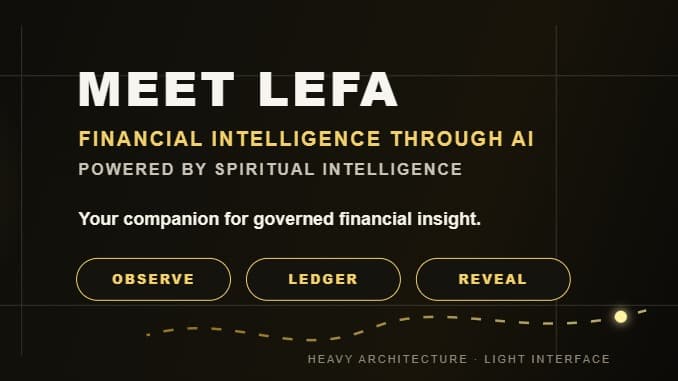
Most finance products introduce themselves with charts, balances, and buttons. You speak to LEFA. LEFA is the user-facing base intelligence. The complicated architecture underneath exists to help LEFA make a better decision — not to make the user learn the architecture. You bring the human question. LEFA brings governed financial intelligence. See the engine room Inspect assets. 👁️ Observe → 📖 Ledger → ✨ Reveal Animated LEFA Observe Ledger Time Reveal timeline LEFA does not treat a convincing first answer as reality. Observe what is happening. Ledger what was known. Let time continue. Reveal what survived. The frontend tells the story. The backend preserves the truth. Time decides what survives. 🧠 What moves under LEFA? Animated LEFA backend control room The public experience stays light. The backend is intentionally heavy. HUMAN ↓ LEFA — base identity / final decision-maker ↓ CRUD — capture the event ↓ ARK — governed structured bloat ↓ BMP—stress test, filter and compress ↓ MAO — route bounded responsibility ↓ SWFUS — five internal ecosystems ↓ EVIDENCE + RECEIPTS + UNCERTAINTY ↓ LEFA ↓ DECISION / EXPLANATION The internal system does not replace LEFA's judgment. It filters unsupported certainty, preserves useful ambiguity, and returns better governed evidence to the base model. OPEN // Why the backend expands before it compresses 🌱 Five agents. Five ecosystems. One LEFA. Animated LEFA SWFUS five-agent ecosystem The five internal agents do not talk to the user. They receive governed information from LEFA's backend and operate inside bounded ecosystems. S Sovereign Ingestion What may enter as a governed signal? W Witness Isolation What must be preserved independently as testimony? F Fluid Vectoring What interpretations or directions remain plausible? U Unified Synchronization What accepted state must align before action? S Severance Execution What must be cut, held, or rejected? Rich at the center. Minimal at the edges.