Qwen3-Coder

Qwen3-Coder is Alibaba Cloud's dedicated coding model, released on July 22, 2025. The flagship variant, Qwen3-Coder-480B-A35B-Instruct, is a mixture-of-experts model trained on 7.5 trillion tokens across 358 programming languages, with 70% of the training data being code. It supports 256K tokens of native context, extensible to 1M tokens with extrapolation, making it suited to repository-scale tasks and multi-file agentic workflows.

General
Release date22 Jul 2025
DeveloperQwen / Alibaba Cloud
TypeOpen-weight coding LLM (MoE)
LicenseApache 2.0
GitHubQwenLM/Qwen3-Coder
Hugging FaceQwen3-Coder-480B-A35B-Instruct
Documentationqwenlm.github.io/blog/qwen3-coder

Core Features

  • 480B/35B MoE architecture: 480B total parameters with 35B active per token, using 160 experts with 8 activated per inference step.
  • 256K native context: natively processes 256,000 tokens, with extrapolation support up to 1,000,000 tokens.
  • 358 programming languages: trained on a broad code corpus covering mainstream and niche languages.
  • Agent RL post-training: long-horizon reinforcement learning trains the model to solve real-world tasks through multi-turn tool interactions.
  • Apache 2.0: weights are available for commercial use and fine-tuning.

Benchmarks

BenchmarkScore
SWE-Bench Verified69.6%

SWE-Bench Verified scores are state-of-the-art among open models at release, comparable to Claude Sonnet 4.


Tools and Resources


Ecosystem and Integrations

  • Paired with Qwen Code, an open-source terminal coding agent with GitHub Actions support.
  • Accessible via the Alibaba Cloud DashScope API using an OpenAI-compatible endpoint.
  • Available on Together AI, LM Studio, and Ollama for local and cloud inference.

To use Qwen3-Coder via API, get an API key on the Qwen API Platform. For local agentic coding, see the Qwen Code terminal agent.

Qwen3-Coder top builders

Explore the top contributors showcasing the highest number of Qwen3-Coder app submissions within our community.

Qwen Qwen3-Coder AI technology Hackathon projects

Discover innovative solutions crafted with Qwen3-Coder, developed by our community members during our engaging hackathons.

Buy You Before

Buy You Before

# Buy You Before — FitLab: AI-Powered Spatial Commerce Buy You Before is an AI-powered furniture shopping platform that solves a common e-commerce problem: determining whether furniture will actually fit a customer's room before purchasing it. Customers can describe their requirements in natural language, browse suitable products, upload photographs of their rooms, and visualize selected furniture in an interactive 3D simulation. **Our core innovation is FitLab**, an AI-driven failure-diagnosis and repair system. Rather than simply rejecting an unsuitable product, FitLab analyzes simulation failures, proposes corrective actions such as rotating furniture or selecting an alternative, and executes new simulations to test those actions. An independent geometry engine verifies every result, ensuring that AI-generated suggestions are never mistaken for proven fit. For AMD ACT III, we aim to integrate an open AI model served through vLLM on AMD GPU infrastructure using ROCm. Evolus AI will orchestrate agent workflows and connect the model to our existing simulation services through MCP tools. We also plan to develop a reproducible benchmark comparing conventional geometry-based recommendations with AI-assisted repairs. Metrics will include verified repair success, false-fit claims, simulation attempts, and latency. These experiments will help us evaluate improvements and potentially fine-tune the model using recorded failure-and-repair examples. **Technology stack:** Next.js, React, TypeScript, Tailwind CSS, Three.js, Python, FastAPI, PostgreSQL, Dapr, Redis, OpenCV, Shapely, vLLM, AMD ROCm, Evolus AI, and MCP. Our mission is to transform furniture shopping from guesswork into evidence-backed spatial decision-making, demonstrating AI that does not merely recommend solutions but tests its decisions in an executable environment and proves whether they work.

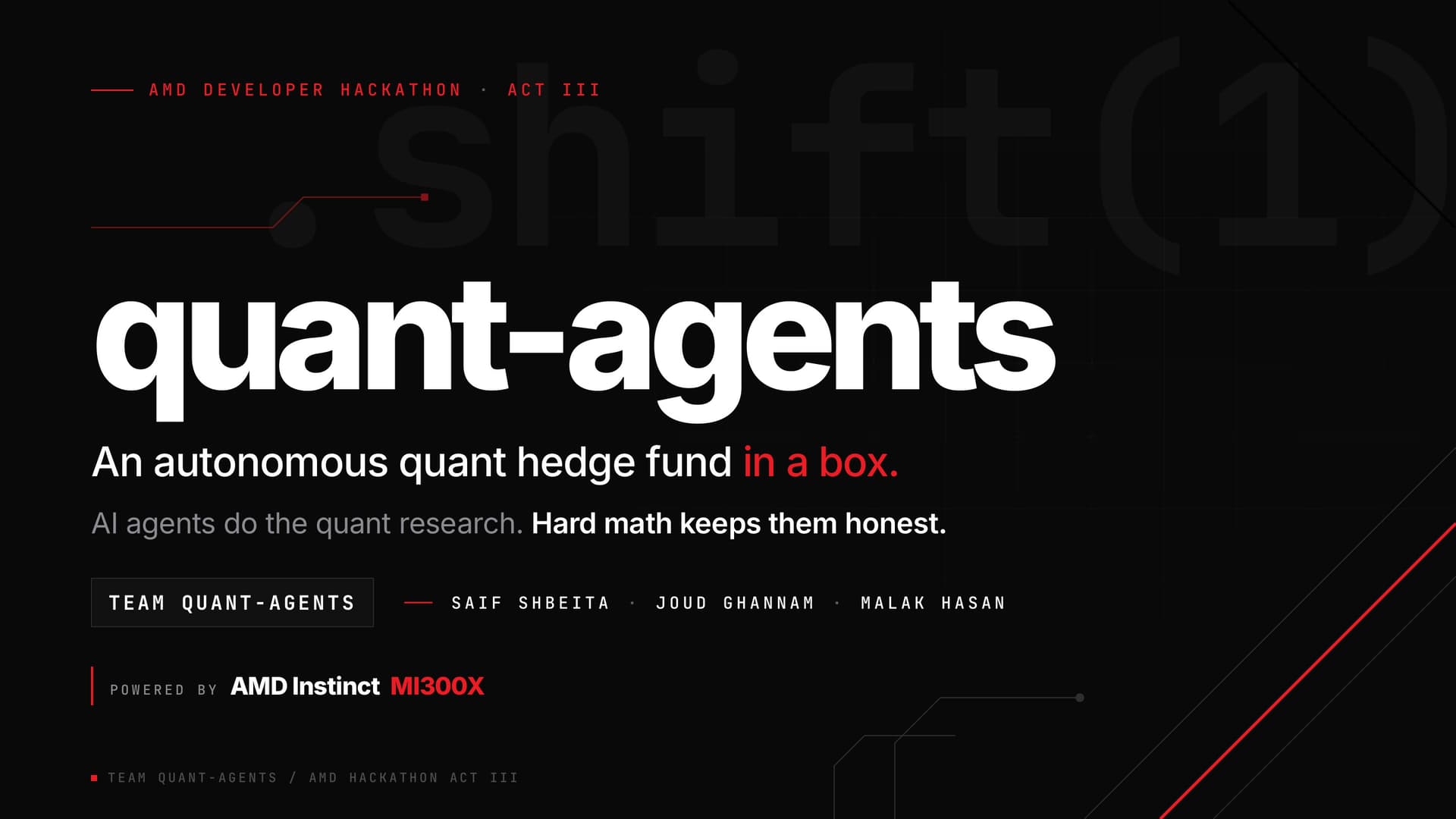
quant-agents: Autonomous Quant Research on AMD

quant-agents: Autonomous Quant Research on AMD

quant-agents is a local "Quant Hedge Fund in a Box": a multi-agent system that runs the full quant research loop end to end with zero cloud dependency. A LangGraph state machine routes work between four agents. The Ideator proposes a market hypothesis with an economic rationale, precise statistical entry and exit rules, and regime filters. The Coder turns it into a fully vectorized pandas/numpy generate_signals function (no loops, no iterrows). A sandbox executes the code on SPY daily data, lags every signal with .shift(1), and computes Sharpe, max drawdown, total return, and win rate. The Auditor acts as head of risk: it diagnoses tracebacks, rejects lookahead bias and curve-fitting, and demands structural fixes like regime filters or volatility-based sizing instead of parameter tweaking. A strategy only passes with Sharpe above 1.5 and drawdown under 15%, checked in code, not by the LLM. Survivors go to the Packager, which writes a production handoff report with documented code, Big-O analysis, execution edge cases, and a C++ translation plan (Eigen/Armadillo). The whole system runs on a single Qwen3.6-35B-A3B Mixture-of-Experts model served by vLLM on AMD Instinct MI300X with ROCm. Instead of loading four models and fragmenting HBM, all agents share one model and LangGraph swaps the persona per call. With only ~3B active parameters per token, the agent loop stays fast enough to iterate many times per strategy. Circuit breakers cap rework attempts and new ideas, so the system either finds a strategy that survives the audit or stops cleanly.

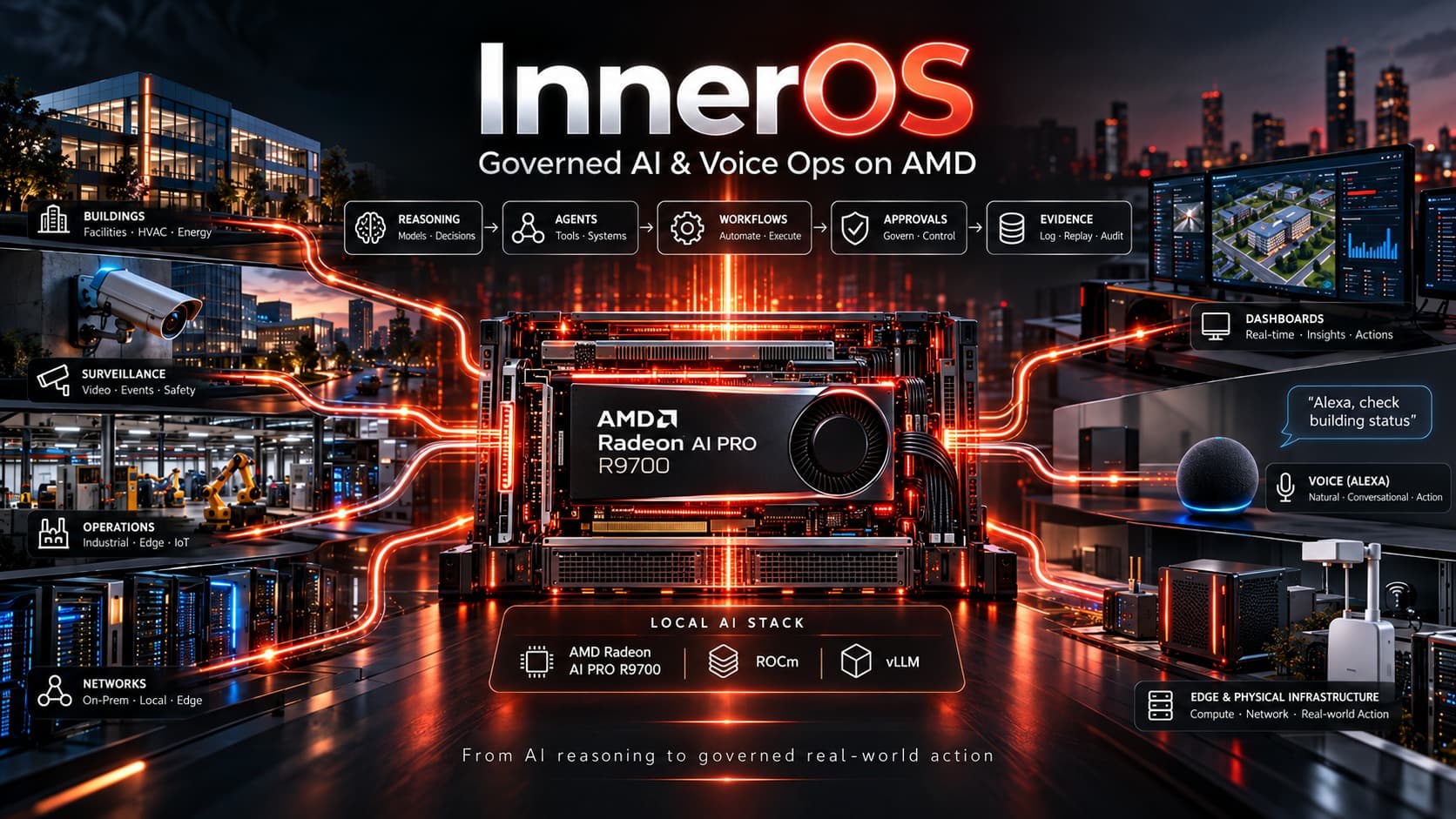
InnerOS: Governed AI & Voice Ops on AMD

InnerOS: Governed AI & Voice Ops on AMD

InnerOS is a governed AI operations fabric that moves AI beyond chat and into real business execution. For AMD Developer Hackathon ACT III, we built and verified a new end-to-end partner lane on top of the existing InnerOS control plane. A real Bellini smart-building incident is analyzed by Gemma-4-31B-IT through AMD Developer Cloud and ROCm. Gemma produces a structured IncidentPlan with diagnosis, severity, recommended actions, and execution boundaries. InnerOS then passes that governed result to Evolus, where Workflow and Knowledge Library components turn the decision into an operational work-order representation. InnerOS preserves policy, approvals, execution state, cryptographic evidence, and replay. We are explicit about what was reused versus built for ACT III. InnerOS governance, local AMD ROCm/vLLM/Qwen execution, MCP/A2A coordination, and evidence/replay concepts existed before the event. ACT III added the live AMD Developer Cloud + Gemma integration, structured IncidentPlan contract, live Evolus integration, Bellini→Gemma→Evolus→Evidence pipeline, Judge Console, and public submission package. InnerOS also reuses technology developed in our parallel Alexa hackathon. The working Inner Oz skill already queries live InnerOS/Home Assistant energy data and has demonstrated a governed UniFi restart with owner approval and post-action verification. A newer voice-programming flow can create a GitHub repository and governed InnerOS Ops Task for an AI agent; task creation is verified, while agent completion is tracked separately. The architecture is unified: AMD provides the compute foundation, Gemma provides reasoning, Evolus provides business workflow execution, Alexa provides natural voice access, and InnerOS provides governance, orchestration, evidence, and proof. Reason. Act. Prove.

Phoenix: Evidence-Driven AI Modernization

Phoenix: Evidence-Driven AI Modernization

Rewriting banking software is easy to demonstrate and difficult to trust. A replacement can serve the same endpoints while changing transfer fees, duplicate-request handling or ledger behaviour. Phoenix makes those differences visible before a migration is accepted. Phoenix uses an agent workflow to discover a legacy service, extract business rules and invariants, capture its behaviour, generate a replacement and compare the results. Its inspector connects claims to source citations, captured expectations, verification reports and implementation artifacts. Our demonstrated migration takes a Java/Spring Boot banking service to Node.js and TypeScript. The recorded run contains five business rules, two invariants, ten scenarios and 662 assertions. Examples cover online fee thresholds, account-age waivers, repeated transfers using an idempotency key, batch settlement and settled-transfer corrections. The first replacement produced 80 mismatches, including JSON numbers emitted as strings. A recorded autonomous repair produced a new implementation artifact, followed by verification with zero mismatches across all ten scenarios. We then deliberately changed a replacement transfer fee from 0.50 to 1.00. Phoenix detected seven mismatches across two scenarios, including the resulting balance and ledger differences. After restoration, all ten scenarios matched again. The evidence does not establish that this fee restoration was autonomous. Phoenix demonstrates evidence-driven modernization of a tested banking slice. The result is an inspectable record of what changed, what matched and which behaviours still need further validation.