Qwen3-VL

Qwen3-VL is Alibaba Cloud's vision-language model series, designed to understand and reason over images, videos, and text in a single architecture. It is available in 2B and 8B parameter sizes, both released under Apache 2.0. The architecture handles diverse visual tasks including document understanding, chart analysis, image-based question answering, and video comprehension.

General
DeveloperQwen / Alibaba Cloud
TypeOpen-weight vision-language LLM
LicenseApache 2.0
GitHubQwenLM/Qwen3-VL
Hugging FaceQwen3-VL-8B-Instruct
Technical Reportarxiv.org/abs/2511.21631
Documentationqwenlm.github.io

Core Features

  • Multimodal inputs: accepts text, images, and videos in a single conversation turn.
  • Document and chart understanding: parses structured visual content like tables, slides, PDFs, and infographics.
  • Video comprehension: understands multi-frame video sequences and answers temporal questions.
  • Thinking mode: includes a reasoning variant (Qwen3-VL-8B-Thinking) for step-by-step visual problem solving.
  • Apache 2.0: weights are open for commercial use and fine-tuning.

Model Variants

VariantParametersKey capability
Qwen3-VL-2B-Instruct2BLightweight multimodal inference
Qwen3-VL-8B-Instruct8BGeneral vision-language tasks
Qwen3-VL-8B-Thinking8BStep-by-step visual reasoning

Tools and Resources


Ecosystem and Integrations

  • Served through Alibaba Cloud DashScope via an OpenAI-compatible vision endpoint.
  • Available on Ollama for local multimodal inference.
  • Weights downloadable from Hugging Face Hub in standard and GGUF formats.
  • Forms the encoder backbone for Qwen-Image-2.0, the image generation model.

Model weights are available on Hugging Face. API access is available through the Qwen API Platform and Alibaba Cloud Model Studio.

Qwen3-VL top builders

Explore the top contributors showcasing the highest number of Qwen3-VL app submissions within our community.

Qwen Qwen3-VL AI technology Hackathon projects

Discover innovative solutions crafted with Qwen3-VL, developed by our community members during our engaging hackathons.

Exact Web Answer Agent (AMD AI League Match 4)

Exact Web Answer Agent (AMD AI League Match 4)

Match 4 entry: an agent that reads a natural-language request, navigates the given website (or a saved copy of it) and returns the one specific value the user asked for, with the page it came from. Not a summary and not a list of links. Match 4 image: docker.io/driedsandwich/amd-ai-league:m4-v1 How it works. Each request runs as a fresh python3 /app/app.py process with a 24-second internal deadline. It writes a well-formed placeholder JSON first, then fetches the start page with short timeouts, follows the same-site links whose text best matches the question, cleans each page to text (tables kept as rows) and ranks passages. A Qwen3-4B-Instruct model, loaded once at container start and kept resident on the AMD GPU behind a unix socket, picks the value from the top passages and names the supporting page. A rule-based extractor for prices, dates, versions, numbers and contacts is the fallback when the model has no time left. The answer is the value only; if the pages do not contain it, the agent returns an empty answer instead of guessing. Output: /app/output/<query-id>_output.json with answer, citations (source URLs, or corpus-relative paths when pages are given as a folder), sources, source_url and confidence. Because the detailed Match 4 harness was not published, the image follows the container contract shared by the earlier Matches: the mandated ROCm PyTorch base image, weights shipped inside the image, no downloads at start-up, and the model placed on the GPU explicitly. The script accepts several argument spellings (--query or --question, --query-id or --id, --url, --corpus for saved pages, --index, --input). No API keys; inference runs locally on the AMD GPU. Match 3 and Match 2 images are given in their Mini Challenge fields (docker.io/driedsandwich/amd-ai-league:mc3-v1 and docker.io/driedsandwich/amd-ai-league:mc2-v2).

ReKit — Visual Recovery Intelligence

ReKit — Visual Recovery Intelligence

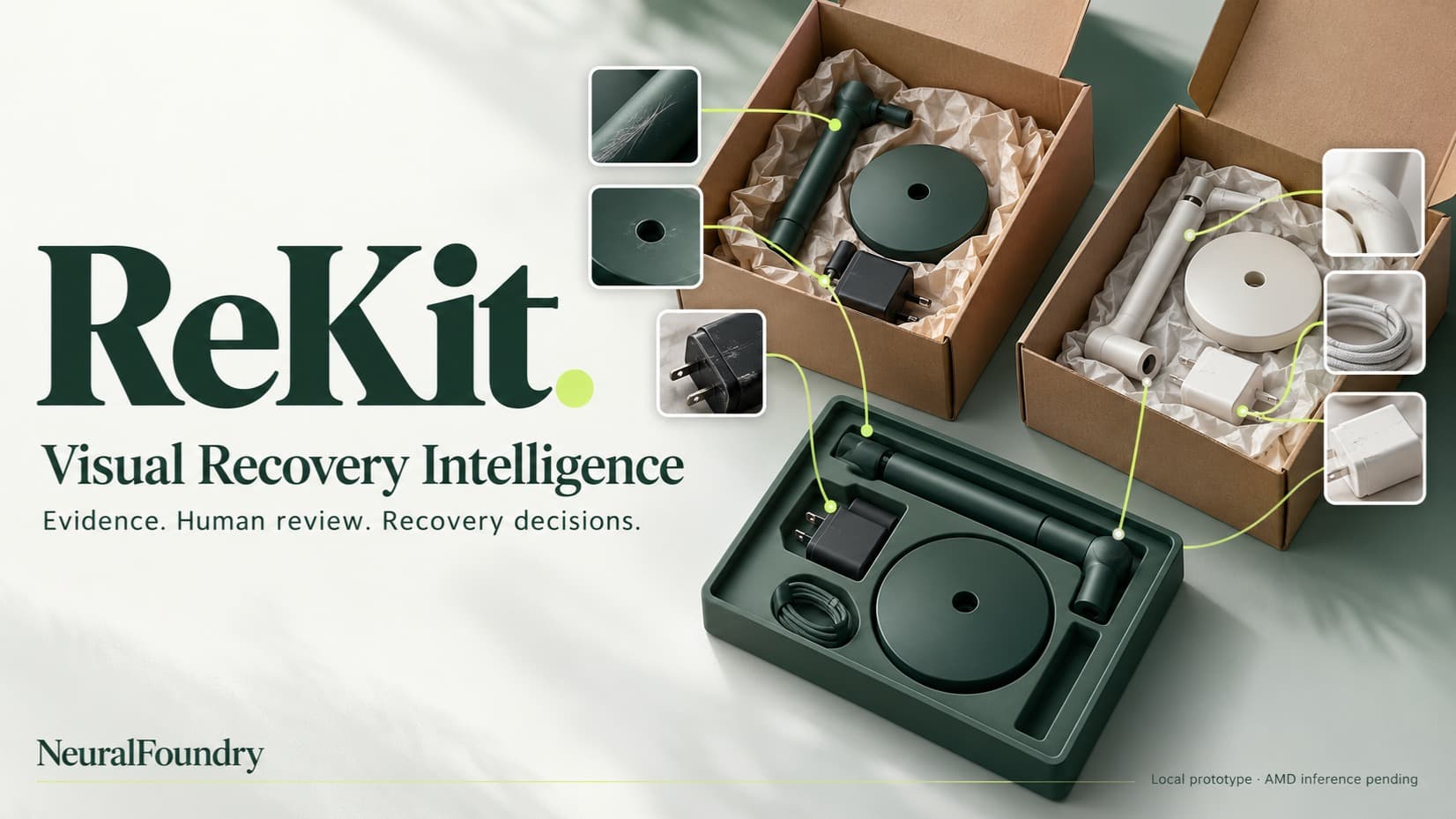
Incomplete returns can contain complementary parts, but a plausible visual match is not enough to rebuild a compatible kit. ReKit connects uncertain visual evidence to accountable recovery decisions. The prototype preserves original images and hashes under unique physical-component identities. Local Qwen3-VL-2B-Instruct inference on NVIDIA hardware records observations, uncertainty and source references. Humans verify or correct those claims; approved BOM and revision rules determine compatibility. CPU OR-Tools CP-SAT compares rebuilds, liquidation, donor retention and holds. Atomic reservations reject conflicting allocations, and explicit completion records preserve kit lineage. Two separate demonstrations show this boundary. Original Amazon Berkeley Objects catalog photographs support actual local visual inspection in simulated intake; they are not customer-return photographs. A scripted synthetic case uses three returns and four components: revision B is rejected, a new close-up requires review, and a recorded A correction enables two synthetic kit completions. Under baseline assumptions the modeled rebuild value is $175, compared with $102.50 whole-return liquidation and $16 noncash retention. Raising labor costs changes the preferred decision to $85 liquidation. These are scenario estimates, not sales or measured savings. ReKit is a validated local prototype, not a production deployment. Human semantic accuracy has not been measured. Actual AMD-hosted inference and application integration remain pending after two HTTP 400 attempts; NVIDIA execution does not satisfy AMD qualification. The contribution is the auditable connection between evidence, human authority, constrained allocation and controlled execution.

VisionForge OCR + Grounded RAG on AMD ROCm

VisionForge OCR + Grounded RAG on AMD ROCm

Two offline AMD ROCm systems share this entry: VisionForge AI for multilingual visual OCR (Match 2) and Grounded RAG for document question answering (Match 3). Each has a separate public Docker image in the matching private image field. Both include pinned model weights and need no runtime model downloads or external inference APIs. Match 2 reads US and Chinese registration plates and road signs from PNG, JPEG and TIFF. A resident Qwen3-VL-2B-Instruct worker loads once; a thin Python CLI sends image requests over a local Unix socket and writes the required JSON text output. US jurisdiction banners are excluded; Chinese province symbols remain part of the registration. Direct ROCm code passed 17/17 own synthetic cases on an AMD Radeon Pro W7900D (16.01 s startup, 3.57 s for ten CLI calls, 4.790 GiB observed peak). GPU inference inside the final Docker image was not tested. Match 3 answers questions over PDF, Word tables, spreadsheets, CSV, logs, Python source, diagrams and photographed labels with exact file citations. When evidence is missing it returns an empty answer and no citations. Resident Qwen3-VL-8B and Qwen3-Embedding-0.6B models combine lexical and semantic retrieval, identifier links and a second evidence check. Direct GPU code passed 287/287 development questions with answers and exact citation sets, plus 47 Linux tests. Peak PyTorch reserved memory was 19.87 GiB. Full Docker plus AMD GPU launch remains unverified because the free notebook has no container runtime. Both images preserve the required ROCm base. The tests use development or self-generated cases and do not establish an official hidden-set score.

Silent Key RAG: cited answers on AMD ROCm

Silent Key RAG: cited answers on AMD ROCm

Silent Key RAG is a single container built on the mandated ROCm PyTorch base image, with its layers kept byte for byte so the base check passes. One resident process loads Qwen3-VL-8B once and keeps the index in memory, so each question pays only for retrieval and one model call. Every file goes through a defensive parser. Empty folders, unreadable and encrypted files, and unknown formats are skipped and logged instead of crashing the run. Images are read by the vision model, so answers that only exist inside a picture are still found. Retrieval is exact BM25 over chunks. The model proposes an answer and its sources; deterministic code then checks that the answer really occurs in a readable file, keeps exactly one answer file (current over superseded) plus a second only when it is a genuine bridge, and runs a short yes or no check that turns near misses into refusals, because citations are graded as an exact set. When nothing in the corpus supports an answer, the container refuses rather than guessing. The image ships its own weights, needs no network at evaluation, and is sized for the 1 to 48 GiB VRAM window. Match 4 (Intelligent Web Information Retrieval): the form has no Mini Challenge 4 Image field yet, so the image is listed here. Mini Challenge 4 Image: ghcr.io/silentkeytech/mc4-web:v1 (public). It answers each question with one exact value and its source page, runs on the same ROCm base image, and scored 10 of 10 on our own tasks on an AMD Radeon Pro W7900D.