

Arslan Abdul Ghaffar@ArslanAG
6
Events attended
4
Submissions made
Korea, Republic of
6+ years of experience
About me
Hi, I’m Arslan Abdul Ghaffar, an AI Engineer and AI Researcher working in Computer Vision, Vision-Language Models, LLMs, and Deep Learning. I’m interested in building practical AI solutions and exploring scalable AI infrastructure and emerging AI technologies.
🤝 Top Collaborators



🤓 Latest Submissions
ReKit — Visual Recovery Intelligence
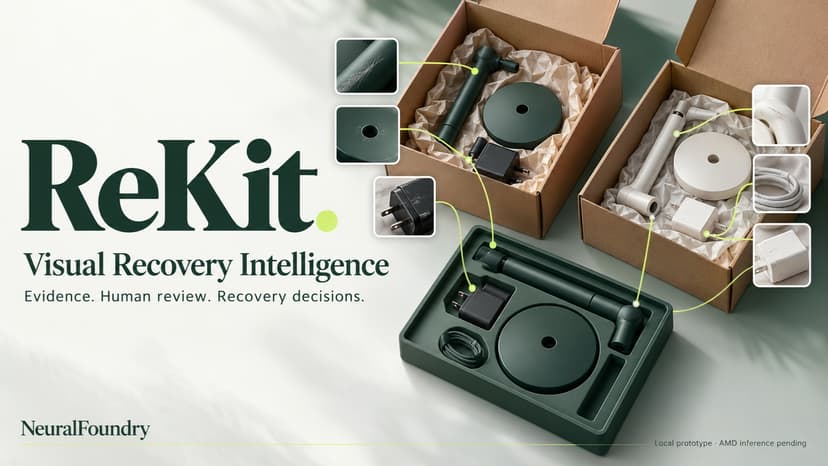
Incomplete returns can contain complementary parts, but a plausible visual match is not enough to rebuild a compatible kit. ReKit connects uncertain visual evidence to accountable recovery decisions. The prototype preserves original images and hashes under unique physical-component identities. Local Qwen3-VL-2B-Instruct inference on NVIDIA hardware records observations, uncertainty and source references. Humans verify or correct those claims; approved BOM and revision rules determine compatibility. CPU OR-Tools CP-SAT compares rebuilds, liquidation, donor retention and holds. Atomic reservations reject conflicting allocations, and explicit completion records preserve kit lineage. Two separate demonstrations show this boundary. Original Amazon Berkeley Objects catalog photographs support actual local visual inspection in simulated intake; they are not customer-return photographs. A scripted synthetic case uses three returns and four components: revision B is rejected, a new close-up requires review, and a recorded A correction enables two synthetic kit completions. Under baseline assumptions the modeled rebuild value is $175, compared with $102.50 whole-return liquidation and $16 noncash retention. Raising labor costs changes the preferred decision to $85 liquidation. These are scenario estimates, not sales or measured savings. ReKit is a validated local prototype, not a production deployment. Human semantic accuracy has not been measured. Actual AMD-hosted inference and application integration remain pending after two HTTP 400 attempts; NVIDIA execution does not satisfy AMD qualification. The contribution is the auditable connection between evidence, human authority, constrained allocation and controlled execution.
18 Oct 2026
VoxOps — Voice. Evidence. Safe Recovery.
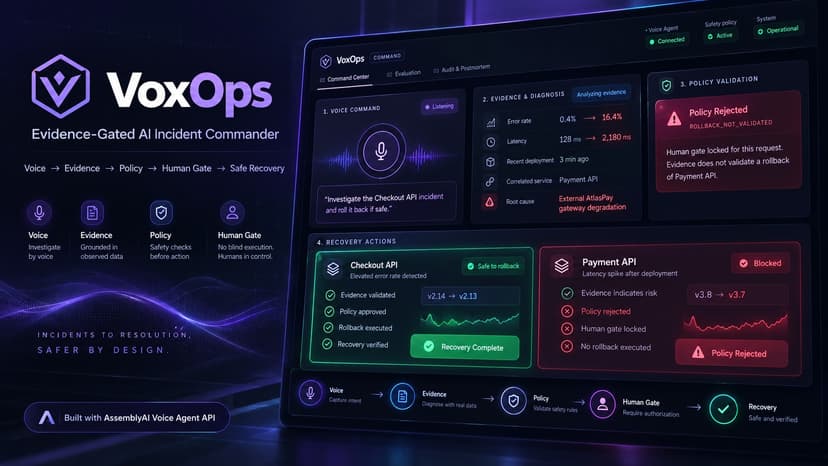
VoxOps is an evidence-gated AI Voice Incident Commander built with the AssemblyAI Voice Agent API. Production incidents are stressful because engineers must quickly inspect service health, logs, deployments, dependencies, and possible recovery actions while avoiding decisions that could make the outage worse. VoxOps allows an engineer to investigate an incident using natural voice commands. AssemblyAI provides the live voice interaction, transcription, turn detection, agent reasoning, structured tool calling, and spoken responses. The important difference is that VoxOps does not blindly execute operational commands. Infrastructure facts are gathered through structured incident tools, including service metrics, logs, deployment history, and dependency health. The resulting evidence is used to form a diagnosis and validate any requested recovery action through deterministic safety policies. If a rollback is supported by the evidence, VoxOps creates a recovery proposal and sends it to a Human Safety Gate. The AI cannot bypass this gate, and the operator must explicitly approve or reject the action. If the requested action is not supported by the evidence, VoxOps blocks it before the Human Safety Gate even opens. For example, when the Payment API becomes unhealthy because of an external AtlasPay Gateway failure, a request to roll back Payment API to v3.7 is rejected with ROLLBACK_NOT_VALIDATED. The Payment API remains unchanged because the evidence shows that rollback would not address the actual root cause. VoxOps also provides recovery verification, an incident timeline, automated postmortem reporting, deterministic safety evaluation, and a live voice-agent benchmark. The AssemblyAI voice and tool-calling path is live. The production services, infrastructure telemetry, and recovery execution in this hackathon prototype are simulated so the safety architecture can be demonstrated without modifying real production infrastructure.
30 Sep 2026
ParityLens: Preprocessing Parity Debugger
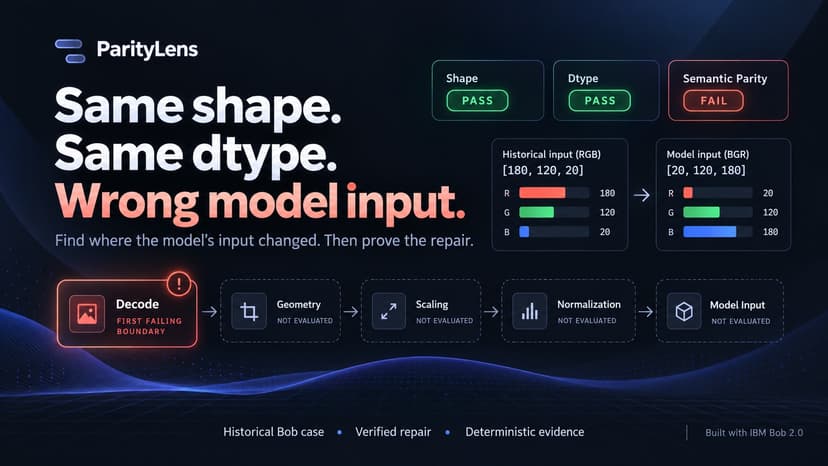
Computer-vision pipelines often fail in a subtle way: the final tensor can have the correct shape and dtype, while its semantic content is wrong. A channel-order change, missing scaling step, or incorrect normalization can silently alter what the model receives, and simple structural checks may still pass. ParityLens is a developer tool for finding exactly where that preprocessing drift begins. It runs a trusted reference pipeline and a candidate serving pipeline side by side, records their outputs at five boundaries: decode, geometry, scaling, normalization, and model input, and stops at the first comparable stage where parity fails. The interface then shows the actual values, shapes, dtypes, maximum difference, source location, and defect classification. Our main demo preserves a real historical RGB/BGR bug. The reference and candidate both pass shape and dtype checks, but ParityLens detects the first semantic mismatch at decode. The recorded probe changes from [180, 120, 20] to [20, 120, 180], exposing the red/blue channel swap. IBM Bob then diagnosed the issue and produced the minimal BGR-to-RGB repair. The repaired candidate is verified again with the same frozen contract, comparator, verifier, and fixtures. ParityLens is designed for computer-vision and ML engineers moving code from experiments to serving, refactoring preprocessing code, migrating frameworks, or comparing edge and cloud pipelines. Users open the live Streamlit app, reproduce the historical bug, inspect the first failing boundary, verify the Bob repair, and explore controlled scaling and normalization failure cases. What makes ParityLens different is the combination of first-boundary localization, numerical evidence, preserved before/after provenance, and verification under unchanged checks. In our deterministic synthetic evaluation, ParityLens detected 45/45 supported defects, localized all 45 first failing boundaries, and produced 0/15 false positives on clean controls. A final shape/dtype-only baseline detected 0/45 of those defective cases. The current prototype is intentionally narrow and honest: it uses synthetic, contract-constrained inputs and does not claim production-wide coverage. Its purpose is to make hidden preprocessing mismatches inspectable, reproducible, and easier to repair.
27 Sep 2026
MISE: Multimodal Bimanual Physical AI
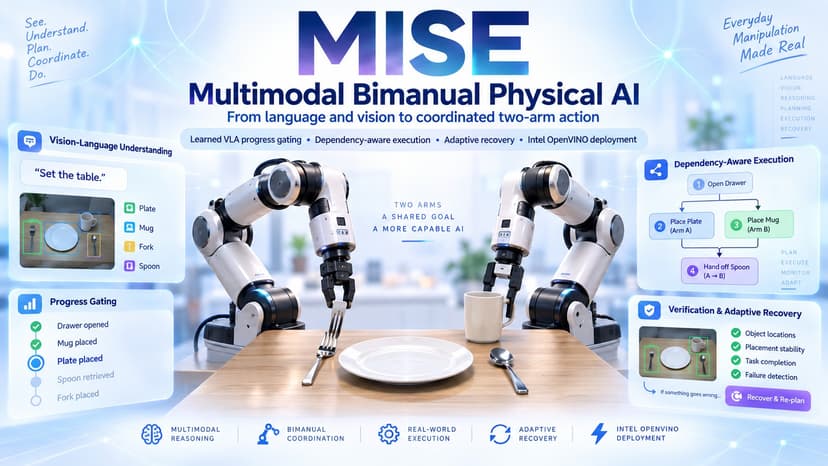
We built MISE to explore a simple question: how can a robot take a natural-language instruction, understand what is happening in the scene, coordinate two arms, and still recover when something does not go exactly as planned? MISE, or Multi-modal Instruction to Skill Execution, is a closed-loop Physical AI system for bimanual manipulation. In our demonstration, the robot receives the instruction “Set the table” and completes a multi-stage task that includes opening a drawer, placing a mug and plate, retrieving a spoon, physically handing the spoon from one arm to the other, and placing the remaining utensils. Instead of asking a learned model to directly control every robot joint, MISE separates reasoning from physical execution. A task-specific vision-language model uses the camera observation and language instruction to determine task progress and the appropriate skill. A validated dependency graph then constrains which action can legally happen next, while camera-guided motor skills perform the physical manipulation. The system continuously verifies task outcomes. If an action does not complete correctly, MISE can detect the failure and select an appropriate validated recovery strategy rather than simply continuing with a bad state. Across our final fixed-seed evaluation, the VLA-guided system completed 10 out of 10 runs, with recovery being activated in 8 of those 10 successful runs. We also exported the learned vision-language component to Intel OpenVINO and ran it on an Intel Core Ultra 7 155H system across the CPU, Intel Arc integrated GPU, and Intel AI Boost NPU. Our goal with MISE is not just to show two robot arms moving. We wanted to demonstrate the complete loop from human instruction and visual understanding to constrained execution, physical verification, recovery, and efficient edge AI deployment.
16 Sep 2026


