Redis

Redis provides access to mutable data structures such as strings, hashes, lists, sets, and sorted sets. These data structures can be manipulated using a variety of commands that are sent over a simple protocol using TCP sockets. Redis also supports various advanced features such as transactions, Lua scripting, pub/sub messaging, and bitmap operations.
The solutions from Redis provide an additional range and capabilities to solutions built on transformer technologies. RediSearch, RedisJson, and other Redis modules allow for building the next generation of AI-Native software solutions.

General
Relese dateApril 10, 2009
AuthorRedis
Typein-memory data store

Tutorials

Great tutorials on how to build with Redis!

Redis - Helpful Resources

Check it out to become Redis Master!

Redis - Clients

Connect Redis to your Project!

Redis - Boilerplates

Get started with Redis!

Redis - Projects

  • ChatGPT Memory Allows to scale the ChatGPT API to multiple simultaneous sessions with infinite contextual and adaptive memory powered by GPT and Redis datastore
  • ChatGPT Retrieval Plugin The ChatGPT Retrieval Plugin repository provides a flexible solution for semantic search and retrieval of personal or organizational documents using natural language queries

Redis top builders

Explore the top contributors showcasing the highest number of Redis app submissions within our community.

Redis AI technology page Hackathon projects

Discover innovative solutions crafted with Redis, developed by our community members during our engaging hackathons.

Agent_Trap_Evals

Agent_Trap_Evals

The problem: agents rarely fail hard questions. They fail chores. They report "backup verified" because the log says success, while the archive is truncated. These false claims slip out during routine work, and a real shell makes them dangerous. What Receipts does: you give it a real task, like checking a backup or triaging a failing build. A control layer plans the work and runs every action in an isolated Vultr sandbox [gVisor pods on VKE]. The sandbox has no secrets, has time and memory caps, and is destroyed after each task. Every command's output, exit code, and files become a receipt. Before any claim reaches you, a verifier checks it against those receipts: did the agent check the layer that matters, or just the easy one? An unsupported claim is blocked and sent back to be verified, or reported as unverified. You get the answer together with its proof. Containment: [demo moment, e.g. the agent runs rm -rf / and the sandbox absorbs it; the host is untouched]. Measured: we score Receipts with agent-trap-evals, an open-source trap set we built before the hackathon from real agent incidents. Verifier off vs. on: [X/Y vs. X/Y caught], [n] false alarms on honest controls. For: platform and DevOps teams putting agents on operational work, where a confident false "done" costs more than a slow answer. Sandboxes like E2B contain actions but don't check claims. Eval tools score offline but don't stop a bad claim at runtime. Receipts does both, live. [Business model; next steps.] All LLM calls use Vultr Serverless Inference.

AEGIS//GRID

AEGIS//GRID

AEGIS//GRID 2.0 is an industrial AI prototype designed to make automated investigation and recovery decisions safer, more explainable, and auditable. The system combines a native C++20 digital twin of six interconnected manufacturing cells with a physics-based anomaly detector. It models thermal behavior, shared coolant flow, and equipment faults, including sensor spoofing and restricted cooling. When an anomaly is detected, a LangGraph multi-agent workflow uses AMD Token Factory hosted inference to investigate potential causes. Pinecone retrieval supplies contextual evidence from 1,235 synthetic plant records and 103 external reference records. AI-generated recovery options are evaluated using native counterfactual simulation and independent safety rules rather than being executed directly. AEGIS//GRID separates intelligence from execution authority. An operator must authorize an incident-specific action through WebAuthn. The independent executor then verifies a short-lived cryptographic capability, checks simulator state and safety constraints, and records an auditable execution receipt. In a verified commissioned simulator demonstration, an authorized safe stop reduced the hottest cell temperature from 42.37°C to 33.45°C over 120 simulated seconds. Simulator evaluation achieved 73% fault-diagnosis recall, 100% precision within the evaluated test set, and 70% thermal-hazard forecasting recall. The project also passed 453 automated checks across Python, C++, Node.js, and Chromium. AEGIS//GRID demonstrates a practical approach to trustworthy industrial autonomy: AI proposes, physics verifies, humans authorize, and independent safeguards control simulator execution. This is a simulator-validated prototype, not a certified production or physical-factory control system.

CertGate: mill certificates, a person decides

CertGate: mill certificates, a person decides

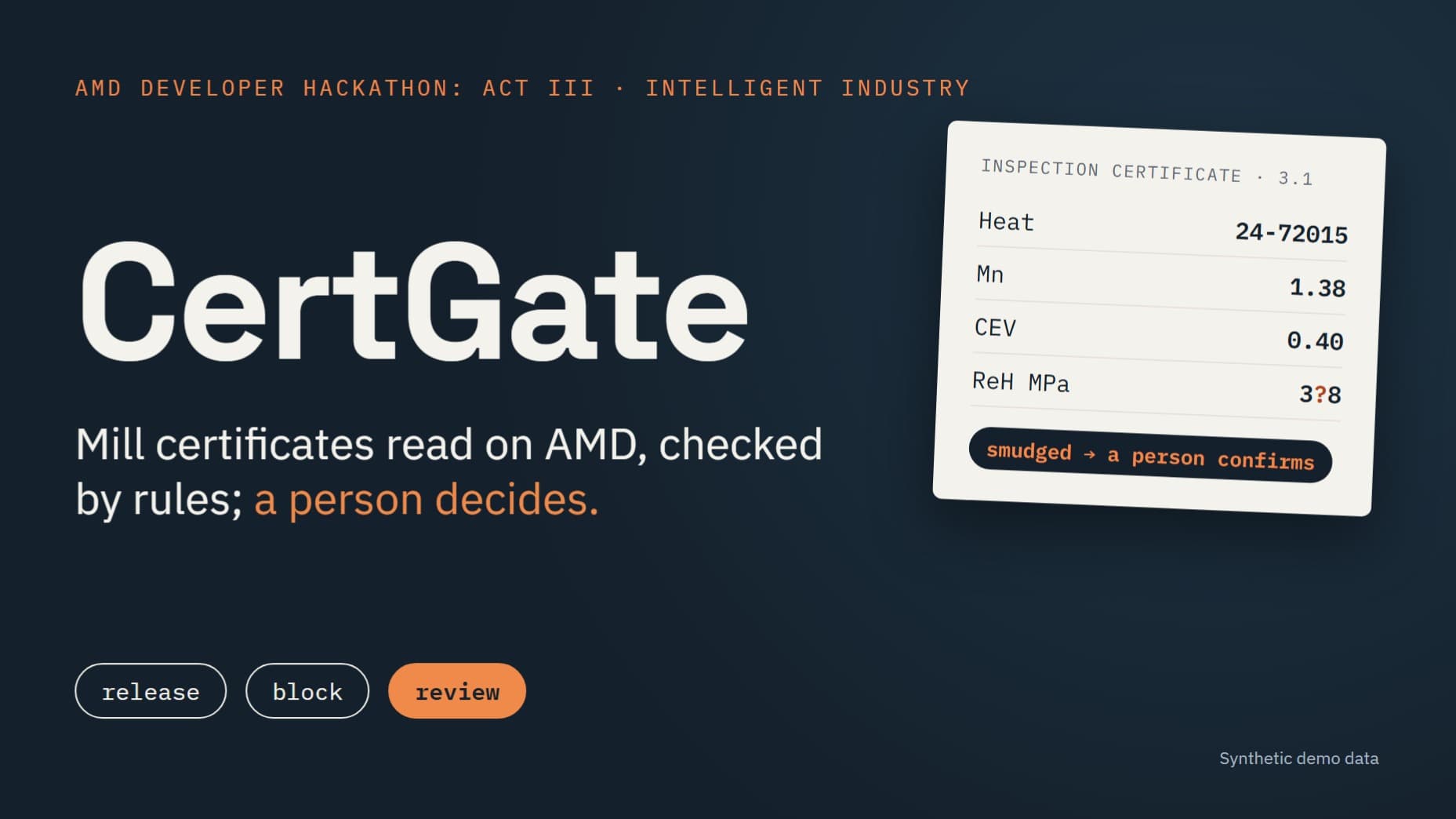
When steel arrives at a plant, it comes with a mill certificate, an inspection certificate of the EN 10204 3.1 kind. A goods-in or Quality technician must check by hand that it belongs to the batch and that every value meets the purchase specification. CertGate prepares that check. The open model Qwen3.8-27B, served by AMD Token Factory, reads the page images of the certificate; live reading also offers Gemma-4-31B-IT and experimental models. On a digital PDF, a second channel without any model reads the text layer, and any disagreement sends the case to review. Deterministic, versioned rules with exact decimals then propose release, block or review, and a person decides. On 27 evaluated fictitious certificates, in two independent Qwen3.8-27B runs, false conforming was 0 of 18 in both runs. Proposals equal to the expected proposal were 27 of 27 in the implementer run and 26 of 27 in the auditor's independent run. Fields read correctly were 591 of 594 in both runs. Of the 9 cases whose expected proposal is release, 9 of 9 were proposed release in the implementer run and 8 of 9 in the auditor's run. Sent to review without need: 0 of 9 in the implementer run and 1 of 9 in the auditor's run (cg-004, a decimal comma caught by the channel check). In a comparison run on AMD Token Factory, Gemma-4-31B-IT gave false conforming 0 of 18, 26 of 27 as expected and 591 of 594 fields correct. The text-layer parser covers the two fictitious layouts of the dataset, not arbitrary mill certificates. A digital PDF in another layout gets no second channel and goes to review, like a scan: this is safe, but it reduces the saving. Four agent seats built and verified CertGate with Claude Code: an analyst, an implementer, an adversary and an independent auditor, with the expected outcomes committed before any product code, mutation checks at every stage, the auditor's own real evaluation run, and a claims table linking every sentence to its proof. All data is fictitious.

Redis