Solo Tech

Solo Tech is a cutting-edge platform that provides on-device artificial intelligence (AI) solutions. It stands out by emphasizing data privacy, efficient performance, and user control without relying on cloud-based services. This technology facilitates the integration of AI capabilities directly onto user devices, allowing for faster, private, and customized AI experiences.

General
AuthorSolo Tech
Websitehttps://www.getsolo.tech/
Link to the official source of APISolo Tech Developer API
TypeOn-device AI platform

Key Features

  • On-Device AI Processing: Runs AI models locally, eliminating the need for continuous internet connectivity and preserving data privacy.

  • Enhanced Data Privacy: Users retain full ownership of their data, as all processing is done locally on their devices.

  • Model Customization: Offers the ability to fine-tune and tailor AI models according to specific user needs and use cases.

  • Offline Functionality: Ensures that AI operations remain functional even in environments with limited or no internet access.

  • High-Efficiency Performance: Optimized for speed and effective operation across various devices, enhancing user experience and productivity.

Use Cases

  • Enterprise Solutions: Deploys predictive analytics, customer insights, and process optimization tools for business growth and operational efficiency.

  • GovTech Applications: Assists in data analysis, public service enhancements, and informed decision-making processes for governmental organizations.

  • Healthcare Innovations: Powers patient data analytics, diagnostic tools, and the development of personalized treatment plans.

  • Education Sector: Facilitates personalized learning experiences and supports administrative functions through AI-driven solutions.

Get Started Building with Solo Tech

To begin developing with Solo Tech, visit the official Solo Tech website for comprehensive guides, API documentation, and support resources. Integrating on-device AI into your projects ensures enhanced data privacy, reliability, and custom AI functionalities tailored to your needs.

Solo Tech top builders

Explore the top contributors showcasing the highest number of Solo Tech app submissions within our community.

Solo Tech AI technology page Hackathon projects

Discover innovative solutions crafted with Solo Tech, developed by our community members during our engaging hackathons.

TrustForge — Evidence-Gated AI Software Factory

TrustForge — Evidence-Gated AI Software Factory

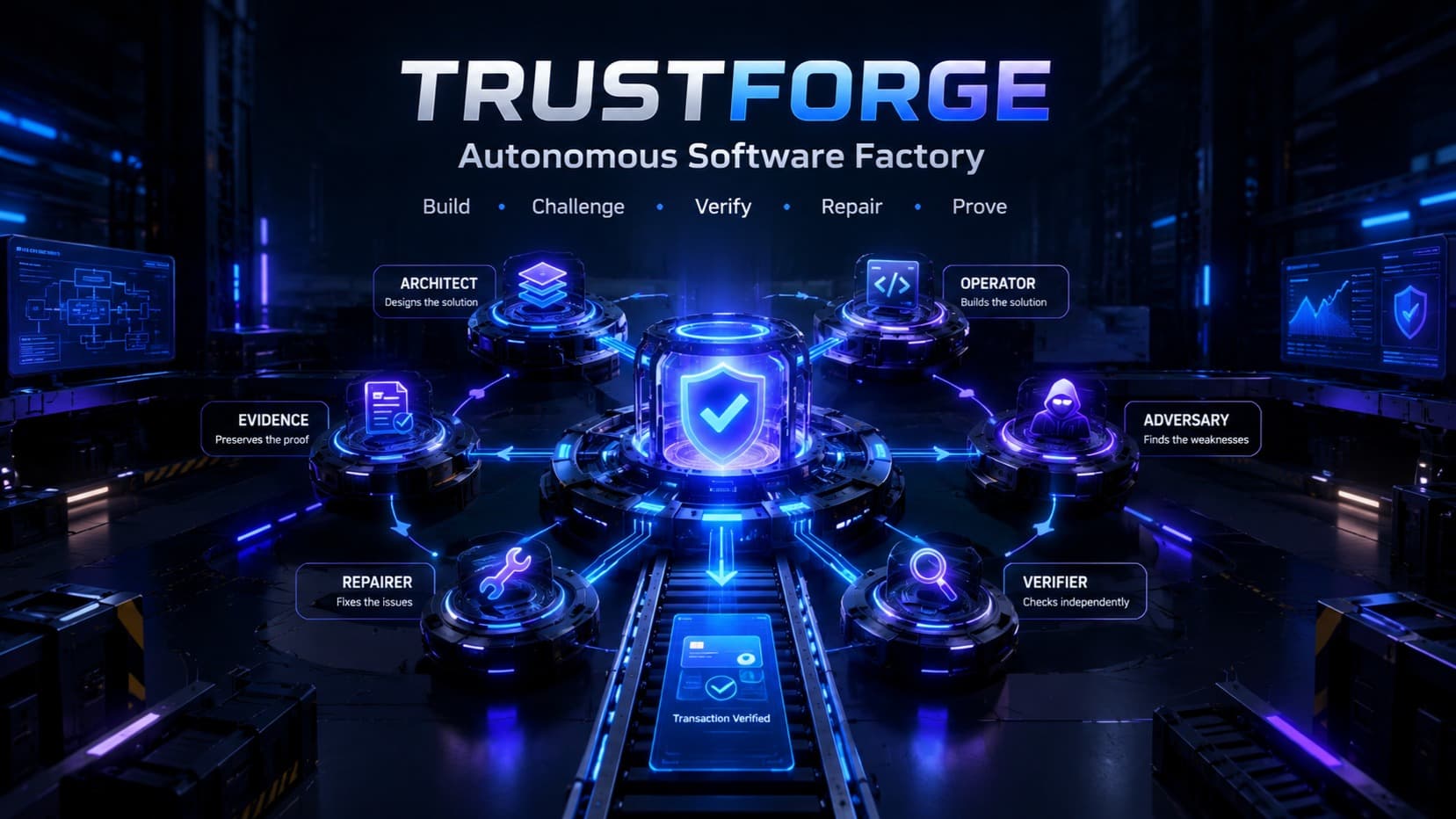
TrustForge is an autonomous software factory designed around one principle: code that works is not necessarily code that can be trusted. Instead of relying on a single AI coding agent to build software and declare it finished, TrustForge creates a complete engineering loop: Architect → Operator → Adversary → Verifier → Repairer → Verifier → Evidence Each seat has a bounded responsibility. The factory transforms requirements into explicit properties, generates adversarial scenarios, implements the required behavior, independently verifies the running system, repairs concrete failures and re-verifies the repaired revision before producing an evidence package. For the Pocketful track, TrustForge produced a self-contained Stage 1 wallet and payments service covering authentication, payments, requests, bill splitting, idempotent writes, atomic multi-item operations, exact integer money arithmetic, activity visibility and state export/import. The verification philosophy is simple: Requirement → Property → Scenario → Implementation → Execution → Observation → Verdict → Repair → Re-verification TrustForge does not treat “tests passed” as proof of universal correctness. Its evidence model explicitly distinguishes VERIFIED, FAILED, INCONCLUSIVE and BLOCKED states and preserves limitations and failure history. The recovered project records 147/147 shipped checks passing in the official isolated Pocketful Stage 1 harness, alongside independent HTTP verification and reproducible container instructions. The factory itself is designed to be reusable beyond Pocketful. Its mandates are domain-agnostic and can be applied to software, APIs, business automations, AI agents and AI-generated applications. TrustForge's goal is not simply to make AI build faster. It is to make AI-built software harder to trust blindly.

Fresno LUX: A Living City

Fresno LUX: A Living City

Fresno LUX is a prototype for a living intelligence layer across an entire city. Fresno already contains enormous amounts of intelligence: residents know where problems exist, nonprofits know where help is needed, businesses know where opportunities exist, educators understand gaps in learning, researchers generate knowledge, and government maintains critical infrastructure and data. The problem is that much of this intelligence is fragmented across disconnected systems. Fresno LUX connects those pieces. The platform creates a shared city graph where people, organizations, resources, needs, projects, observations, experiments, and outcomes become connected nodes. Instead of simply collecting data, LUX continuously asks: What is happening? What do we know? What is missing? What can we test? What changed? A community problem can become an observable signal. That signal can become an experiment. The experiment produces evidence. Evidence changes the system's understanding. That updated understanding informs the next action. Observe → Connect → Understand → Act → Measure → Learn → Converge. The goal is to move Fresno from disconnected information toward collective intelligence—a system where knowledge can travel across boundaries and successful solutions can be discovered, tested, measured, and replicated. LUX is designed to make the invisible connections visible: the relationship between a neighborhood and its resources, between a student and educational opportunity, between a business and workforce capacity, between environmental conditions and community health, and between an idea and measurable real-world impact. This hackathon prototype demonstrates the beginning of a Living Fresno Graph: a city that can observe itself, learn from evidence, and coordinate toward better outcomes.

Deterministic Risk-Managed Agent

Deterministic Risk-Managed Agent

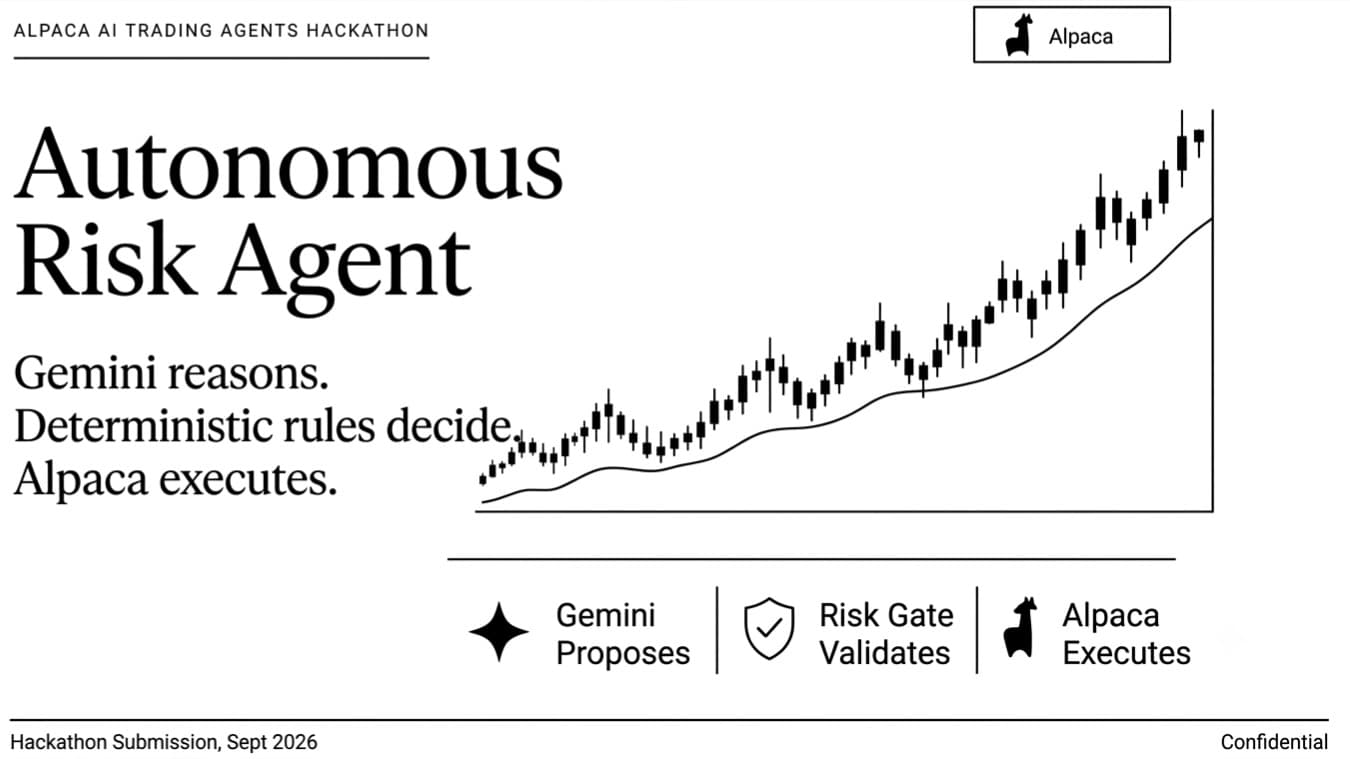
Most AI trading bots fail in live markets because Large Language Models are non-deterministic, suffer from hallucinations, and lack built-in position discipline. This project bridges cutting-edge AI reasoning with 4+ years of real-world options trading experience (2020–present) to build a safe, auditable, and production-ready trading agent on Alpaca. The system architecture enforces a strict boundary: Intelligence != Authority. 1. Strategy Layer (Gemini): Gemini analyzes live market data, option chains, RSI, IV Rank, and news sentiment on 30-minute automated cycles. It proposes defined-risk strategies (such as Bull Put Spreads, Bear Call Spreads, or Iron Condors) as structured JSON payloads 2. Deterministic Risk Gate (risk/risk_gate.py): The LLM never has direct order execution authority. Every proposal must pass a hardcoded Python risk gate that directly encodes hard-earned real-world trading rules: Rule 1 (Capital Control): Max 3.5% risk per trade and 30% max portfolio deployment. Rule 2 (Overtrade Guard): Circuit breakers cap activity at 3 trades/day and freeze trading after 2 consecutive losses. Rule 3 (Volatility Protection): Automated blackout filters block new trades prior to earnings releases and during low IV periods 3. Execution & Audit (Alpaca API): Approved trades are submitted via alpaca-py with explicit DAY vs GTC order tracking. Every decision, rejection, and exit check is logged to an immutable .jsonl audit trail and monitored on a FastAPI/Tailwind control dashboard.

RasoSynthTune: Text-to-Dataset & Fine-Tuning

RasoSynthTune: Text-to-Dataset & Fine-Tuning

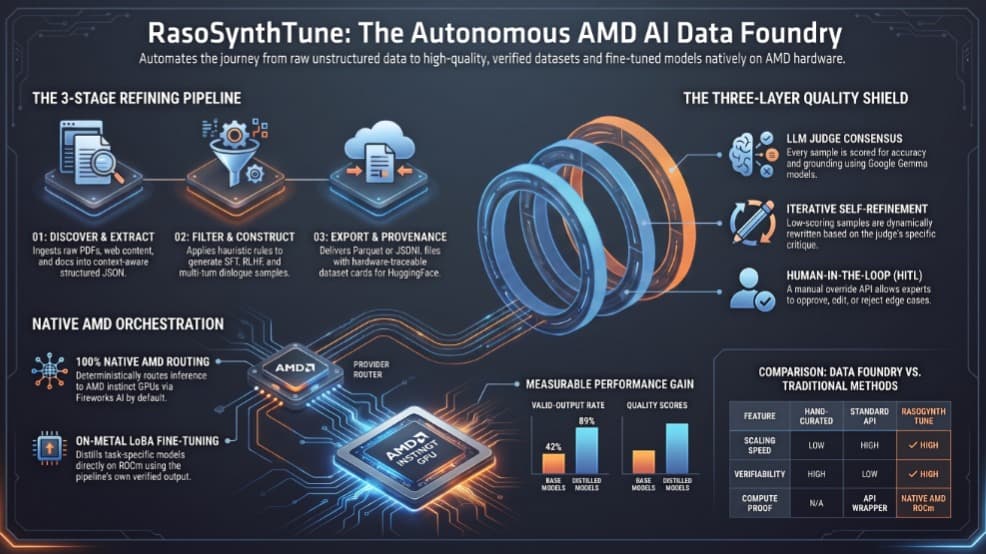
ML teams fine-tuning models spend immense time hand-curating data or blindly trusting API-generated data that silently poisons training runs with hallucinations. RasoSynthTune solves this bottleneck as an autonomous multi-agent data refinery that converts raw, unstructured documents into verified fine-tuning datasets. The platform ensures quality through a rigorous three-layer verification shield: consensus-based LLM judge scoring, iterative self-refinement where low-scoring samples are dynamically revised using the judge's own critiques, and a Human-in-the-Loop (HITL) manual review API. Furthermore, the system actively truncates hallucinated claims in generated multi-turn dialogues. Crucially, RasoSynthTune provides genuine hardware utilization rather than just standard API routing. Heavy multi-agent workflows and dynamic inference routing natively prioritize Fireworks AI, executing Google Gemma models (gemma2-9b-it and gemma2-27b-it) directly on AMD Instinct GPUs. The platform takes this further with an on-metal LoRA distillation loop, utilizing ROCm to fine-tune a smaller model directly on AMD hardware using the pipeline's own rigorously verified output data. Built for enterprise scale, the entire architecture—featuring a LangGraph multi-agent engine, FastAPI router, PostgreSQL, Redis, Qdrant vector storage, and a React/Next.js visual workflow studio—is fully containerized and features OpenTelemetry and Prometheus observability. It is engineered to deploy instantly on the AMD Developer Cloud, delivering transparent datasets (JSONL, Parquet) complete with hardware and model provenance cards.