Stable LM

Stable LM is a groundbreaking language model introduced by Stability AI. With 3 billion parameters, this compact language model is specifically designed for high-performance language generation on smart devices, such as handhelds and laptops.

Its efficiency and affordability make it an ideal choice for a wide range of applications, from creative writing assistance to specialized programming tasks.

General
Relese dateOctober 2, 2023
AuthorStability AI
Repositoryhttps://github.com/Stability-AI/StableLM
TypeLanguage Model

Start building with Stable LM

StableLM-3B-4E1T is a 3 billion parameter decoder-only language model pre-trained on 1 trillion tokens of diverse English and code datasets for 4 epochs.

Stable LM Tutorials


Stable LM Usage and Resourses

StableLM-3B-4E1T is intended to serve as a foundational base model for application-specific fine-tuning. Developers are encouraged to evaluate and fine-tune the model for safe performance in downstream applications.

Stable LM models


Stable LM top builders

Explore the top contributors showcasing the highest number of Stable LM app submissions within our community.

Stability AI Stable LM AI technology Hackathon projects

Discover innovative solutions crafted with Stable LM, developed by our community members during our engaging hackathons.

Dependency Blackout

Dependency Blackout

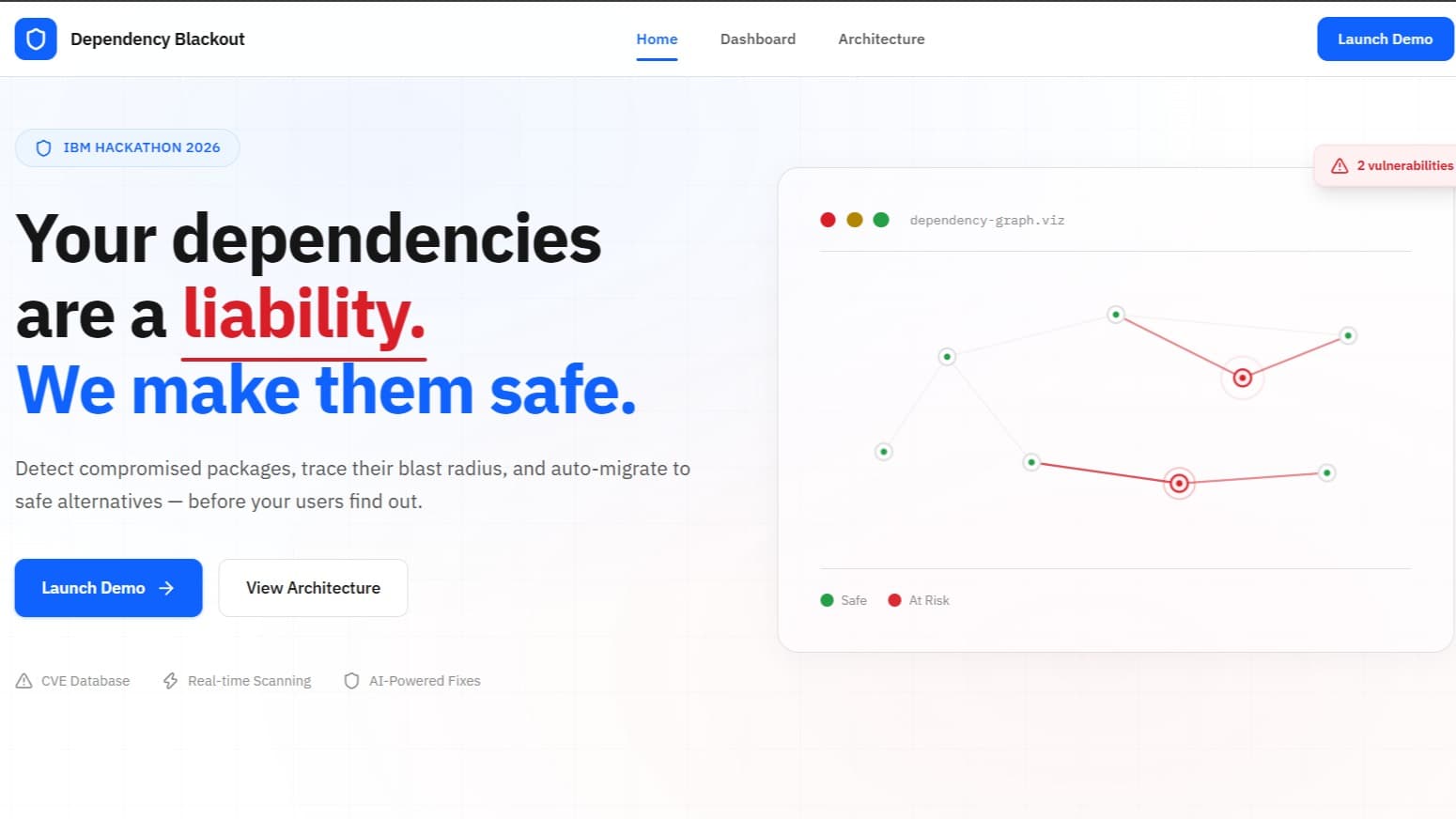
Dependency Blackout tackles an issue that many software projects face today. New applications use a lot of open‑source packages. If one of those packages is weak, broken or old it can expose the codebase to danger. Regular scanners can point out weak packages but developers still have to figure out how bad the problem is, look for a better option change the code and test that everything still runs. Dependency Blackout brings all those steps into a workflow. It scans a projects dependencies and spots packages that are known to have security or maintenance problems. When it finds a dependency it draws an impact graph that shows where that dependency is used in the application. This helps developers see the spread of the risk instead of just getting a simple alert. Dependency Blackout then suggests replacement options and gives a confidence score so developers can judge the choices. After a replacement is chosen Dependency Blackout helps move the code over and shows a clear before‑and‑after diff that tells exactly what changed. At the end it runs tests to make sure the fix does not create issues. The main users of Dependency Blackout are software developers, security engineers, DevSecOps teams and any development group that manages applications with dependencies. They use a dashboard to choose a repository run a scan look into vulnerabilities examine the impact pick alternatives run the migration and check the outcome. What sets Dependency Blackout apart is that it does more than just find a vulnerability. It links detection, impact analysis fixing moving to a package and verification into one workflow. This cuts down the work that developers normally do when dealing with dependency problems and gives them a clearer route from spotting a security issue to safely fixing it. In short Dependency Blackout helps developers spot dependencies see what they touch swap them safely and confirm the fix—all, in one system.

Fresno LUX: A Living City

Fresno LUX: A Living City

Fresno LUX is a prototype for a living intelligence layer across an entire city. Fresno already contains enormous amounts of intelligence: residents know where problems exist, nonprofits know where help is needed, businesses know where opportunities exist, educators understand gaps in learning, researchers generate knowledge, and government maintains critical infrastructure and data. The problem is that much of this intelligence is fragmented across disconnected systems. Fresno LUX connects those pieces. The platform creates a shared city graph where people, organizations, resources, needs, projects, observations, experiments, and outcomes become connected nodes. Instead of simply collecting data, LUX continuously asks: What is happening? What do we know? What is missing? What can we test? What changed? A community problem can become an observable signal. That signal can become an experiment. The experiment produces evidence. Evidence changes the system's understanding. That updated understanding informs the next action. Observe → Connect → Understand → Act → Measure → Learn → Converge. The goal is to move Fresno from disconnected information toward collective intelligence—a system where knowledge can travel across boundaries and successful solutions can be discovered, tested, measured, and replicated. LUX is designed to make the invisible connections visible: the relationship between a neighborhood and its resources, between a student and educational opportunity, between a business and workforce capacity, between environmental conditions and community health, and between an idea and measurable real-world impact. This hackathon prototype demonstrates the beginning of a Living Fresno Graph: a city that can observe itself, learn from evidence, and coordinate toward better outcomes.

ORION — Autonomous Options Alpha Agent

ORION — Autonomous Options Alpha Agent

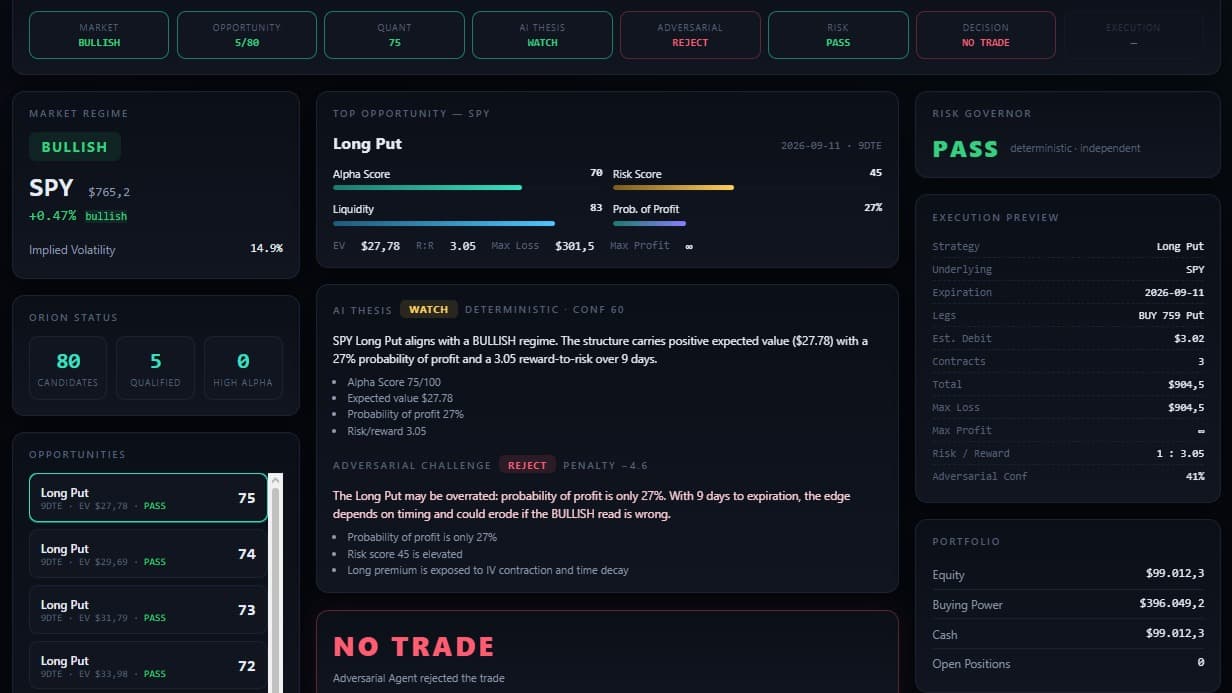
ORION is an autonomous AI options trading agent built on Alpaca. Unlike agents that go straight from "find" to "trade", ORION must prove every trade through a disciplined pipeline: Market Intelligence → Options Scanner → Quant Engine → AI Analyst → Adversarial Agent → Risk Governor → Trade Validator → Execution. "NO TRADE" is a first-class, valued outcome — ORION optimizes decision quality, not trade count. Hybrid intelligence by design: all financial math is deterministic Python — market-regime classification, probability of profit and expected value (numeric integration over a lognormal terminal distribution), Greeks/IV, liquidity, an Alpha Score and a Risk Score. The LLM is used only for reasoning: an AI Analyst writes the thesis; an Adversarial Agent tries to prove the trade wrong and can reduce the Alpha Score. The LLM is optional (deterministic fallback) and never the authority on risk; every LLM output is schema-validated or rejected. Independent risk gates: a deterministic Risk Governor can veto any trade (min Alpha/liquidity, max risk, min risk-reward, non-negative expected value, spread, duplicate and exposure caps); conservative position sizing; a pre-flight Trade Validator; and hard paper-trading enforcement. On any error or ambiguity, ORION resolves to NO TRADE. Every decision is audited and journaled. Alpaca integration: trading and account operations (account, clock, positions, orders and order submission — including multi-leg options spreads) run through the official Alpaca CLI; market data (quotes, option chains, Greeks/IV) via the Alpaca REST market-data API. Developed and tested on a dedicated paper account with a $100,000 balance. Includes a premium dark, quant-styled React dashboard (EN/PT), a Monte-Carlo backtest, a searchable decision journal, an offline demo mode that runs with no keys and no network, and 93 automated tests. Paper trading only — ORION refuses to run against real money.

LectureAI

LectureAI

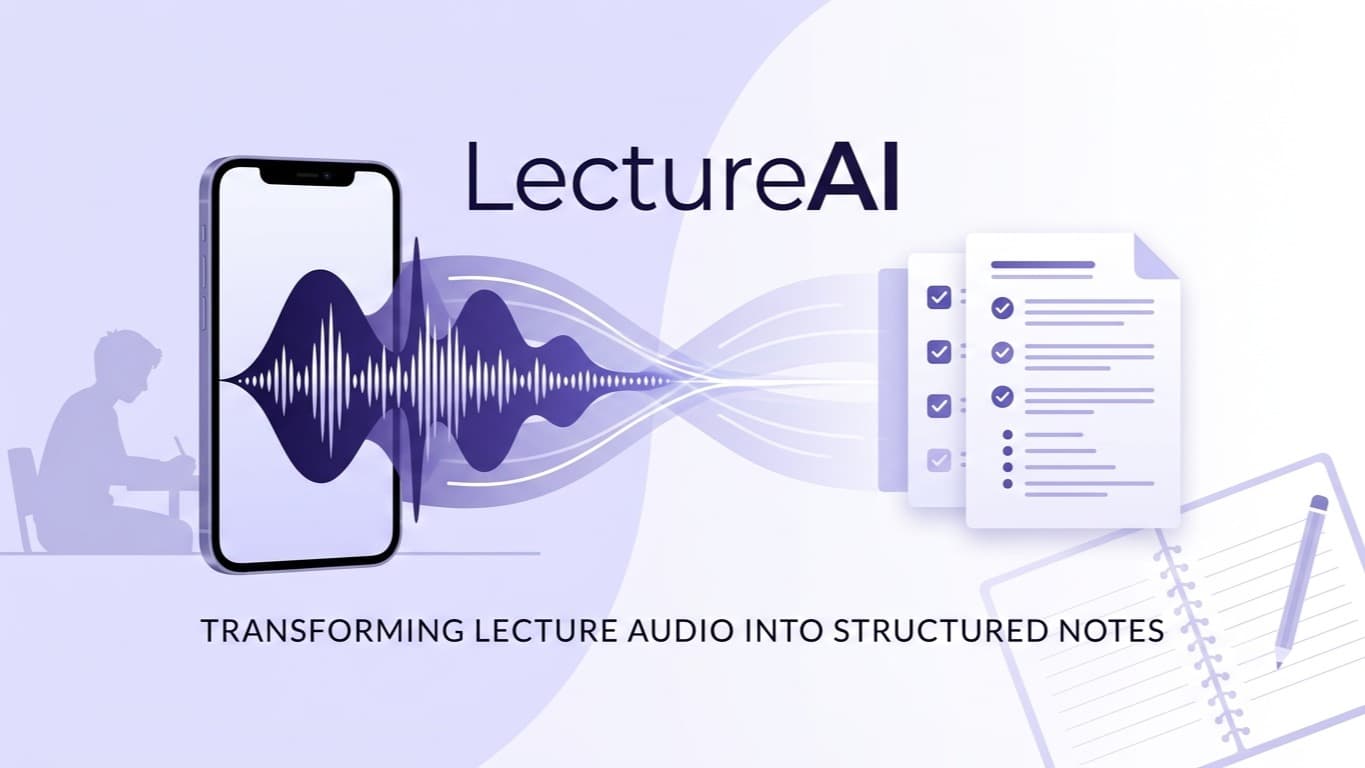
LectureAI helps university and college students turn recorded lecture audio into organized, exam-ready study material — automatically, without writing a single note by hand. A student logs in, selects or creates a subject (like "Programming Fundamentals" or "Calculus"), and uploads a lecture recording. The audio is transcribed using Speechmatics' Melia 1 model, which is purpose-built for multilingual, code-switched speech — meaning it accurately handles lectures spoken in English, Urdu, or a natural mix of both, common in many classrooms. The resulting transcript, always in English, is then processed by four specialized AI agents powered by Claude Sonnet 5: a Summarizer that captures the lecture's main topics and flow, a Key Concepts Extractor that pulls out important terms, definitions, and formulas as a cheat-sheet, a Confusion Highlighter that flags unclear or rushed parts of the lecture with simplified explanations, and a Memory/Continuity Checker that compares the lecture to the student's most recent previous lecture in the same subject, showing exactly how the two connect and clearly displaying that previous lecture's date. Each agent produces its own downloadable PDF, giving students four focused, ready-to-use study documents per lecture. Every student's data is kept private through Google OAuth authentication and Supabase's row-level security, and lectures are organized by subject so the Continuity Checker always compares against the correct prior lecture. Built entirely on native.builder, LectureAI integrates two AI Factory hackathon technology partners: Speechmatics for transcription and AI/ML API (Claude Sonnet 5) for the four content agents — turning a genuinely time-consuming student problem into a fully automated, exam-ready workflow.

ReelBudget

ReelBudget

The Vision Pre-production is one of the most expensive and time-consuming phases of video creation. Whether you are an independent filmmaker pitching a short film or an enterprise marketing team designing a high-budget commercial, the process requires weeks of sketching, planning, and budgeting before a single frame is ever shot. Reelbudget was built to completely automate this process, acting as your autonomous AI creative director and line-producer. How it Works Users simply input a raw text creative brief. Our multi-agent backend instantly parses the creative intent and breaks the script down into structured scenes, characters, and semantic camera directions. The AMD MI300X Advantage To bring these storyboards to life, we needed massive, uncompromised compute power. We proudly deployed our True AI Video Engine on the AMD MI300X Cloud Instance. Rather than relying on simple static images, our pipeline leverages the MI300X's incredible speed to run two state-of-the-art models on the fly: Stable Diffusion XL generates hyper-realistic, anatomically correct base frames. Stable Video Diffusion instantly animates those frames into true moving video clips, physically matching the AI's camera directions. The system then automatically stitches these clips together, burns in dialogue subtitles, and overlays a background soundtrack, outputting a highly polished, ready-to-pitch movie animatic. Feasibility & Cost Estimation Finally, our AI Feasibility Agent analyzes the generated shot list to provide accurate, real-world cost estimations and suggests cheaper production alternatives, saving businesses thousands of dollars in pre-production overhead. Reelbudget proves that with AMD hardware, AI can handle the heavy lifting of video production, allowing creators to focus entirely on the story.

Stable LM