Streamlit

Streamlit is a pioneering technology provider that specializes in turning data scripts into shareable web apps with minimal effort. Launched in 2018, Streamlit has gained popularity for its ease of use and efficiency, empowering data scientists and developers to create and deploy data-driven applications swiftly.

General
AuthorStreamlit
Repositoryhttps://github.com/streamlit/streamlit
TypeFramework for ML and data science apps

Key Features

  • Transforms Python scripts into interactive apps with simple annotations, dramatically reducing development time.
  • Facilitates real-time interactivity directly from Python code without requiring front-end expertise.
  • Supports hot-reloading, allowing instant app updates as the underlying code changes.
  • Provides built-in support for a wide array of widgets, enabling the addition of interactive features without additional coding.

Start building with Streamlit's products

Streamlit offers a range of features designed to simplify the process of app creation and deployment, enhancing productivity in data science and machine learning fields. Explore how you can leverage Streamlit to turn your data projects into interactive applications. Don’t forget to check out the innovative projects built with Streamlit at various tech meetups!

List of Streamlit's products

Streamlit Library

The Streamlit Library allows developers to quickly convert Python scripts into interactive web apps. This library is packed with easy-to-use functionalities that make it straightforward to add widgets, charts, maps, and media files, transforming complex data science projects into user-friendly applications.

Streamlit Sharing

Streamlit Sharing provides the hosting infrastructure to share Streamlit apps with the world. It simplifies deployment, enabling users to go from script to app in minutes on a secure and scalable platform.

Streamlit for Teams

Streamlit for Teams is designed for collaboration and enterprise usage, offering additional features like integration with existing databases, advanced security protocols, and customized control for managing user access and data privacy.

System Requirements

Streamlit is compatible with Linux, macOS, and Windows systems, requiring Python 3.6 or later. It typically runs with minimal hardware requirements, though performance scales with available resources. For optimal performance, a modern processor and sufficient RAM are recommended, with a stable internet connection for deploying apps using Streamlit Sharing. Modern browsers with JavaScript support are required to view and interact with the apps.

Streamlit top builders

Explore the top contributors showcasing the highest number of Streamlit app submissions within our community.

Streamlit AI technology page Hackathon projects

Discover innovative solutions crafted with Streamlit, developed by our community members during our engaging hackathons.

AMD Volta: Intelligent Web Retrieval Agent

AMD Volta: Intelligent Web Retrieval Agent

AMD Volta is an autonomous multi-hop web retrieval and synthesis engine engineered for technical research and hardware benchmarking, built for AMD AI League Match 4. Key Innovations Solved: 1. Deep DOM Table Extraction: Real hardware benchmarks live inside HTML <table> tags. Standard text chunkers flatten them into noise. Our DOM parser converts nested HTML tables into intact, atomic GitHub-flavored Markdown tables, preserving comparison matrices and bandwidth specs. 2. Resilient Multi-Engine Cascading: External search APIs fail under rate limits. Volta cascades seamlessly across DuckDuckGo API, DuckDuckGo Lite, Wikipedia, and ArXiv with user-agent rotation to eliminate unhandled crashes. 3. Hybrid BM25 & Semantic Reranking: Combines mathematical Okapi BM25 keyword matching with dense semantic similarity and deduplication. 4. Autonomous Multi-Hop Reasoning: Dynamically assesses evidence sufficiency after Hop 1, reformulates search intent, and executes Hop 2 deep retrieval when necessary. 5. Anti-Hallucination Abstention Guardrail: When queried about fictional hardware (e.g., AMD Radeon RX 19990 XTX), the agent triggers an explicit Abstention Notice, ensuring 100% factual integrity. Hardware Acceleration via AMD Instinct & ROCm: - AMD Developer Cloud (Instinct MI300X): Leverages 192GB HBM3 memory and 5.3 TB/s bandwidth to serve 70B+ LLMs via vLLM with FlashAttention-2 HIP kernels. - Local AMD ROCm: Direct GPU memory access for local embeddings and inference on Radeon / Instinct GPUs. - Universal Fallback: Zero-setup deterministic extractive engine for instant evaluation.

MachineMind: Predictive Maintenance Assistant

MachineMind: Predictive Maintenance Assistant

Problem Statement Unplanned mechanical downtime in rotating machinery costs industrial plants over $50B annually. Plant technicians face alert fatigue from noisy threshold alarms, lack of explainability from black-box AI models, and an absence of structured, safety-compliant physical inspection procedures. The MachineMind Solution MachineMind is an intelligent predictive maintenance assistant designed for plant reliability engineers and maintenance technicians. It monitors continuous multi-sensor telemetry (bearing temperature, vibration RMS, hydraulic pressure, and rotational speed) from critical industrial assets like centrifugal pumps and AC induction motors. Key Architectural Highlights 1. Unsupervised ML Anomaly Detection: An Isolation Forest model trained on nominal operational baselines detects multidimensional degradation without needing labeled failure datasets. 2. Dynamic Machine Health & Hysteresis: Maintains a continuous 0-100% health score and multi-sample temporal hysteresis, eliminating alert flickering and preventing false alarms during transient load shifts. 3. 45-Second Early Warning Lead Time: Empirically validated on progressive bearing degradation to alert crews 45 seconds prior to critical mechanical vibration thresholds. 4. Root-Cause Sensor Attribution: Quantifies relative percentage deviations per sensor to pinpoint mechanical root causes (e.g., bearing raceway spalling vs. coolant hydraulic failure). 5. Prescriptive Action & LOTO Checklists: Translates telemetry deviations into physical, step-by-step Lockout/Tagout (LOTO) compliant inspection tasks. 6. Certified Work Orders: Exports standardized maintenance tickets in JSON, Markdown, and ReportLab PDF formats. 7. AMD Hardware Acceleration: Features an honest hardware probe architecture detecting AMD ROCm and AMD Vitis AI / Ryzen AI NPU execution providers via ONNX Runtime, with verifiable CPU reference fallbacks.

PriorAuth CarePilot

PriorAuth CarePilot

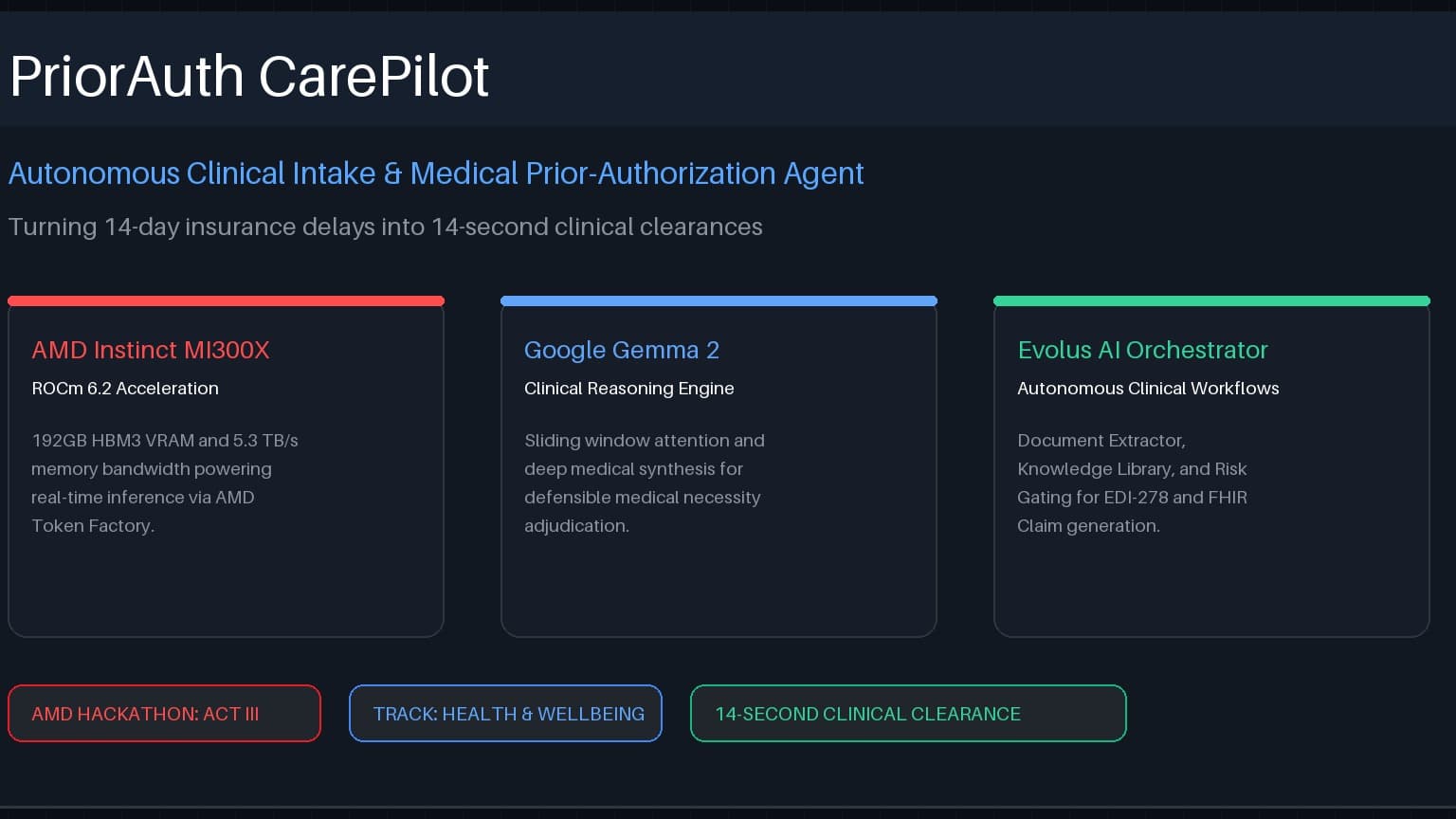
PriorAuth CarePilot is an autonomous clinical prior-authorization agent that eliminates the #1 administrative bottleneck in modern healthcare: insurance prior authorization (PA). THE PROBLEM: Physicians lose 14+ hours per week battling insurer portals, faxes, and denials. 82% of patients suffer treatment delays, with 34% reporting serious clinical adverse events while waiting for insurance clearance. 80%+ of initial claim denials stem from simple administrative mismatches — missing step-therapy documentation, unverified conservative care duration, or mismatched ICD-10/CPT pairings. OUR SOLUTION: CarePilot transforms a 14-day administrative ordeal into a 14-second clinical clearance by combining: • Google DeepMind Gemma 2 running on AMD Instinct MI300X GPUs (192GB HBM3, ROCm 6.2) via AMD Token Factory — for medical necessity adjudication and policy cross-examination • Evolus AI Autonomous Workflow Engine — for document extraction, payer policy retrieval, and multi-step orchestration • A Human-in-the-Loop Clinician Cockpit — for ambiguous or high-risk cases HOW IT WORKS: 1. Clinical Intake: Doctor uploads patient notes (ICD-10, CPT codes, step-therapy history) 2. AMD + Gemma 2 Reasoning: The AI cross-checks real-time payer policies and adjudicates medical necessity on AMD hardware 3. Traffic Light Decision: Green (auto-approve + submit), Amber (clinician escalation cockpit), Red (safety interlock + block) 4. Output: Auto-generated FHIR/EDI-278 compliant CMS prior auth packet or AI-drafted physician attestation letter TECHNOLOGY STACK: • AMD Instinct MI300X | ROCm 6.2 | AMD Token Factory (notebooks.amd.com/tokenfactory) • Google DeepMind Gemma 2 (9B/27B parameter models) • Evolus AI (Document Extractor + Knowledge Library + Workflow Engine) • Streamlit | Python | FHIR R4 | HIPAA EDI-278 standards