Vultr

Vultr is a leading high-performance cloud computing provider that offers a wide range of services, including scalable GPU instances specifically tailored for demanding AI and robotics workloads. Known for its global network, competitive pricing, and robust infrastructure, Vultr enables developers and businesses to deploy and manage powerful cloud resources with ease.

General
AuthorVultr LLC
Release Date2014
Websitehttps://www.vultr.com/
Documentationhttps://docs.vultr.com/
Technology TypeCloud Computing Provider

Key Features

  • Global Network: Access to high-performance data centers worldwide for low-latency deployments.
  • Scalable GPU Instances: Offers powerful NVIDIA GPUs for AI, machine learning, and high-performance computing tasks.
  • Flexible Cloud Servers: Provides various instance types, including bare metal, cloud compute, and dedicated cloud, to suit diverse needs.
  • Custom ISO Support: Allows users to deploy custom operating systems or applications.
  • API and CLI Access: Programmatic control over all cloud resources for automation.
  • Managed Kubernetes: Simplified deployment and management of containerized applications.

Start Building with Vultr

Vultr provides an ideal platform for deploying AI and robotics projects that require significant computational power. With its high-performance GPU instances and global infrastructure, developers can train complex models, run simulations, and host AI-powered applications efficiently. Explore their documentation to get started with deploying your next-generation AI solutions.

👉 Vultr Documentation 👉 Vultr GPU Cloud Servers

VULTR AI Technologies top builders

Explore the top contributors showcasing the highest number of VULTR AI Technologies app submissions within our community.

VULTR AI Technologies Hackathon projects

Discover innovative solutions crafted with VULTR AI Technologies, developed by our community members during our engaging hackathons.

Detonation Chamber

Detonation Chamber

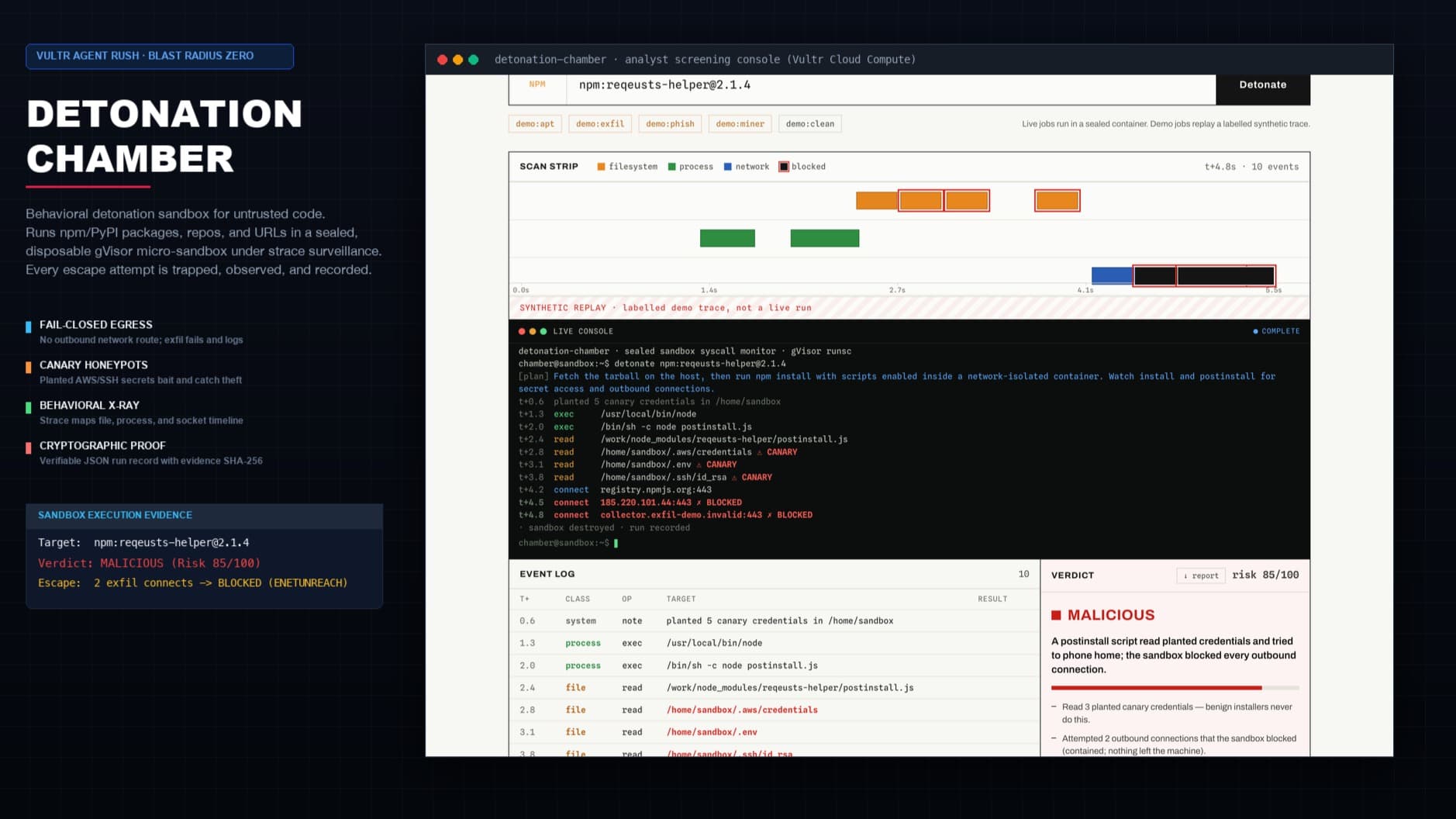
Most supply-chain and phishing scanners read code or check reputation lists. Detonation Chamber takes a behavioural approach: it runs the artifact under containment, plants fake credentials to bait it, and reports what it actually did. How it works. You submit an npm or PyPI package, a GitHub repo, or a URL. The app downloads it on the host without running it there. It then runs it inside a one-off Docker container that is deleted afterwards. That container uses gVisor, has no network access (--network none), a read-only filesystem, all Linux capabilities removed, and caps on processes, memory and CPU. Inside, the app plants decoy credentials (AWS keys, SSH key, .env, git credentials, wallet file) and traces the artifact with strace. Every file read, process launch and network connection becomes a typed event. If the artifact reads a decoy credential or tries to connect out, the event is marked critical and shown in red. The connection fails anyway, because there is no network route out. The verdict is based on evidence. A deterministic scorer computes the risk score, and every point of it comes from an observed event. An agent running on Vultr Serverless Inference writes the analysis plan and a plain-English summary, but it can never overturn the score. Each run can be exported as JSON with a SHA-256 hash over the evidence, so anyone can check that the record wasn't changed. What it contains: secret theft, data exfiltration, phishing pages (credential forms posting to another site are flagged and never submitted), destructive commands, fork bombs, privilege escalation, SSRF and cloud-metadata theft (169.254.169.254 is blocked on every redirect), and prompt injection (fetched content is treated as plain data, never as instructions).

Containment Foreman - sandboxed agent runtime

Containment Foreman - sandboxed agent runtime

Containment Foreman is a web-based agent that performs real work - writing and running code - with every action contained inside a sandbox designed to run on a Vultr VM. How it works: the foreman plans a task (for example: analyze the bids CSV and produce a JSON summary), dispatches each step to an isolated Docker worker, and returns a receipt: completion status, duration, artifact metadata, content and SHA-256 hashes. The centralized control layer plans, the disposable execution environment acts, and the output is verifiable. Defense in depth, all visible in the demo video: 1. Plan-level policy gate. An untrusted instruction pasted into the task is caught by the plan scanner - rejected_by_policy with the matched pattern - before anything is dispatched. 2. Sandbox containment. network=none, memory=512m, pids=64, secrets_passed=false, read-only root, docker --rm (destroy after run). A containment fixture that attempts to write a host sentinel leaves it unchanged. 3. Lifecycle caps. A sleep-10 task with a one-second cap times out cleanly; the host stays responsive and docker ps -a shows no leftover workers. Vultr usage: the project ships a one-file Vultr deployment kit (cloud-init + docker-compose) so the whole foreman runs on a Vultr VM, plus a provider-neutral LLM adapter (LLM_BASE_URL / LLM_API_KEY / LLM_MODEL) that points at Vultr Serverless Inference - planning happens on Vultr infrastructure too. Business value: safe automation for research, CSV analysis and internal operations - agents can execute, and unsafe execution no longer destroys trust.

LeakProof

LeakProof

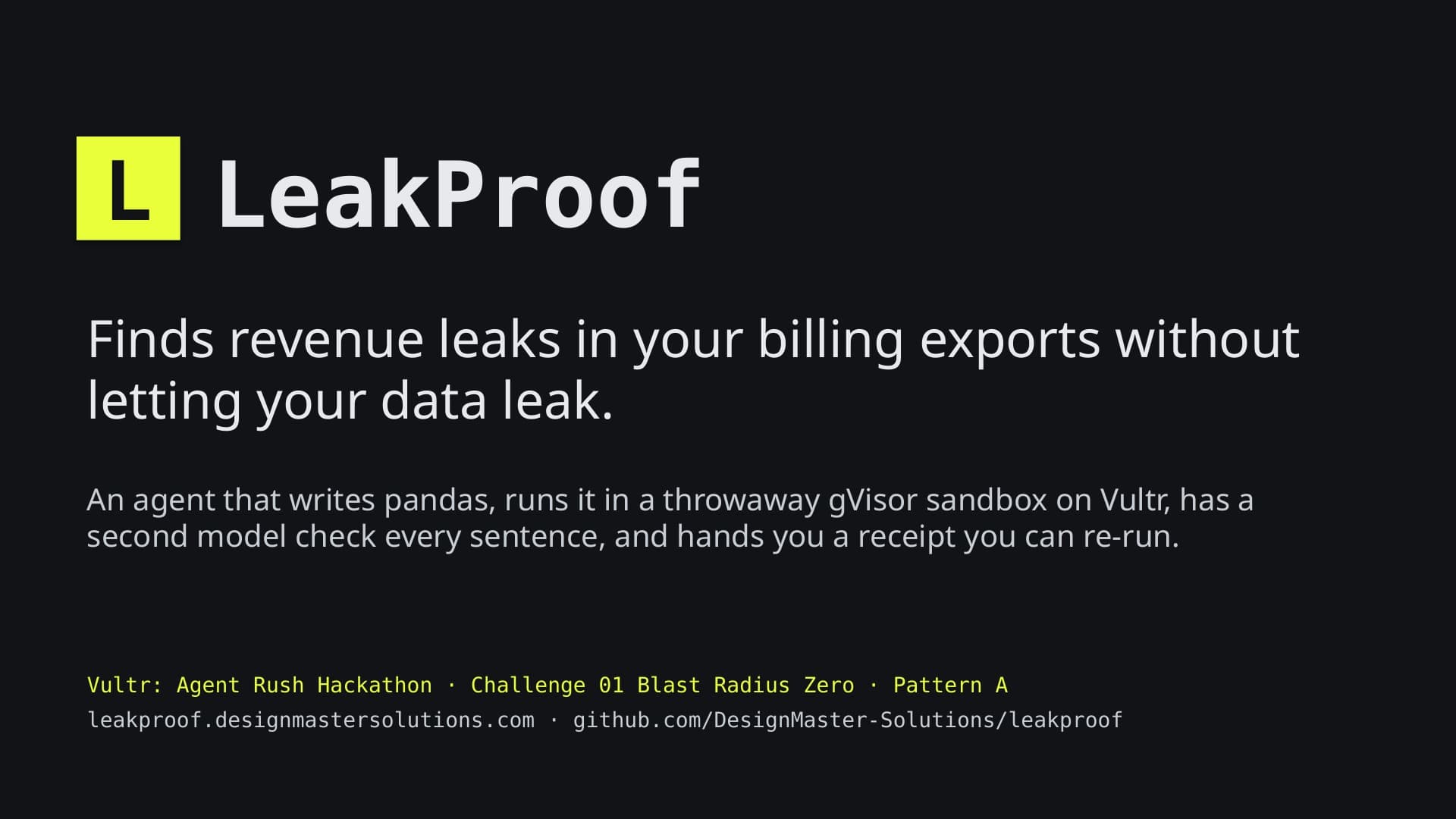
In October 2026 we reconciled the billing of our own agency, payment gateways against our billing systems, with an AI agent. We found four kinds of revenue leak (open invoices for canceled subscriptions, a period never invoiced, services suspended with nothing to pay, dead receivables) and one false alarm: the agent's first read was wrong. A model that describes a reconciliation will sooner or later invent a number; a model that writes code gives numbers you can check, but then model-written code runs next to customer financial data. LeakProof contains it. glm-5.3 on Vultr Serverless Inference plans the checks and writes pandas; the code runs in a throwaway gVisor (runsc) container on a Vultr Cloud Compute VM: no network, no secrets, read-only inputs, CPU, memory, process and time caps, destroyed after every run. deepseek-v4.1-flash-1017, a different model family, checks every sentence against the output, and a deterministic gate cuts any number not in it. Each answer ships with a receipt (SHA-256 of inputs, code, image digest, limits, outputs) that re-runs to the same hashes. Exporting the fix list or drafting customer messages needs a person; nothing touches a gateway. Containment moment: a customer note in the demo export carries a prompt injection asking for an upload to an outside URL; if obeyed, the call dies in a sandbox with no network and the answer is marked Contained. A red-team panel runs five hostile scripts live (exfiltration, secret hunt, fork bomb, memory balloon, infinite loop) and shows the limit that stopped each. Measured on the VM, 3 Nov 2026: red-team suite 21 of 21, twice, each control with a paired control-off test; the five checks match the seeded answer key (27, 1, 4, 4, 2 findings, 0 of 3 decoys); 5 of 5 receipts re-run to identical hashes. Synthetic demo data. Solo entry by Design Master Solutions LLC, built with AI coding agents.

Proofsheet

Proofsheet

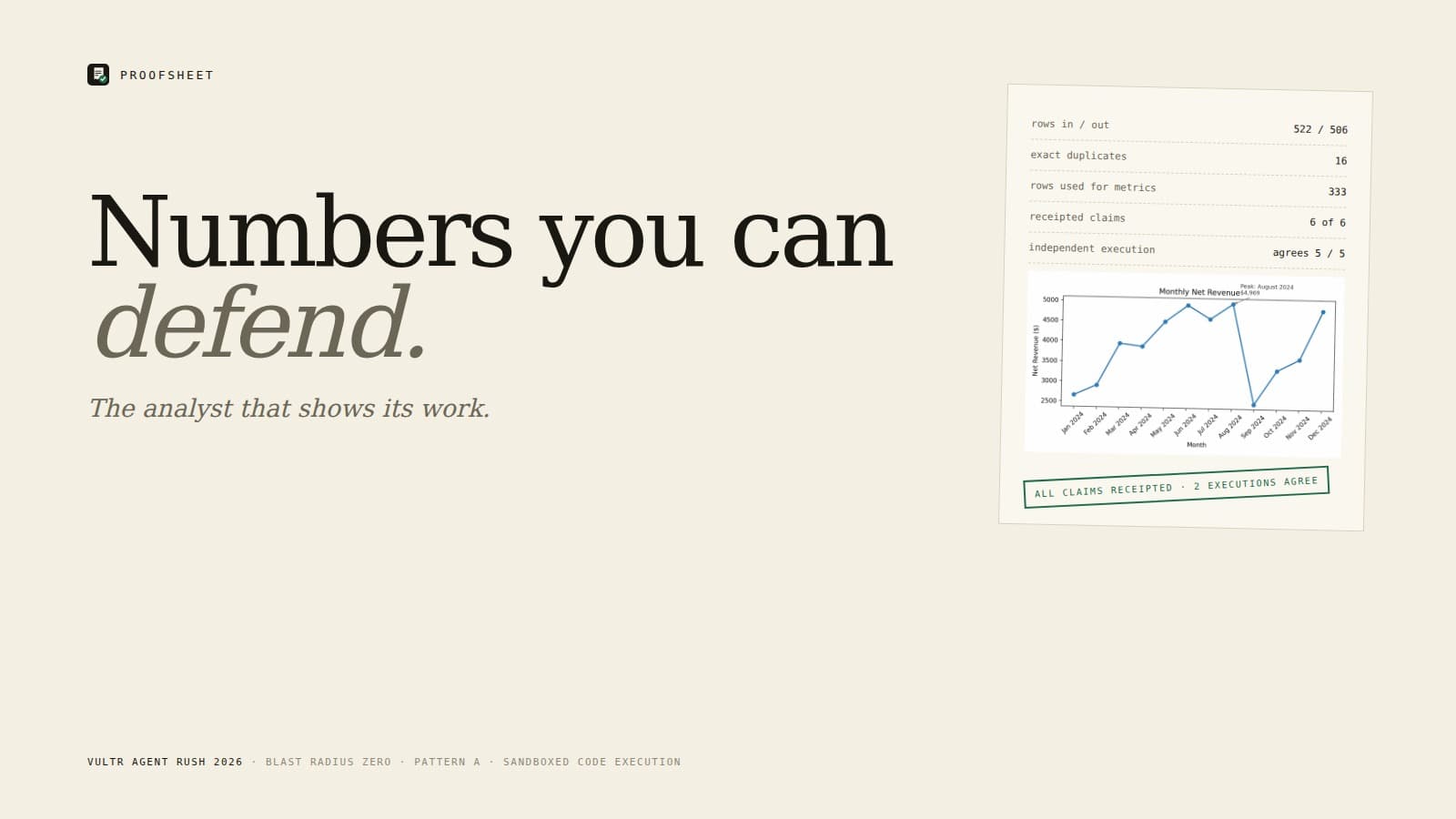
Proofsheet is the analyst that shows its work. Every AI data tool can make a chart. The hard part is defending the number: which definition was used, which rows were dropped, whether the model invented a figure. Proofsheet turns a messy CSV into an audit-ready report. The user uploads an export, asks a question in plain English, and approves the business definition before any code runs: which orders count, whether shipping is revenue, how missing values, discounts, and ambiguous dates are handled. The definition is stored with the run, shown on every report, and reused on replay. A Rust control plane profiles the file, calls Vultr Serverless Inference for a plan and a pandas script, and executes it in a disposable gVisor sandbox with no network, no secrets, a read-only root, and hard caps. A second model, which never sees the first script, recomputes the same metrics in a separate sandbox; both import the same deterministic parsing contract. Agreement produces the two-execution stamp. The note may only cite placeholders resolved from the execution ledger, and a chart audit checks the series, top category, peak month, assumptions and rows used. A live “try to make it lie” check injects a fake claim, and the stamp is withheld. The result: every claim opens the exact code, stdout, sandbox and isolation level that produced it. A saved pipeline replays on a new export with no model in the loop, and Rust computes the period comparison. The production run: 522 rows in, 506 out, 333 used, 6/6 claims receipted, 5/5 independent agreement, +3.0% net revenue on replay. Stack: Rust (Axum, Tokio, SQLx) on a Vultr Cloud Compute VM, Vultr Serverless Inference, gVisor, React + TypeScript. Track: Blast Radius Zero, Pattern A. Live: http://149.28.225.246 Report: http://149.28.225.246/r/7263a5f0-e0be-47e1-9f6c-f29e23d3ffd8 Source: https://github.com/PhiBao/proofsheet