
🤝 Top Collaborators




🤓 Latest Submissions
Trails
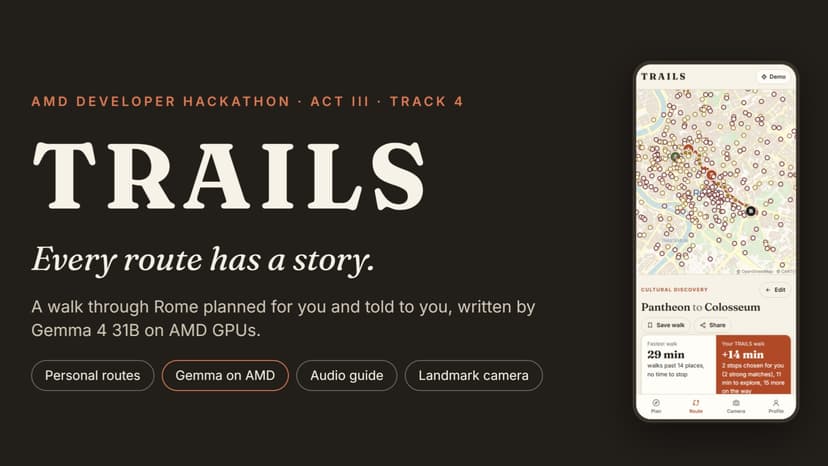
Rome had a record 22.9 million arrivals in 2025, and most visitors walk the same few streets. Maps send you the fastest way and say nothing; audio guides cover one monument and are the same for everyone. TRAILS is a walking guide planned for you and told to you. You give any start, any destination and the time you have. A small neural network on the phone ranks 465 historical places for your taste, an optimiser picks the stops worth the detour, and a router follows real OpenStreetMap streets. Then Gemma 4 31B, running on AMD GPUs through the AMD Developer Cloud Token Factory, writes the story of exactly this walk, with numbered sources. As you walk, each stop is read aloud when you get close. Point the camera at one of 27 landmarks and TRAILS recognises it in the browser and opens its history. The experience changes with the audience: with the same start, end and 45 minutes, a history lover gets the Temple of Hadrian and Trajan's Column, while an art lover gets three churches and a different story. Every like or skip shifts the next walk. Quality control: Gemma only receives facts from our own sourced place records, and every story is checked automatically. On 5 fixed walks: 5/5 stories, 17/17 stops covered, 0 unsupported numbers. If the model is slow, the app falls back to a pre-generated story, so a walk never breaks. Business model: hotels (branded walking concierge), tourism boards (spreading visitors away from hotspots) and travellers (premium city story packs). One story costs a fraction of a cent; ranking, routing and recognition run free on the phone. No account: your data stays on your device.
18 Oct 2026
ContextGuard - Live Decision Helper
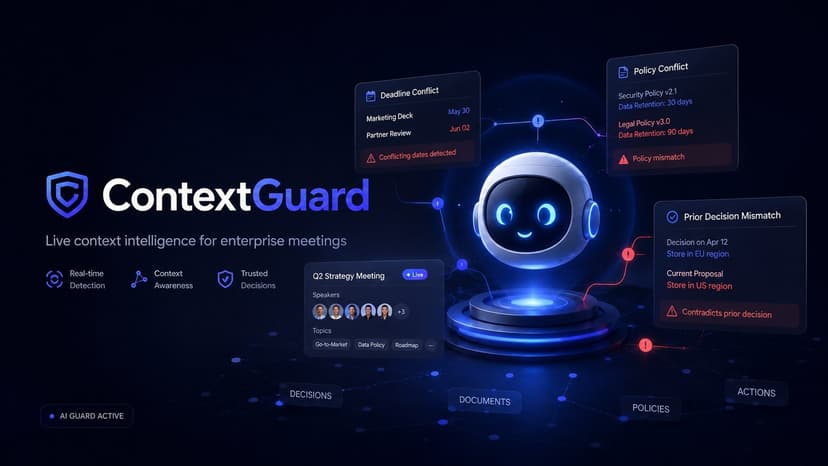
ContextGuard is a real-time meeting agent that catches conflicts between what's being said and what your company already knows — then acts on it. It listens through Speechmatics with speaker diarization, parses every decision, promise, and assignment via Gemini 2.5 Flash, and checks each one against your company's memory graph: legal blockers, prior decisions, owner capacity, customer commitments, dependency chains. The moment a statement collides with reality, an evidence-backed card appears on screen — citing the exact source ("Legal Review, May 12 — DPA pending") with a suggested next step. The intervention happens during the call, when course-correction still costs seconds. After the meeting, two more layers activate. A Personal Summary engine rewrites the session from one participant's point of view: what they now own, what was decided that affects their scope, which flags involved them. A Service Agent Layer then executes the operational decisions: a GitHub agent updates issues and labels, a Jira/Notion agent reassigns owners and shifts priorities, a Gmail agent drafts the customer email walking back the promise that just got flagged. Every action is logged with before/after diffs. Target audience: product, engineering, and operations teams at companies of 50+ where Sales, Legal, Platform, and Product each carry a different version of reality, and meetings are where those versions collide. The whole stack runs as a single Next.js app, deployable to Vultr in one command — Speechmatics tokens minted server-side, structured Gemini output under a strict JSON schema, and a Valkey-backed action queue so service agents run asynchronously without blocking the meeting UI. Meeting assistants tell you what happened. We surface what would stop it — and then do something about it.
19 May 2026

