
🤝 Top Collaborators



🤓 Latest Submissions
CLARIO
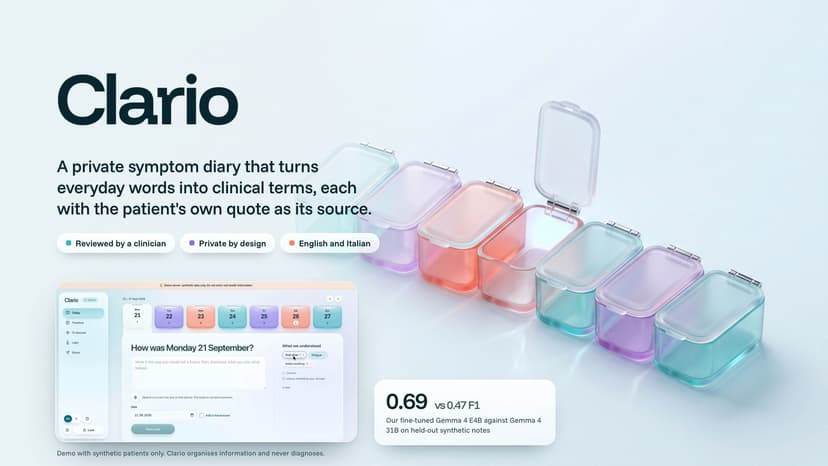
300 million people live with a rare disease, most starting in childhood. Diagnosis often takes over five years: appointments, inconclusive tests, the same story retold. The clues may already exist: a forgotten symptom, a lab value buried in a PDF, a pattern no single visit revealed. What if we could connect those dots sooner? CLARIO connects patients with unexplained symptoms and the doctors looking for answers. Patients keep a diary in their own words, by voice or text, and upload lab reports. CLARIO links clues across months and asks the one question that would help most. Clinicians get a dashboard with the history, symptom and lab trends, rare conditions worth considering, and an evidence-backed brief. Every AI finding can be traced, corrected or rejected, and the brief is a draft until a doctor signs it. Privacy is engineered in: AES-256-GCM vault, Argon2id keys, pseudonymisation before any remote call, tamper-evident AI logs, X25519-sealed sharing, on-device transcription. Bigger isn't always better. Our LoRA-tuned Gemma 4 E4B reaches F1 0.70 on 300 disease-held-out cases (0.35 before tuning), with 100% valid JSON and 99.8% quote grounding. On 100 of those cases, scored the same way, it beats Gemma 4 31B: 0.69 vs 0.47. On AMD: Gemma 4 31B on AMD Token Factory wrote our 2,992-diary training set, reads lab PDFs with MinerU (48/48 rows) and drafts the brief. Our fine-tuned model runs offline on an AMD Ryzen CPU (F1 0.64), so the diary can stay on the patient's computer. Also tested on real patient text (PsyTAR). Every number links to a file in the repo. We don't replace doctors. We help the patient's whole story reach them, because five years is too long to wait to be heard.
18 Oct 2026
The Counterfeit Desk
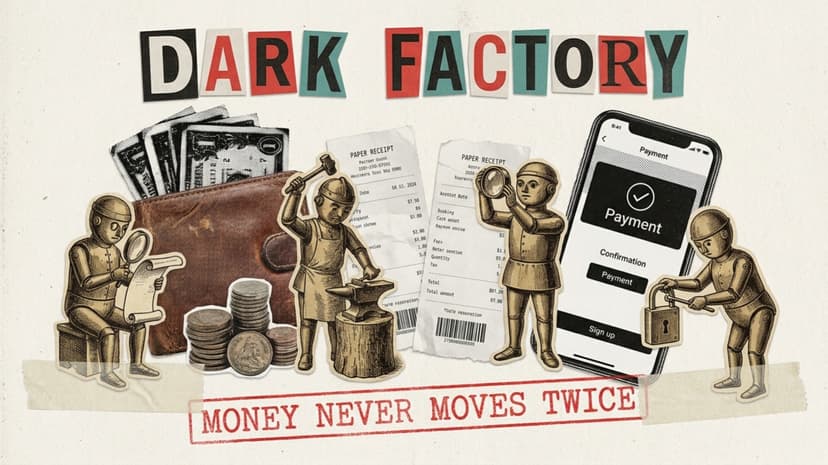
A dark factory for Band Desktop, built on one measured observation: a single strong agent builds faster than a team that splits the code, but it cannot check its own work. So my factory never splits the code. One seat (the printer, Sonnet) builds the whole product. Three seats exist only where independence adds information: a blind examiner (Opus) writes tests from the spec before any code exists and is locked out of the product repository by the macOS sandbox, a forger (Sonnet) attacks every build and prints counterfeit builds to test the examiner, and a clerk (Opus) keeps the requirement ledger and rules on disputes. One dispatch message built all four pocketful stages in about five hours for $52.82 at list price. The examiner's blind suite grew to 1,182 tests and caught all 20 counterfeits served as unlabeled addresses. Official suites, never shown to any seat: 147/147, 33/35, 6/6, 5/5. I also ran the honest baseline: one Opus agent, same spec, no Band. It scored 188/188 on stages 1 to 3 in 26 minutes for $7.18, two checks ahead of the desk. It also shipped four spec violations our forger found and we reproduced by hand: a 500 on a garbage path, a 500 on a deeply nested unknown field, a wrong handle for an emoji email, a 500 on a valid huge hold lifetime. The desk ships none of them. FACTORY.md documents the seats, the sandbox and serve daemon that enforce blindness, mutation testing of the tester, every defect and who caught it, the solo comparison, and an open limits section.
6 Oct 2026
ContextGuard - Live Decision Helper
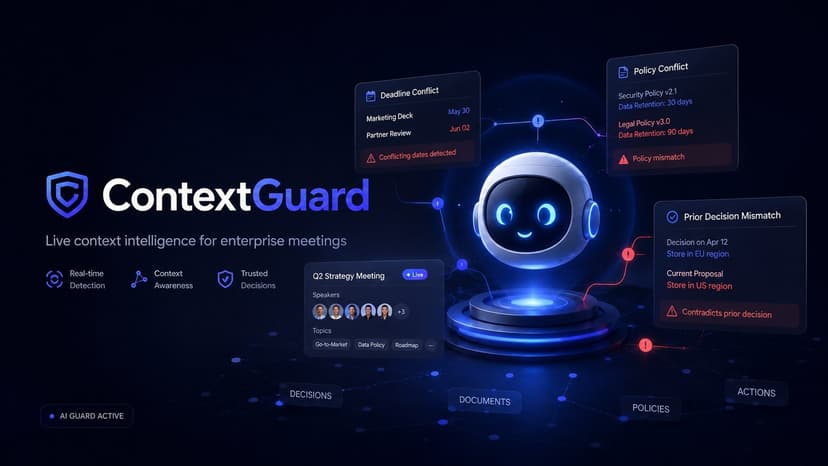
ContextGuard is a real-time meeting agent that catches conflicts between what's being said and what your company already knows — then acts on it. It listens through Speechmatics with speaker diarization, parses every decision, promise, and assignment via Gemini 2.5 Flash, and checks each one against your company's memory graph: legal blockers, prior decisions, owner capacity, customer commitments, dependency chains. The moment a statement collides with reality, an evidence-backed card appears on screen — citing the exact source ("Legal Review, May 12 — DPA pending") with a suggested next step. The intervention happens during the call, when course-correction still costs seconds. After the meeting, two more layers activate. A Personal Summary engine rewrites the session from one participant's point of view: what they now own, what was decided that affects their scope, which flags involved them. A Service Agent Layer then executes the operational decisions: a GitHub agent updates issues and labels, a Jira/Notion agent reassigns owners and shifts priorities, a Gmail agent drafts the customer email walking back the promise that just got flagged. Every action is logged with before/after diffs. Target audience: product, engineering, and operations teams at companies of 50+ where Sales, Legal, Platform, and Product each carry a different version of reality, and meetings are where those versions collide. The whole stack runs as a single Next.js app, deployable to Vultr in one command — Speechmatics tokens minted server-side, structured Gemini output under a strict JSON schema, and a Valkey-backed action queue so service agents run asynchronously without blocking the meeting UI. Meeting assistants tell you what happened. We surface what would stop it — and then do something about it.
19 May 2026
Multi-agent AI cockpit for employee onboarding
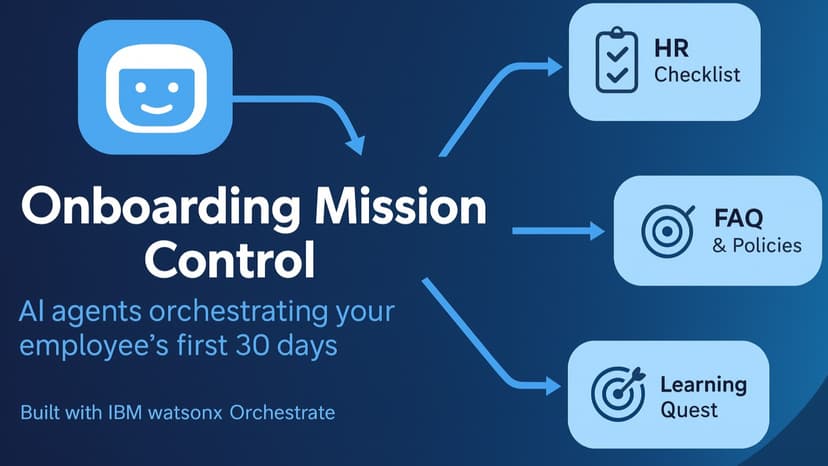
Onboarding Mission Control is a multi-agent AI solution that turns fragmented employee onboarding into a guided, trackable journey. Built on IBM watsonx Orchestrate, it uses an orchestration agent to route every request to specialist agents: an HR checklist agent, a role-based Learning Quest agent, a RAG-powered FAQ agent grounded in the employee handbook, and a Knowledge Guardian that reviews RAG answers for hallucinations and policy mismatches. For new hires, the system provides a day-by-day checklist, personalized 3-day learning quests with quizzes and badges, and a conversational FAQ that only responds with verified information. For HR and managers, an agent aggregates progress by user, highlights who is stuck on critical steps such as security or compliance training, and surfaces onboarding risks. The result is faster, more consistent onboarding with less manual follow-up, lower compliance risk, and a reusable orchestration pattern that can be extended to other HR workflows like role changes, promotions and offboarding.
23 Nov 2025


