
🤝 Top Collaborators




🤓 Latest Submissions

Supplier Document Desk
Small companies receive many supplier invoices and delivery notes by email, in different formats and languages. Staff retype them by hand, miss mistakes, and sometimes pay the wrong amount. Supplier Document Desk is an AI agent that does this check automatically. A supplier document arrives by email or upload. An Evolus workflow reads the file and turns it into structured data. An open model, served by us with vLLM, checks the document, explains problems in plain words, and writes a polite reply to the supplier in the supplier's language. Our own code does all the math and matching, so the AI never guesses a number. It checks line totals, tax, purchase order match, price and quantity differences, duplicate invoices and changed bank details. Personal data is hidden before anything is shared. Clean documents are approved automatically. Unclear or risky cases go to a human review queue. [AMD SENTENCE: see below] We tested the system on [N] fake documents in [languages]. Results: [X]% field accuracy, [Y]% of planted errors caught, and about [Z] seconds per document compared with [W] minutes by hand. The product saves staff time and reduces payment mistakes. Companies would pay a small monthly fee per team.
18 Oct 2026
Tablekeeper: Autonomous Dark Factory
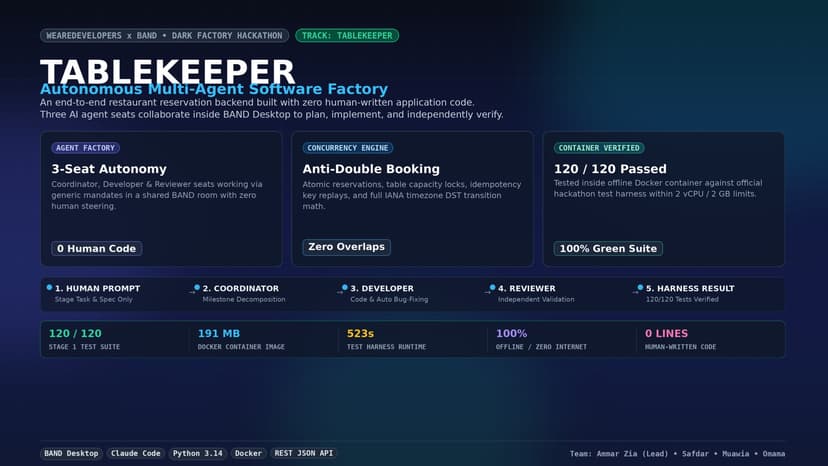
Tablekeeper is an autonomous software engineering project built for the Dark Factory Hackathon by WeAreDevelopers and BAND. Under strict dark factory rules, zero lines of application code were written by humans. Our team acted solely as factory builders, defining generic mandates and orchestrating three autonomous AI agent seats inside BAND Desktop: Coordinator, Developer, and Reviewer. The Coordinator parsed the official track specification into structured work items, managed room handoffs, and maintained strict stage isolation. The Developer autonomously implemented the complete Stage 1 REST JSON API service, resolving complex domain requirements such as concurrency locking to prevent double-booking, safe idempotent write replays, atomic reservation transactions, state export and import, and IANA timezone daylight-saving transitions. The Reviewer independently inspected commits and verified test runs. The completed backend was verified in an isolated container environment against the official hackathon test harness, achieving a clean pass across all 120 test cases. The project repository includes generic mandate files passing the swap test, the complete room.json collaboration log, and container deployment files.
6 Oct 2026

CommunityCare Voice Assistant
Billions of people cannot get basic health guidance or education because they live far from a clinic, cannot read, or cannot afford a modern setup. CommunityCare is a voice-first assistant built for them. A person speaks a question and hears a clear spoken answer. The answer also appears on screen, so it works with sound off. It has two modules. Health Triage listens to symptoms and says whether it is an emergency, something to see a doctor about soon, or manageable at home, with steps to take and warning signs to watch. It never diagnoses or names a condition, and every health answer ends with a reminder to see a real healthcare provider, even during a system failure. The Education module explains math, science, and language in short spoken sentences for low-literacy learners and ends with a follow-up question. Pipeline: AssemblyAI real-time speech-to-text, a Groq classifier that sorts questions into health, education, or off-topic, ChromaDB retrieval from a local knowledge base, a Groq model (gpt-oss-20b) that writes the answer, and Edge TTS to speak it. Off-topic questions are refused on purpose, because an assistant that answers everything cannot be trusted with health. API keys never reach the browser. The frontend is one HTML file, the backend is FastAPI, and the install is 338 MB. No login, no account needed. NGOs, clinics, and learning centers can run it on one shared device.
30 Sep 2026

TrustGate
AI coding tools now generate code faster than humans can review it safely. A developer can ship hundreds of lines in minutes, but speed creates new risks: hardcoded secrets, hallucinated packages, missing auth checks, prompt injection attacks, and spec violations that slip through human review undetected. TrustGate is an automated merge gate built to catch these AI-specific failure modes before code reaches production. When a pull request is submitted, five specialized IBM watsonx-powered checkers run in parallel on the code and deliver a clear PASS, REVIEW, or BLOCK verdict with exact cited evidence file path, line number, and quoted snippet before the code is allowed to merge. The five checkers are: Security Reviewer (finds hardcoded secrets, SQL injection, missing auth), Spec Conformance (reads the PRD and compares it against code using document understanding), Injection Scanner (finds prompt injection attempts in comments and README), Dependency Verifier (catches hallucinated PyPI packages), and License Checker (detects GPL violations in MIT projects). Every finding must cite exact evidence or it is not reported. This eliminates hallucinated false positives that make AI security tools untrustworthy. The verdict engine scores findings (high=5, medium=2, low=1) and forces a BLOCK on any single high-severity finding regardless of total score. TrustGate integrates directly into GitHub via a GitHub Action that fires on every pull request and posts the verdict as a PR comment. The Explainable Trust Dashboard shows judges and reviewers exactly why a PR was blocked, with a human-approval-with-reason override flow that demonstrates responsible AI deployment. Built in 48 hours for the IBM Bob 2.0 Hackathon.
27 Sep 2026

EdgeGuard: Multi-Modal Consensus Broker
Robots and self-driving machines need absolute certainty about their surroundings before they make a move. Our project acts as a real-time safety checkpoint for these autonomous systems. Instead of relying on a single point of failure, it constantly compares live data from multiple different sensors, including cameras, depth monitors, and lasers. Think of it as a team of spotters double-checking each other's work. If one sensor gets blinded by a glare, gets covered in dirt, or suddenly starts giving bad readings, our system catches the error immediately. It overrides the confused sensor, raises a high-risk warning, and completely stops the machine from making a dangerous physical movement. To show this in action, we built a live web dashboard. During our demonstration, viewers can use a slider to manually break a sensor reading on purpose. You can watch our system instantly spot the outlier, sound the alarm, and hit the brakes in real-time, proving that the machine only moves when it is objectively safe.
16 Sep 2026

TradeAudit AI — AI Trade Audit Agent
When algorithmic trading happens, most people have no idea why their trades executed. You place an order and it fills — but the "why" remains a mystery. That's what we solved. TradeAudit AI is an autonomous agent that connects directly to Alpaca Paper Trading, detects every fill in real-time, and immediately explains it in plain English using Groq AI. No jargon. No confusion. Here's what it does: A trade happens on Alpaca → Our agent detects it via WebSocket → AI generates a human-friendly explanation → Risk score is calculated → Everything is saved to an audit database → Users can ask questions about their trades anytime. Example: User's trade: BUY 10 AAPL @ $200 = $2,000 Agent explains: "Apple was purchased to increase Technology sector exposure. The trade represents 8% of portfolio value, making it LOW risk." Users can also chat with the AI. Ask "Show me today's risky trades" or "Why did we buy Tesla?" and get instant answers from the audit history. We built three interfaces: - Web dashboard (React) with live portfolio, charts, and audit log - AI chatbot panel with natural conversation - Mobile app (Flutter) so traders can monitor on the go All powered by a single backend that orchestrates Alpaca API, Groq AI, SQLite database, and real-time WebSocket streaming. Why it matters: Transparency builds trust. In trading, that's everything.
4 Sep 2026

SkillMatch AI
SkillMatch AI helps job seekers figure out, instantly, how well their resume actually fits a job. No more guessing. Most people apply to jobs without really knowing if their resume matches what the job needs. They only find out after getting rejected. Comparing a resume to a job description by hand takes time, and it's easy to miss things. Our solution is simple. Just upload your resume in PDF, DOCX, or TXT format, then add the job you're applying for in whatever way works best for you. You can paste the job description as text, paste a link to the job posting, or even upload a screenshot or poster of the job. Our AI, powered by Claude, reads both and instantly shows your match score, which skills you already have, which ones you're missing, and a simple summary of where you stand. The platform can also keep track of your match history so you can look back anytime, and it supports signing in with Google or GitHub, along with regular email and password login. It works smoothly on any device and was built to be easy for anyone to use, whether they're tech savvy or not. It was built using the NativelyAI platform, with React and TypeScript on the frontend; Supabase for the backend, including the database, storage, and login; and the Claude API for reading resumes, understanding job postings, and doing the actual matching. It was built by Team Code Voyagers, led by Muhammad Ammar Zia, with the whole team contributing across frontend, backend, database, and AI work.
10 Aug 2026
AI-Powered Resume Extractor and Career Recommender
CV Parser is a web-based AI application designed to automate the extraction and analysis of resume data. Users can upload resumes in PDF, JPG, or PNG format. The app performs the following: Text Extraction: Uses PyMuPDF for digital PDFs and Tesseract OCR for scanned documents and images. AI-Powered Analysis: Sends extracted resume text to the Groq-hosted LLaMA 3 model to: Parse structured JSON fields (name, email, phone, etc.) Recommend 2–3 relevant career fields based on the resume content Data Storage: Automatically logs parsed results to a connected Google Sheet for easy access, reporting, or recruitment pipelines. This tool helps recruiters, HR platforms, and job portals automate resume handling and job matching processes efficiently using cutting-edge LLMs and OCR technologies. Technology & Category Tags AI OCR LLaMA3 Groq API Resume Parsing Google Sheets API Gradio Python Document Analysis Job Matching PDF Processing Tesseract PyMuPDF
15 Jun 2025
Text2Speech AI Application
Text2Speech AI is a powerful generative application that transforms user-input text into lifelike spoken audio using advanced natural language processing and speech synthesis models. Designed to provide high-quality, natural-sounding voice output, the app utilizes a combination of large language models (LLMs) and text-to-speech (TTS) engines to generate context-aware, expressive audio. The application is built using tool such as Gradio for a user-friendly frontend, while Google Colab supports the backend environment for fast prototyping and scalability. It leverages Hugging Face models for TTS tasks, integrates RAG (Retrieval-Augmented Generation) for improved text interpretation, and uses PyTorch, Torchaudio, and SoundFile for audio processing and output. By combining these cutting-edge technologies, Text2Speech AI enables real-time, natural voice generation suitable for educational tools, accessibility applications, audiobooks, and voice assistants.
1 May 2025


