
🤝 Top Collaborators




🤓 Latest Submissions

Supplier Document Desk
Small companies receive many supplier invoices and delivery notes by email, in different formats and languages. Staff retype them by hand, miss mistakes, and sometimes pay the wrong amount. Supplier Document Desk is an AI agent that does this check automatically. A supplier document arrives by email or upload. An Evolus workflow reads the file and turns it into structured data. An open model, served by us with vLLM, checks the document, explains problems in plain words, and writes a polite reply to the supplier in the supplier's language. Our own code does all the math and matching, so the AI never guesses a number. It checks line totals, tax, purchase order match, price and quantity differences, duplicate invoices and changed bank details. Personal data is hidden before anything is shared. Clean documents are approved automatically. Unclear or risky cases go to a human review queue. [AMD SENTENCE: see below] We tested the system on [N] fake documents in [languages]. Results: [X]% field accuracy, [Y]% of planted errors caught, and about [Z] seconds per document compared with [W] minutes by hand. The product saves staff time and reduces payment mistakes. Companies would pay a small monthly fee per team.
18 Oct 2026
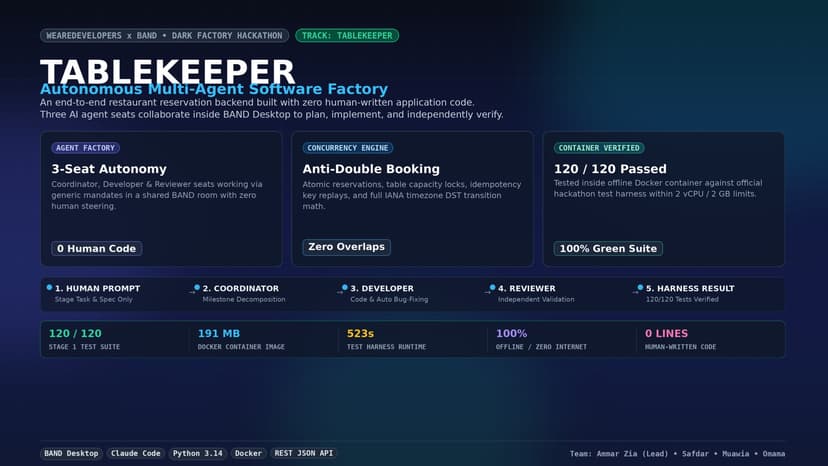
Tablekeeper: Autonomous Dark Factory
Tablekeeper is an autonomous software engineering project built for the Dark Factory Hackathon by WeAreDevelopers and BAND. Under strict dark factory rules, zero lines of application code were written by humans. Our team acted solely as factory builders, defining generic mandates and orchestrating three autonomous AI agent seats inside BAND Desktop: Coordinator, Developer, and Reviewer. The Coordinator parsed the official track specification into structured work items, managed room handoffs, and maintained strict stage isolation. The Developer autonomously implemented the complete Stage 1 REST JSON API service, resolving complex domain requirements such as concurrency locking to prevent double-booking, safe idempotent write replays, atomic reservation transactions, state export and import, and IANA timezone daylight-saving transitions. The Reviewer independently inspected commits and verified test runs. The completed backend was verified in an isolated container environment against the official hackathon test harness, achieving a clean pass across all 120 test cases. The project repository includes generic mandate files passing the swap test, the complete room.json collaboration log, and container deployment files.
6 Oct 2026

TrustGate
AI coding tools now generate code faster than humans can review it safely. A developer can ship hundreds of lines in minutes, but speed creates new risks: hardcoded secrets, hallucinated packages, missing auth checks, prompt injection attacks, and spec violations that slip through human review undetected. TrustGate is an automated merge gate built to catch these AI-specific failure modes before code reaches production. When a pull request is submitted, five specialized IBM watsonx-powered checkers run in parallel on the code and deliver a clear PASS, REVIEW, or BLOCK verdict with exact cited evidence file path, line number, and quoted snippet before the code is allowed to merge. The five checkers are: Security Reviewer (finds hardcoded secrets, SQL injection, missing auth), Spec Conformance (reads the PRD and compares it against code using document understanding), Injection Scanner (finds prompt injection attempts in comments and README), Dependency Verifier (catches hallucinated PyPI packages), and License Checker (detects GPL violations in MIT projects). Every finding must cite exact evidence or it is not reported. This eliminates hallucinated false positives that make AI security tools untrustworthy. The verdict engine scores findings (high=5, medium=2, low=1) and forces a BLOCK on any single high-severity finding regardless of total score. TrustGate integrates directly into GitHub via a GitHub Action that fires on every pull request and posts the verdict as a PR comment. The Explainable Trust Dashboard shows judges and reviewers exactly why a PR was blocked, with a human-approval-with-reason override flow that demonstrates responsible AI deployment. Built in 48 hours for the IBM Bob 2.0 Hackathon.
27 Sep 2026


