

Muhammad Awais@Pebble_Catalystc6qt
19
Events attended
17
Submissions made
Pakistan
4+ years of experience
About me
# Muhammad Awais – Biography Muhammad Awais is a Software Engineering student and aspiring AI Engineer from Faisalabad, Pakistan, with a strong passion for Artificial Intelligence, Machine Learning, and Generative AI. He is currently pursuing a Bachelor's degree in Software Engineering at The University of Faisalabad. He specializes in building intelligent applications using Python, machine learning, large language models (LLMs), Retrieval-Augmented Generation (RAG), AI automation, and modern AI frameworks such as LangChain and LangGraph. His work focuses on developing real-world AI solutions that solve practical problems and improve user experiences. Muhammad has developed multiple software and AI projects, including AI-powered assistants, web applications, online developer tools, and automation systems. He enjoys participating in hackathons, contributing to open-source projects, and continuously learning the latest advancements in AI technologies. His long-term goal is to become a world-class AI Engineer, contribute to cutting-edge AI research, and build innovative products that create meaningful impact. He is committed to lifelong learning, technical excellence, and using technology to solve complex real-world challenges.
🤝 Top Collaborators




🤓 Latest Submissions

Supplier Document Desk
Small companies receive many supplier invoices and delivery notes by email, in different formats and languages. Staff retype them by hand, miss mistakes, and sometimes pay the wrong amount. Supplier Document Desk is an AI agent that does this check automatically. A supplier document arrives by email or upload. An Evolus workflow reads the file and turns it into structured data. An open model, served by us with vLLM, checks the document, explains problems in plain words, and writes a polite reply to the supplier in the supplier's language. Our own code does all the math and matching, so the AI never guesses a number. It checks line totals, tax, purchase order match, price and quantity differences, duplicate invoices and changed bank details. Personal data is hidden before anything is shared. Clean documents are approved automatically. Unclear or risky cases go to a human review queue. [AMD SENTENCE: see below] We tested the system on [N] fake documents in [languages]. Results: [X]% field accuracy, [Y]% of planted errors caught, and about [Z] seconds per document compared with [W] minutes by hand. The product saves staff time and reduces payment mistakes. Companies would pay a small monthly fee per team.
18 Oct 2026
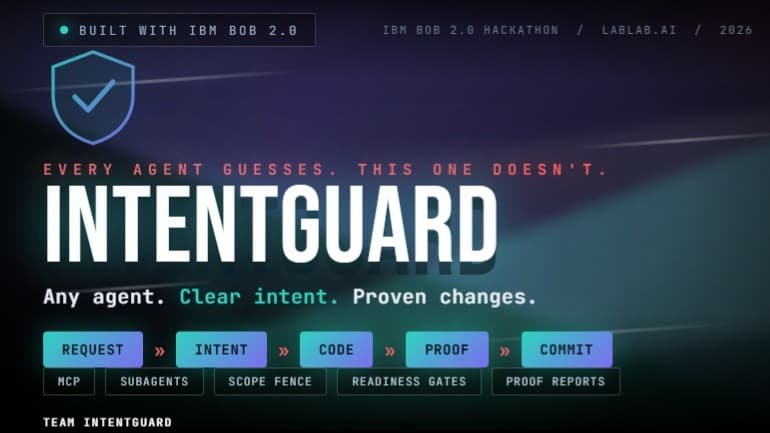
IntentGuard — Intent Layer for AI Coding Agents
AI coding agents are powerful, but they often guess at what a developer actually wants — and that guesswork breaks things: unrelated files get touched, edge cases get missed, and nobody can prove the change actually did what was asked. IntentGuard solves this by sitting between the developer and the agent as a local intent layer. When a request comes in, IntentGuard drafts a structured spec covering objective, scope, constraints, and verification criteria, then asks the developer targeted clarifying questions instead of assuming. Only once the spec is approved does the agent — in our case, IBM Bob 2.0 — start editing, and only within the approved scope. Every file touched is checked against a scope fence in real time, and every change ends with a proof report confirming what was verified, not just claimed. IntentGuard is built for developers and teams who use AI coding agents daily and want speed without losing control — from solo developers wary of AI "helpfully" breaking unrelated code, to teams enforcing review discipline at scale. It connects to any MCP-capable agent (Bob, Claude Code, Cursor, and others), runs entirely locally, and turns "the AI did something" into "the AI did exactly this, and here's the proof."
27 Sep 2026

Taible OrderFlow
Taible Voice Orchestration is the CPU turn-taking layer for the Taible voice agent, built as a Pipecat/LiveKit Agents worker. It bridges a diner's browser microphone to a fully hosted STT to LLM to TTS pipeline and drives ordering through the Taible MCP server, requiring no GPU. Audio flows from the browser mic over WebRTC into a LiveKit room, through the orchestrator, and back out to the browser speaker. Inside the orchestrator, Deepgram handles speech-to-text as the ears, Fireworks AI's gpt-oss-120b model serves as the brain, and Deepgram again handles text-to-speech as the mouth. MCP tools connect out to a Cloud Run service backed by Supabase, and the agent writes live transcript and cart state to the sibling Next.js UI's public folder. The full voice loop has been verified end-to-end in Docker: a diner speaks, the AI waiter replies with voice, updates the cart, and persists the order. On each session, the agent bootstraps against the MCP server to resolve the restaurant and menu, starts a session and order, and adds items as the diner orders them, resolving spoken names to real menu-item IDs. Order confirmation is intentionally left to the diner, who taps a Confirm Order button in the UI rather than letting the AI place it. The stack is configurable via environment variables for LiveKit, Deepgram, Fireworks, and the restaurant/table identifiers, and can run either via Docker Compose or a local Python virtual environment alongside the UI.
16 Sep 2026

Taible OrderFlow
Taible Voice Orchestration is the CPU turn-taking layer for the Taible voice agent, built as a Pipecat/LiveKit Agents worker. It bridges a diner's browser microphone to a fully hosted STT to LLM to TTS pipeline and drives ordering through the Taible MCP server, requiring no GPU. Audio flows from the browser mic over WebRTC into a LiveKit room, through the orchestrator, and back out to the browser speaker. Inside the orchestrator, Deepgram handles speech-to-text as the ears, Fireworks AI's gpt-oss-120b model serves as the brain, and Deepgram again handles text-to-speech as the mouth. MCP tools connect out to a Cloud Run service backed by Supabase, and the agent writes live transcript and cart state to the sibling Next.js UI's public folder. The full voice loop has been verified end-to-end in Docker: a diner speaks, the AI waiter replies with voice, updates the cart, and persists the order. On each session, the agent bootstraps against the MCP server to resolve the restaurant and menu, starts a session and order, and adds items as the diner orders them, resolving spoken names to real menu-item IDs. Order confirmation is intentionally left to the diner, who taps a Confirm Order button in the UI rather than letting the AI place it. The stack is configurable via environment variables for LiveKit, Deepgram, Fireworks, and the restaurant/table identifiers, and can run either via Docker Compose or a local Python virtual environment alongside the UI.
10 Aug 2026

Taible Voice Orchestration
Taible Voice Orchestration is the CPU turn-taking layer for the Taible voice agent, built as a Pipecat/LiveKit Agents worker. It bridges a diner's browser microphone to a fully hosted STT to LLM to TTS pipeline and drives ordering through the Taible MCP server, requiring no GPU. Audio flows from the browser mic over WebRTC into a LiveKit room, through the orchestrator, and back out to the browser speaker. Inside the orchestrator, Deepgram handles speech-to-text as the ears, Fireworks AI's gpt-oss-120b model serves as the brain, and Deepgram again handles text-to-speech as the mouth. MCP tools connect out to a Cloud Run service backed by Supabase, and the agent writes live transcript and cart state to the sibling Next.js UI's public folder. The full voice loop has been verified end-to-end in Docker: a diner speaks, the AI waiter replies with voice, updates the cart, and persists the order. On each session, the agent bootstraps against the MCP server to resolve the restaurant and menu, starts a session and order, and adds items as the diner orders them, resolving spoken names to real menu-item IDs. Order confirmation is intentionally left to the diner, who taps a Confirm Order button in the UI rather than letting the AI place it. The stack is configurable via environment variables for LiveKit, Deepgram, Fireworks, and the restaurant/table identifiers, and can run either via Docker Compose or a local Python virtual environment alongside the UI.
13 Jul 2026

Smartly
Smartly is an innovative, next-generation AI-powered travel companion designed to revolutionize how we plan trips. Built specifically for the edge, Smartly brings the full power of advanced large language models directly onto mobile devices without relying on cloud connectivity. By leveraging Meta’s ExecuTorch framework and optimizing inference for Qualcomm’s high-performance AI engines, our application generates highly personalized, contextual travel itineraries in real time. Traditional travel apps require a constant internet connection, leaving users stranded in remote destinations or facing heavy roaming charges. Smartly solves this by executing complex prompt reasoning entirely offline. Users can input their destination, budget, personal interests, and time constraints to instantly receive tailored day-by-day routes, restaurant recommendations, and local insights. Because all data processing happens locally on the handset, Smartly ensures blazing-fast response times, zero data latency, and absolute user privacy. Our project demonstrates the true potential of decentralized, hardware-accelerated on-device AI for real-world everyday utility.
28 Jun 2026
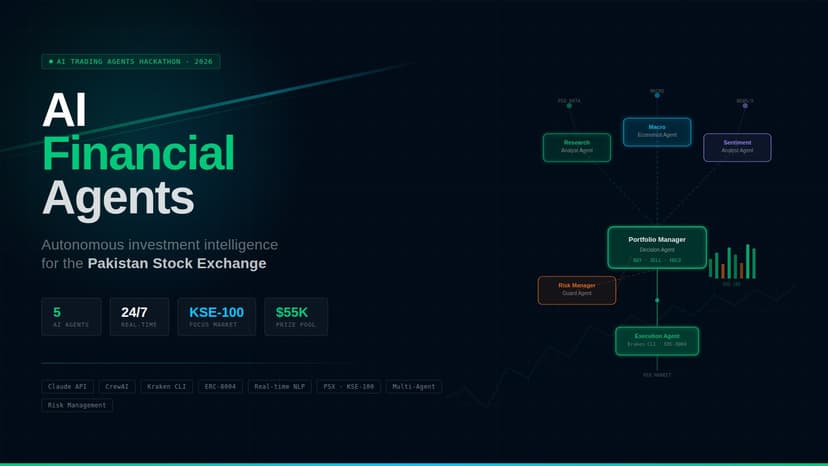
PakAI Capital – Autonomous Trading System
PakAI Capital is an AI-assisted algorithmic trading platform designed to explore how intelligent systems can analyze market data and execute trades autonomously. The platform collects real-time market information, evaluates trading indicators, and generates trading signals that can be executed programmatically through Kraken CLI connected to the infrastructure of Kraken. The system combines data ingestion, signal analysis, and automated execution into a unified trading workflow. Market data and indicators are processed by the backend engine, which evaluates trading opportunities using rule-based strategies and sentiment signals. Once a valid trading opportunity is detected, the execution layer triggers secure commands through Kraken CLI to simulate or perform trades. To provide transparency and monitoring, the platform includes a real-time dashboard that visualizes trading signals, execution logs, portfolio activity, and performance metrics. This interface allows users to track the behavior of the trading system, monitor trade decisions, and evaluate system performance over time. The goal of PakAI Capital is to demonstrate how AI-assisted trading systems can combine automated analysis, real-time data processing, and programmatic execution to support intelligent financial decision-making. By integrating modern cloud deployment, a modular backend architecture, and Kraken’s trading infrastructure, the project showcases how autonomous financial systems can be built using scalable tools and APIs.
12 Apr 2026

Ai News Facts Checker
Motivation / Problem Firsthand news facts are hard to monetize directly and quickly. AI agents need verifiable sources with clean payment trails. Impact Turns micro-facts into paid, citable sources. Demonstrates agentic commerce with USDC micropayments on Arc. Solution UI-first NewsFacts Studio for journalists to submit short facts. Free search + paid fact detail using x402 via Circle Gateway. MCP server for Gemini CLI to search and pay for facts with citations. Tech Stack Node.js 20, TypeScript + tsx Express 5 Circle x402 batching SDK (@circlefin/x402-batching) Local embeddings with @xenova/transformers (used when LLM phase is enabled) MCP SDK for Gemini CLI integration
15 Feb 2026

Navora
Navora is an intelligent navigation and safety guidance application designed to make travel safer and more informed. The platform not only provides accurate route directions and tour-guide style assistance but also delivers real-time updates on natural disasters such as floods and earthquakes. Streetly analyzes environmental data to identify which areas are safe and which zones should be avoided, ensuring users can make quick and confident decisions during emergencies. Whether someone is exploring a new city, commuting, or looking for safety information during a disaster, Streetly acts as a reliable companion that helps protect users, prevent risks, and simplify everyday travel.
23 Nov 2025


