
Maryam Habib@Mariam__
7
Events attended
4
Submissions made
Pakistan
1 year of experience
About me
I am passionate about Artificial Intelligence, Machine Learning, Python, and Full-Stack Development. I enjoy building innovative solutions, experimenting with new technologies, and turning ideas into practical projects. I am continuously learning, strengthening my programming and problem-solving skills, and exploring AI through hands-on projects and hackathons. I love collaborating with others, taking on new challenges, and creating solutions that can make a real-world impact.
🤝 Top Collaborators


🤓 Latest Submissions
CareCoordinator
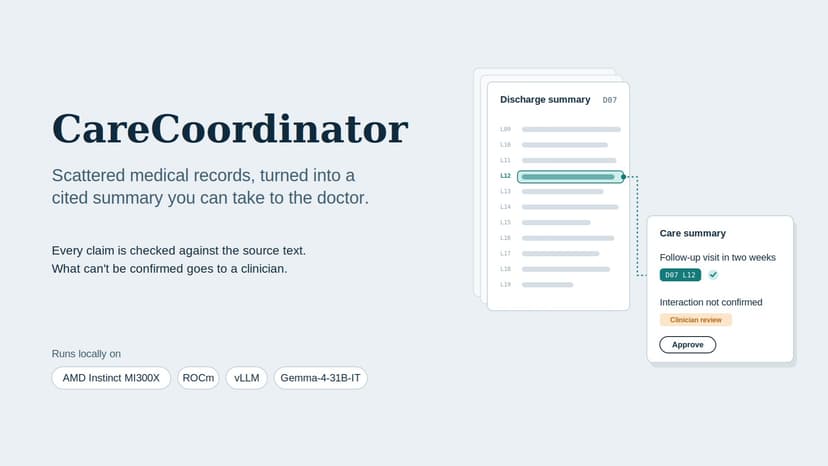
Patients and caregivers are often overwhelmed by scattered medical records, from discharge summaries and prescriptions to lab reports and clinical notes, making it hard to prepare for appointments or track a health history. General-purpose AI tools can introduce unsupported facts, while cloud services may expose sensitive health data to external APIs. CareCoordinator addresses both challenges through local inference and verification-first processing. It runs on an AMD Instinct MI300X GPU (192 GB) using ROCm and vLLM to serve Gemma-4-31B-IT across six specialized agents with continuous batching. When a user uploads documents and describes a goal, a Main Agent creates a structured Care Contract and delegates tasks to four parallel Worker Agents: Intake, Document Classifier, Record Summarizer, and Medication Checker. A Manager/Compiler Agent combines their findings into four sections: a plain-language summary, questions for the doctor, a medication checklist, and a clinician review section. The key differentiator is that verification is enforced through deterministic Python checks rather than left to the model. The backend validates inline citations against the original source text, while claims it cannot ground are marked “cannot confirm” and routed to clinician review instead of being presented as fact. A multi-layer safety gate halts normal processing when a configured emergency indicator is triggered, while historical risks are flagged for review. Users must approve a summary before it becomes final, and the “Improve” feature routes feedback to the relevant worker for revision and re-verification. In a demo with synthetic patient records, CareCoordinator generated a cited summary at a 7.5 reading grade level in 83 seconds, with 52 statements checked against the sources. It helps patients and caregivers organize their records and prepare for clinical conversations without diagnosing conditions or giving medical advice.
18 Oct 2026

Composable Floor — Visual Restaurant Bookings
Problem Traditional reservation systems use basic lists and forms. They often ignore the physical floor, make table combinations difficult, limit staff visibility, and may face concurrent booking conflicts. Composable Floor makes the restaurant floor central to booking and operations. Solution Composable Floor offers a visual 2D/3D floor experience for restaurant discovery, availability, table-group selection, and staff operations. PostgreSQL constraints and atomic booking logic help protect reservation correctness. Key Differentiator Our key differentiator is the combination of a functional 3D floor, composable table groups, and database-level double-booking prevention. The floor shows real table states, while the database remains the source of truth. Frontend Technologies Next.js, React, TypeScript, Tailwind CSS, CSS design tokens, React Three Fiber/Three.js, Zustand, and Zod. Backend Technologies Next.js API routes, Supabase Auth, PostgreSQL, RLS, constraints, triggers, atomic booking logic, advisory locks, Realtime, and polling fallback. Target Users Restaurant guests, hosts, servers, floor managers, restaurant managers, and owners—especially teams needing flexible table combinations and better floor visibility. Future Scope Smart table recommendations, demand heatmaps, QR check-in, email confirmations, advanced floor editing, saved layouts, utilization analytics, restaurant branding, and offline staff support.
6 Oct 2026
ProofChange AI Change Verification
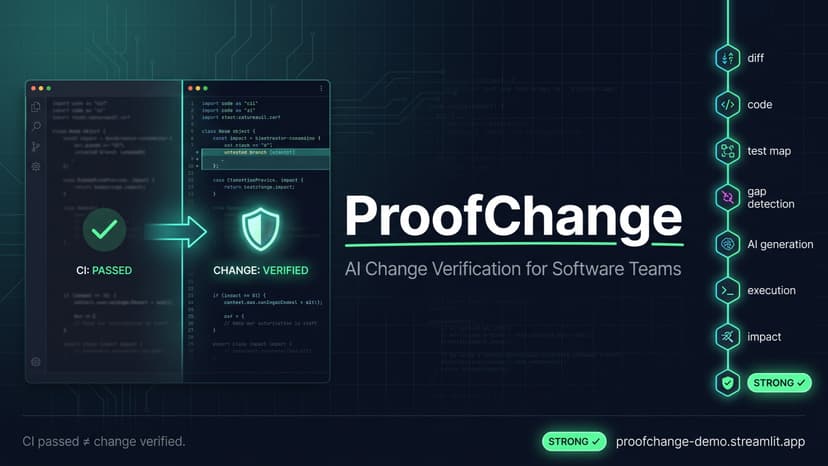
THE PROBLEM CI answers one question: "Did the configured tests pass?" It does not answer the question that matters at merge time: "Is the newly changed behavior adequately verified?" A pull request can add a new branch, a new execution path, or a new edge case while CI stays entirely green — because the existing test suite never exercises the new code. Those tests were written for the old behavior. No test ever fails. The change ships unverified. This is not a test-quality problem. It is a test-coverage blindspot at the point of change, and every team that treats a green CI check as its only safety signal has it. The failure mode is silent and expensive: an untested authorization branch ships on a Friday, and the incident lands on Monday. THE SOLUTION ProofChange is an AI-powered verification layer that closes the gap between "CI passed" and "this change is verified." Its core output is a Change Evidence Package — a structured, machine-readable artifact produced automatically for every pull request. The key insight is ordering. Test generation is step 5 of 7, not the product. ProofChange first proves a gap exists (steps 1–4) and then proves the gap is closed (steps 6–7). The generated test is evidence, not the deliverable. The 8-stage pipeline runs: 1. Diff Analysis — parses the unified diff, extracting changed files, line ranges, and added conditionals. 2. Code Analysis — Python AST walk mapping functions, branches, return paths, and source file paths. 3. Test Mapping — links existing tests to affected functions by name heuristics and docstring scan. 4. Gap Detection — finds branches with no mapped test scenario; promotes security-keyword branches to HIGH severity. 5. Test Generation — IBM Bob produces focused pytest scaffolds targeting each detected gap. 6. Execution — runs real pytest against generated tests, capturing pass/fail/skipped/duration. 7. Impact Analysis — classifies affected paths as verified / partial / unresolved, deduplicated by (source_path, fn_name). 8. Evidence Package — aggregates all outputs into a scored, timestamped JSON + Markdown artifact. TARGET USERS & INTERACTION Backend developers shipping urgent fixes, new developers working in unfamiliar legacy code, and compliance/security teams needing audit evidence. Users interact through a Streamlit dashboard (8 pages) or automatically via a GitHub App webhook that posts a Check Run on every PR — no manual step required. Every PR receives a verdict: STRONG (all gaps addressed, ≥70% paths verified, all tests passed), PARTIAL (some gaps or paths unresolved), or INSUFFICIENT (tests failed or gaps remain). Critically, the level is computed by explicit, auditable rules — not an LLM opinion — and every level carries a plain-language rationale string. WHAT MAKES IT UNIQUE Unlike generic AI test generators that work speculatively across a whole repo from an arbitrary prompt, ProofChange is anchored to the diff itself. It detects gaps before generating, runs tests as a mandatory step, and issues a scored verdict. AI assists the pipeline; the engine runs deterministically without it. IMPACT ProofChange prevents the untested Friday deploy, helps new developers ship safely in unfamiliar code, and gives compliance teams a byproduct artifact — the EvidencePackage JSON is generated on every PR, so audits need no retrospective authoring. Live at proofchange-demo.streamlit.app with a working STRONG-evidence VIP-discount demo, live GitHub PR analysis (App ID 5079526, Check Run posted), 27/27 passing tests, and a green GitHub Actions pipeline.
27 Sep 2026
AIRA
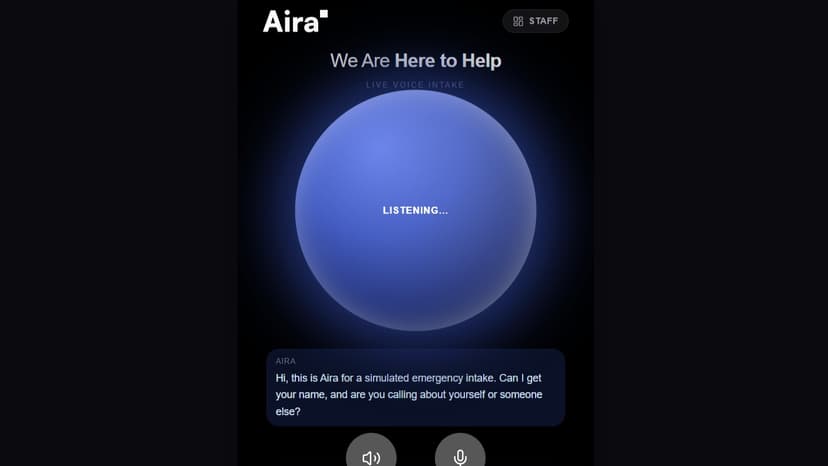
When someone calls the ER, they're rarely calm or organized. They're usually stressed, in pain, or trying to help someone who is. AIRA is a voice tool we built to handle that messy reality. It lets patients or caregivers simply explain what's going on in their own words. As they talk, AssemblyAI's Universal-3 Pro handles the real-time transcription. AIRA keeps track of what's already been said and only asks follow-up questions when something important is missing things like when the symptoms started, how severe they are, current medications, or allergies. The goal is to get the information staff need without forcing someone through a rigid checklist. The real bottleneck for ER staff isn't just taking the call. It's what happens after. Handing a nurse a massive raw transcript doesn't help much when they're already dealing with a busy emergency department. So, we use AssemblyAI's LeMUR to turn the conversation into a concise, structured triage brief. It appears on a staff dashboard, with every detail linked back to an exact timestamp. If a doctor needs to verify something, they can jump straight to that moment in the conversation instead of searching through an entire transcript. We also use AssemblyAI's Sentiment Analysis and Disfluency Detection to pick up on signs that a caller may be stressed, hesitant, or struggling to communicate. On the backend, JSON-Schema Tool Calling handles things like patient lookup and keeps the extracted information in consistent, structured fields. We were careful to make sure AIRA stays assistive. It doesn't diagnose the patient or make medical decisions. Staff review the generated brief, edit anything that needs correcting, request more information if necessary, and explicitly approve the case before it enters the clinical workflow.
30 Sep 2026


