
🤝 Top Collaborators




🤓 Latest Submissions
CareCoordinator
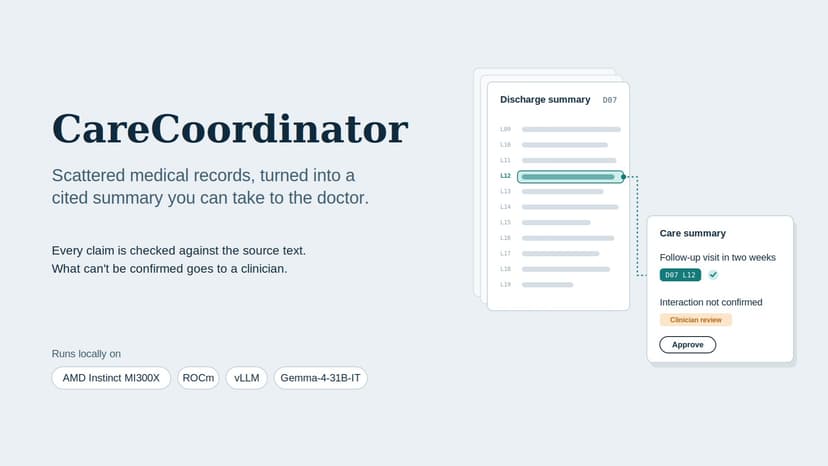
Patients and caregivers are often overwhelmed by scattered medical records, from discharge summaries and prescriptions to lab reports and clinical notes, making it hard to prepare for appointments or track a health history. General-purpose AI tools can introduce unsupported facts, while cloud services may expose sensitive health data to external APIs. CareCoordinator addresses both challenges through local inference and verification-first processing. It runs on an AMD Instinct MI300X GPU (192 GB) using ROCm and vLLM to serve Gemma-4-31B-IT across six specialized agents with continuous batching. When a user uploads documents and describes a goal, a Main Agent creates a structured Care Contract and delegates tasks to four parallel Worker Agents: Intake, Document Classifier, Record Summarizer, and Medication Checker. A Manager/Compiler Agent combines their findings into four sections: a plain-language summary, questions for the doctor, a medication checklist, and a clinician review section. The key differentiator is that verification is enforced through deterministic Python checks rather than left to the model. The backend validates inline citations against the original source text, while claims it cannot ground are marked “cannot confirm” and routed to clinician review instead of being presented as fact. A multi-layer safety gate halts normal processing when a configured emergency indicator is triggered, while historical risks are flagged for review. Users must approve a summary before it becomes final, and the “Improve” feature routes feedback to the relevant worker for revision and re-verification. In a demo with synthetic patient records, CareCoordinator generated a cited summary at a 7.5 reading grade level in 83 seconds, with 52 statements checked against the sources. It helps patients and caregivers organize their records and prepare for clinical conversations without diagnosing conditions or giving medical advice.
18 Oct 2026
AIRA
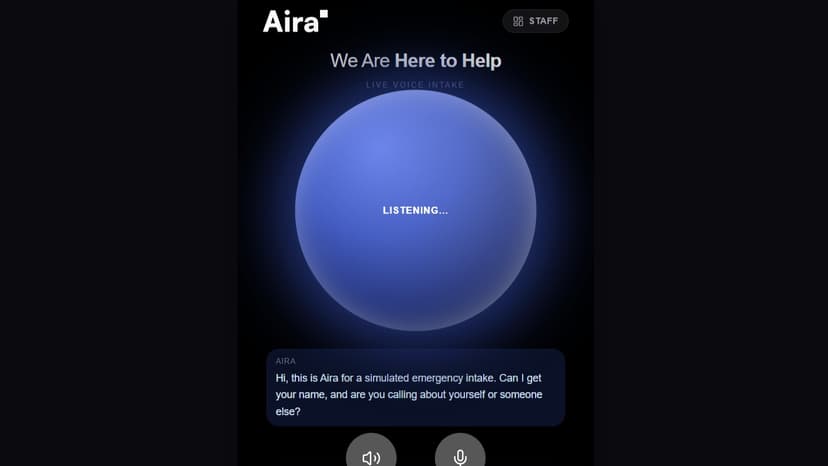
When someone calls the ER, they're rarely calm or organized. They're usually stressed, in pain, or trying to help someone who is. AIRA is a voice tool we built to handle that messy reality. It lets patients or caregivers simply explain what's going on in their own words. As they talk, AssemblyAI's Universal-3 Pro handles the real-time transcription. AIRA keeps track of what's already been said and only asks follow-up questions when something important is missing things like when the symptoms started, how severe they are, current medications, or allergies. The goal is to get the information staff need without forcing someone through a rigid checklist. The real bottleneck for ER staff isn't just taking the call. It's what happens after. Handing a nurse a massive raw transcript doesn't help much when they're already dealing with a busy emergency department. So, we use AssemblyAI's LeMUR to turn the conversation into a concise, structured triage brief. It appears on a staff dashboard, with every detail linked back to an exact timestamp. If a doctor needs to verify something, they can jump straight to that moment in the conversation instead of searching through an entire transcript. We also use AssemblyAI's Sentiment Analysis and Disfluency Detection to pick up on signs that a caller may be stressed, hesitant, or struggling to communicate. On the backend, JSON-Schema Tool Calling handles things like patient lookup and keeps the extracted information in consistent, structured fields. We were careful to make sure AIRA stays assistive. It doesn't diagnose the patient or make medical decisions. Staff review the generated brief, edit anything that needs correcting, request more information if necessary, and explicitly approve the case before it enters the clinical workflow.
30 Sep 2026

Reverse-Engineer
### **AI-Powered Reverse Engineering Assistant** Businesses struggle to stay ahead due to long R&D cycles, high costs, and limited competitor insights. Our AI-powered reverse Engineering Assistant leverages IBM Granite AI and NLP to automate benchmarking, feature extraction, and innovation scoring, helping companies make data-driven decisions faster. ### **Key Features** #### 🔍 **Competitor Product Analysis** - Extracts specs, features, pricing, and feedback from manuals, reviews, patents, and datasheets. - Uses AI to highlight strengths, weaknesses, and innovation gaps. #### 📊 **AI-Powered Benchmarking** - Compares user products against competitors to find areas for improvement. - Analyzes key components, pricing strategies, and market trends. #### ⚙️ **Faster R&D Through Reverse Engineering** - Speeds up product development by analyzing competitors in real time. - Reduces trial-and-error with AI-driven prototyping insights. - Ensures compliance by focusing on publicly available data. ### **Industries That Benefit** ✅ **Consumer Electronics**: Smartphones, laptops, smart devices. ✅ **Automotive**: Vehicle features, safety, energy efficiency. ✅ **Pharmaceuticals**: Drug formulations, medical devices. ✅ **Manufacturing**: Machinery, production techniques. ✅ **Software & SaaS**: AI models, cloud platforms, enterprise apps. ### **Business Impact** ✅ Cuts R&D time by **50%**, accelerating innovation. ✅ Saves costs by providing **ready-to-use insights**. ✅ Enhances market competitiveness by aligning with trends. ✅ Reduces risk by avoiding investment in outdated features. ### **Conclusion** The AI-powered reverse Engineering Assistant helps businesses **innovate smarter** and outperform competitors. By integrating **IBM Granite AI**, it **automates competitor analysis**, making R&D **faster, smarter, and more cost-effective**. **Revolutionizing R&D with AI!**
23 Feb 2025
Medical AI Health System
The Medical AI Health System is an advanced solution designed to optimize hospital operations, particularly in the emergency department, by combining automated patient classification with real-time visualization and movement tracking. The system integrates cutting-edge technologies such as Gemini AI for efficient patient categorization, Gemini for managing the vector database, and React for dynamic visualization of ward activities. The primary goal of the system is to enhance the performance of healthcare facilities by focusing on five key areas: Intelligent Patient Management: The system automatically classifies patients based on severity, ensuring timely care and resource allocation. Resource Optimization: By analyzing real-time data, the system efficiently utilizes medical resources, reducing waste and improving service delivery. Staff Management: It aids in the coordination of healthcare staff by tracking their workload, improving staff allocation, and minimizing delays. Analytics Dashboard: The system provides insightful data visualizations and reports, enabling decision-makers to monitor hospital performance and identify areas for improvement. System Intelligence: The integration of AI enables continuous learning and process improvement, making the system adaptable to evolving needs and improving overall hospital efficiency. This system aims to revolutionize healthcare management by ensuring smoother operations, better resource allocation, and improved patient outcomes.
26 Jan 2025

Revert
Revert aims to impact the $100 Billion Software Development Industry by helping technical and non-technical users, enterprises and clients with their Go Live Strategy. Currently, there are a lot of tools available in the market that only help with project management, none help with strategies, we aim to do that by integrating various important features like generating documents, work break down structures, scope, plans and estimates. We aim to help with strategies needed at each stage of software development lifecycle. Revert aims to impact the $100 Billion Software Development Industry by helping technical and non-technical users, enterprises and clients with their Go Live Strategy.
18 Nov 2024


