

Mamuna Ahmad@Mei3
🤝 Top Collaborators


🤓 Latest Submissions
BoLocal
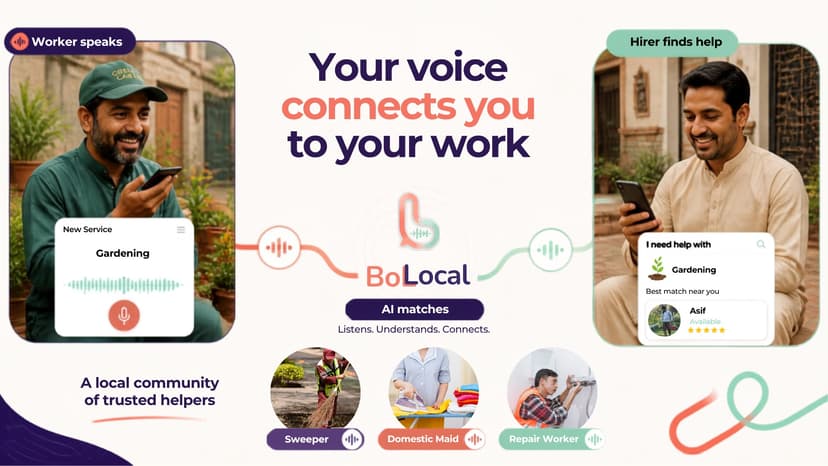
Many local and informal workers find employment through personal networks. Their skills and availability are often not digitally visible. At the same time, people looking for domestic or local service workers may have no structured way to discover who is available nearby and suitable for the work they need. Existing employment platforms often require users to read, type, create written profiles, prepare CVs, and navigate text-based interfaces. This creates barriers for workers with limited literacy or limited experience using formal digital employment platforms. We propose a local employment platform that uses Voice AI to bridge this gap. Workers can simply speak about the services they provide, their experience, location, and availability. People looking for workers can search through either voice or text. Instead of browsing generic job listings, they can describe what they need, such as someone for house cleaning in a particular area who is currently available. AI interprets the request and identifies relevant workers based on service, location, and availability. The platform includes phone and identity/age verification to provide employers with basic verified information about workers. Over time, profiles can be expanded with work history, ratings, and other information that supports informed hiring. The initial focus is on local services such as cleaning, cooking, household work, gardening, and similar services, with potential expansion to other informal service workers such as electricians, plumbers, drivers, and mechanics. The core idea is simple: workers should be able to make their skills discoverable without navigating a traditional employment platform, while people looking for local workers should have an easier way to find suitable, available workers. Voice AI provides the bridge between a worker's spoken description and a searchable digital employment profile.
30 Sep 2026
Dcypher
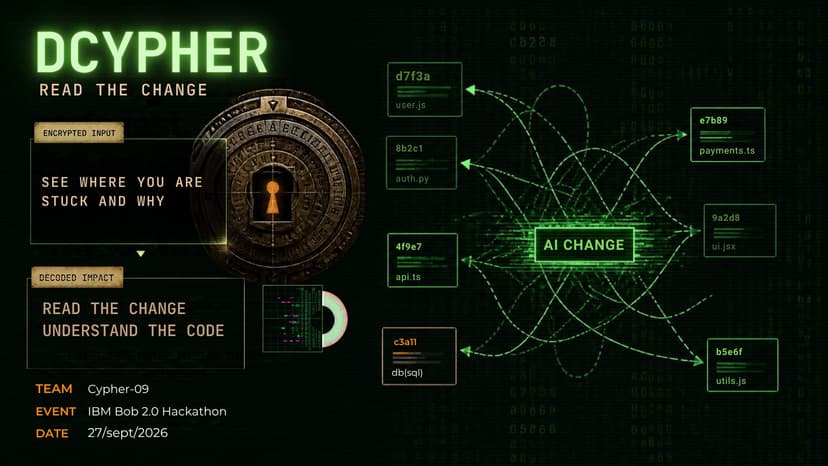
AI coding tools can now generate or modify large parts of an application from a single prompt. But the developers using these tools often cannot see what actually happened. They may know what they asked for, but not which files were touched, how those files connect to the rest of the app, what else changed, or which existing behavior is now affected. This gap is worst for a specific group: AI-assisted developers working with unfamiliar or AI-generated codebases. These are people who can describe what they want and build with AI, but who lack the mental map to safely navigate what the AI produced. They are not beginner programmers, and they are not senior engineers. They are the growing group in between. For example: someone who has built a working prototype with AI, but cannot answer the question "which file controls the login button?" without searching the whole repository. Dcypher is a control and comprehension layer that sits between the user's request and the AI agent's code changes. The AI still reads the repository and writes the code. Decypher adds a three-stage workflow around it. Stage 1 — Plan Before Change. When the user requests a modification, Decypher does not let the AI start editing immediately. It produces a change plan showing which files will be created or modified, what each file does, and how it connects to the request. The user approves or adjusts before any code is written. Stage 2 — Protect What Matters. Before approving, the user can lock files, components, or interface elements the AI must not touch. If the planned change requires a locked element, Dcypher blocks it and explains which element is involved and why the change needs it. The user decides: allow it, keep the lock and try another approach, or cancel. Stage 3 — Compare Before and After. Once approved, the AI applies the change. Decypher keeps the original version available and shows both versions side by side. The user can interact with each and see how the change affected behavior, rather than reading a diff. Decypher identifies which files changed and why. The user keeps the new version or reverts. The workflow is: Request, see plan, lock boundaries, approve, apply within limits, compare original and modified, keep or revert. What makes Dcypher unique is the combination. Planning tools exist. File-permission systems exist. Side-by-side comparisons exist. But no single tool combines pre-change planning, user-defined locked boundaries, and post-change side-by-side comparison into one workflow. Dcypher is not a replacement for the coding agent. It is the layer above it that answers three questions: What is about to change? What am I not willing to let change? What actually changed, and does it work? For this hackathon, the prototype demonstrates the workflow on a real audio-safety application with a broken transcription feature: a change plan preview, a locked file that blocks modification with an explanation, and a side-by-side comparison of the broken and fixed versions. If the modified version does not behave as expected, the user can revert and see exactly which files were involved. The prototype is built with a pluggable agent adapter wired to IBM Bob for code generation, and Bob was used throughout development to scaffold the UI and change-plan logic. Future extensions include full dependency visualization, automatic behavior diagnosis, and version history.
27 Sep 2026


