

Tamreena Tashfeen@tamreena
4
Events attended
2
Submissions made
Pakistan
1 year of experience
About me
Creative AI builder focused on turning rough concepts into clear, functional prototypes. I enjoy approaching complex technical problems with a design-first mindset to build simple, user-focused applications. Looking to partner with engineers and developers to ship practical projects during hackathons.
🤝 Top Collaborators




🤓 Latest Submissions
BoLocal
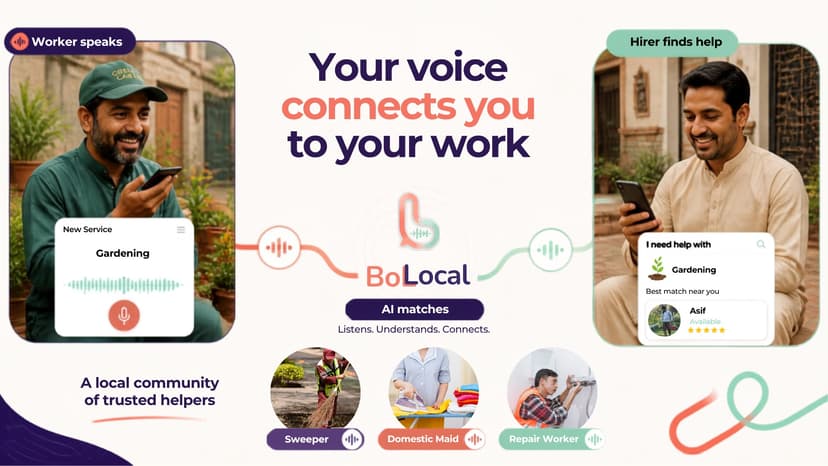
Many local and informal workers find employment through personal networks. Their skills and availability are often not digitally visible. At the same time, people looking for domestic or local service workers may have no structured way to discover who is available nearby and suitable for the work they need. Existing employment platforms often require users to read, type, create written profiles, prepare CVs, and navigate text-based interfaces. This creates barriers for workers with limited literacy or limited experience using formal digital employment platforms. We propose a local employment platform that uses Voice AI to bridge this gap. Workers can simply speak about the services they provide, their experience, location, and availability. People looking for workers can search through either voice or text. Instead of browsing generic job listings, they can describe what they need, such as someone for house cleaning in a particular area who is currently available. AI interprets the request and identifies relevant workers based on service, location, and availability. The platform includes phone and identity/age verification to provide employers with basic verified information about workers. Over time, profiles can be expanded with work history, ratings, and other information that supports informed hiring. The initial focus is on local services such as cleaning, cooking, household work, gardening, and similar services, with potential expansion to other informal service workers such as electricians, plumbers, drivers, and mechanics. The core idea is simple: workers should be able to make their skills discoverable without navigating a traditional employment platform, while people looking for local workers should have an easier way to find suitable, available workers. Voice AI provides the bridge between a worker's spoken description and a searchable digital employment profile.
30 Sep 2026
MUHAFIZ AI
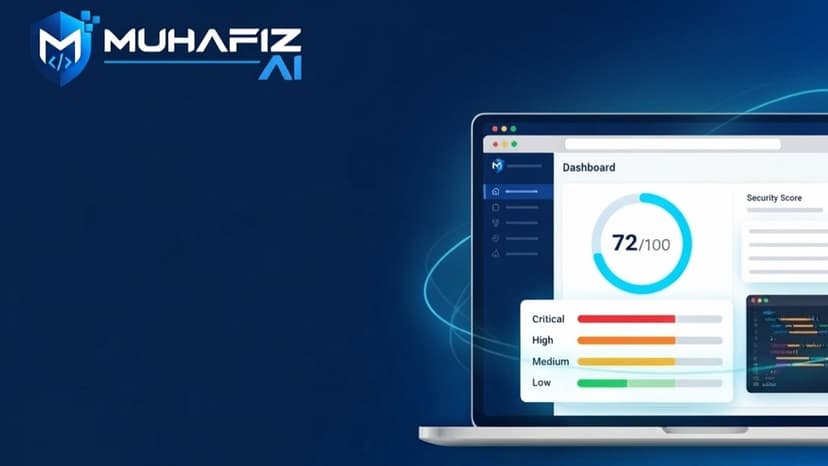
The Problem: Security vulnerabilities are one of the most expensive, preventable mistakes in software development — yet most developers can't afford enterprise tools like Snyk or Veracode, and don't have the security expertise to know why a piece of code is dangerous or how to fix it correctly. Existing scanners flag issues and stop there, burying developers in jargon-heavy reports that force them to Google what a vulnerability even means and guess at a fix — often introducing new bugs. Critical security flaws routinely reach production simply because no one had the time, budget, or expertise to catch and fix them properly. The Solution: Muhafiz AI is an AI Security Engineer built for developers, students, indie hackers, and small teams who can't justify a dedicated security hire or an enterprise security budget. Users simply upload a single file or an entire project (full ZIP uploads supported) through the web dashboard — no configuration and no security background required — and step through one guided workflow: Find → Explain → Fix → Rescan → Improve. Instantly, they receive a detailed report covering vulnerabilities such as SQL injection, XSS, command injection, hardcoded secrets, weak authentication, path traversal, insecure file uploads, missing input validation, and insecure dependencies, each tagged Critical, High, Medium, or Low. What makes Muhafiz AI unique is its depth of explanation and action. For every vulnerability, it explains what it is, why it's dangerous, what could happen if exploited, exactly where it lives in the code, and how to fix it — written so even a beginner can follow along. Its AI Auto-Fix feature then generates a corrected, more secure version of the code side-by-side with the original, with a plain-language explanation of what changed and why. A built-in AI Security Assistant lets users ask natural follow-up questions — "why is this dangerous?", "fix this without changing my app's behavior" — turning a passive scanner into an interactive security partner. After every scan, users see an overall Security Score (e.g. 72/100) broken down across Injection Protection, Authentication, Input Validation, Secrets Management, Data Security, and Dependency Security, so they instantly know what matters most. Rather than dumping a long list of issues on them, Muhafiz AI prioritizes what to fix immediately versus what can wait, and lets users rescan after applying fixes to see measurable improvement (e.g. 54/100 → 91/100) — proof the tool is actually solving the problem, not just flagging it. Built privacy-first — secure transmission, minimal data retention, no sharing of code across accounts — Muhafiz AI turns security from an afterthought into a fast, understandable, guided part of every developer's workflow, helping them catch what they'd otherwise miss and fix it with confidence before insecure code ever reaches production.
27 Sep 2026


