
🤝 Top Collaborators




🤓 Latest Submissions

Day Zero
Autonomous Repository Architecture Synthesizer DayZero is an AI-powered engineering tool built on IBM Bob that solves one of the most persistent and costly problems in software development — the onboarding bottleneck. When a new engineer joins a project, they typically spend three to five days just navigating an unfamiliar codebase, reading scattered documentation, tracing data flows across dozens of files, and pulling senior engineers away from productive work for manual walkthroughs. Day Zero eliminates this friction entirely by automating the entire architectural discovery and documentation process through a coordinated multi-agent AI pipeline. The system is triggered with a single command — /onboard — and immediately deploys three specialized analytical subagents in parallel. The first subagent performs deep static analysis using Python's Abstract Syntax Tree to scan every file in the repository. It identifies entry points such as FastAPI and Flask applications, CLI tools, and worker loops, then traces the full invocation call graph to understand how data transforms as it moves between modules. It extracts precise file coordinates, function signatures, and line numbers, never inventing symbols that don't exist in the actual code. The second subagent focuses on semantic and contextual understanding. It reads README files, dependency manifests, Dockerfiles, environment configuration files, and any markdown documentation present in the project. From these it extracts the project's domain intent, runtime requirements, hardware constraints, and critical environment secrets — and importantly, it identifies discrepancies where documentation has drifted away from what the code actually does. The third subagent synthesizes the findings from both passes into a structured output. It constructs a syntactically valid Mermaid.js architecture diagram representing the real data and request flow through the system. It formats every pipeline stage into an ordered execution flow that includes explicit input and output contracts, the exact mechanism used, and a verified code anchor pointing to the precise lines in the source file. All discoveries are written to a repo_blueprint.json file adhering to a strict schema. A critical safety layer sits on top of this pipeline: verifier.py. After the blueprint is generated, the verifier performs a grounding check on every file reference, code anchor, pipeline stage, and data model path in the JSON. It confirms that each mentioned file exists on disk, that each line range is within bounds, and that no invalid combined paths have been produced. In the DayZero benchmark, the verifier caught a hallucination on the first run — a pipeline stage had incorrectly referenced two files joined by a slash separator. Bob read the failure report, patched the instruction schema, re-ran the full pipeline, and the verifier passed at one hundred percent on the second attempt. This closed-loop self-correction is what separates DayZero from simple code summarization tools. The final step runs visualizer.py, which reads the verified blueprint and renders a fully interactive single-page HTML architecture tour. This document contains a clickable Mermaid diagram where each node jumps to its corresponding pipeline card, detailed stage cards with input/output contracts and code anchors, a complete Pydantic data model reference, full API endpoint documentation, and a copy-paste setup playbook with verified terminal commands. A new engineer can understand the entire system architecture without opening a single source file.
27 Sep 2026
Delegate
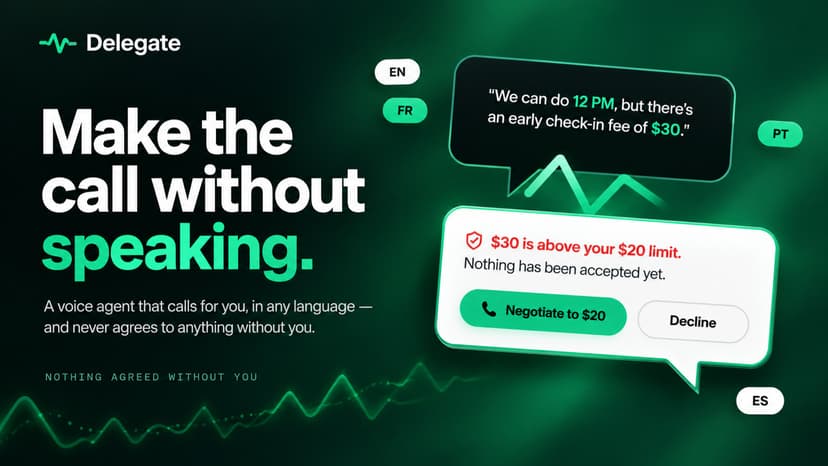
Calling a hotel, internet provider to negotiate takes time. It's harder still when the conversation isn't in your first language. Handing it to an AI entirely is risky, because it might agree to a price you never approved or share details it shouldn't. Delegate sits in the middle. You describe what you need in plain words,Delegate turns that into clear rules: your goal, your spending limit, and what it must never say Then it holds the conversation for you. For each reply, Delegate drafts a response and checks it against your rules. It shows you the draft alongside a translation into your language. Nothing is said until you approve it. If the other side asks for more than you allowed, or asks for something you said never to share, Delegate stops and gives you one-click options instead of deciding for you. Approved replies are read aloud in a natural neural voice When the conversation ends, Delegate gives you a summary: what was agreed, what's still open, and the outcome. Key features: Plain-language setup: your request becomes structured limits and an opening line. Human approval on every commitment: a spending limit and dealbreakers are checked before anything is said. Bilingual: you read and approve in your language while the business hears clear English. Five languages are supported. Live speech: AssemblyAI streaming transcription for the other side, plus a natural voice for the agent. Negotiation memory: terms you approve mid-conversation are remembered and counted as successes. End-of-conversation summary: confirmed points, unresolved items and the outcome. Private pilot: passcode access, expiring invitation links for the other participant, and deletable saved conversations. Built with Python (FastAPI, AssemblyAI for speech-to-text and the Voice Agent API, GPT-4o mini through AI/ML API, and edge-tts for the neural voice. It's deployed with Docker. Current scope: the business side joins through a shared browser link. Dialing real phone numbers is the next step.
30 Sep 2026


