

🤝 Top Collaborators


🤓 Latest Submissions
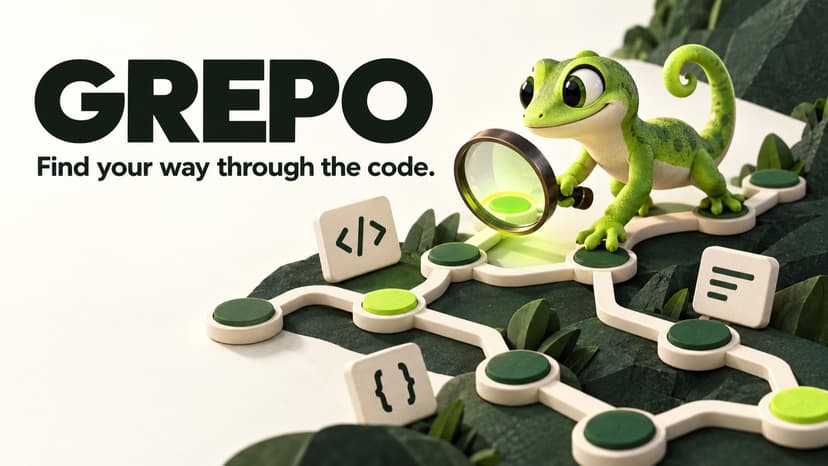
GREPO — Find Your Way Through the Code
A repository is easy to clone and hard to understand. Before making a useful change, a developer must discover where behavior lives, how modules connect, what can be reused, and what might break. That knowledge is scattered across file trees, searches, documentation, and teammates' memories. GREPO brings it into one workspace: a connected path from repository structure to source evidence to a reviewable next step. Import a public GitHub repository or ZIP to create a read-only snapshot. Start with the overview, search the file tree, explore an interactive repository map, and open the corresponding source without losing your place. Shared selection and source ranges keep the map, files, and findings connected. The dependency explorer traces supported static imports and function calls, attaches source evidence, and explains unresolved relationships. Reusable functions, duplicate patterns, and potentially unused code become concrete starting points for investigation. File and folder summaries surface inventory and syntax facts. Coverage information helps developers judge what the analysis can establish. The recorded workflow also demonstrates optional AI assistance. Ask a repository question, inspect the cited excerpts, and follow them back to source. Describe an improvement to generate a change proposal with affected files, suggested checks, and open questions. Create an onboarding guide, repository overview, or developer reference, then edit and export the Markdown. These outputs remain reviewable drafts; the imported code stays untouched. GREPO is designed for developers joining a codebase, maintainers investigating unfamiliar modules, and contributors preparing a change. Its value comes from keeping exploration, explanation, and planning close to the evidence. Instead of rebuilding context in separate tools, users can carry what they discover directly into their next question or decision. Underneath the interface, snapshot-scoped identifiers, source hashes, bounded reads, and explicit unresolved states provide a traceable foundation. Core exploration runs locally without executing imported code. Optional Groq-powered AI works through the backend with selected source excerpts. React and TypeScript power the interface; Python, FastAPI, Tree-sitter, and Archify support analysis and visualization. IBM Bob was a central development tool for the team's implementation and corrective engineering. GREPO helps developers find their bearings, inspect the evidence, and approach the next change with a clearer understanding of the code.
27 Sep 2026

AFTERIMAGE — GuavaMango
AFTERIMAGE is an autonomous trading agent connected to a dedicated $100,000 Alpaca paper account. GuavaMango scans 11 liquid ETFs for a two-day liquidity shock inside an established uptrend. Its “shadow clock” carries skipped opportunities forward as causal market memory, so live behavior matches the research. On authenticated Alpaca IEX daily data, the 2022–2026 admission window produced 95 trades, +48.05R net, a 2.253 profit factor, +0.506R expectancy per trade, and 4.746R maximum drawdown. All five annual folds were positive, 108/108 immediate parameter neighbors remained profitable, and 1.5× modeled costs retained +46.88R with a 2.222 profit factor. These are cost-aware historical pseudo-out-of-sample results, not broker P&L. A four-role Featherless decision desk attacks every candidate. GLM-5.3 runs the strategist and prosecutor; GLM-5.3-Flash runs the regime and execution witnesses. Each claim must cite the frozen evidence packet. Risk code enforces paper-only operation, account and market state, executable-price quality, exposure limits, a $500 modeled-loss ceiling, and structural plus operational reward-to-risk of at least 3:1. A short-lived, single-use Ed25519 warrant binds the evidence, risk vector, quote, account, quantity, and order intent before submission. The broker path uses the official Alpaca CLI 0.0.14 with OAuth, endpoint attestation, authenticated market data, dry runs, optional paper execution, reconciliation, watchdog exits, and fill autopsy. A separate Alpaca MCP transport and Level 3 options lane support chain discovery, defined-risk multi-leg construction, payoff previews, and Mleg intents. GuavaMango executes equity brackets; options are an independently tested platform capability. The responsive Flight Deck exposes performance, positions, AI reasoning, risk gates, orders, options, and the Market Data → Signal → AI Jury → Risk → Warrant → Alpaca workflow.
4 Sep 2026

Vox — The Living Memory of Every Meeting
Vox is the living memory of every meeting. Upload audio or video and Vox transforms it into speaker-aware transcripts, clear summaries, decisions, action items, topics, and timestamped evidence—turning conversations into structured, searchable intelligence. Ask Vox lets teams question their entire meeting history and receive direct, citation-backed answers instead of hunting through recordings. Its Multimodal Visual Memory can understand what was shown—not only what was said—surfacing relevant slides, interfaces, documents, error messages, screenshots, and playable evidence clips. Vox goes beyond summarization through AgentClaw: an agentic workflow layer that prepares meeting briefs, creates weekly digests, reconciles action items, and supports custom agents that can reason across organizational memory and connected tools. The Action Centre then turns extracted commitments into editable, assignable, trackable work. Its connector ecosystem integrates with tools such as Gmail, Slack, GitHub, Linear, Notion, Stripe, and custom MCP servers, while Bright Data brings live, cited web intelligence directly into the workflow. Featherless AI powers Vox’s extraction, reasoning, embeddings, and grounded intelligence. Speechmatics delivers accurate, speaker-aware transcription. Bright Data connects internal meeting knowledge with the live web. Built and shaped through native.builder’s Builder, Product Architect, Task Planner, and QA agents, Vox demonstrates what becomes possible when AI does not merely record work—it remembers, verifies, connects, and acts.
10 Aug 2026
O(1) Agent
O(1) is a hybrid AI orchestration platform that intelligently routes every request to the most efficient execution path, balancing accuracy, latency, and operational cost. Instead of treating every prompt equally, the system analyzes task complexity and dynamically selects the optimal execution strategy. The routing pipeline begins with T0, a deterministic Python engine capable of solving structured, factual, mathematical, classification, and rule-based tasks instantly without invoking an LLM, resulting in zero LLM inference cost. Requests requiring language understanding are automatically escalated to T1, where multiple Gemma 4 models are served locally on AMD GPUs using ROCm and vLLM. This provides responses that are fast and of same accuracy while spending less on premium models. When local inference is insufficient or a request exceeds predefined routing criteria, does the router escalate to T2, a cloud-hosted LLM, where prompts are optimized to minimize token consumption while preserving response quality. Beyond routing, the platform includes automatic task classification, adaptive model selection, token-efficiency profiling, latency benchmarking, structured request logging, performance analytics, response caching, and real-time streaming using Server-Sent Events (SSE). Built-in benchmarking and monitoring provide detailed insights into throughput, latency, GPU utilization, cache performance, and routing decisions, making the system suitable for both production deployments and research workflows.
13 Jul 2026


