

Jose Miguell Barron@amJae
7
Events attended
5
Submissions made
Philippines
1 year of experience
About me
Hi! I'm jae a new dev from the Philippines, I'm here to test my critical thinking, creativity as well as my skills. Feel free to hit me up if you want to collab~ Every experience here makes up to my journey to become a better dev~
🤝 Top Collaborators



🔥 Own Projects
🤓 Latest Submissions

GREPO — Find Your Way Through the Code
A repository is easy to clone and hard to understand. Before making a useful change, a developer must discover where behavior lives, how modules connect, what can be reused, and what might break. That knowledge is scattered across file trees, searches, documentation, and teammates' memories. GREPO brings it into one workspace: a connected path from repository structure to source evidence to a reviewable next step. Import a public GitHub repository or ZIP to create a read-only snapshot. Start with the overview, search the file tree, explore an interactive repository map, and open the corresponding source without losing your place. Shared selection and source ranges keep the map, files, and findings connected. The dependency explorer traces supported static imports and function calls, attaches source evidence, and explains unresolved relationships. Reusable functions, duplicate patterns, and potentially unused code become concrete starting points for investigation. File and folder summaries surface inventory and syntax facts. Coverage information helps developers judge what the analysis can establish. The recorded workflow also demonstrates optional AI assistance. Ask a repository question, inspect the cited excerpts, and follow them back to source. Describe an improvement to generate a change proposal with affected files, suggested checks, and open questions. Create an onboarding guide, repository overview, or developer reference, then edit and export the Markdown. These outputs remain reviewable drafts; the imported code stays untouched. GREPO is designed for developers joining a codebase, maintainers investigating unfamiliar modules, and contributors preparing a change. Its value comes from keeping exploration, explanation, and planning close to the evidence. Instead of rebuilding context in separate tools, users can carry what they discover directly into their next question or decision. Underneath the interface, snapshot-scoped identifiers, source hashes, bounded reads, and explicit unresolved states provide a traceable foundation. Core exploration runs locally without executing imported code. Optional Groq-powered AI works through the backend with selected source excerpts. React and TypeScript power the interface; Python, FastAPI, Tree-sitter, and Archify support analysis and visualization. IBM Bob was a central development tool for the team's implementation and corrective engineering. GREPO helps developers find their bearings, inspect the evidence, and approach the next change with a clearer understanding of the code.
27 Sep 2026
O(1) Agent
O(1) is a hybrid AI orchestration platform that intelligently routes every request to the most efficient execution path, balancing accuracy, latency, and operational cost. Instead of treating every prompt equally, the system analyzes task complexity and dynamically selects the optimal execution strategy. The routing pipeline begins with T0, a deterministic Python engine capable of solving structured, factual, mathematical, classification, and rule-based tasks instantly without invoking an LLM, resulting in zero LLM inference cost. Requests requiring language understanding are automatically escalated to T1, where multiple Gemma 4 models are served locally on AMD GPUs using ROCm and vLLM. This provides responses that are fast and of same accuracy while spending less on premium models. When local inference is insufficient or a request exceeds predefined routing criteria, does the router escalate to T2, a cloud-hosted LLM, where prompts are optimized to minimize token consumption while preserving response quality. Beyond routing, the platform includes automatic task classification, adaptive model selection, token-efficiency profiling, latency benchmarking, structured request logging, performance analytics, response caching, and real-time streaming using Server-Sent Events (SSE). Built-in benchmarking and monitoring provide detailed insights into throughput, latency, GPU utilization, cache performance, and routing decisions, making the system suitable for both production deployments and research workflows.
13 Jul 2026
ChorusOps — Voice-Native Dealflow Orchestrator
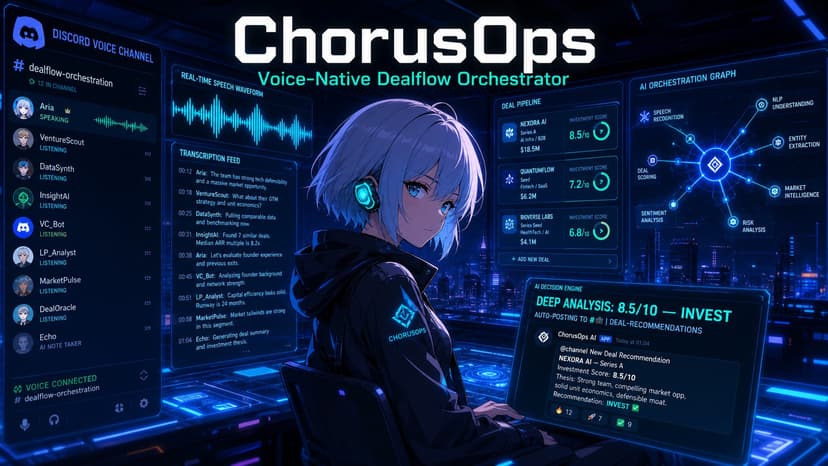
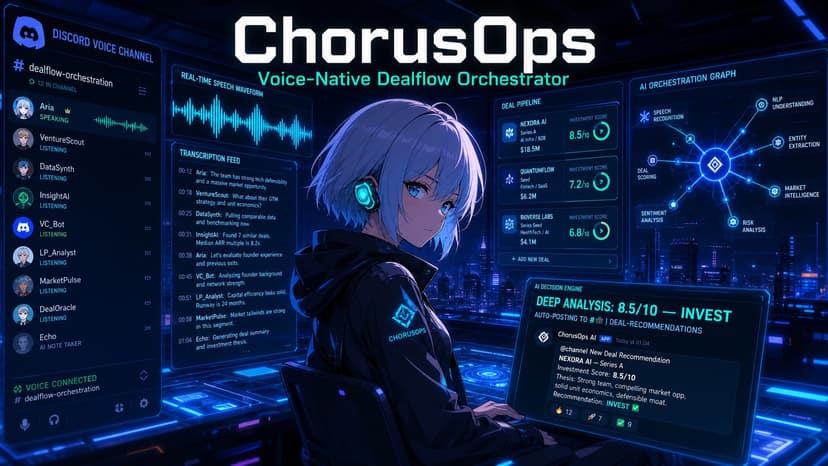
ChorusOps is a voice-native dealflow orchestrator built for investors and enterprise teams who run deal discussions inside Discord voice channels. Instead of taking manual notes or switching to a CRM mid-call, ChorusOps listens, understands, and acts autonomously. The system captures Discord voice audio (Opus stereo 48kHz), downmixes it to mono, and streams it in real-time to Speechmatics' WebSocket API for highly accurate transcription with multi-speaker diarization — attributing every spoken sentence to the correct speaker automatically. Transcripts are routed to Gemini 2.5 Flash, which acts as a multi-step planning orchestrator. Using function calling, Gemini maintains a persistent deal state (deal name, stage, team notes, market context, funding ask) across the entire conversation via structured tool calls. When sufficient context is gathered, Gemini autonomously dispatches a DEEP_ANALYSIS job to a Featherless serverless inference worker running an open-source LLM. This worker produces a scored investment scorecard — including investment score, recommendation, strengths, and risks — which is automatically posted back to the Discord text channel and spoken aloud via Kokoro TTS. The bot supports barge-in interruption: if a user starts speaking while the bot is talking, TTS stops instantly. Multi-guild isolation ensures the system runs across multiple Discord servers simultaneously. Slash commands (/join, /say, /status, /tts, /voice) provide a full text fallback interface. ChorusOps targets the Agentic Workflows track: the agent plans its own steps, calls external tools, manages async multi-step tasks over time, and posts results without any human intervention — from first spoken word to final scored deal. Tech stack: Discord.js, Speechmatics RT API, Gemini 2.5 Flash, Featherless LLM inference, Kokoro TTS, Express, TypeScript.
19 May 2026

Bob the SAGE – AI Research Copilot
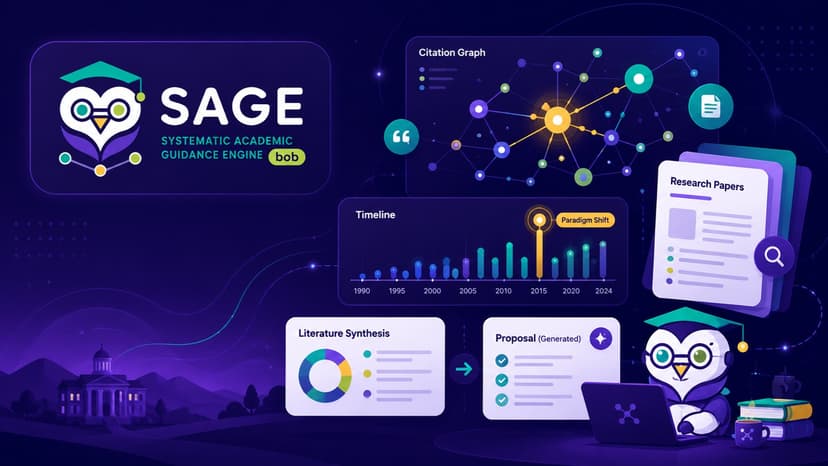
Bob the SAGE (Systematic Academic Guidance Engine) is an AI‑assisted research copilot that helps developers and researchers turn messy academic queries into structured insight. Given a topic like “CRISPR gene therapy”, it fetches real papers, builds a citation graph with PageRank to surface key work, constructs a timeline to highlight paradigm shifts, and then summarizes everything as a literature review and draft research proposal. Under the hood, SAGE is a full web app with a FastAPI backend and modern frontend. The citation graph and timeline engines have been hardened to handle noisy data, disconnected components, and edge cases, and the backend is covered by dozens of tests with 80%+ coverage. We used IBM Bob throughout the lifecycle: to review and improve the core algorithms, define five reusable Bob Skills (extraction, synthesis, graph analysis, translation, proposal), generate tests, produce a 600+ line security audit, and write architecture and API documentation. The app shows a clear pipeline from query to results and exposes controls for year range, language, and max papers, with sensible defaults and ethical API usage: no keys in the repo, pluggable data sources, and explicit respect for provider terms. For judges, Bob the SAGE is both a working demo you can run locally and a concrete example of how IBM Bob can accelerate building production‑style developer tools for research and education.
17 May 2026
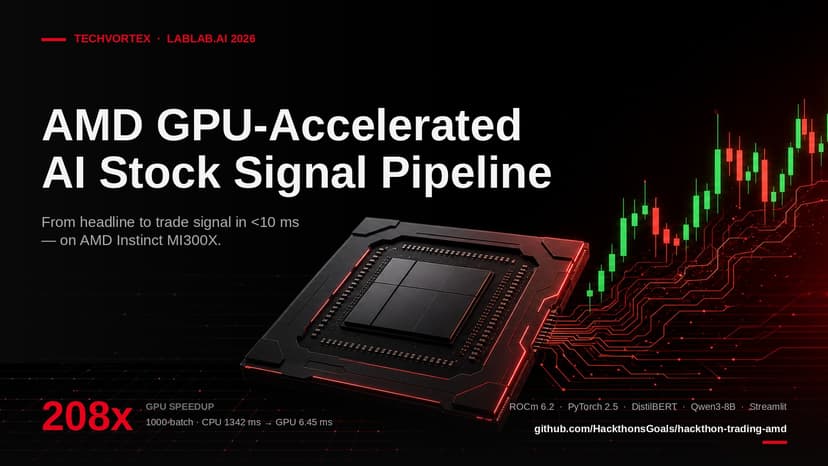
Sentiment Analysis of a Stock Data on News
We built an end-to-end AI stock signal pipeline that turns live market data and news headlines into explainable trade signals — fully accelerated on AMD Instinct MI300X via ROCm + PyTorch. The system runs three cooperating agents in an agentic workflow: 1. Signal Agent — pulls live OHLCV and headlines via yfinance, computes rolling-volatility regimes (LOW/MED/HIGH), and runs batched market inference on GPU. 2. Sentiment Agent — a fine-tuned DistilBERT classifier from Hugging Face Hub (POS/NEU/NEG with signed scores) running batched ROCm inference for thousands of headlines per second. 3. Reasoning Agent — Qwen3-8B generates a natural-language explanation for each BUY / SELL / HOLD decision, with entry, stop-loss, and target levels. A simulated execution engine then runs an OPEN-to-CLOSED trade lifecycle with slippage and P&L, surfacing win-rate, average return, and a cumulative P&L curve. The Streamlit dashboard exposes a live GPU diagnostics banner, KPI tiles, signal table, sector heatmap, sentiment analytics, and CPU-vs-GPU throughput charts. Verified on AMD Developer Cloud (ROCm 6.2 + PyTorch 2.5.1+rocm6.2): 17.0x speedup on 100-batch market pipeline, 208.0x on 1000-batch market pipeline, 14.49x on sentiment batch — all from the exact same code path that runs on CPU. AMD-first, IP-safe, judge-friendly, and built to scale to multi-GPU MI300X clusters.
10 May 2026


