
Simone Choudhary@Sim-20
2
Events attended
2
Submissions made
India
1 year of experience
About me
I am a third-year Engineering student with a keen interest in coding and software development. I am dedicated, disciplined, and committed to continuous learning. I possess knowledge of C, Python, and Java, including Object-Oriented Programming concepts, and have developed mini projects using Java. Currently, I am learning Flutter to explore mobile application development. I am passionate about improving my creativity, analytical thinking, and problem-solving skills through practical experiences and challenging projects. I look forward to leveraging my technical skills, learning from industry experts, and contributing effectively
🤝 Top Collaborators

🤓 Latest Submissions
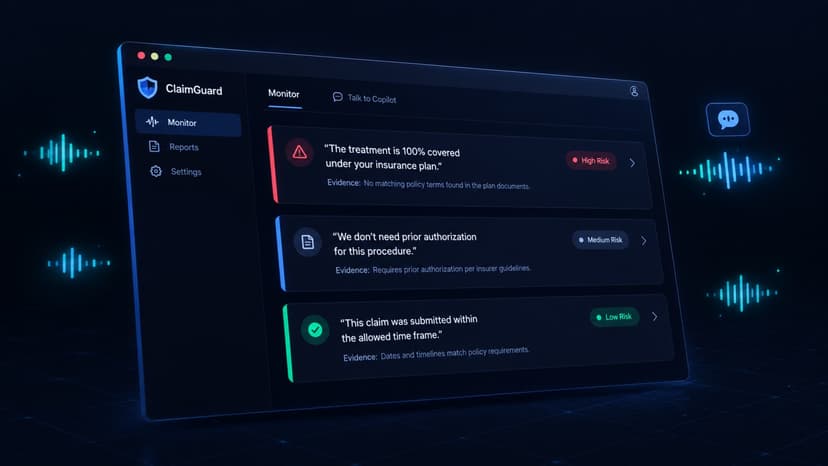
ClaimGuard — Voice Compliance Copilot
Sales and support reps routinely make claims on live calls that don't match what a company actually promises — wrong refund windows, delivery times, or support hours. By the time a compliance team reviews the recording, the customer has already been misled, and the damage is done. Nobody is listening live. ClaimGuard fixes this. It uses AssemblyAI's Streaming Speech-to-Text to transcribe a live call in real time, automatically extracts factual, checkable claims from the conversation, and verifies each one against the company's own policy document — flagging contradicted claims with a risk level and confidence score within about ten seconds of the claim being spoken. What makes ClaimGuard different from a typical fact-checking dashboard is the second half of the system: a genuine, two-way voice agent built on AssemblyAI's Voice Agent API. A supervisor can talk to ClaimGuard directly, out loud, mid-call — asking "what's the risk on this call right now," or "why was that claim flagged" — and ClaimGuard answers in a synthesized voice, calling real backend tools to pull live data rather than guessing. It can also escalate the call to a human supervisor on command. Both halves — the passive listening pipeline and the live voice conversation — run off the exact same backend and the exact same claims data, deployed as a single app with no separate servers required. ClaimGuard shows what's possible when real-time transcription and a real conversational voice agent are combined into one compliance tool that doesn't just watch a call, but actively participates in keeping it honest.
30 Sep 2026

RepoGuide — Verified AI Codebase Onboarding
New developers routinely lose days to weeks reading through an unfamiliar codebase before their first meaningful commit — piecing together tribal knowledge, guessing at architecture, and hesitating to touch anything they don't understand. This onboarding tax is a universal, quantifiable cost for every engineering team, and it compounds every time someone joins a project or returns to old code. RepoGuide solves this with three integrated features built on IBM Bob 2.0. First, point it at any repository (local path or GitHub URL) and it produces a plain-English architecture summary, a real "percent of codebase explained" score, and a ranked list of safe, well-scoped first tasks — actual TODOs and thin-test-coverage files, not busywork. Second, a grounded Q&A system lets a new developer ask anything about the codebase and receive an answer with file:line citations that are independently re-verified by a separate Critic agent against the actual source before being shown as verified or unverified — tested against a real public repository (pallets/flask), it achieved a 100% citation verification rate, and when asked a question the repo genuinely couldn't answer, it honestly said so instead of hallucinating a plausible-sounding fake answer. Third, an Error Triage tool lets any developer paste a stack trace or error log and get back ranked likely causes with confidence scores, using real regex-based extraction across Python, Node/JS, and Java formats plus LLM-driven root-cause ranking. What makes RepoGuide different from a general-purpose AI chatbot pointed at a codebase is the verification loop: it doesn't just answer, it checks its own answers before showing them to you, and admits uncertainty when warranted. Every number shown — files explained, tasks found, citation pass rate — is computed live from the actual run, not hardcoded. RepoGuide turns the slowest, most frustrating part of joining a new codebase into a guided, honest, minutes-long process.
27 Sep 2026

