

🤝 Top Collaborators


🤓 Latest Submissions

Aatam
Imagine you are at a friend's place and they bring out a board game you don't know. Traditionally, that would mean your friend has to explain it or you have to painstakingly read the manual for a solid hour to grasp what the game is about! That's where our project Aatam comes in. It can help you learn the game very quickly with a chatbot and video generator that explains the new game based on games you may have played before. It is powered by powerful Gemma model running on AMD servers. Gemma because it is the smartest model in it's category(based on number of parameters), and AMD because it is cheap scalable and replicable. We hope you find good use for it and learn fun, new boardgames along the way!
18 Oct 2026
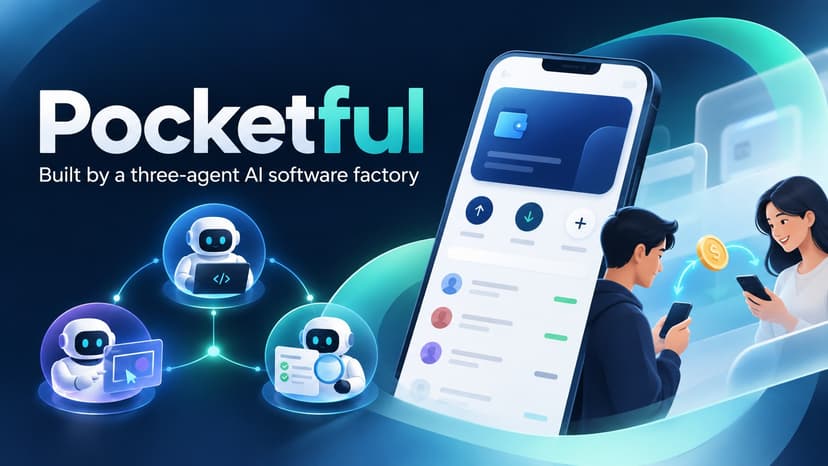
Pocketful
Pocketful is a wallet and payments application built by a three-seat software factory in BAND Desktop. Our API Engineer, UI Designer, and independent Reviewer collaborated in one room, handed work to each other, and checked the results before acceptance. Their reusable mandates, full room log, and commit history are included in the public repository so the factory can be inspected and run again. The application supports wallet balances, payments, requests, bill splitting, holds, refunds, and historical corrections. Financial amounts use integer minor units. Transfers are atomic, retries are idempotent, and balances cannot become negative. We delivered separate Docker services for all four hackathon stages and verified the final stage against the supplied harness. The video shows the agents’ handoffs and review alongside a working browser demo. The hosted link shows the team’s live wallet; the repository’s stage-4 folder contains the final staged submission.
6 Oct 2026

EchoMind — Talk. It remembers.
EchoMind is a voice-first AI personal memory agent designed to help people remember the context behind everyday conversations. Instead of manually writing notes, users can speak naturally about people, tasks, plans, events, and important details. EchoMind uses AssemblyAI’s realtime Voice Agent technology for live voice interaction, then passes the conversation into an AI layer that extracts structured information and relationships. Those memories are stored in Neon PostgreSQL and represented as a Personal Memory Graph. Users can retrieve memories, search connected context, complete tasks, and forget information. EchoMind also resolves relative time such as “tomorrow” or “in 2 hours” into absolute dates so relevant memories can be considered for proactive suggestions. The result is a voice-first memory system that listens, understands, remembers, connects, and brings context back when it becomes useful.
30 Sep 2026
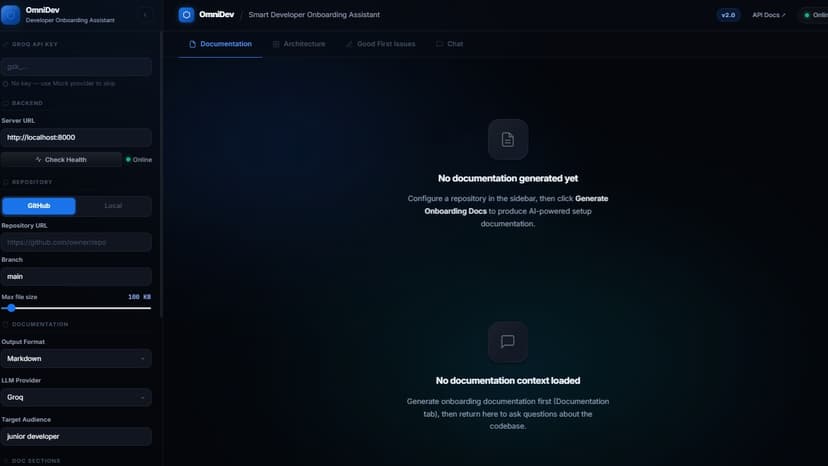
OmniDev: AI-Powered Developer Onboarding Platform
Problem Statement: Joining a new engineering team or adopting a complex codebase presents a massive bottleneck. New developers struggle with understanding undocumented architectures, setting up local environments, configuring environment variables, and finding appropriate starter tasks without overwhelming senior engineers. Solution & Architecture: OmniDev is an enterprise-grade, AI-powered developer onboarding and codebase analysis platform built using FastAPI, Tailwind CSS, and Groq LLMs. It points to any local or GitHub repository to instantly parse code structures and deliver a complete onboarding suite: 1. Automated Documentation: Generates comprehensive multi-section setup guides and technical manuals. 2. Architecture Mapping: Instantly builds live interactive Mermaid.js system architecture and data flow diagrams. 3. Smart Starter Tasks: Extracts practical onboarding tasks mapped with dynamic difficulty levels (Beginner, Intermediate, Advanced) and step-by-step implementation instructions. 4. Codebase RAG Chat: Provides an interactive context-aware Q&A interface for developers to query repository internals. Target Users & Uniqueness: OmniDev targets software engineering teams, open-source maintainers, and enterprise organizations looking to accelerate developer ramp-up time. Its unique edge lies in providing an end-to-end visual and interactive companion that eliminates manual documentation overhead.
27 Sep 2026

AlphaPilot AI
AlphaPilot AI is an end-to-end automated options paper-trading platform built to deliver transparent, rule-backed execution with institutional capital discipline. The core engine continuously monitors SPY using a multi-factor technical matrix—combining SMA20, SMA50, RSI, MACD, and volume telemetry—to generate deterministic BUY or NO-TRADE signals paired with a real-time confidence score. Upon issuing a validated BUY signal, the platform’s algorithmic contract scanner searches, filters, and ranks option chains based on Days to Expiration (DTE), strike proximity, open interest, and liquidity metrics. Before any order is routed, the Entry Manager enforces strict safety controls, including technical confidence verification, active position collision checks, duplicate order protection, option quote validation, and strict portfolio risk limits. Once a paper position is active, the Position Monitor continuously tracks real-time price action, unrealized P&L, Stop Loss, and Take Profit thresholds. The engine automatically triggers paper exits when pre-established risk limits are met. All executed trades are permanently logged to a CSV audit ledger and analyzed through a comprehensive Performance Intelligence module to calculate win rates, risk metrics, and cumulative P&L. AlphaPilot AI is strictly configured for paper trading via the Alpaca API, allowing the entire algorithmic trading workflow to be thoroughly evaluated in real-time market conditions with zero capital risk.
4 Sep 2026

VoiceShield
VoiceShield is built around a simple question: how can we be sure an AI voice agent is safe before letting real people talk to it? In real life, conversations don’t always go as planned. People can be angry, confused, vulnerable, emotional, or simply unpredictable. Traditional testing usually focuses on expected scenarios, so it can easily miss these difficult situations. VoiceShield tackles this by creating AI-powered personas that act like different types of real callers and put voice agents through realistic conversations. During each test, these personas challenge the voice agent with different situations while VoiceShield analyzes the conversation as it happens. It looks for things that could go wrong—such as unsafe or inappropriate responses, policy violations, risky behavior, or poor handling of vulnerable users. This helps teams discover potential problems before the AI agent is exposed to real customers. We use Speechmatics for voice interaction and speech processing, DataBright to bring relevant EU policies and regulatory information into the evaluation process, and our Smith evaluation agent to analyze conversations and determine risks, violations, and severity. The results are then presented through VoiceShield as clear Pass, Flag, or Fail outcomes with actionable recommendations. Our goal is to make AI voice testing feel less like traditional QA and more like putting an AI agent through a realistic stress test before real customers do it. VoiceShield helps businesses find problems early, understand where their agents are vulnerable, and build voice AI that people can trust.
10 Aug 2026


