
🤓 Latest Submissions

Tablekeeper a four-seat dark factory
Tablekeeper is a restaurant reservation service: search availability, book a table, find the booking again by reference, amend or cancel it over time zones, daylight saving, idempotent retries, policies that change at a point in time, and seating replans that rewrite bookings without breaking their history. No human wrote any of it. It was built by a dark factory: four coding agent seats sharing one Band room. The coordinator runs the floor. The implementer writes the code and posts a handoff card carrying the revision, the claim, every command it ran with its exit code, and the whole task pasted again the seat reading it may assume nothing. Two of the four seats do nothing but check. The falsifier re runs the delivered tests five ways on its own clone: as delivered, on the last revision it accepted, with the implementation reverted, with every changed function emptied, and against the earlier stage's accepted code. The verifier builds from a third clone and tests the running service against the spec. The best thing it caught: a stage 2 revision whose suite passed exit zero and which the falsifier rejected anyway. It had diffed those tests against the stage 1 tests it had already accepted and found one quietly rewritten, with no requirement asking for the change. Nothing failed, nothing was red, and it was refused because a green suite is not evidence on its own. That is the event's own disqualifying rule, enforced by the factory on itself. All four stages were built and accepted in 9h 42m of running time on six human messages four stage dispatches and two process notes about reporting, neither touching the service. Ten verdicts, two of them rejections. Forty findings raised: five fixed, thirty-five withdrawn by the checker itself on replay. Every one of the nine commits touching a stage folder is the implementer's. No merges, no rebases. It is not magic: it stalled twice, and a second model family failed the job and was swapped back to Claude.
6 Oct 2026
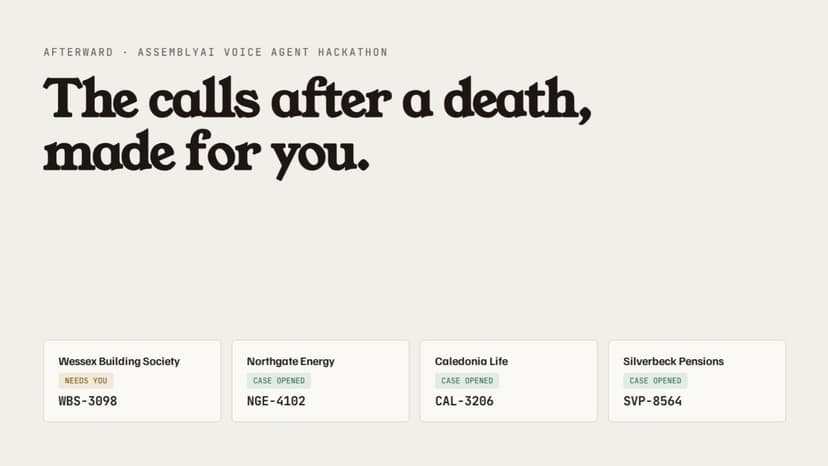
Afterward the calls after a death, made for you
When someone dies in the UK, the government's Tell Us Once service notifies every government department with one form. Then GOV.UK tells the family, in its own words: "You'll also need to tell organisations outside government, like employers and private pension providers, banks, and utility companies." So the family spends the worst week of their lives in phone queues, repeating the death to a dozen call centres. Afterward makes those calls instead. One short conversation with the executor, and it phones each institution: presses the menu keys, waits through the hold in silence, opens by saying it's an AI calling with the family's permission, states only facts from the family's brief, and records the outcome through a validated tool. A server-side check compares every reference against what the clerk actually said and refuses anything that doesn't match — it refused its own agent once, mid-call, and recovered on the same call. Anything the family didn't provide becomes an amber "Needs you" card instead of a guess. Every call ends with a stereo recording (institution left, Afterward right), a timeline, and a verified reference in a shareable Estate Ledger. Measured at full-length holds: 12 calls, 12/12 references verified, 0 unverified writes, 2 escalations instead of guesses, 9m47s of hold endured. Run "npm run verify" to reproduce it offline. Honesty: the twelve institutions are a fictional, labelled test bed modelled on real bereavement lines — calling a real bank about a fictional death would be fraud, so we refuse to demo that. Everything the agent did on those calls was real: live AssemblyAI Voice Agent sessions, real tool calls, unedited recordings. The business: 650k UK deaths a year, ~3M in the US, dozens of organisations per estate. Measured cost ~£2–3 of agent time per estate; target £79–149 per case through funeral directors' aftercare. Empathy and Settld prove the category, and both stop at forms and email. Nobody makes the calls.
30 Sep 2026


