DeepSeek R1

General
Release date2023
AuthorDeepSeek
WebsiteDeepSeek Models
Repositoryhttps://github.com/deepseek-ai
TypeFoundation Language Model

The DeepSeek R1 model provides a lightweight yet powerful solution for basic natural language processing tasks. Optimized for speed and efficiency, this model delivers reliable performance for text classification, entity recognition, and simple text generation.

Key Features

  • 4K Token Context Window: Handles medium-length documents effectively
  • Multi-Lingual Support: Base capabilities in 5 major languages
  • Low Resource Requirements: Runs efficiently on standard hardware
  • Fine-Tuning Ready: Compatible with common ML frameworks

👉 [Deepseek R1 Paper] (https://github.com/deepseek-ai/DeepSeek-R1/blob/main/DeepSeek_R1.pdf) 👉 [Access on Hugging Face] (https://huggingface.co/deepseek-ai/DeepSeek-R1) 👉 [Try Deepseek] (https://deepseek.com) 👉 [API Documentation] (https://api-docs.deepseek.com/)


DeepSeek R1 top builders

Explore the top contributors showcasing the highest number of DeepSeek R1 app submissions within our community.

Deepseek DeepSeek R1 AI technology Hackathon projects

Discover innovative solutions crafted with DeepSeek R1, developed by our community members during our engaging hackathons.

ATLAS

ATLAS

ATLAS is not a simple chatbot; it is a universal AI orchestration system designed to manage any organization or startup. It acts as the "operating system" of a company, capable of planning, delegating tasks to specialized AI agents, and enforcing strict security protocols (Zero Trust). The Demo: Orchestrating Cloud Infrastructure For this hackathon, we demonstrate ATLAS orchestrating a complex cloud infrastructure: ZTC Hosting. Managing web hosting requires juggling multiple APIs (cPanel/WHM, billing, DNS) and handling critical incidents. ATLAS acts as the central brain. It analyzes events, delegates tasks to specialized agents (Support, Network Operations, Provisioning), and uses secure, typed API tools to execute operations. Real-time 3D Digital Twin To make this complex AI activity understandable to humans, ATLAS projects the entire organization into a real-time 3D digital twin. Every AI agent has a 3D avatar. Their movements, statuses, and animations map directly to the actual infrastructure state. If an incident occurs, the NOC agent visibly investigates. Crucially, for high-risk actions, the agent waits for human approval (Human-in-the-loop). AMD Technology Integration To meet the hackathon's technical requirements, ATLAS's core reasoning engine (a high-performance Large Language Model) is hosted and served on AMD Developer Cloud using ROCm and vLLM. The heavy lifting of the AI inference is powered by AMD GPUs. This proves that ATLAS is a hardware-agnostic, production-ready architecture capable of running on AMD infrastructure without rewriting its core logic.

Turno

Turno

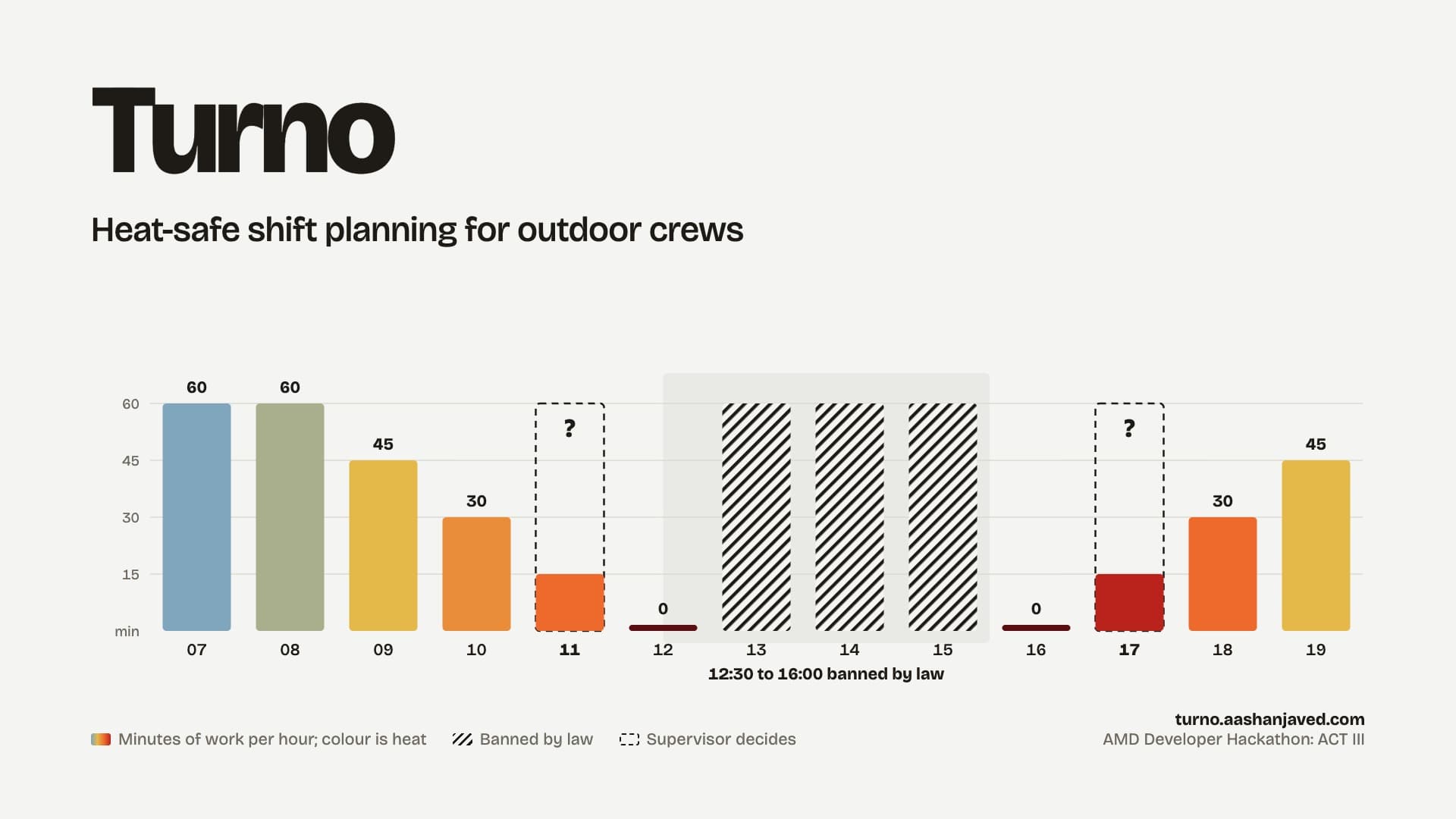
Italian regions ban outdoor work from 12:30 to 16:00 on days rated ALTO for heat risk. A supervisor still has to plan the other hours, prove the ban was kept, and brief the crew. On ERA5 (June to August 2026, five sites), 59 to 66% of heat-restricted working hours fall outside the ban window. Turno plans those hours. How it works. ECMWF's 10-member open-data ensemble gives WBGT for every member and hour (Liljegren, thermofeel). Fixed NIOSH limits set 60, 45, 30, 15 or 0 minutes of work per hour, planned on the hottest member. Hours where members are 30 minutes of work apart go to the supervisor with the reason. The supervisor confirms the Worklimate rating; until then the ban is assumed. Output: a day strip, a bilingual crew briefing, a compliance log. On AMD. AMD Token Factory (AMD Radeon Cloud) runs the ordinance reader: MinerU2.5-Pro reads each region's signed PDF and DeepSeek-V4-Flash proposes every rule field with a verbatim quote. Code accepts a field only if the quote is in the document and contains the value. DeepSeek-V4-Flash also explains each hand-off. Off AMD: Gemma 4 writes the crew briefing through Google's Gemini API, and the forecast is ECMWF open data. No GPU instance was available, so the planned Aurora run on an MI300X did not happen. Pre-registered results: settings chosen on June dates; July and August (10 dates, 5 sites) untouched. One day ahead, a single ECMWF forecast over-planned work in 6.6% of heat-restricted hours; Turno in 1.1%, handing 3.0 to 17.0% of working hours to the supervisor. The reader accepted 0 wrong fields across two runs, and a live Lombardia re-read verified 7 of 7. Limits. Truth is ERA5 (0.25 degrees); there is no thermometer on site. ECMWF open data is 3-hourly. The number check proves every number came from the plan; it does not prove each sentence is right. Not tried with a real crew; no substitute for the employer's risk assessment. Live app: turno.aashanjaved.com. Code (MIT): github.com/Aashan47/turno

Elo Functional Intelligence

Elo Functional Intelligence

Elo Functional Intelligence is a human-centered AI platform designed to support pediatric occupational therapists in transforming session observations into structured, traceable functional information and family-friendly communication. **The Problem** Occupational therapists must document meaningful observations while remaining focused on the child. Information about participation, independence, assistance, attention, and task transitions can become fragmented across notes and reports, making it difficult to communicate clearly with families. **Our Solution** Elo provides an integrated workflow for organizing therapy sessions, reviewing observations, exploring functional indicators, and generating evidence-linked family reports. The platform includes operational dashboards, Functional Progress, Functional Intelligence, and AI Governance views. Each functional statement can be traced to supporting session evidence. **AMD Integration** Elo integrates AMD Token Factory infrastructure to support AI-assisted report generation. The implementation emphasizes controlled generation, traceability, and human review rather than autonomous clinical decision-making. **Human Oversight** A professional reviewer must explicitly approve generated family-report content. The system preserves review decisions and audit records, keeping clinical judgment with the human professional. **Working Demonstration** The prototype demonstrates an end-to-end workflow using synthetic pediatric occupational therapy data: reviewed session observations, functional dashboards, AI-assisted report generation, evidence references, and explicit human approval. **Our Vision** Make functional documentation more understandable, auditable, and useful for communication between occupational therapists and families, without replacing professional expertise. Elo is a functional prototype, not a validated medical device. No clinical effectiveness or longitudinal improvement is claimed.